Quantum Computing Master Course — 069. Interference as an Algorithmic Tool
Lesson 069: Interference as an Algorithmic Tool
Smartyfy Quantum Computing Master Course
Prerequisites and objectives
Several oracle algorithms share a pattern: prepare amplitudes, mark them with phases, and combine them so a useful property appears in a measurement. This lesson treats interference as a calculation tool rather than a slogan. You will derive the signed-sum formula, inspect constructive and destructive contributions, and explain how unwanted records prevent the cancellation an algorithm needs.
We focus on Hadamard-based interference over n-bit strings. Later Fourier-transform lessons generalize from signs ±1 to other complex roots of unity. The principles of amplitude addition and probability extraction remain the same.
Different paths to the same outcome
For a state with amplitudes αx followed by a unitary U, the amplitude at output z is Σx Uzxαx. Contributions add as complex numbers before the final magnitude is squared. The probability is not generally Σx|Uzxαx|².
The latter sum applies when alternatives are distinguished by an unobserved record and combined incoherently, not when they remain coherent paths to the same final state. The physical availability of distinguishing information matters even if a person never looks at it.
Two equal positive amplitudes add constructively, while equal opposite amplitudes cancel. Complex contributions can meet at intermediate angles as well. Normalization of the full unitary evolution ensures the final probabilities remain consistent.
The Hadamard signed-sum formula
Prepare a uniform n-qubit input and apply a phase oracle for a Boolean function f. The input amplitudes are (−1) raised to f(x) divided by √N, where N=2ⁿ. A final Hadamard layer gives Az=(1/N)Σx(−1) raised to f(x)⊕x·z.
Each output label z defines a different pattern of plus and minus contributions through the binary dot product x·z. The circuit evaluates how strongly the function’s phase pattern aligns with each such pattern. This is a Walsh-Hadamard transform of the signed function values.
The transformation is unitary, so Σz|Az|²=1. A large amplitude at one output requires contributions that align there; zeros arise from exact cancellation. There is no extra probability budget created by considering many inputs.
Worked example with one negative input phase
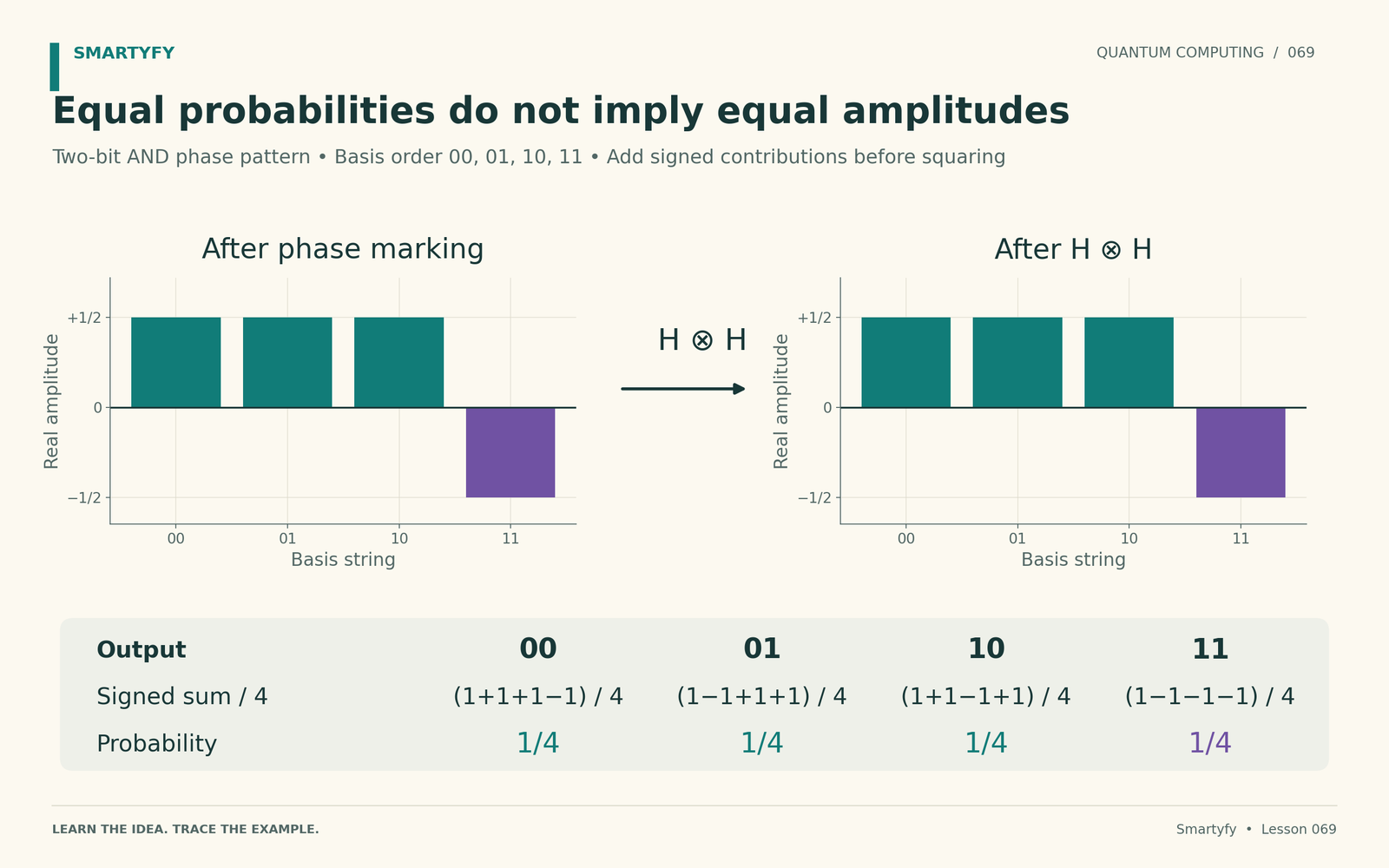
Take n=2 and f(x₁x₀)=x₁x₀, the AND function. The phase-marked vector is [1,1,1,−1]/2 in order 00,01,10,11. Apply the two-qubit Hadamard matrix, whose rows have sign patterns ++++, +−+−, ++−−, and +−−+.
| Output z | Signed numerator | Amplitude Az |
|---|---|---|
| 00 | 1+1+1−1 | 1/2 |
| 01 | 1−1+1+1 | 1/2 |
| 10 | 1+1−1+1 | 1/2 |
| 11 | 1−1−1−1 | −1/2 |
Every numerator is divided by four, not two: one factor comes from preparation and one from the transform. The output probabilities are all one quarter even though the output amplitudes include a relative minus sign.
This example shows that adding a phase pattern need not concentrate probability at a single answer. An algorithm needs a phase structure matched to its intended property, not merely a collection of nontrivial signs.
Why linear functions concentrate perfectly
For f(x)=s·x, the amplitude formula becomes an average of (−1) raised to x·(s⊕z). At z=s, all contributions are positive. At every other z, a bit-flip pairing cancels them.
The output distribution is therefore concentrated at s, as in Bernstein-Vazirani. By contrast, Deutsch-Jozsa uses only the zero output amplitude to decide a promised category. It does not require the rest of the spectrum to concentrate anywhere particular.
Simon’s algorithm uses a related cancellation on two-element input pairs. The factor 1+(−1) raised to s·z removes half the possible equation labels. The surviving distribution is deliberately spread across a subspace because multiple samples provide different constraints.
Phase-equivalent and phase-different functions
Replacing f by f⊕1 negates every phase-marked amplitude and every transformed amplitude. The complete output probability distribution is unchanged. The two functions therefore cannot be distinguished by this phase-sampling circuit alone.
This is a statement about that circuit and access pattern, not a claim that full function oracles are identical. A function query with a basis target can reveal the offset at a chosen x. Likewise, controlled access can turn an otherwise global phase into a relative one.
More generally, equal output probability distributions do not imply equal output states. The AND example has uniform probabilities but relative phases that a later unitary can still use. A probability histogram is an incomplete description of coherent algorithmic progress.
Which-branch records suppress interference
Consider a uniform input correlated with workspace labels |g(x)⟩. After a Hadamard transform, the probability at z contains cross terms weighted by overlaps ⟨g(x′)|g(x)⟩. Identical workspace states preserve those cross terms; orthogonal records remove them.
For a one-qubit example, |+⟩ becomes zero certainly after H. If it first controls a CNOT into a clean record qubit, the joint state becomes Φ+. Applying H only to the input gives a fifty-fifty local outcome instead.
Uncomputing the record before H restores the deterministic zero result. This is the same mechanism behind the clean-oracle requirement: temporary information must not remain in distinguishable systems when the algorithm expects paths to interfere.
Design and diagnose an interference calculation
Write the amplitude before measurement, state the output basis, and identify which input branches contribute to the same final state. Track phases and workspace labels until the sum is complete. Only then calculate probabilities.
Check special cases: a constant phase pattern, a known linear pattern, and a deliberately phase-corrupted oracle. Verify normalization and compare predicted forbidden outcomes against actual simulator results. If probabilities look correct in only one basis, retain the possibility of a hidden phase error.
Do not interpret every constructive peak as a speedup. The cost of preparing the phase pattern and extracting the desired output still matters. Interference supplies a mechanism; the full algorithm analysis determines whether that mechanism solves a task efficiently.
Four exercises with worked solutions
-
For f(x₁x₀)=x₀, where does the final probability concentrate?
Solution. This is the linear function with s=01. The output is |01⟩, with probability one there and zero elsewhere. Bit order identifies the rightmost coefficient.
-
What happens to Az if every f value is complemented?
Solution. Every term acquires a common minus sign, so Az becomes −Az for all z. Squared magnitudes are unchanged, making the output distribution identical.
-
Why is the AND example’s 00 amplitude one half rather than one?
Solution. Three positive contributions and one negative contribute numerator two. Dividing by N=4 gives one half. The corresponding probability is one quarter.
-
What changes when a record distinguishes two paths whose amplitudes would otherwise cancel?
Solution. Orthogonal record states remove the cross term when the record is ignored. The alternatives no longer combine as amplitudes for one indistinguishable final state, so the intended cancellation can disappear.
Five explained multiple-choice questions
-
Coherent contributions to one outcome are combined by: A. Adding amplitudes before squaring. B. Adding only their probabilities. C. Dropping negative signs. D. Adding amplitude magnitudes before squaring.
Answer: A. Cross terms arise from the squared magnitude of the total amplitude.
-
The phase-marked Hadamard output amplitude has normalization: A. 1/√N only. B. No normalization. C. √N. D. 1/N multiplying the signed sum.
Answer: D. Two layers each supply one factor of 1/√N.
-
A nontrivial phase pattern guarantees a single output peak: A. Only if probabilities are real. B. Always. C. No; the pattern’s structure determines the spectrum. D. Whenever the register is large.
Answer: C. The AND example gives uniform probabilities despite its negative phase.
-
Orthogonal garbage records can: A. Increase every cross term. B. Act only as one irrelevant global phase. C. Suppress interference between labelled branches. D. Be discarded without changing the useful register’s coherence.
Answer: C. Their zero overlaps remove the corresponding coherent cross terms from local probabilities.
-
Complementary f and f⊕1 have: A. Different norms. B. The same phase-sampling probabilities. C. Identical full function-oracle actions. D. Different probabilities in this phase-sampling circuit necessarily.
Answer: B. Their transformed vectors differ globally here, while their function interfaces can still differ.
Pitfalls and summary
Track amplitudes, basis labels, phases, and records together. Constructive and destructive sums become useful only when they encode the requested property and remain coherent. Interference is a precise algebraic resource, with input access and output interpretation still part of the algorithm.
Primary sources and further study
These sources support the definitions and context. The numerical examples, exercises, and explanations here were prepared for this lesson. Research papers are optional advanced reading.