AAO Lesson 019: Extract a trial balance and trace a disagreement
AAO · Lesson 019 · English
Extract a trial balance and trace a disagreement
Study time: about 100 minutes including practice. Prerequisites: AAO-015, AAO-018.
Learning outcomes
- Derive debit/credit balances from actual ledger entry totals without counting c/d twice.
- Reconcile the totals and balance methods.
- Diagnose extraction errors using evidence while explaining trial-balance limitations.
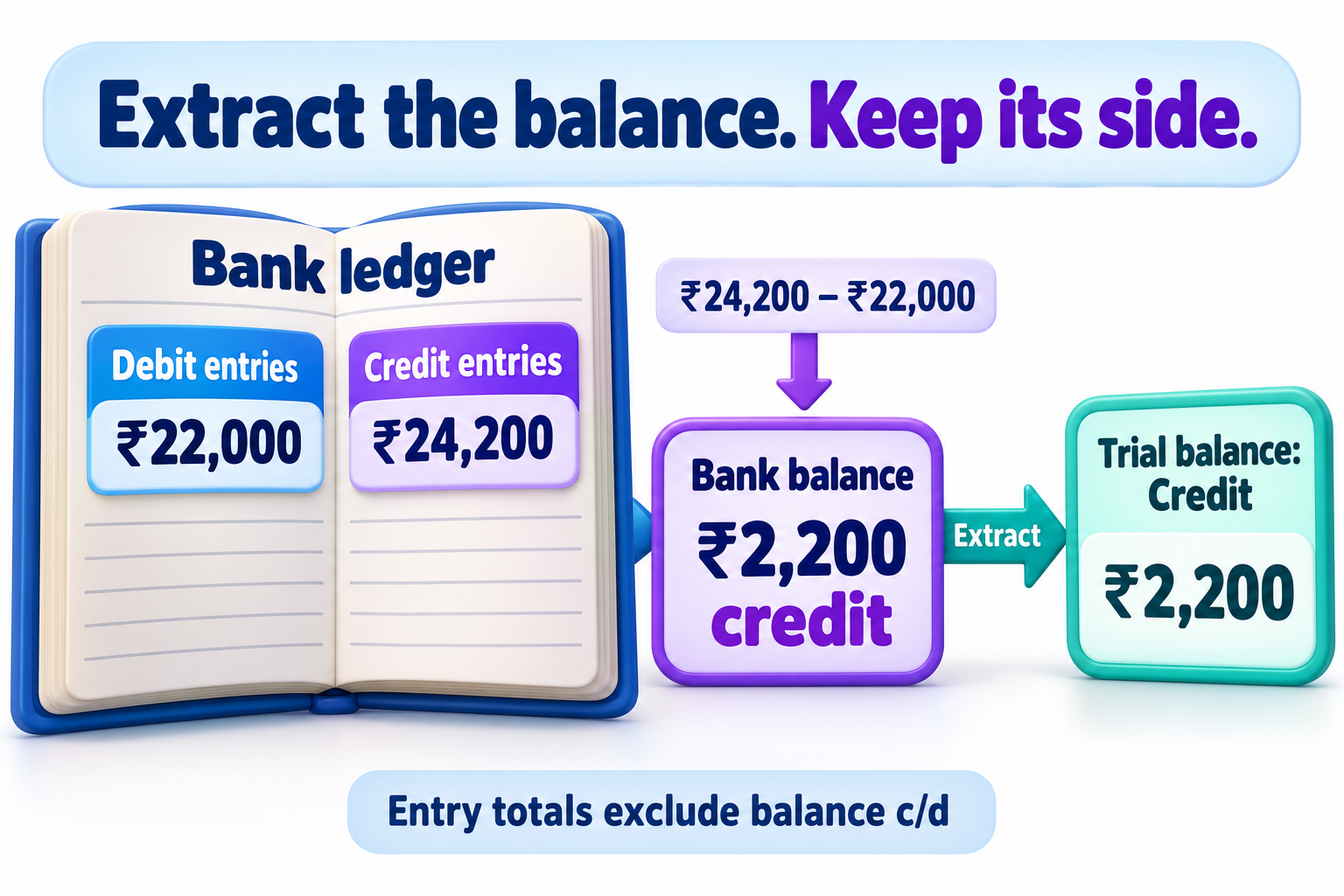
1. Extract what the ledger actually says
A trial balance is a structured check of ledger amounts at a specified date. In the balance method, each account contributes its net debit or credit balance, not both of its entry totals. The task looks mechanical until an overdraft, contra-asset, opening balance or balancing entry is copied to the wrong column.
This lesson makes the extraction visible. First calculate each balance from actual entry totals. Then prove the overall total in two independent ways. Finally diagnose several flawed extractions without assuming that every mismatch comes from the underlying journal.
Scope: Oak Reporting Desk is a fictional commercial sole trader. The following sixteen accounts form the complete ledger set as at 30 June 2024 for this exercise. All required period adjustments are already recorded, but income, expenses and drawings have not been closed. Equipment is carried under the stipulated cost model with a separate accumulated-depreciation account. No tax or depreciation rate is being prescribed. Figures are in rupees.
2. Know exactly what the supplied totals contain
The next table gives actual debit and credit entries accumulated in each account, including its opening b/d where one exists. It excludes balance c/d. That last qualification matters: once a balance c/d is inserted, the two sides are deliberately made equal. Subtracting those equal sides would hide the balance you are trying to extract.
| Account | Debit entry total | Credit entry total | Difference and balance side |
|---|---|---|---|
| Cash | ₹6,000 | ₹5,300 | ₹700 debit |
| Bank | ₹22,000 | ₹24,200 | ₹2,200 credit |
| Equipment, gross cost | ₹42,000 | ₹0 | ₹42,000 debit |
| Accumulated depreciation | ₹0 | ₹6,500 | ₹6,500 credit |
| Customer receivable | ₹19,000 | ₹9,000 | ₹10,000 debit |
| Prepaid rent | ₹1,200 | ₹400 | ₹800 debit |
| Supplier payable | ₹6,000 | ₹10,000 | ₹4,000 credit |
| Wages payable | ₹1,200 | ₹2,100 | ₹900 credit |
| Capital | ₹0 | ₹35,000 | ₹35,000 credit |
| Drawings | ₹1,000 | ₹0 | ₹1,000 debit |
| Service revenue | ₹0 | ₹11,000 | ₹11,000 credit |
| Rent expense | ₹1,200 | ₹0 | ₹1,200 debit |
| Utilities expense | ₹500 | ₹0 | ₹500 debit |
| Depreciation expense | ₹500 | ₹0 | ₹500 debit |
| Salary expense | ₹900 | ₹0 | ₹900 debit |
| Stationery expense | ₹2,000 | ₹0 | ₹2,000 debit |
| Total actual entries | ₹103,500 | ₹103,500 | Balance-method totals calculated separately below |
For each row, subtract the smaller entry total from the larger. Retain the side of the larger actual total. Cash is ₹6,000 − ₹5,300 = ₹700 debit. Bank is ₹24,200 − ₹22,000 = ₹2,200 credit. The word “Bank” does not force a debit balance; this bank account is overdrawn under the supplied facts.
Do not call ₹22,000 the period’s Bank receipts merely from this table. Opening balances are included, and a credit opening overdraft is part of the credit total. Entry totals and current-period cash flows are not interchangeable descriptions.
3. Balance c/d and b/d do not change the answer
| Account | Actual debit / credit totals | Where c/d goes to make sides equal | Next-period b/d side |
|---|---|---|---|
| Bank | ₹22,000 / ₹24,200 | ₹2,200 on debit side; both sides become ₹24,200 | ₹2,200 credit |
| Customer receivable | ₹19,000 / ₹9,000 | ₹10,000 on credit side; both become ₹19,000 | ₹10,000 debit |
| Supplier payable | ₹6,000 / ₹10,000 | ₹4,000 on debit side; both become ₹10,000 | ₹4,000 credit |
The balancing amount appears on the smaller side because it fills the difference. The balance carried forward retains the economic side established by the actual entries. A Bank debit c/d therefore does not turn a credit balance into a debit balance.
When working from a ruled ledger, identify whether the figure is an actual entry, an opening b/d, a c/d inserted for balancing, or the next period’s b/d. Never count both c/d and the newly brought-down balance in the same extraction. A ledger may be neatly ruled and still be copied incorrectly.
4. Prepare the balance-method trial balance
| Account | Debit balance | Credit balance |
|---|---|---|
| Cash | ₹700 | — |
| Bank | — | ₹2,200 |
| Equipment, gross cost | ₹42,000 | — |
| Accumulated depreciation | — | ₹6,500 |
| Customer receivable | ₹10,000 | — |
| Prepaid rent | ₹800 | — |
| Supplier payable | — | ₹4,000 |
| Wages payable | — | ₹900 |
| Capital | — | ₹35,000 |
| Drawings | ₹1,000 | — |
| Service revenue | — | ₹11,000 |
| Rent expense | ₹1,200 | — |
| Utilities expense | ₹500 | — |
| Depreciation expense | ₹500 | — |
| Salary expense | ₹900 | — |
| Stationery expense | ₹2,000 | — |
| Total | ₹59,600 | ₹59,600 |
Each account appears once on its actual balance side. Drawings is debit but is not a business operating expense. Accumulated depreciation is credit but is not sales income or an outside creditor. Debit/credit tells you the accounting side; classification still requires the account’s meaning.
Equipment remains ₹42,000 gross and accumulated depreciation ₹6,500 credit in this extraction. Their balance-sheet carrying amount is ₹35,500 under the stipulated cost model. If you replace Equipment by ₹35,500 and also retain the ₹6,500 credit, the deduction is counted twice. A financial-statement net presentation does not authorise changing the separate ledger balances in a trial balance.
5. Prove why the two different totals can both be right
The totals method takes both actual entry totals from every account: ₹103,500 debit and ₹103,500 credit. The balance method offsets the debit and credit entries within each account and carries only the net differences. That is why ₹59,600 is smaller than ₹103,500 without anything being lost.
| Account with both sides | Common amount offset from debit and credit totals |
|---|---|
| Cash | ₹5,300 |
| Bank | ₹22,000 |
| Customer receivable | ₹9,000 |
| Prepaid rent | ₹400 |
| Supplier payable | ₹6,000 |
| Wages payable | ₹1,200 |
| Total offset on each side | ₹43,900 |
₹103,500 − ₹43,900 = ₹59,600 on each side. This check is independent of simply adding the balance columns again. It also explains why one cannot compare a debit column prepared by the totals method with a credit column prepared by the balances method. The extraction method must be consistent.
6. Diagnose errors in the extraction before changing the ledger
Error A: Bank’s ₹2,200 credit is copied as debit
The incorrect debit total becomes ₹59,600 + ₹2,200 = ₹61,800. The incorrect credit total becomes ₹59,600 − ₹2,200 = ₹57,400. The difference is ₹4,400, twice the misplaced balance. Moving the figure back to the credit column fixes this extraction. It does not require a ₹4,400 payment or journal in otherwise correct books.
Error B: omit prepaid rent ₹800
Debit becomes ₹58,800 while credit remains ₹59,600. Locate the omitted account, compare it with the ledger and insert ₹800 debit. Do not create a second prepaid asset in the ledger merely to repair a copied schedule.
Error C: copy the receivable as ₹1,000 instead of ₹10,000
The debit column is short by ₹9,000 and totals ₹50,600. The underlying customer account is still ₹10,000. Correct the extracted figure, preserving the checked reference. A ₹9,000 journal would incorrectly alter a ledger balance that was not wrong.
These examples expressly state that the ledger is correct and the extraction is faulty. If source comparison reveals a wrong posting or an omitted transaction in the ledger itself, correct the underlying account effect with a proper evidence trail. Lesson020 handles that separate stage.
7. Numerical clues narrow the search; they do not prove the cause
A difference that is twice an account balance can suggest a wrong-side extraction. A difference divisible by nine can suggest a transposition or a displaced zero. But several unrelated errors may produce the same number. Check the proposed cause against source records before changing anything.
For example, ₹4,860 copied as ₹4,680 creates a ₹180 difference, divisible by nine. So does omitting a ₹1,800 debit balance: ₹1,800 is divisible by nine, but no digit transposition occurred. Conversely, several mistakes can partially offset and disguise their individual signatures.
A useful sequence is: re-add the columns; check every account’s inclusion and side; compare amounts with the ledger; inspect whether c/d or b/d was counted twice; recalculate suspicious ledger balances; and then trace actual postings back to journals and evidence. Record what was checked. Do not begin by choosing an account that happens to make the totals agree.
8. Agreement is a limited control
Equal totals show equality in the amounts included in the extraction. They do not establish that every event was recorded, every account was appropriate or every amount correct. A complete omission contributes nothing to either side. A wrong account can replace another debit without changing the debit total. A duplicated balanced transaction increases both sides equally.
Suppose a ₹2,000 cash sale was correctly recorded once and then duplicated in full. Cash is ₹2,000 too high and Sales ₹2,000 too high, but debit and credit remain equal. The lesson is not that the trial balance is useless. It is that the control must be combined with source completeness, account classification, cut-off and reconciliation checks.
Do not “improve” profit or force agreement by adjusting depreciation, sales or rent without evidence. A temporary suspense difference may be used in a specified correction exercise, but it is not income, an approved expense or proof that the accounts are ready for final reporting.
9. Graded practice and complete answers
A. A ledger has actual debit entries ₹8,750 and credit entries ₹6,200, excluding c/d. Find the balance and explain its c/d and b/d positions.
Answer A. ₹2,550 debit balance. Insert ₹2,550 credit c/d to make both current sides ₹8,750; bring it down as ₹2,550 debit next period. Do not extract the side on which c/d was inserted.
B. A supplier account has debit entries ₹9,600 and credit entries ₹7,400. Evidence confirms a recoverable advance to that supplier, not a missing invoice. Which side is extracted?
Answer B. ₹2,200 debit. The supplied evidence explains the asset/advance position. “Supplier” does not automatically force every party balance to credit. If the evidence were missing, investigate rather than invent an advance.
C. Correct trial-balance totals are ₹48,000 each. A ₹1,350 credit is wrongly copied as debit. Find the incorrect column totals and difference.
Answer C. Debit ₹49,350; credit ₹46,650; difference ₹2,700. The double effect is adding ₹1,350 to one side and removing it from the other.
D. ₹4,860 is copied as ₹4,680. Find the difference. Does divisibility by nine prove this is the only error?
Answer D. ₹180. It is compatible with this transposition, but the numeric property alone proves neither the cause nor the absence of other errors. Confirm the ledger amount and inspect the wider extraction.
E. A complete ₹2,000 debit-to-Cash/credit-to-Sales entry is duplicated. Will the trial balance necessarily disagree, and what must be corrected?
Answer E. No: both sides increase equally. Once duplication is established, remove the duplicate effect by debiting Sales and crediting Cash ₹2,000, with a reference to the duplicate entry. Do not reverse the genuine sale as well.
10. Explained objective checks
Question 1. Oak’s Bank column has actual debit entries ₹22,000 and credit entries ₹24,200. The balance-method trial balance should show A ₹22,000 debit; B ₹24,200 credit; C ₹2,200 debit; D ₹2,200 credit.
Answer: D. A and B are entry totals, not the net balance. C copies the balancing c/d side rather than the actual credit balance.
Question 2. Which conclusion follows from Oak’s ₹59,600 equal totals? A every transaction is complete and correctly classified; B no bank overdraft exists; C the extracted debit and credit balances agree arithmetically; D profit is ₹59,600.
Answer: C. Agreement is the demonstrated control. The ledger explicitly contains an overdraft, and profit is not a trial-balance total. Completeness and classification require further evidence.
11. A structured written answer
Prompt: Distinguish correcting an extraction error from correcting an underlying posting error.
Model answer: Compare the trial-balance row with the ledger and the ledger with its evidence. If the ledger correctly shows Bank ₹2,200 credit but the schedule copies it as debit, correct the schedule only. Its ₹4,400 disagreement arises from placing one balance on the wrong side; a new journal would corrupt the correct account. If the ledger itself has an incorrect or missing posting, establish the intended debit/credit effects, compare them with what was recorded, and correct the difference with an auditable entry. Re-extract after correction. Equal totals are then one check, not proof that all transactions and classifications are complete.
Mastery check: Derive all sixteen balances, prove both ₹103,500 and ₹59,600 totals, explain the ₹43,900 common offsets, and trace each deliberate error without changing an account unnecessarily.