AAO Lesson 025: Prepare linked trading, profit-and-loss and balance-sheet statements
AAO · Lesson 025 · English
Prepare linked trading, profit-and-loss and balance-sheet statements
Study time: about 120 minutes including practice. Prerequisites: AAO-015, AAO-019, AAO-020, AAO-021, AAO-023, AAO-024.
Learning outcomes
- Turn a complete retail trial balance and evidence pack into linked final statements.
- Reconcile both effects of every adjustment and prove closing capital against net assets.
- Recognise when stock or other adjustments are already posted and avoid a second deduction or credit.
1. The task: make the statements agree for the right reason
Finishing accounts is more than placing trial-balance figures into boxes. One amount may need a period adjustment; one closing balance may already include it; one transfer may change the presentation without changing profit. Your job is to keep that trail intact from evidence to journal, ledger, performance and financial position.
This workshop brings together inventory, accruals and closing capital. Its new demand is integration: you will prepare a complete retailer’s statements, reconcile six adjustments, and compare two legitimate inventory-recording routes. Do not complete both routes in the same books. The alternative is a check on method, not an extra journal to post.
Case boundary. Cedar Home Retail is a fictional sole trader using commercial accrual accounts and periodic inventory. Prepare statements for 1 January–31 March 2024 and a balance sheet as at 31 March 2024. Ordinary interchangeable retail goods are in scope. The case stipulates the selected AS 2 inventory basis and the cost model for equipment. It is not an instruction to apply commercial entries to government cash accounts, nor a comprehensive treatment of all accounting standards.
The ledger is otherwise correct and complete. There are no unreported taxes, losses, owner transactions or impairment adjustments. Receivables are collectible. The loan is contractually interest-free for this quarter; no hidden interest adjustment is required. All six matters listed below are unposted in the original trial balance. Complete each schedule before reading the answer.
2. Start with the original trial balance
The debits and credits agree, but the equality does not establish that March salary, insurance consumption or closing inventory has been recognised. Treat the trial balance as the starting ledger state, not as an assertion that all period-end work is finished.
| Account | Debit | Credit |
|---|---|---|
| Opening inventory | ₹12,000 | — |
| Purchases | ₹48,000 | — |
| Purchase returns | — | ₹2,000 |
| Sales | — | ₹80,000 |
| Sales returns | ₹3,000 | — |
| Carriage inward | ₹2,000 | — |
| Delivery expense | ₹1,500 | — |
| Rent expense | ₹6,000 | — |
| Salary expense | ₹9,000 | — |
| Insurance expense | ₹2,400 | — |
| Equipment cost | ₹30,000 | — |
| Accumulated depreciation | — | ₹6,000 |
| Cash | ₹2,000 | — |
| Bank | ₹8,000 | — |
| Trade receivables | ₹16,000 | — |
| Trade payables | — | ₹12,000 |
| Loan | — | ₹15,000 |
| Drawings | ₹4,000 | — |
| Commission income | — | ₹1,200 |
| Maintenance income | — | ₹1,800 |
| Capital | — | ₹25,900 |
| Total | ₹143,900 | ₹143,900 |
Opening inventory is the stock at 1 January. Purchases and purchase returns relate to resale goods; carriage inward brings those goods to the business. Delivery expense concerns goods already sold to customers. Drawings are the owner’s withdrawals, not staff pay or another expense. These facts control classification; the mere words “payment” or “debit” do not.
3. Read the evidence before choosing the adjustment
Inventory: value the unsold items
The count and ownership records establish that Cedar owns the quantities below at 31 March. Assigned unit costs already include the relevant acquisition costs. Each selling-price estimate reflects reporting-date conditions. The completion and selling costs shown are necessary estimated costs for the identified items; no omitted cost is to be guessed as zero.
| Item | Units | Unit cost | Unit NRV calculation | Selected unit value | Closing amount |
|---|---|---|---|---|---|
| R | 60 | ₹180 | ₹200 − ₹0 − ₹10 = ₹190 | ₹180 | ₹10,800 |
| S | 40 | ₹150 | ₹120 − ₹10 − ₹5 = ₹105 | ₹105 | ₹4,200 |
| Total | 100 | Cost total ₹16,800 | Item-specific comparison | — | ₹15,000 |
Item R stays at cost: its ₹190 NRV does not permit a ₹10 gain above ₹180 cost. Item S is reduced from ₹150 to ₹105 per unit, a reduction of 40 × ₹45 = ₹1,800. Closing inventory is ₹10,800 + ₹4,200 = ₹15,000. The ₹1,800 reduction is already embedded in that amount. If the original books have not recognised closing inventory at all, recognise ₹15,000 once; do not also subtract ₹1,800 from it.
Five further evidence items
| Item | Evidence and current ledger | Required period amount or closing balance | Adjustment needed |
|---|---|---|---|
| Salary | ₹9,000 paid and recorded for January and February at ₹4,500 per month. March service completed; March unpaid. | Quarter expense ₹13,500; payable ₹4,500 | Add ₹4,500 expense and liability |
| Insurance | ₹2,400 paid on 1 January for twelve equal monthly coverage units, January–December. Entire payment was expensed. | 3 × ₹200 = ₹600 expense; 9 × ₹200 = ₹1,800 prepaid | Remove ₹1,800 future coverage from expense |
| Equipment | Cost ₹30,000; accumulated depreciation already ₹6,000. The verified asset schedule supplies a further ₹1,500 charge for this quarter. | Expense ₹1,500; accumulated depreciation ₹7,500; carrying amount ₹22,500 | Post the supplied charge once |
| Commission | ₹1,200 in the ledger was earned this quarter. A further ₹500 was earned on completed, accepted March work and remains uncollected. | Income ₹1,700; separate commission receivable ₹500 | Add ₹500 income and asset |
| Maintenance | ₹1,800 received on 1 February covers three equal monthly service units, February–April. February and March completed and accepted; April remains owed. All receipt was credited to income. | Income ₹1,200; unearned liability ₹600 | Remove April’s ₹600 from current income |
Rent and delivery expense belong wholly to this quarter. The equipment is an administrative asset: its stipulated depreciation is an operating expense here, not inventory conversion cost. Depreciation allocates the asset’s depreciable amount over use; the ₹1,500 is not a claim that its market price fell by precisely that amount. We are given the verified charge and do not invent a statutory rate.
4. Route A: post six adjustments, with both effects explained
Use these entries against the original trial balance only. Debit increases the inventory, prepaid amount or receivable where an asset is recognised; credit establishes or increases a liability where Cedar still owes performance or payment. Expense and income corrections depend on what the unadjusted account already includes.
| Ref | Debit | Credit | Reason |
|---|---|---|---|
| A1 | Closing inventory ₹15,000 | Trading ₹15,000 | Recognise the unsold asset and remove its selected cost from the amount charged through Trading. |
| A2 | Salary expense ₹4,500 | Salary payable ₹4,500 | Recognise completed March labour and the unpaid obligation. |
| A3 | Prepaid insurance ₹1,800 | Insurance expense ₹1,800 | Carry unconsumed future cover as an asset rather than this quarter’s expense. |
| A4 | Depreciation expense ₹1,500 | Accumulated depreciation ₹1,500 | Record this quarter’s allocation while retaining the original equipment cost separately. |
| A5 | Commission receivable ₹500 | Commission income ₹500 | Recognise the earned fee and the right to collect it. |
| A6 | Maintenance income ₹600 | Unearned maintenance ₹600 | Defer the portion for the unperformed April service. |
Journal turnover is ₹23,900 on each side. It is not extra cash paid and is not the profit. None of these adjustments changes Cash or Bank. If a displayed journal figure differs from the amount needed to move the actual ledger to its required balance, stop and investigate rather than forcing a statement total.
| Account | Debit | Credit |
|---|---|---|
| Opening inventory | ₹12,000 | — |
| Purchases | ₹48,000 | — |
| Purchase returns | — | ₹2,000 |
| Sales | — | ₹80,000 |
| Sales returns | ₹3,000 | — |
| Carriage inward | ₹2,000 | — |
| Delivery expense | ₹1,500 | — |
| Rent expense | ₹6,000 | — |
| Salary expense | ₹13,500 | — |
| Insurance expense | ₹600 | — |
| Equipment cost | ₹30,000 | — |
| Accumulated depreciation | — | ₹7,500 |
| Cash | ₹2,000 | — |
| Bank | ₹8,000 | — |
| Trade receivables | ₹16,000 | — |
| Trade payables | — | ₹12,000 |
| Loan | — | ₹15,000 |
| Drawings | ₹4,000 | — |
| Commission income | — | ₹1,700 |
| Maintenance income | — | ₹1,200 |
| Capital | — | ₹25,900 |
| Closing inventory | ₹15,000 | — |
| Trading | — | ₹15,000 |
| Salary payable | — | ₹4,500 |
| Prepaid insurance | ₹1,800 | — |
| Depreciation expense | ₹1,500 | — |
| Commission receivable | ₹500 | — |
| Unearned maintenance | — | ₹600 |
| Total | ₹165,400 | ₹165,400 |
The temporary Trading credit of ₹15,000 is visible because A1 has already been posted but the other trading balances have not yet been transferred. The next statement uses that existing credit once. It does not call for another A1. An adjusted trial balance can therefore contain both a closing-inventory asset and an existing Trading credit. Always inspect the counterpart before deciding what remains to post.
5. Trading account: separate trading margin from other results
Net sales are ₹80,000 − ₹3,000 = ₹77,000. Net purchases are ₹48,000 − ₹2,000 = ₹46,000. Cost available is opening stock ₹12,000 + net purchases ₹46,000 + carriage inward ₹2,000 = ₹60,000. Unsold inventory ₹15,000 remains an asset, so the cost charged against sales is ₹45,000.
| Debit side | Amount | Credit side | Amount |
|---|---|---|---|
| Opening inventory | ₹12,000 | Net sales | ₹77,000 |
| Net purchases | ₹46,000 | Closing inventory, from A1 | ₹15,000 |
| Carriage inward | ₹2,000 | — | — |
| Gross profit transferred to P&L | ₹32,000 | — | — |
| Total | ₹92,000 | Total | ₹92,000 |
The ₹32,000 gross profit is also ₹77,000 net sales − ₹45,000 cost of goods sold. Showing closing stock on the credit side is the traditional account presentation of removing the unsold portion; it does not mean Cedar sold that inventory or earned an extra ₹15,000 revenue. The two-sided account and the COGS calculation describe the same result.
Delivery to customers is an operating expense in this stipulated retail case. Putting it into COGS would reduce gross profit by ₹1,500, but if it were included exactly once overall, net profit would not change. Including it in both Trading and P&L would reduce net profit improperly.
6. Profit-and-loss account: earn the bridge to capital
| Debit side | Amount | Credit side | Amount |
|---|---|---|---|
| Delivery expense | ₹1,500 | Gross profit transferred from Trading | ₹32,000 |
| Rent expense | ₹6,000 | Commission income | ₹1,700 |
| Salary expense | ₹13,500 | Maintenance income | ₹1,200 |
| Insurance expense | ₹600 | — | — |
| Depreciation expense | ₹1,500 | — | — |
| Net profit transferred to Capital | ₹11,800 | — | — |
| Total | ₹34,900 | Total | ₹34,900 |
The check is ₹32,000 gross profit + ₹2,900 other income − ₹23,100 operating expenses = ₹11,800 net profit. This result is not the ₹10,000 Cash-plus-Bank balance. Cash balances include earlier financing and settlements; profit measures this quarter’s recognised income less expenses.
Closing capital is ₹25,900 opening capital + ₹11,800 profit − ₹4,000 drawings = ₹33,700. The profit transfer is debit Profit and loss, credit Capital ₹11,800. Closing drawings is debit Capital, credit Drawings ₹4,000. Neither transfer causes new cash to arrive or leave: the withdrawal was already recorded during the quarter. They explain how the owner’s claim changes.
7. Balance sheet: prove the second side of every adjustment
Equipment is shown at ₹30,000 cost less ₹7,500 accumulated depreciation = ₹22,500 carrying amount. Accumulated depreciation is a deduction from that asset, not a trade liability. In contrast, salary payable and unearned maintenance are obligations. Keep these distinctions visible rather than putting every credit balance under liabilities.
| Assets | Amount | Owner’s capital and liabilities | Amount |
|---|---|---|---|
| Equipment: ₹30,000 − ₹7,500 | ₹22,500 | Closing capital | ₹33,700 |
| Closing inventory | ₹15,000 | Trade payables | ₹12,000 |
| Trade receivables | ₹16,000 | Loan | ₹15,000 |
| Commission receivable | ₹500 | Salary payable | ₹4,500 |
| Prepaid insurance | ₹1,800 | Unearned maintenance | ₹600 |
| Cash | ₹2,000 | — | — |
| Bank | ₹8,000 | — | — |
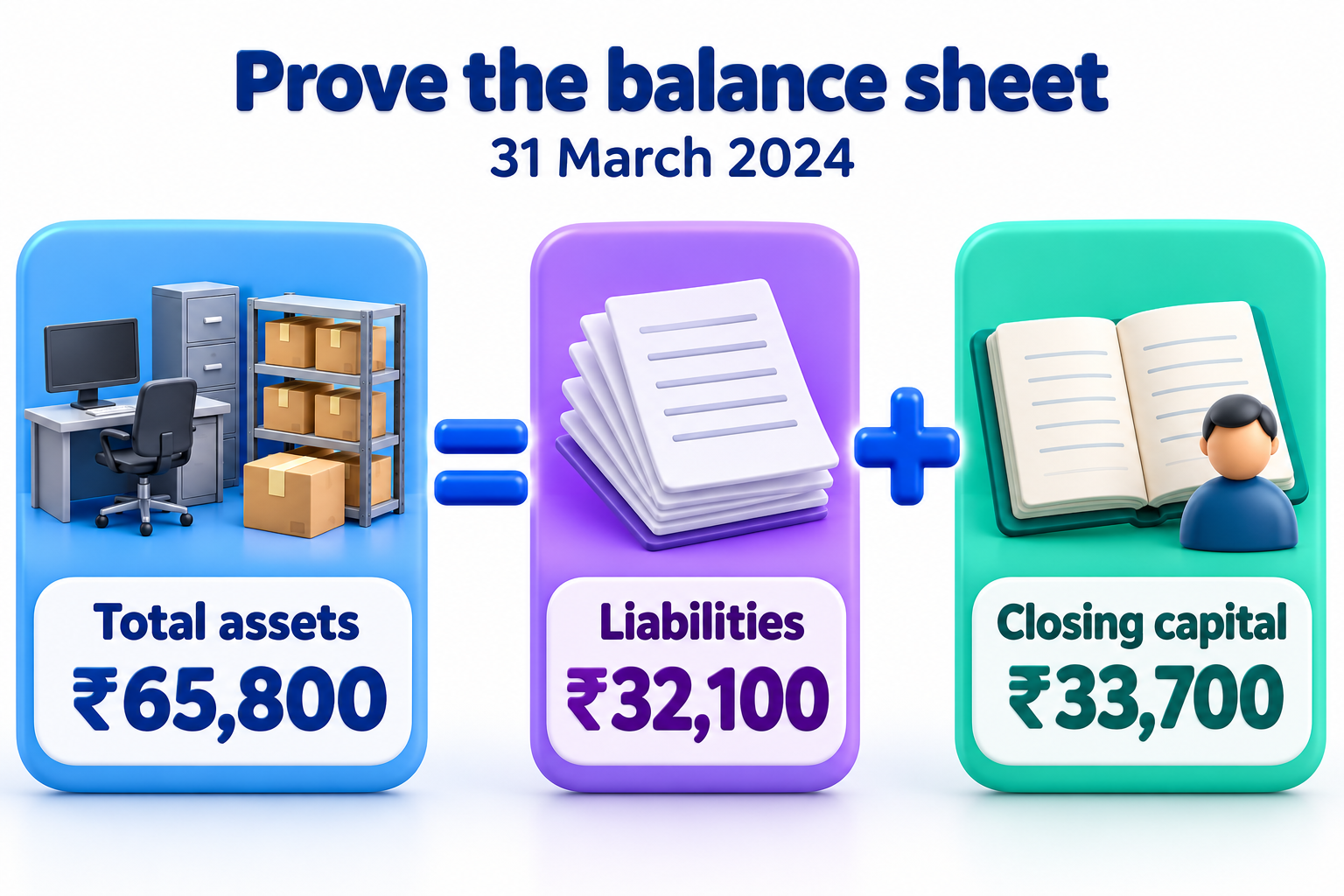
| Total assets | ₹65,800 | Total capital and liabilities | ₹65,800 |
Liabilities total ₹32,100. Therefore net assets are ₹65,800 − ₹32,100 = ₹33,700, equal to closing capital. “Total assets” and “net assets” are different amounts; do not subtract liabilities twice. The loan is listed separately without inventing a current/non-current maturity classification that the case has not supplied.
Every adjustment has an identifiable second destination: stock to an asset; salary to a payable; insurance to a prepayment; depreciation to an asset deduction; commission to a receivable; advance maintenance to a liability. Equality is a useful cross-check, but a duplicated balanced entry could still leave both sides equal. Reconcile the evidence too.
8. Route B: recognise stock already included in adjusted purchases
Return to the original trial balance for this alternative. Instead of A1, post debit Closing inventory/credit Purchases ₹15,000 and debit Purchases/credit Opening inventory ₹12,000. Then post A2–A6 unchanged. This is an alternative presentation described in the selected NCERT closing-stock section. Do not add these two entries to the Route A books.
Purchases becomes ₹48,000 − ₹15,000 + ₹12,000 = ₹45,000 debit, and Opening inventory becomes zero. Purchase returns ₹2,000 credit and carriage inward ₹2,000 debit remain separate in our chosen workpaper. Therefore COGS is adjusted Purchases ₹45,000 − returns ₹2,000 + inward carriage ₹2,000 = ₹45,000. Do not re-add opening inventory or credit closing inventory again.
| Account | Debit | Credit |
|---|---|---|
| Purchases | ₹45,000 | — |
| Purchase returns | — | ₹2,000 |
| Sales | — | ₹80,000 |
| Sales returns | ₹3,000 | — |
| Carriage inward | ₹2,000 | — |
| Delivery expense | ₹1,500 | — |
| Rent expense | ₹6,000 | — |
| Salary expense | ₹13,500 | — |
| Insurance expense | ₹600 | — |
| Equipment cost | ₹30,000 | — |
| Accumulated depreciation | — | ₹7,500 |
| Cash | ₹2,000 | — |
| Bank | ₹8,000 | — |
| Trade receivables | ₹16,000 | — |
| Trade payables | — | ₹12,000 |
| Loan | — | ₹15,000 |
| Drawings | ₹4,000 | — |
| Commission income | — | ₹1,700 |
| Maintenance income | — | ₹1,200 |
| Capital | — | ₹25,900 |
| Closing inventory | ₹15,000 | — |
| Salary payable | — | ₹4,500 |
| Prepaid insurance | ₹1,800 | — |
| Depreciation expense | ₹1,500 | — |
| Commission receivable | ₹500 | — |
| Unearned maintenance | — | ₹600 |
| Total | ₹150,400 | ₹150,400 |
Route B totals ₹1,50,400 each, whereas Route A totals ₹1,65,400. Different intermediate trial-balance totals do not mean different profits. Route A retains separate opening stock, unadjusted Purchases and a Trading credit; Route B absorbs the opening/closing stock effects into Purchases. Both produce COGS ₹45,000, net profit ₹11,800 and the same balance sheet.
The diagnostic question is “What entry created this balance?” Closing inventory in a trial balance is a warning to inspect the recording route, not permission to apply a slogan blindly. With adjusted purchases, the stock effect is already there. With Route A, the Trading credit is already there. Either way, account for each effect once.
9. Explain the change from the careless draft
A clerk who used the unadjusted ledger and omitted stock would report gross profit ₹17,000, other income ₹3,000 and operating expenses ₹18,900: an apparent ₹1,100 profit. Reconcile rather than simply replacing the answer.
| Change | Effect on profit | Running profit |
|---|---|---|
| Original unadjusted draft | — | ₹1,100 |
| Recognise selected closing stock | +₹15,000 | ₹16,100 |
| Accrue March salary | −₹4,500 | ₹11,600 |
| Remove future insurance | +₹1,800 | ₹13,400 |
| Recognise quarter depreciation | −₹1,500 | ₹11,900 |
| Recognise earned commission | +₹500 | ₹12,400 |
| Defer unperformed April maintenance | −₹600 | ₹11,800 |
This bridge identifies why profit changed. Adding ₹1,800 “inventory loss” again would incorrectly reduce the final profit to ₹10,000 and stock to ₹13,200. The reduction from cost ₹16,800 to selected value ₹15,000 has already been used. A second charge needs a second supported fact, not a second label for the same fact.
10. Graded practice: decide, calculate, explain
- Omitted stock. All five non-stock adjustments are correct, but Route A’s stock entry was omitted. Find profit, total assets and closing capital. Would the balance sheet necessarily stop balancing?
- Duplicate reduction. After correctly recording stock ₹15,000, an assistant posts debit Inventory loss/credit Inventory ₹1,800 for the same write-down. Find the wrong profit and assets, then give the repair.
- Already accrued. A different starting trial balance already shows Salary expense ₹13,500 and Salary payable ₹4,500. The notes repeat “March salary unpaid ₹4,500.” What additional salary entry is needed?
- Revised estimate with evidence. Keep R unchanged. In a separate variant, reporting-date evidence supports S’s selling price ₹130 rather than ₹120, with completion ₹10 and selling ₹5 unchanged. Find stock, profit, total assets and capital. Does Bank change?
- Classification versus duplication. The ₹1,500 delivery expense is moved from P&L into Trading once. Find the resulting gross and net profits. Then suppose it is charged in both places. What are the results?
- Performance condition. In a separate variant, only February’s maintenance unit was completed by 31 March; March remains owed as well as April, with no refund or other changed fact. Find earned income, liability, required correction from the original ₹1,800 income balance, and the revised profit and capital.
Complete answers
1. Profit is ₹11,800 − ₹15,000 = a ₹3,200 loss. Total assets are ₹65,800 − ₹15,000 = ₹50,800. Capital is ₹25,900 − ₹3,200 − ₹4,000 = ₹18,700. Liabilities ₹32,100 + capital ₹18,700 still equal assets ₹50,800. The omission is balanced but wrong: the unsold asset and the correct performance have both been understated. A balancing statement is not a substitute for the stock evidence.
2. The wrong profit is ₹10,000 and wrong assets ₹64,000; stock is ₹13,200. Reverse the duplicate entry: debit Inventory ₹1,800, credit Inventory loss ₹1,800. Profit returns to ₹11,800, assets to ₹65,800 and stock to ₹15,000. Do not credit Trading a fresh ₹15,000.
3. None. The supplied ledger already includes the required ₹13,500 expense and ₹4,500 liability. Confirm the note describes the same obligation and retain the supporting reconciliation. Posting a further ₹4,500 would make each balance too high by ₹4,500. The need for an adjustment is determined by the difference between required and recorded amounts.
4. S’s revised NRV is ₹130 − ₹10 − ₹5 = ₹115, still below cost ₹150. S contributes 40 × ₹115 = ₹4,600; total stock is ₹15,400, an increase of ₹400. COGS falls ₹400, so profit is ₹12,200, total assets ₹66,200 and closing capital ₹34,100. Bank stays ₹8,000. This is a separate reporting-date estimate variant, not permission to book a later event that arose only after the reporting date.
5. Charged once in Trading, gross profit falls to ₹30,500. Remaining operating expenses fall to ₹21,600, so net profit stays ₹11,800. Charged in both places, gross profit remains ₹30,500 but operating expenses remain ₹23,100, producing a wrong ₹10,300 net profit. The first is a classification error for our case; the second is also a double charge.
6. One completed unit earns ₹600; two owed units create ₹1,200 liability. From the original ledger, debit Maintenance income and credit Unearned maintenance ₹1,200. Compared with the main case, income/profit/capital each fall ₹600: profit ₹11,200 and capital ₹33,100. Assets remain ₹65,800; liabilities rise to ₹32,700. If the main ₹600 deferral had already been posted, only a further ₹600 is required. Count performance first, then compare with the actual ledger.
11. Objective checks with explained alternatives
A. In Route B, adjusted Purchases is ₹45,000, Purchase returns ₹2,000 and Carriage inward ₹2,000. Closing inventory ₹15,000 appears in the trial balance. Which COGS is correct? (a) ₹30,000; (b) ₹45,000; (c) ₹57,000; (d) ₹60,000.
Answer: (b). ₹45,000 − ₹2,000 + ₹2,000 = ₹45,000. (a) subtracts closing inventory a second time. (c) adds the ₹12,000 opening inventory already absorbed into adjusted Purchases. (d) reverses the closing-stock effect by adding ₹15,000. The label “Purchases” alone is insufficient; the adjustment trail explains the balance.
B. Which main-case amount equals the owner’s closing claim? (a) ₹65,800 total assets; (b) ₹32,100 liabilities; (c) ₹33,700 net assets; (d) ₹10,000 Cash plus Bank.
Answer: (c). Assets less liabilities give ₹33,700, independently matched by opening capital plus profit less drawings. (a) ignores external claims. (b) measures obligations, not ownership. (d) covers only two assets and says nothing about the remaining assets and liabilities.
12. Written-answer workshop and final checklist
Prompt. Explain why a balanced trial balance containing closing inventory cannot be used mechanically to decide a second stock adjustment. Use Cedar’s two routes and state the final figures. This is an instructional answer workshop, not an official marking rubric.
Model answer. First identify which stock adjustment has already been posted and its counterpart. Under Cedar’s Route A, Closing inventory is debited and Trading credited ₹15,000. That existing Trading credit must be used once when preparing the account. Under Route B, Closing inventory is debited and Purchases credited, while opening inventory is transferred into Purchases. Adjusted Purchases becomes ₹45,000; returns and carriage complete COGS of ₹45,000. No further closing-stock credit or opening-stock addition is appropriate. Both routes give net sales ₹77,000, gross profit ₹32,000, net profit ₹11,800 and total assets ₹65,800. Closing capital ₹33,700 agrees with assets less liabilities. Trial-balance agreement tests equality; evidence and posting history establish whether the correct amount was recognised once.
- Put the period on the performance statements and the date on the balance sheet.
- Derive each adjustment from evidence; identify whether it is already recorded.
- Trace each adjustment to both destinations without changing Bank unnecessarily.
- Use one inventory route and retain the purchase/stock reconciliation.
- Check gross profit, net profit, capital movement and net assets independently.
- State unresolved information rather than inventing a rate, maturity or missing transaction.