AAO Lesson 034: Assess debt structure and interest cover with stated conventions
AAO · Lesson 034 · English
Assess debt structure and interest cover with stated conventions
Study time: about 110 minutes including practice. Prerequisites: AAO-025, AAO-031, AAO-032.
Learning outcomes
- Reconcile equity, long-term debt, current liabilities, total assets and capital employed.
- Calculate and label debt-equity, funding shares, asset coverage and interest cover without mixing conventions.
- Assess independent financing and earnings scenarios while distinguishing accounting coverage from cash repayment ability.
1. Separate funding structure from the ability to pay
A business can report substantial assets and still struggle to pay interest or repay a loan on time. Conversely, a temporary low cash balance does not by itself establish that its long-term funding structure is unsound. This lesson asks two different questions: how are the reported assets financed, and how large are reported earnings relative to interest? Neither calculation replaces a dated cash schedule or the loan agreement.
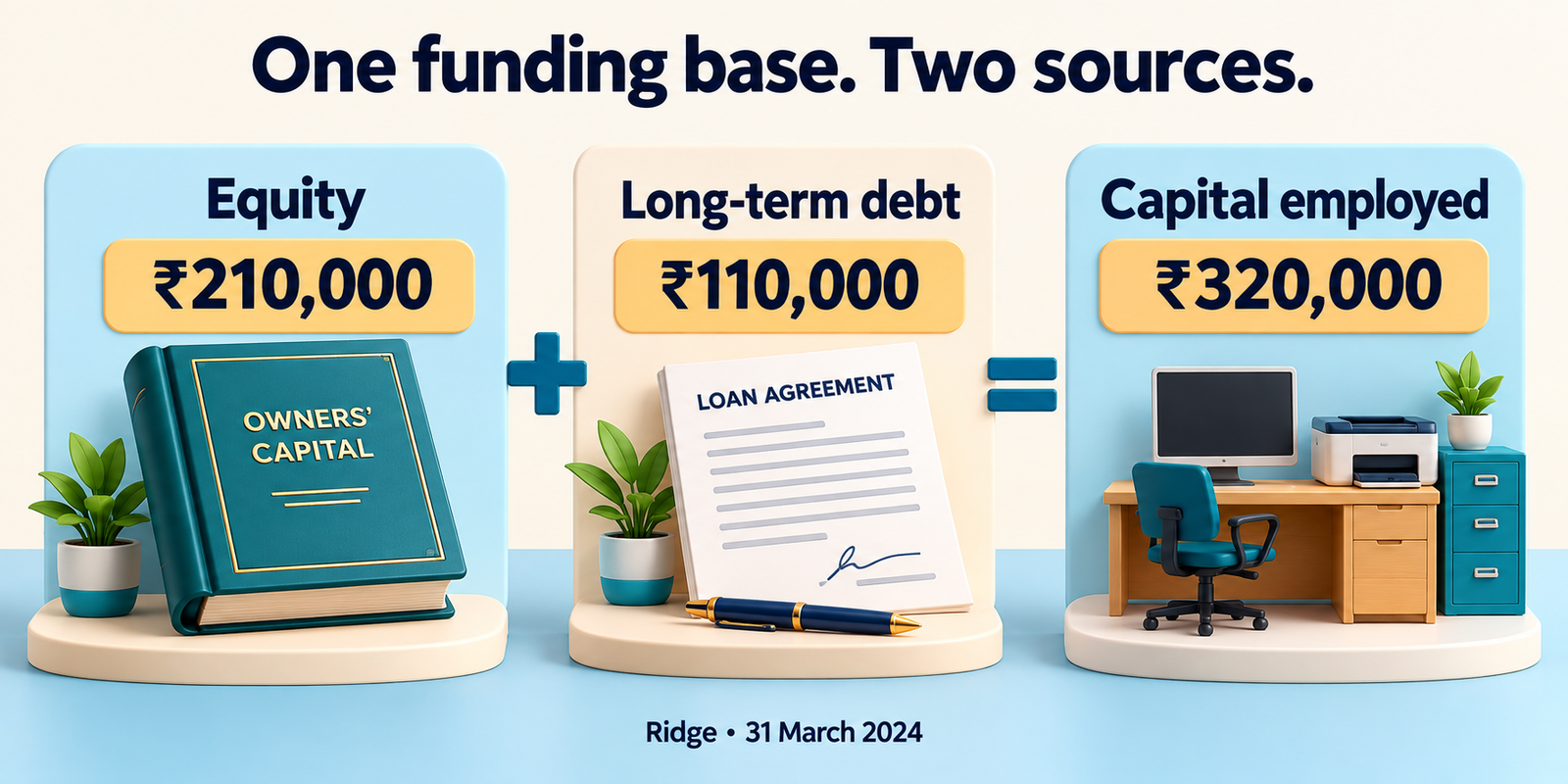
Use Ridge’s original condensed analytical statements at 31 March 2024. Total assets are ₹390,000, current liabilities ₹70,000, long-term debt ₹110,000 and shareholders’ equity ₹210,000. Equity consists of share capital ₹150,000 plus reserves and retained earnings ₹60,000. The base contains no preference-share complication, lease liability, deferred tax or other non-current liability. These simplifications are deliberate; do not carry them into a different question without evidence.
The annual PBIT is ₹70,000, made up of operating profit ₹58,500 plus other non-operating income ₹11,500. Interest is ₹11,000, all on the stated long-term borrowing under this case’s convention; short-term borrowing is stipulated interest-free. PBT is ₹59,000 and supplied tax expense ₹14,750 gives PAT ₹44,250. The tax figure is an exercise input, not a tax-law calculation.
2. Reconcile the denominators and terminology
| Quantity | Derivation | Amount |
|---|---|---|
| Total assets | Equipment 200,000 + current assets 190,000 | 390,000 |
| Total outside liabilities | Long-term debt 110,000 + current liabilities 70,000 | 180,000 |
| Equity | Assets 390,000 − all outside liabilities 180,000 | 210,000 |
| Capital employed: funding route | Equity 210,000 + long-term debt 110,000 | 320,000 |
| Capital employed: asset route | Assets 390,000 − current liabilities 70,000 | 320,000 |
| Capital employed: operating-position route | Net equipment 200,000 + working capital 120,000 | 320,000 |
Some textbooks call capital employed “net assets” in these ratio formulas, meaning total assets less current liabilities. In the usual equity reconciliation used earlier in this course, net assets means assets less all outside liabilities. For Ridge those amounts are ₹320,000 and ₹210,000 respectively. They are not interchangeable. We use the explicit words capital employed for ₹320,000 and equity for ₹210,000 throughout this workpaper.
The three capital-employed routes agree because the simplified case contains only equity, long-term debt and current liabilities as funding categories. If other non-current liabilities exist, examine the required convention before asserting that equity plus long-term borrowing alone equals total assets less current liabilities.
Reserves within equity are not a separate cash asset. An internal transfer from retained earnings to a named reserve leaves total equity unchanged. Borrowing cash, issuing capital and earning profit are different events even when each increases a credit-side account.
3. State the formula before the answer
| Measure | Declared formula | Ridge calculation | Result |
|---|---|---|---|
| Debt-equity | Long-term debt / equity | 110,000 / 210,000 | 0.5238:1 |
| Debt share of capital employed | Long-term debt / capital employed | 110,000 / 320,000 | 34.375% |
| Proprietary share, capital-employed basis | Equity / capital employed | 210,000 / 320,000 | 65.625% |
| Total assets to long-term debt | Total assets / long-term debt | 390,000 / 110,000 | 3.5455:1 |
| Equity share, total-assets variant | Equity / total assets | 210,000 / 390,000 | 53.8462% |
| All outside liabilities / total assets | (Long-term debt + current liabilities) / assets | 180,000 / 390,000 | 46.1538% |
The main debt-equity numerator is long-term debt, not every credit balance. The two capital-employed funding shares add to 100% because their numerators are the two components of that same ₹320,000 denominator. The total-assets variants also form a 100% pair: equity 53.8462% plus all outside liabilities 46.1538%.
Do not add debt/capital-employed 34.375% to equity/total-assets 53.8462% and expect 100%. Their denominators describe different wholes. Likewise, total assets / long-term debt 3.5455 is not the reciprocal of debt/capital-employed 34.375%; the reciprocal would be capital employed / debt = ₹320,000 / ₹110,000 = 2.9091.
These are accounting carrying amounts. A high asset-coverage figure does not prove that each asset can be sold immediately at book value, that creditors rank equally, or that the assets are unencumbered. Obtain valuation, security and contractual information before making those claims. This is educational interpretation, not a legal recovery estimate or lending recommendation.
4. Calculate interest cover using the matching earnings level
Under the stated convention, interest cover = PBIT / interest = ₹70,000 / ₹11,000 = 6.3636 times. The numerator must be before the interest being compared. Starting from PBT ₹59,000, add back interest ₹11,000 to obtain PBIT ₹70,000. Starting from PAT ₹44,250, add supplied tax ₹14,750 and interest ₹11,000. Do not add interest again to a figure already labelled PBIT.
Operating profit is only ₹58,500, so its ratio to interest is 5.3182 times. That can be a useful separately labelled operating-only sensitivity because the ₹11,500 other income may not recur. It is not the same formula as total PBIT cover. Do not silently switch the numerator while keeping the old label.
Coverage of 6.3636 times means reported annual PBIT is that multiple of reported annual interest. It does not mean the firm holds enough cash to pay six years of interest. It also says nothing directly about scheduled principal repayments. Accrual earnings can include amounts not yet collected, while interest and principal have their own payment dates.
A dated cash counterexample
In an independent short-window scenario, interest ₹11,000 and principal ₹25,000 are due, while confirmed cash available by that date is ₹24,000. The scheduled outflow is ₹36,000 and the dated gap ₹12,000, notwithstanding a favourable-looking annual accounting cover. No unapproved refinancing is assumed. The correct response is to establish the cash timetable and available committed facilities, not to declare the gap solved by a profit ratio.
5. Test independent financing and loss scenarios
Each row restarts from Ridge’s base position; the alternatives are not cumulative. Assume the listed transaction is valid, fully recorded and has no incidental costs or tax effect for this isolated analysis.
| Scenario | Assets | CL | Long-term debt | Equity | Capital employed | Debt-equity |
|---|---|---|---|---|---|---|
| Repay ₹10,000 long-term debt from existing bank | 380,000 | 70,000 | 100,000 | 210,000 | 310,000 | 0.4762:1 |
| Buy inventory ₹20,000 on current trade credit | 410,000 | 90,000 | 110,000 | 210,000 | 320,000 | 0.5238:1 |
| Receive ₹40,000 new equity capital in bank | 430,000 | 70,000 | 110,000 | 250,000 | 360,000 | 0.4400:1 |
| Recognise an established ₹30,000 asset loss | 360,000 | 70,000 | 110,000 | 180,000 | 290,000 | 0.6111:1 |
Debt repayment reduces both assets and long-term borrowing; equity is unchanged. Buying on current trade credit increases total assets and current liabilities equally, so capital employed and the main long-term debt-equity ratio stay unchanged. Yet short-term obligations increase. A ratio can remain stable because it excludes the newly changed category.
New equity increases the owners’ funding without creating a loan obligation in this simplified scenario. An asset loss reduces equity even though the borrowing balance does not rise; debt-equity therefore increases from 0.5238 to 0.6111. A higher debt-equity ratio does not always mean new debt was taken.
New borrowing plus an earnings stress
In a separate prospective full-year scenario, Ridge receives additional long-term borrowing ₹110,000 and retains it in cash. Assets become ₹500,000; long-term debt ₹220,000; equity ₹210,000; capital employed ₹430,000. Debt-equity becomes 1.0476:1. The stipulated future annual interest is ₹22,000. If PBIT remains ₹70,000, cover falls to 3.1818 times. If supported stress assumptions reduce PBIT to ₹55,000, cover falls to 2.5 times. These are conditional calculations, not predictions or assertions about a bank’s lending terms.
6. Deal with zero or negative denominators honestly
If long-term debt is zero, debt-equity can be zero when equity is positive, but total assets / long-term debt is undefined. Do not present an infinite coverage score as an ordinary measured result. If interest is zero, ordinary interest cover is likewise undefined; explain that the stated period has no interest denominator.
If equity is zero, debt-equity is undefined. If equity is negative, a negative quotient is arithmetically possible but must not be ranked as “lower and safer” than a positive debt-equity ratio. State the deficit and inspect the underlying financial position. Similarly, negative PBIT divided by positive interest gives a negative multiple showing a loss before interest, not negative years of cash coverage.
7. Graded practice with complete answers
A. Reconcile two funding bases
Assets ₹400,000, current liabilities ₹80,000, long-term debt ₹120,000. Find equity, capital employed, debt-equity and the two capital-employed funding shares.
Solution: equity ₹200,000; capital employed ₹320,000. Debt-equity 0.6:1. Debt share 37.5%; proprietary share 62.5%; the pair totals 100%. Equity/total-assets is instead 50%, a separately labelled variant.
B. Recover PBIT from PAT
PAT ₹36,000, supplied tax expense ₹12,000 and interest ₹8,000. Compute interest cover.
Solution: PBIT=₹36,000+₹12,000+₹8,000=₹56,000. Cover 7 times. PAT/interest 4.5 and PBT/interest 6 use earnings after some deductions that must be added back for this formula.
C. Current credit changes the snapshot
Use Practice A’s base and buy ₹50,000 inventory on current credit. What happens to debt-equity and capital employed?
Solution: assets ₹450,000; CL ₹130,000; capital employed still ₹320,000; long-term debt ₹120,000 and equity ₹200,000 unchanged. Debt-equity stays 0.6:1. The unchanged long-term ratio does not erase the extra ₹50,000 current obligation.
D. A loss raises leverage
Long-term debt ₹90,000 and equity ₹150,000; an established asset loss ₹30,000 is recognised without tax effects. Calculate before and after debt-equity.
Solution: before 0.6:1. Afterwards equity ₹120,000 and debt unchanged ₹90,000, giving 0.75:1. No new borrowing is required to produce this increase.
E. Distinguish operating-only cover
Operating profit ₹40,000, non-operating gain ₹20,000, interest ₹10,000. Calculate total PBIT cover and an operating-only sensitivity.
Solution: PBIT ₹60,000; total cover 6 times. Operating-only cover 4 times. Label both. Whether the gain will recur needs evidence; the presence of a gain does not make it false, but it may affect a forward-looking assessment.
F. Recognise an undefined ratio
Assets ₹180,000, current liabilities ₹60,000 and long-term debt ₹120,000. What is debt-equity?
Solution: equity is zero, so debt-equity has a zero denominator and is undefined. State the zero-equity position. Do not insert 1 to avoid the problem or describe it as 0:1.
8. Explained objective checks
MCQ A. For Ridge, which pair correctly partitions capital employed? (a) debt 34.375% plus equity 65.625%; (b) debt 34.375% plus equity 53.8462%; (c) all liabilities 46.1538% plus equity 65.625%; (d) long-term debt 28.2051% plus current liabilities 17.9487%.
Answer:(a). Both numerators use the ₹320,000 capital-employed denominator and together exhaust it. The other pairs mix denominators or omit equity.
MCQ B. After a fully recorded asset loss, debt-equity rises while the debt balance is unchanged. The immediate mathematical reason is: (a) cash interest was paid; (b) equity fell; (c) a new loan was received; (d) current liabilities must have doubled.
Answer:(b). The loss reduces equity through earnings. The other events do not follow from the stated evidence.
9. Written-answer model and summary
Model: At 31 March 2024 Ridge’s equity ₹210,000 and long-term debt ₹110,000 finance capital employed ₹320,000, also equal to assets ₹390,000 less current liabilities ₹70,000. On the declared long-term-debt convention, debt-equity is 0.5238:1; debt and equity represent 34.375% and 65.625% of capital employed. PBIT ₹70,000 covers interest ₹11,000 by 6.3636 times, while the operating-only sensitivity is 5.3182 times. These are carrying-value and accrual-earnings measures. They do not prove realisable asset value, creditor ranking or cash available for principal and interest at their due dates. Obtain security details, maturity schedules, recurring-earnings evidence and a dated cash forecast before drawing a stronger conclusion.
Summary: identify the funding categories, reconcile the denominator, label the ratio convention and separate accounting earnings from cash service. Do not rank undefined, negative or differently defined ratios as if they were comparable scores.