AAO Lesson 040: Build and prove a complete club income-and-expenditure set
AAO · Lesson 040 · English
Build and prove a complete club income-and-expenditure set
Study time: about 115 minutes including practice. Prerequisites: AAO-036, AAO-037, AAO-038, AAO-039, AAO-026, AAO-028.
Learning outcomes
- Prepare a reconciled income/expenditure account with explicit unrestricted/restricted columns.
- Reconcile opening and closing assets, liabilities and funds using the supporting schedules.
- Explain why cash growth, current surplus and fund movements differ, then repair an inconsistent draft.
1. Assemble a complete, linked set
Willow Learning Club’s year ended 31 March 2024 can now be closed using the workpapers in 036–039. The task is to produce an income-and-expenditure account and integrated balance sheet that agree with the cash records, continuing controls and fund movements. This is more demanding than forcing two totals to match: each item must have a supported period, classification and counterpart.
The case uses the selected fund-column conventions explained in 039, with reasonable assurance of receipt and compliance, verified eligible programme costs and the stated donor terms. It is a teaching set, not a claim of complete ICAI-format compliance or a statutory filing. The gross incidental-trading workpaper is retained beside the selected net-result line. No management designation, extra impairment, write-off, tax, interest accrual or unrecorded liability is assumed.
Cash means cash in hand plus the ordinary bank, with term deposits separately shown as investments. Income/expenditure measures current earning and consumption; the balance sheet retains resources, obligations and funds at the closing date. Preserve those different questions through every stage.
2. Establish the opening balance sheet
| Assets | Amount | Outside liabilities and funds | Amount |
|---|---|---|---|
| Cash in hand | 2,000 | Subscription advances | 6,000 |
| Ordinary bank | 28,000 | Salary payable | 3,000 |
| Subscription receivables | 4,000 | Consumables supplier payable | 2,500 |
| Prepaid insurance | 1,200 | Outside liabilities subtotal | 11,500 |
| Consumables stock | 3,000 | Building restricted fund | 12,000 |
| Supplier advance | 500 | General fund, balancing residual | 85,200 |
| Activity merchandise | 2,000 | — | |
| Equipment carrying amount | 48,000 | — | |
| Term-deposit investments | 20,000 | — | |
| Total assets | 108,700 | Total liabilities and funds | 108,700 |
The outside liabilities total ₹11,500. General fund is total assets ₹108,700 − outside liabilities ₹11,500 − restricted building fund ₹12,000 = ₹85,200. The fund is an opening residual of supported balances, not this year’s income or an unexplained bank balance. The equipment carrying amount consists of cost ₹60,000 less accumulated depreciation ₹12,000.
Do not add the ₹11,500 subtotal to its own three component liabilities when checking the table. Likewise, the opening cash/bank pool ₹30,000 is already represented by its two separate lines.
3. Bring forward the completed controls
| Workpaper | Current result or treatment | Closing balance carried forward |
|---|---|---|
| 036: actual cash and bank | External receipts 128,200; external payments 107,600 | Cash 1,600; bank 49,000 |
| 037: subscription controls | Current income 48,000 | Receivable 7,000; advances 8,000 |
| 038: consumables | Current consumption 10,500 | Stock 4,500; supplier advance 1,000; supplier payable 3,500 |
| 038: activity merchandise | Separate activity surplus 9,000 | Merchandise stock 3,000 |
| 039: restricted programme | Release income 7,500 and expense 7,500 | Programme fund 2,500 |
| 039: building fund and interest | Building interest 720; general interest 480 | Building restricted fund 30,720 |
The general donation ₹9,000 is eligible current unrestricted support under the stipulated terms. The building contribution ₹18,000 goes to its restricted fund. The interest-free loan received ₹15,000 and principal repayment ₹3,000 leave an outside loan liability ₹12,000; neither amount is current income or expense. The ₹8,000 term-deposit purchase increases investments from ₹20,000 to ₹28,000 without creating an operating expense.
4. Derive the remaining current expenses
Salaries paid ₹27,000 include settlement of the opening ₹3,000 payable. Current unpaid salary at year end is ₹4,000. The expense is therefore ₹27,000 + ₹4,000 − ₹3,000 = ₹28,000. All these salary balances are supported; no separate advance exists.
The opening insurance prepayment ₹1,200 covers April–June 2023 at ₹400 per month. A new ₹3,600 premium paid on 1 July covers July 2023–June 2024 at ₹300 per month. The policies provide the stipulated even monthly coverage, with no refund, overlap or other benefit. Current insurance expense is ₹1,200 plus nine months × ₹300 = ₹3,900; three months × ₹300 = ₹900 remains prepaid.
| Expense | Current cash payment | Adjustment proof | Current expense | Closing balance |
|---|---|---|---|---|
| Salaries | 27,000 | +4,000 closing payable −3,000 opening payable | 28,000 | Payable 4,000 |
| Insurance | 3,600 | +1,200 opening prepayment −900 closing prepayment | 3,900 | Prepayment 900 |
| Utilities | 4,800 | All supported services received this year; no unpaid/prepaid part | 4,800 | 0 |
| Repairs | 2,200 | Completed current maintenance; no qualifying asset component | 2,200 | 0 |
The repairs preserve existing equipment and do not meet the case’s asset-recognition conditions for a separate component or enhancement. This stipulation prevents a payment label from deciding capitalisation. Neither the new equipment purchase nor the term-deposit purchase belongs in this operating-expense table.
5. Close the equipment and disposal workpaper
On 1 April 2023 the club sells equipment having cost ₹10,000 and accumulated depreciation ₹4,000 for ₹4,000. Its opening carrying amount ₹6,000 therefore produces a loss ₹2,000. Sale is at the start of the period, so there is no additional current depreciation on that sold asset in this case; there are no disposal costs.
The remaining old equipment carries ₹42,000 at 1 April. Its supported remaining useful life is seven years, zero residual value, straight-line under the cost model, giving current depreciation ₹6,000. New equipment ₹24,000 is available for use on 1 October, with a ten-year useful life, zero residual value and the same straight-line method. The stipulated monthly apportionment gives six months’ charge ₹1,200. Total depreciation is ₹7,200. These are case estimates, not rates prescribed for all clubs.
| Movement | Cost | Accumulated depreciation | Carrying amount |
|---|---|---|---|
| Opening equipment | 60,000 | 12,000 | 48,000 |
| Remove sold equipment | −10,000 | −4,000 | −6,000 |
| Add equipment ready 1 October | 24,000 | 0 | 24,000 |
| Current depreciation | 0 | 7,200 | −7,200 |
| Closing equipment | 74,000 | 15,200 | 58,800 |
Disposal entries: debit Disposal ₹6,000 and Accumulated depreciation ₹4,000, credit Equipment cost ₹10,000; debit Bank ₹4,000, credit Disposal ₹4,000; then debit Disposal loss ₹2,000 and credit Disposal ₹2,000. The disposal account clears, while the loss enters current expenditure. If the ₹4,000 bank receipt is already in the cashbook, reconcile it rather than posting it again.
Depreciation is debit Depreciation expense ₹7,200 and credit Accumulated depreciation ₹7,200. The remaining old carrying amount is ₹36,000 and the new carrying amount ₹22,800, together ₹58,800. Charging the whole ₹24,000 purchase as expense and also charging its depreciation would double-count part of the cost.
6. Retain the gross incidental-activity workpaper
| Item | Calculation | Amount |
|---|---|---|
| Sales revenue | 750 kits × ₹32 | 24,000 |
| Opening merchandise | 100 kits × ₹20 | 2,000 |
| Purchases | 800 kits × ₹20 | 16,000 |
| Closing merchandise | 150 kits × ₹20 | 3,000 |
| Cost of sales | 2,000 + 16,000 − 3,000 | 15,000 |
| Activity surplus transferred once | 24,000 − 15,000 | 9,000 |
The main account uses the selected net activity surplus ₹9,000, with this gross workpaper retained. It does not repeat the activity’s ₹24,000 revenue and ₹15,000 cost alongside the same surplus. The cash summary still contains the actual sales receipt and purchase payment separately.
7. Prepare the columnar income-and-expenditure account
“General” below identifies unrestricted current activity in this case. “Restricted” displays eligible programme expenditure and its matching release, following the selected convention. Donations to the building fund and its ₹720 restricted interest remain fund movements rather than general current income.
| Item | General | Restricted | Total |
|---|---|---|---|
| Income: subscriptions | 48,000 | 0 | 48,000 |
| Income: general donation | 9,000 | 0 | 9,000 |
| Income: general deposit interest | 480 | 0 | 480 |
| Income: activity surplus, separate workpaper | 9,000 | 0 | 9,000 |
| Income: eligible restricted-fund release | 0 | 7,500 | 7,500 |
| Total income | 66,480 | 7,500 | 73,980 |
| Expense: salaries | 28,000 | 0 | 28,000 |
| Expense: insurance | 3,900 | 0 | 3,900 |
| Expense: consumables used | 10,500 | 0 | 10,500 |
| Expense: utilities | 4,800 | 0 | 4,800 |
| Expense: repairs | 2,200 | 0 | 2,200 |
| Expense: depreciation | 7,200 | 0 | 7,200 |
| Expense: loss on equipment disposal | 2,000 | 0 | 2,000 |
| Expense: eligible programme costs | 0 | 7,500 | 7,500 |
| Total expenditure | 58,600 | 7,500 | 66,100 |
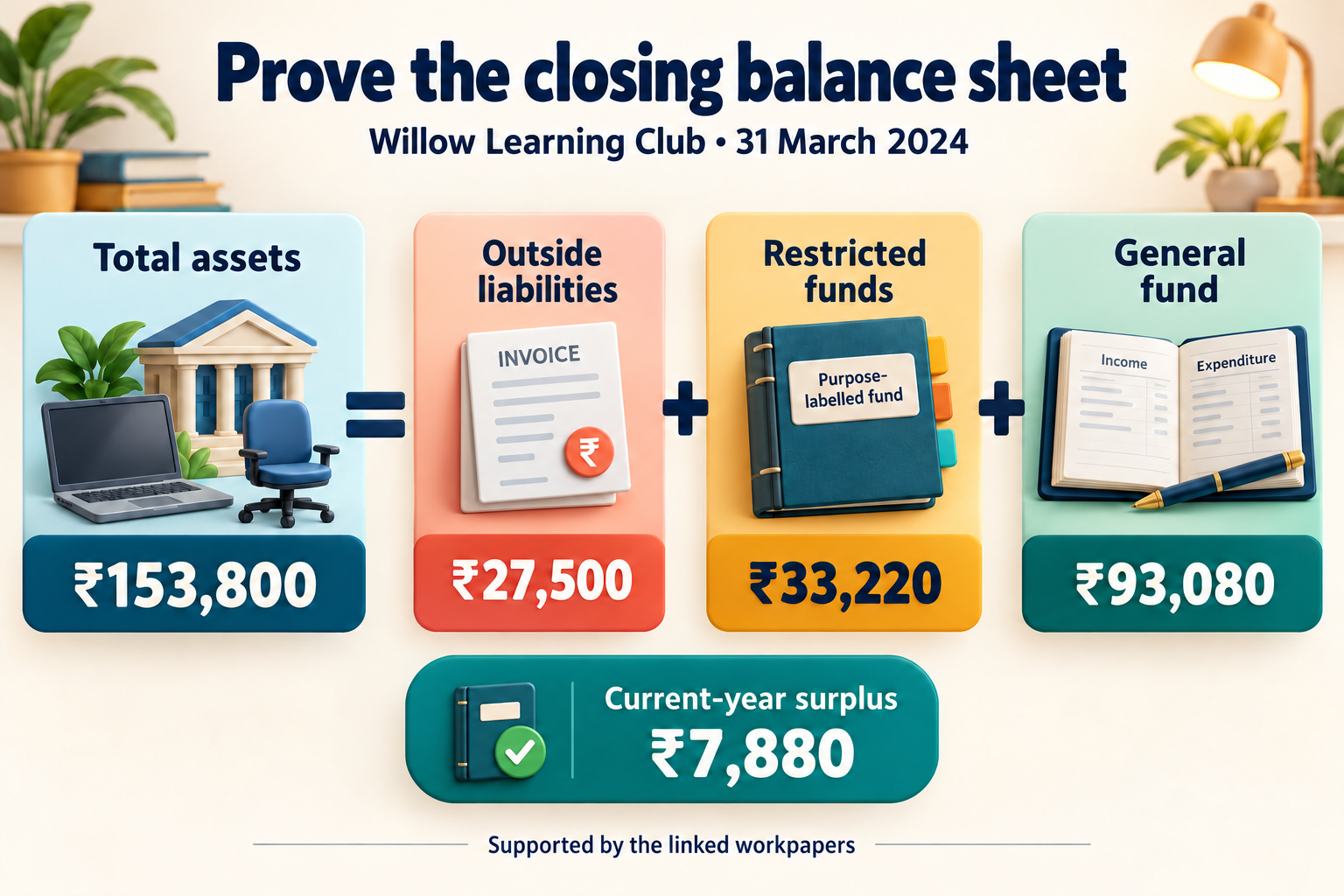
| Surplus transferred to general fund | 7,880 | 0 | 7,880 |
General income ₹66,480 minus general expense ₹58,600 gives surplus ₹7,880. The restricted column shows real programme income and expenditure of ₹7,500 each and a zero net result. Total income ₹73,980 less total expenditure ₹66,100 also gives ₹7,880. “Zero restricted result” does not mean there is no programme expense or no remaining restricted fund.
After closing each income and expense once into the respective income-and-expenditure control, transfer the ₹7,880 credit surplus by debiting Income-and-expenditure account and crediting General fund. General fund becomes ₹85,200 + ₹7,880 = ₹93,080. The main case has no appropriation to a management-designated fund.
8. Prepare an integrated balance sheet
| Assets | Amount | Outside liabilities and funds | Amount |
|---|---|---|---|
| Cash in hand | 1,600 | Subscription advances | 8,000 |
| Ordinary bank | 49,000 | Salary payable | 4,000 |
| Subscription receivables | 7,000 | Consumables supplier payable | 3,500 |
| Prepaid insurance | 900 | Interest-free loan outstanding | 12,000 |
| Consumables stock | 4,500 | Outside liabilities subtotal | 27,500 |
| Supplier advance | 1,000 | Building restricted fund | 30,720 |
| Activity merchandise stock | 3,000 | Programme restricted fund | 2,500 |
| Equipment cost 74,000 less depreciation 15,200 | 58,800 | Restricted funds subtotal | 33,220 |
| Term-deposit investments | 28,000 | General fund | 93,080 |
| Total assets | 153,800 | Total outside liabilities and funds | 153,800 |
The proof is total assets ₹153,800 = outside liabilities ₹27,500 + restricted funds ₹33,220 + general fund ₹93,080. The two subtotals are explanatory and must not be added again to their components. All fund-related assets remain in the asset total; no investment or bank amount is netted against its fund.
The selected restricted monetary-asset representation from 039 is building deposits ₹18,000 plus building bank ₹12,720, and programme bank ₹2,500. These are included in the bank/investment lines above, not additional assets. Outside liabilities are separated from purpose-bound fund balances. Closing receivables and advances also remain gross: they belong to different member balances and periods and cannot be cancelled merely because both concern subscriptions.
9. Explain why cash grew more than the surplus
The cash/bank pool rises ₹20,600, whereas current surplus is ₹7,880. A useful diagnostic is the balance-sheet equation, expressed as movements. It reconciles all funds and outside liabilities, then removes changes in assets outside the defined cash pool. This is an original equation bridge, not a complete statutory cash-flow statement.
| Component | Opening | Closing | Change |
|---|---|---|---|
| General fund | 85,200 | 93,080 | 7,880 |
| Restricted funds | 12,000 | 33,220 | 21,220 |
| All funds | 97,200 | 126,300 | 29,100 |
| Outside liabilities | 11,500 | 27,500 | 16,000 |
| Assets outside cash/bank pool | 78,700 | 103,200 | 24,500 |
| Cash/bank pool | 30,000 | 50,600 | 20,600 |
Cash increase = all-fund increase ₹29,100 + outside-liability increase ₹16,000 − non-pool-asset increase ₹24,500 = ₹20,600. The ₹29,100 fund increase comprises current surplus ₹7,880 plus restricted-fund increase ₹21,220. Thus it would also be wrong to equate total fund growth with current income-and-expenditure surplus.
The non-pool asset movement includes receivables, prepayments, consumables, advances, merchandise, equipment and term deposits. Using only equipment purchases in this bridge would omit other asset movements. The cash equation from 036 and this balance-sheet movement equation independently reach the same closing pool ₹50,600.
10. Audit the routes before accepting a balanced set
Missing advance: calling next-year subscriptions income may still permit a balanced set if the advance liability is also omitted. Recheck period allocations, not just totals. Hidden programme: netting expense directly against a fund may preserve closing totals yet omit the selected statement’s restricted-column income and expense. Wrong disposal: cash proceeds do not establish the disposal gain or loss. Duplicated stock: taking the activity surplus and also adding closing merchandise as income exaggerates the result.
Before closing, match each cash line to its ledger counterpart, each adjustment to a dated workpaper, each continuing balance to its supporting record and each result transfer to one posting. Equal debit and credit totals cannot prove eligibility, completeness, valuation or correct period allocation.
11. Graded practice with complete answers
A. Correct the consumables count
In an independent variation, Willow’s usable closing consumables are ₹3,500 rather than ₹4,500. All other facts remain unchanged. Recompute consumption, surplus, total assets and general fund.
Solution: consumption rises from ₹10,500 to ₹11,500. Surplus falls ₹1,000 to ₹6,880; assets fall to ₹152,800; general fund falls to ₹92,080. Outside liabilities ₹27,500 and restricted funds ₹33,220 are unchanged. Their sum with ₹92,080 is ₹152,800. No cash movement is caused by correcting the count.
B. Correct a salary cut-off
Closing salary payable should be ₹4,800 rather than ₹4,000, with payment unchanged. What happens?
Solution: salary expense becomes ₹28,800; surplus becomes ₹7,080 and general fund ₹92,280. Outside liabilities rise to ₹28,300. Total assets remain ₹153,800. The ₹800 liability increase is offset by the ₹800 fund reduction, not by imaginary cash.
C. Remove unearned programme income
A draft credits the whole ₹10,000 programme grant to restricted income and records programme expense ₹7,500, instead of retaining the unused ₹2,500 fund. How is it repaired?
Solution: before closing, debit Restricted income ₹2,500 and credit Restricted programme fund ₹2,500. Eligible release income returns to ₹7,500 and restricted result to zero. If the excess was already closed into a fund, correct that actual closing destination consistently instead of debiting an empty income account. The bank remains unchanged.
D. Change disposal proceeds only
The 1 April equipment instead sells for ₹6,500, with the same ₹6,000 carrying amount and all other facts unchanged. Find the disposal result and changes to the final set.
Solution: gain ₹500 replaces loss ₹2,000, improving surplus ₹2,500 to ₹10,380. Bank becomes ₹51,500; total assets ₹156,300; general fund ₹95,580. Equipment carrying amount is unchanged because the same asset is removed. ₹27,500 + ₹33,220 + ₹95,580 = ₹156,300.
E. Identify a duplicated activity result
A draft includes activity sales ₹24,000, activity cost ₹15,000 and, in addition, the transferred activity surplus ₹9,000 in the main account. What is wrong?
Solution: the activity contributes ₹18,000 instead of ₹9,000, overstating surplus by ₹9,000. Under the selected net-result presentation, remove the repeated gross sales/cost pair from the main account while preserving the separate gross workpaper. If correcting posted books, reverse the actual duplicate transfers rather than inventing a bank adjustment.
F. Prove an independent cash movement
Another club’s total funds rise ₹12,000, outside liabilities fall ₹3,000 and assets outside its defined cash pool rise ₹5,000. Find cash movement.
Solution: ₹12,000 − ₹3,000 − ₹5,000 = increase ₹4,000. This equation does not by itself disclose operating cash flow or surplus; those require the underlying classifications.
12. Explained objective checks
MCQ A. Which is Willow’s current income-and-expenditure surplus? (a) ₹20,600 cash increase; (b) ₹29,100 increase in all funds; (c) ₹7,880; (d) ₹33,220 restricted closing funds.
Answer: (c). Current total income ₹73,980 less expenditure ₹66,100 gives ₹7,880. Each other figure answers a different question.
MCQ B. Which closing presentation agrees with the case? (a) Bank ₹49,000 less restricted funds ₹33,220 only; (b) gross assets ₹153,800, outside liabilities ₹27,500, restricted funds ₹33,220 and general fund ₹93,080; (c) programme expense omitted because it is fully funded; (d) subscription advances deducted from unrelated receivables.
Answer: (b). It preserves the integrated gross asset and obligation/fund information. The other options hide classifications that the workpapers specifically establish.
13. Written-answer model and final checks
Model: Willow’s current general income is ₹66,480 and general expenditure ₹58,600. Eligible restricted programme income and expenditure are each ₹7,500. The resulting surplus ₹7,880 increases the general fund from ₹85,200 to ₹93,080. Closing assets total ₹153,800 and equal outside liabilities ₹27,500 plus restricted funds ₹33,220 and general fund ₹93,080. Equipment is carried at ₹58,800 after the disposal and supported depreciation. Cash and bank close at ₹50,600. Their ₹20,600 increase is reconciled by all-fund growth ₹29,100 plus liability growth ₹16,000 less non-pool-asset growth ₹24,500; it is not the current surplus. Supporting membership, supplier, inventory, activity and donor-term workpapers are retained.
Completion check: prove opening balances, derive every cut-off, preserve gross workpapers, close each result once, reconcile funds to their movements, then cross-check both cash and the integrated balance sheet.