AAO Lesson 041: Measure results from statements of affairs and owner movements
AAO · Lesson 041 · English
Measure results from statements of affairs and owner movements
Study time: about 120 minutes including practice. Prerequisites: AAO-002, AAO-015, AAO-025, AAO-029.
Learning outcomes
- Distinguish a statement of affairs assembled from partial evidence from a complete ledger-derived balance sheet.
- Derive adjusted opening and closing capital, then isolate profit or loss from owner contributions and drawings.
- Quantify how omitted balances and unsupported valuations distort the inferred result.
1. Know what incomplete records can and cannot tell you
Maple Stationery is a fictional sole-proprietor business. For the year 1 April 2023 to 31 March 2024, it has bank statements, cash notes, customer and supplier lists, stock counts and some invoices, but no complete linked ledger. The owner asks whether the business made a profit. Your first route is to establish the opening and closing business capital, then remove movements caused by the owner.
“Single entry” is often used as a label for incomplete records. It does not mean every transaction is necessarily written exactly once. Some transactions may have both effects recorded, some only one and some neither. A trial balance assembled from whatever happens to be present cannot establish that the missing records are complete. Equally, do not make the absolute claim that no balanced trial balance could ever be extracted from any partial system.
A statement of affairs assembles assets and outside liabilities from available evidence to derive the owner’s residual capital. It may resemble a balance sheet in layout, but its amounts can depend on outside records, estimates and information supplied by the owner rather than a complete double-entry ledger. Neither format guarantees that an omitted liability has been found. Reliability comes from supporting and reconciling each amount.
2. Establish the business boundary and evidence
Exclude the owner’s private assets and debts unless a supported transaction has introduced an asset into, or created an obligation of, the business. A private bank balance is not automatically business cash. Owner contributions and drawings are capital movements, not sales and operating expenses.
| Balance or movement | Useful evidence | Risk if accepted without checking |
|---|---|---|
| Cash and bank | Count, cash record, bank statement and reconciliation | A bank statement alone may omit unpresented items or business cash elsewhere |
| Trade receivables | Customer-wise balances, invoices, receipts and collectibility assessment | Old, disputed or duplicated debts may inflate assets |
| Bills receivable/payable | Separate accepted-bill register and settlement evidence | The same debt may appear both as an open account and a bill |
| Stock and equipment | Ownership, stock count, cost/valuation records and asset schedule | Private goods, obsolete stock or omitted depreciation distort capital |
| Outside liabilities | Supplier statements, unpaid-expense evidence and loan confirmations | Missing debts overstate capital |
| Owner movements | Deposit source, cash withdrawals and goods taken at supported carrying cost | An owner deposit may be mistaken for revenue; drawings may be omitted |
For this bounded case, the supplied evidence has been reconciled. Stock is owned, usable and supported at cost without a further write-down. Closing trade receivables after the identified write-off are collectible; no additional allowance is required. Bills are kept separate from ordinary open-account debt. They represent separately documented amounts receivable or payable, not additional sales or purchases. Later lessons explain their simple movements.
3. Prepare the opening statement of affairs
| Assets | Amount | Outside liabilities and capital | Amount |
|---|---|---|---|
| Cash in hand | 5,000 | Trade payables | 16,000 |
| Bank | 25,000 | Bills payable | 3,000 |
| Trade receivables | 18,000 | Salary payable | 2,200 |
| Bills receivable | 4,000 | Interest-free business loan | 10,000 |
| Stock | 22,000 | Outside liabilities subtotal | 31,200 |
| Equipment: cost 50,000 less depreciation 10,000 | 40,000 | Opening capital, residual | 84,000 |
| Prepaid rent | 1,200 | — | |
| Total assets | 115,200 | Total liabilities and capital | 115,200 |
Opening assets total ₹115,200 and outside liabilities ₹31,200. Opening capital is ₹115,200 − ₹31,200 = ₹84,000. The subtotal line helps explain the result; do not add it again to the component liabilities. The ₹40,000 equipment is its carrying amount, not a fresh cash balance or current-year expense.
The business loan is a liability even if the owner arranged it. Its stated interest-free terms avoid a missing interest calculation in this exercise. If the evidence instead showed the owner contributed the money without a business repayment obligation, its classification would need to change. The label on the deposit alone does not decide that question.
4. Adjust the closing evidence before deriving capital
At 31 March 2024 the preliminary equipment amount is ₹50,000, representing opening carrying amount ₹40,000 plus an addition ₹10,000 before current depreciation. Supported current depreciation is ₹5,000, so closing equipment is ₹45,000. The preliminary customer list totals ₹22,000 before a specifically identified irrecoverable balance ₹1,000 is removed, leaving ₹21,000. The list and depreciation must not be adjusted twice.
Other supported closing balances include prepaid rent ₹1,800 and unpaid salary ₹3,000. These are not optional extras because no cash has moved at year end. The closing statement below already incorporates these adjustments.
| Assets | Amount | Outside liabilities and capital | Amount |
|---|---|---|---|
| Cash in hand | 1,600 | Trade payables | 12,000 |
| Bank | 6,000 | Bills payable | 4,000 |
| Trade receivables after write-off | 21,000 | Salary payable | 3,000 |
| Bills receivable | 4,000 | Business loan remaining | 8,000 |
| Stock | 26,000 | Outside liabilities subtotal | 27,000 |
| Equipment carrying amount | 45,000 | Closing capital, residual | 78,400 |
| Prepaid rent | 1,800 | — | |
| Total assets | 105,400 | Total liabilities and capital | 105,400 |
Closing capital is ₹105,400 − ₹27,000 = ₹78,400. The fall from ₹84,000 is ₹5,600. That fall is not yet the loss: owner additions and drawings also changed capital. If an unsupported closing asset were included, the inferred profit would be overstated or the loss understated by that amount, even though this statement would still balance through its residual capital figure.
5. Isolate the owner movements
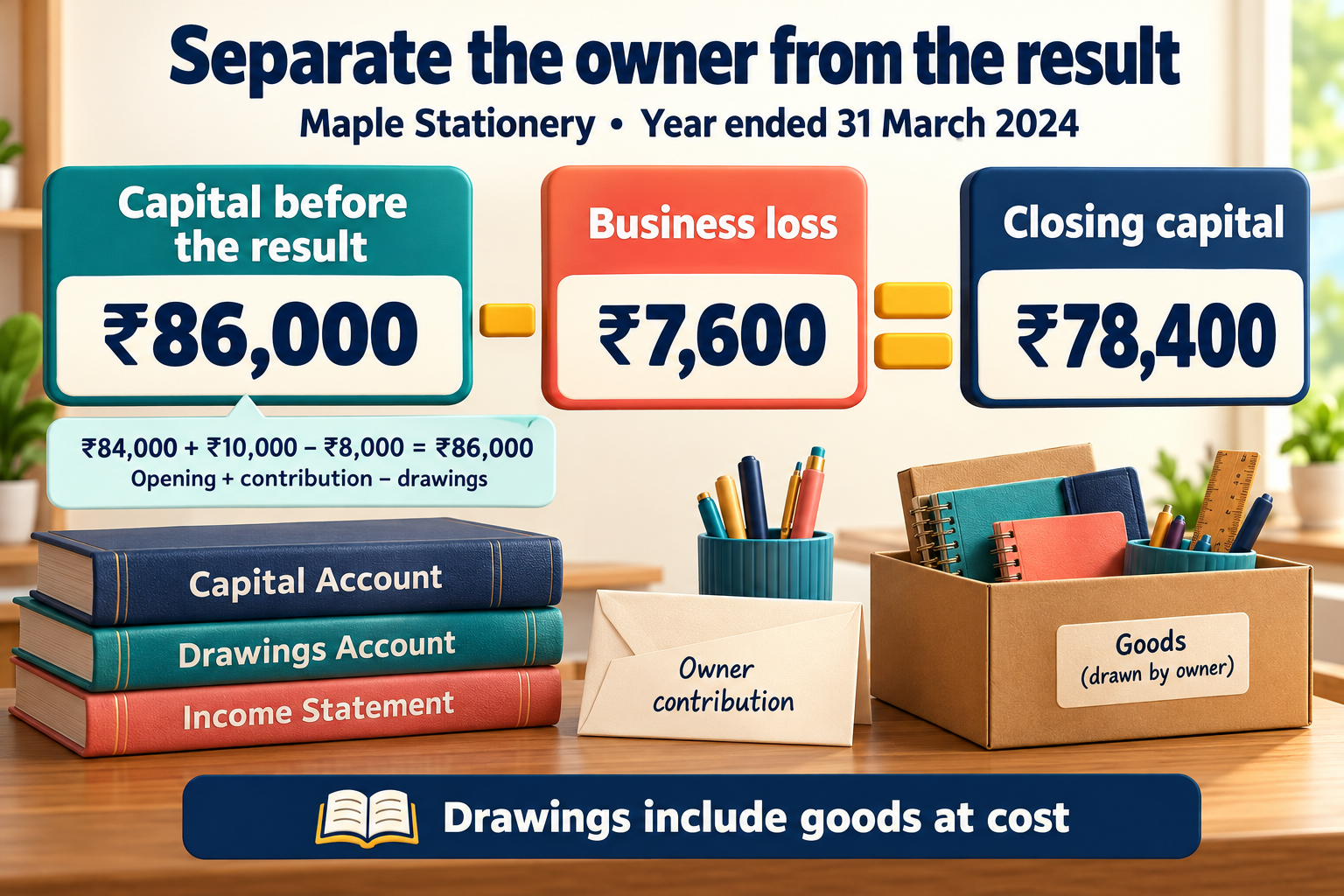
During the year, the owner introduced ₹10,000 into the business bank from personal resources. Personal withdrawals from business cash and bank total ₹6,000. The owner also took merchandise with recorded cost ₹2,000 for personal use. Its normal selling price would have been ₹2,500, but the case measures this goods drawing at its supported cost; no sale to the owner is recorded. Total drawings are therefore ₹8,000.
No other owner movement, revaluation or direct-to-capital adjustment exists in the main case. This restriction matters: the simple capital-comparison formula assumes that all changes outside the period’s result have been separately identified.
| Step | Amount | Meaning |
|---|---|---|
| Opening capital | 84,000 | Starting residual business interest |
| Add owner contribution | 10,000 | Increase unrelated to trading result |
| Deduct monetary drawings | −6,000 | Resources taken for personal use |
| Deduct goods drawings at cost | −2,000 | Non-cash owner withdrawal |
| Capital before the period result | 86,000 | 84,000 + 10,000 − 8,000 |
| Actual closing capital | 78,400 | From adjusted closing statement |
| Period result | −7,600 | 78,400 − 86,000: loss |
Formula from the movement equation: closing capital = opening capital + contributions + profit − drawings. Rearranging, profit = closing capital + drawings − contributions − opening capital. For Maple: ₹78,400 + ₹8,000 − ₹10,000 − ₹84,000 = −₹7,600. A negative result means a loss ₹7,600; do not report it as a positive profit merely because the formula contains the word “profit”.
Why add drawings back? They reduced closing capital without being business expenses. Why subtract new capital? It increased the residual without being earned income. The same logic covers both cash and goods withdrawals; looking only at the bank would miss the latter.
The cashbook’s ₹10,000 owner deposit is recorded as debit Bank and credit Capital. Monetary drawings are debit Drawings and credit Cash/Bank ₹6,000. In a periodic merchandise system, the ₹2,000 goods drawing is debit Drawings and credit Purchases; in an inventory-control system, credit the relevant inventory instead. Either correct route removes owner goods from business consumption once. Do not apply both routes.
6. Test what a plausible-looking answer hides
Reporting only the capital fall: a loss ₹5,600 ignores the net ₹2,000 increase from owner contribution less drawings. Once this outside increase is removed, the business loss is larger, ₹7,600.
Ignoring goods drawings: using only ₹6,000 drawings gives an apparent loss ₹9,600, overstating the true loss ₹2,000. The goods withdrawal caused a capital reduction without operating loss.
Failing to depreciate closing equipment: keeping equipment at ₹50,000 overstates closing capital ₹5,000 and produces apparent loss ₹2,600 instead of ₹7,600. Keeping the bad debt: overstating closing receivables ₹1,000 produces apparent loss ₹6,600. These are separate errors and can coexist.
Omitting closing salary payable: leaving out ₹3,000 overstates closing capital and improves the inferred result by ₹3,000. A statement of affairs will still “balance” because capital is the residual. The balancing process therefore cannot independently detect the omission.
7. Understand the limit of this method
The method yields an overall result from two supported positions and owner movements. It does not by itself tell you total sales, gross profit, cost of goods sold or which operating expense caused a loss. The next lessons reconstruct those missing flows from customer, supplier, bills and cash evidence, then compare the detailed result with this ₹7,600 loss.
Missing capital movements can make a unique answer impossible. Suppose the owner cannot say whether a ₹5,000 bank credit was a business receipt, a contribution or a loan, and no independent evidence resolves it. Do not arbitrarily classify it merely to reach a preferred profit. Report the specific uncertainty and show the effect of each supported alternative until better evidence is available.
Likewise, an unexplained change in asset valuation is not automatically trading profit. Identify revaluation or other direct-equity movements before using the simple formula. The main case expressly excludes them; a different case may not.
8. Graded practice with full solutions
A. A positive result despite drawings
Opening capital ₹50,000; closing ₹62,000; contributions ₹8,000; monetary drawings ₹7,000 and goods drawings at cost ₹1,000. Find the result.
Solution: ₹62,000 + ₹8,000 − ₹8,000 − ₹50,000 = profit ₹12,000. Total drawings include both kinds. A ₹12,000 capital rise happens to equal profit here because contributions and drawings offset, not because they may always be ignored.
B. Capital rises but the business loses
Opening capital ₹40,000; closing ₹46,000; contribution ₹15,000; drawings ₹4,000. Find the result.
Solution: ₹46,000 + ₹4,000 − ₹15,000 − ₹40,000 = −₹5,000: loss ₹5,000. The owner’s net addition ₹11,000 more than covers the loss, leaving a ₹6,000 capital rise.
C. Correct an omitted liability
A preliminary calculation reports profit ₹9,000, but closing unpaid business expense ₹1,800 was omitted. All else is correct. Revise the result.
Solution: closing liabilities increase ₹1,800, capital falls ₹1,800 and profit becomes ₹7,200. Cash does not change merely because the payable is recognised.
D. Do not adjust an already adjusted asset twice
Closing equipment ₹18,000 is explicitly after current depreciation ₹2,000. A preparer deducts that depreciation again in the statement of affairs. What is the effect?
Solution: assets and closing capital are understated ₹2,000, so inferred profit is understated ₹2,000 or loss overstated. Restore equipment to the supplied adjusted ₹18,000. The word “depreciation” is not an instruction to deduct it twice.
E. Separate a private asset
The owner’s personal jewellery ₹6,000 is wrongly included in closing business assets, with no introduction into the business. The draft profit is ₹14,000. Correct it.
Solution: remove the private asset. Closing capital and inferred profit each fall ₹6,000, producing profit ₹8,000. This is a business-boundary correction, not a cash payment or expense for jewellery.
F. An unresolved owner contribution
Opening capital ₹30,000, closing ₹38,000, drawings ₹5,000. A disputed receipt may be either no additional contribution or a ₹4,000 owner contribution. Show the two results and the next evidence needed.
Solution: with no contribution, profit is ₹38,000 + ₹5,000 − ₹30,000 = ₹13,000. With contribution ₹4,000, profit is ₹9,000. Trace the receipt’s payer, purpose and supporting obligation or transaction. A range caused by unresolved classification must not be presented as a verified single profit.
9. Explained objective checks
MCQ A. Maple’s ₹2,000 goods drawing is added back in the result calculation because it: (a) is sales revenue; (b) reduces capital without being a business expense; (c) increases cash; (d) is a new capital contribution.
Answer: (b). It is an owner withdrawal. Its cost affects the owner’s residual but must not be mistaken for the loss generated by trading.
MCQ B. A balanced statement of affairs proves: (a) every liability was found; (b) the residual equals the listed assets less listed liabilities; (c) sales were completely recorded; (d) no valuation estimate was used.
Answer: (b). The residual arithmetic is valid for the listed amounts. Completeness and valuation require evidence beyond the balancing figure.
10. Written-answer model and summary
Model: Maple’s opening statement of affairs gives assets ₹115,200 less outside liabilities ₹31,200, hence capital ₹84,000. After the supported write-off and depreciation, closing assets ₹105,400 less liabilities ₹27,000 give capital ₹78,400. Owner contributions are ₹10,000 and total drawings ₹8,000, including goods at cost ₹2,000. The result is ₹78,400 + ₹8,000 − ₹10,000 − ₹84,000 = loss ₹7,600. This is more than the ₹5,600 fall in capital because owner movements increased capital by a net ₹2,000. The result remains conditional on the stated completeness, valuation and owner-movement evidence; detailed trading and expense flows still require reconstruction.
Summary: verify the business boundary, adjust both positions consistently, isolate all owner movements, derive the result, and state what the method has not proved.