AAO Lesson 053: Reconcile government receipts, arrears and authorised remissions
AAO · Lesson 053 · English
Reconcile government receipts, arrears and authorised remissions
Study time: about 125 minutes including practice. Prerequisites: AAO-009, AAO-051.
Learning outcomes
- Reconcile assessment, collection, remittance and account credit using separate dated records.
- Distinguish arrears, receipt errors, authorised remissions and fictitious suspense credits.
- Apply the selected rent, fine and miscellaneous-demand controls and the express DoP exception in Rule19.
1. Follow the money through four different records
A demand raised, a receipt issued, a remittance made and a credit appearing in the Accounts Officer’s statement are related events, but they are not interchangeable totals. GFR Rules 7–20 establish responsibilities for assessment, collection, credit, reconciliation, outstanding dues and remission. This lesson builds one original workpaper that distinguishes those stages and then applies the related rent, fine and miscellaneous-demand controls.
The case is a fictional Central Government service-fee office using the stated departmental records. The exercise does not prescribe a real postal transaction code, receipt form, bank-clearing entry or remission power. Rule 7 requires money received on Government’s behalf to be brought into Government Account without delay under the applicable rules. Rule 9 requires correct and prompt assessment and collection and credit to the appropriate Consolidated Fund or Public Account. The correct head and detailed procedures remain source-specific.
2. Assign responsibility without inventing a new system
| Rule | Control | Evidence to seek |
|---|---|---|
| 7–9 | Bring receipts into Government Account without delay and use the appropriate account treatment | Receipt evidence, remittance trail, correct classification and applicable departmental/accounting instructions. |
| 10 | Controlling Officer compares subordinate monthly accounts/returns with credits furnished by the Accounts Officer | A reconciliation that identifies missing, duplicate and timing items rather than accepting totals untested. |
| 11 | Departmental regulations provide detailed assessment, collection, allocation, remission and abandonment procedures | Applicable departmental instructions; where GAR-6 receipt books are required, a proper account of receipt and issue of the books, the number issued to each officer at a time, and checking used books against that officer’s accounts when returned. |
| 12 | Do not leave dues outstanding without sufficient reason; obtain competent orders for adjustment if apparently irrecoverable | Aged demand register, recovery evidence and the actual adjustment authority. |
| 13 | Unless specifically authorised, do not credit revenue by debiting suspense before actual realisation | Evidence of collection or the specific authorised exception; an unpaid demand is not cash realised. |
| 14 | Keep Finance Ministry informed as prescribed about collection progress and important variation against estimates | The applicable reporting arrangements and an explained comparison, not an invented universal form. |
Rule 8 separately addresses specified moneys received or deposited with Union officers in their official capacity, other than Government revenues/public moneys, and moneys received by or deposited with the Supreme Court of India or any other court, other than a High Court, within a Union Territory. It directs the Public Account treatment and refers classification and withdrawal to the relevant accounting/payment rules and orders. Do not assume every receipt is departmental revenue simply because a Government officer handled it. Lesson 009 introduced the account parts; this lesson focuses on the evidence and control trail.
3. Build the demand-to-collection reconciliation
The fictional Meridian Service Office prepares its May 2024 return. Its checked demand records show opening arrears ₹8,000 and new valid demands ₹62,000. A competent authority has separately authorised remission of ₹2,000, and that decision is correctly entered in the demand record. The remission is not a cash receipt. No other demand correction, refund, write-off, set-off or authorised book adjustment applies.
| Receipt/date | Actual collection ₹ | Remittance and credit evidence |
|---|---|---|
| R 501,2 May | 12,000 | Verified bank credit and Accounts Officer credit 12,000 |
| R 502,8 May | 8,000 | Verified bank credit and Accounts Officer credit 8,000 |
| R 503,12 May | 14,000 | Verified bank credit and Accounts Officer credit 14,000 |
| R 504,18 May | 9,000 | Verified bank credit and Accounts Officer credit 9,000 |
| R 505,27 May | 11,000 | Bank credit 11,000 verified; Accounts Officer statement currently shows only 8,000 for this remittance |
| R 506,31 May | 2,000 | Actual collection and same-day remittance supported; banking process credits it on 3 June; May account-credit statement has none |
| Total unique collections | 56,000 | Each receipt counted once |
The subordinate office’s submitted return wrongly totals ₹58,000 because R 506’s ₹2,000 was copied into it twice. There are six unique receipts, not seven collections. Inspect receipt references and supporting records: matching a total without identifying its components would miss the duplicate.
| Movement | Amount ₹ |
|---|---|
| Opening arrears | 8,000 |
| New valid demands | 62,000 |
| Total demands to account for | 70,000 |
| Authorised remission | (2,000) |
| Actual unique collections | (56,000) |
| Closing arrears requiring follow-up | 12,000 |
The erroneous ₹58,000 collection total would show arrears ₹10,000, understating them ₹2,000. Correct the return to ₹56,000 and carry ₹12,000 as the checked demand balance. Do not invent another demand or remove a valid receipt to force a desired total. The ₹2,000 remission reduces the amount still claimed; it does not increase money collected.
4. Reconcile collections to the Accounts Officer’s credits
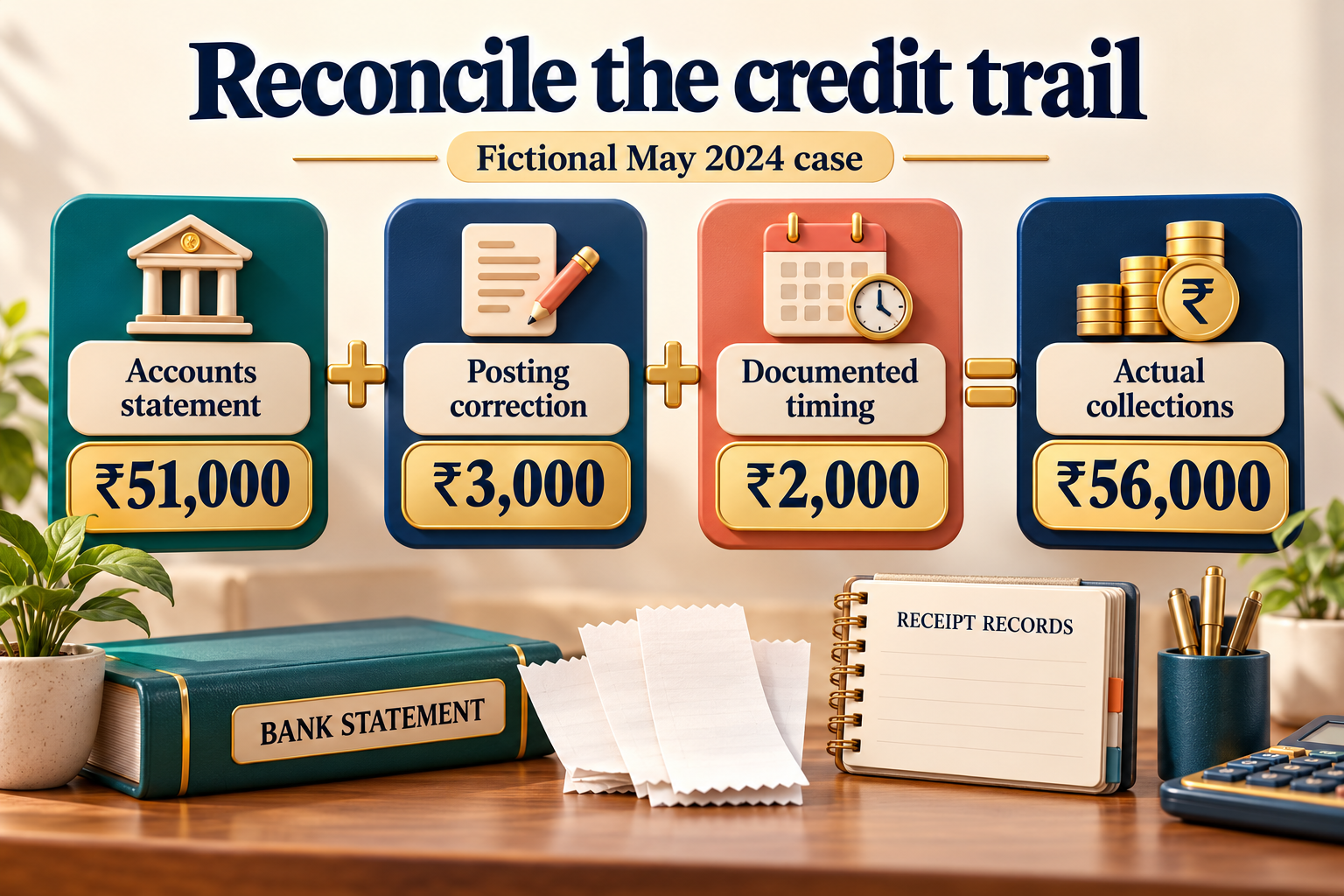
The May credit statement totals ₹51,000:₹12,000 + ₹8,000 + ₹14,000 + ₹9,000 + ₹8,000. The R 505 bank evidence supports ₹11,000, so ₹3,000 is missing from that account-credit record. R 506’s ₹2,000 has a separately evidenced banking timing trail. These two differences have different causes.
| Item | Amount ₹ | Action/evidence |
|---|---|---|
| Actual unique collections | 56,000 | Checked against six receipt records |
| Accounts Officer’s May statement credits | 51,000 | Extract from the monthly statement |
| Difference to explain | 5,000 | 56,000 − 51,000 |
| R 505 account-credit omission | 3,000 | Obtain correction against verified 11,000 bank credit; do not collect 3,000 again from payer |
| R 506 documented timing item | 2,000 | Trace 3 June bank/account treatment under applicable procedures and prevent duplicate credit |
| After correcting R 505, May statement credits | 54,000 | 51,000 + 3,000 |
| Remaining supported timing reconciliation | 2,000 | 54,000 + 2,000 = 56,000 collections |
The workpaper explains a difference; it does not by itself prescribe the formal accounting date or clearing-head entry for money in transit. R 506 is an actual collection, so do not treat it as an unpaid demand merely because bank processing continued into June. Follow the applicable departmental/accounting treatment, retain the dated evidence and check the later credit. Do not credit it twice by treating both the receipt and the subsequent bank advice as independent new receipts.
Equally, an unexplained difference is not automatically proof of theft or a harmless timing item. In this case the bank trail and specific posting omission are supplied. If those documents were missing, identify the unresolved amount and investigate/report as appropriate; do not label it “in transit” merely to close the reconciliation. The loss-reporting lesson 055 considers that distinct issue.
5. Do not convert assessed arrears into realised revenue through suspense
A trainee proposes Dr Suspense ₹12,000 / Cr Revenue ₹12,000 for the closing arrears so that reported collection matches the original demand. No money has been realised for those arrears, and no special rule/order authorises that treatment. Rule 13 does not permit this shortcut. Keep the demand and recovery record, explain why the amount remains outstanding and take the appropriate follow-up action.
This is a different issue from R 506’s already realised collection with a bank-processing trail. The rule’s distinction is actual realisation and authorised treatment, not the simplistic rule “anything absent from a bank statement can never be revenue”. Nor does an apparent commercial accrual entry from earlier bookkeeping lessons override the Government-accounting rules.
6. Work the related revenue controls
| Topic | Source-defined responsibility | Original conditional example |
|---|---|---|
| Rent of buildings/land, Rule 15 | For rentable buildings maintained by a civil department other than CPWD, the Administrator/Head of Department is responsible for due recovery; the assessment/recovery of hired-out building rent is generally regulated by rules applicable to buildings under CPWD’s direct charge; detailed departmental regulations govern the demand/recovery procedure | An unpaid rent demand needs the actual assessment and departmental recovery procedure; do not infer a rate from this lesson. |
| Fines, Rule 16 | Authority imposing/realising fines ensures realisation, checking and deposit; refunding authority checks against duplicate refunds and refunds of sums not actually deposited | Before refunding a collected fine 1,500, verify its payment/deposit and any earlier refund, not just a fresh request letter. |
| Miscellaneous demands, Rule 17 | Accounts Officers watch realisation of specified demands outside ordinary revenue administration, including contributions towards establishment charges | Track a contractor contribution separately with its demand and receipt evidence; do not assume it is automatically collectible without the underlying authority. |
| Remission/abandonment, Rule 18 | A revenue claim requires competent sanction before remission or abandonment | An aged 8,000 demand is not erased merely because a clerk considers recovery inconvenient. |
If the ₹1,500 fine was already refunded in full, a second ₹1,500 refund would duplicate it. If it was never actually paid into the treasury/bank, the stated Rule 16 check is not satisfied by an assessment notice alone. These examples illustrate controls, not the legal power to impose or remit a particular fine.
7. Preserve the precise Department of Posts exception
Under Rule 19(1), subject to general/special orders, Central Government departments, Administrators and Heads of Departments other than those in the Department of Posts submit the described annual statement on 1 June to the Audit and Accounts Officers for the preceding year. The statement concerns the specified discretionary remissions and abandonments sanctioned otherwise than by law or a rule having the force of law. Individual remissions below ₹1,000 need not be included. The exclusion is below, not ₹1,000 and below.
The Department of Posts exception concerns this annual-statement requirement. It does not remove Rule 18’s need for competent sanction, erase receipt controls or prove that the Department has no separate reporting instructions. The actual postal procedure must be retrieved when that topic is taught. Rule 19(2) calls for broad classification by grounds, totals for each class and a brief explanation of the circumstances. Rule 20 permits the specified departments/administrators to define remissions and abandonments for that purpose.
For an independent non-Do P example within Rule 19’s stated scope, discretionary individual remissions ₹900, ₹1,000 and ₹1,400 are sanctioned in the preceding year. The ₹900 item is within the below ₹1,000 exclusion; the other two total ₹2,400 for inclusion, subject to applicable orders and classification by their grounds. Do not apply this numerical example automatically to a Do P annual statement.
8. Graded practice with full solutions
Practice A: demand control
Question. Opening arrears ₹6,500; valid new demands ₹40,000; competent remission ₹1,500; unique collections ₹36,000. Find closing arrears.
Solution. ₹6,500 + ₹40,000 − ₹1,500 − ₹36,000 = ₹9,000. The remission and the collection both reduce the outstanding demand, but only ₹36,000 is money collected. Do not call the ₹37,500 combined reduction “cash receipts”.
Practice B: correct the return before reconciling
Question. Unique receipts total ₹27,500. A return shows ₹29,500 after duplicating one ₹2,000 reference. Account credits are ₹26,000, with a fully supported ₹1,500 timing item. What is the correct reconciliation?
Solution. Remove the duplicate ₹2,000 from the return: actual collections ₹27,500. Then ₹26,000 account credits + ₹1,500 supported timing item = ₹27,500. The original ₹3,500 apparent difference combines a return error and a timing item; it is not wholly money missing from the bank.
Practice C: apparent irrecoverability
Question. An officer believes a ₹7,000 demand cannot be recovered and deletes it without obtaining an order. Is an old age analysis enough?
Solution. No. Rule 12 requires sufficient reasons for outstanding dues and competent orders for adjustment where they appear irrecoverable; Rule 18 controls remission/abandonment. Preserve the demand and supporting recovery evidence while seeking the applicable competent decision. Age alone is neither sanction nor a write-off power.
Practice D: the ₹1,000 boundary
Question. In a covered non-Do P Rule 19 statement, otherwise qualifying individual remissions are ₹999, ₹1,000 and ₹1,001. Which may be excluded solely by the stated monetary proviso?
Solution. Only ₹999 is below ₹1,000. The ₹1,000 and ₹1,001 items total ₹2,001 and are not excluded by that proviso. Other applicable scope/orders still need checking. The boundary does not give power to sanction the remissions.
Practice E: no receipt, no special authority
Question. A ₹5,000 fee has been assessed but remains unpaid. No authorising exception exists. The office wants to debit suspense and credit revenue to improve its collection report. Decide.
Solution. Do not make the proposed revenue credit. Rule 13 requires the stated actual-realisation sequence unless specially authorised. Continue the assessment/recovery record and report the unpaid amount honestly. A collection target does not create money or an exception.
Practice F: a fund-classification question
Question. An officer receives a deposit in official capacity which falls within Rule 8’s specified class, rather than Government revenue. A trainee classifies it as fee revenue solely because the office collected it. What should be checked?
Solution. Apply Rule 8’s Public Account direction for that class and identify the appropriate head and withdrawal treatment under the relevant accounting/payment rules and orders. The collector’s identity alone does not convert a deposit into revenue. The case does not supply a numeric head code, so none should be invented.
9. Explained objective practice
MCQ A. Meridian’s correct closing arrears are: (a) ₹10,000; (b) ₹12,000; (c) ₹14,000; (d) ₹5,000. Answer: (b). Total demands ₹70,000 less authorised remission ₹2,000 and unique collections ₹56,000. Option (a) uses the duplicated return; (c) ignores remission; (d) is the collection-to-account-credit difference, not arrears.
MCQ B. Rule 19’s express Do P exception means: (a) no competent remission sanction is needed; (b) all receipts may remain outside Government Account; (c) the specified annual statement excludes those authorities, without removing the underlying controls; (d) ₹1,000 remissions may always be omitted by every department. Answer: (c). The other options extend the exception beyond its text or misstate the monetary boundary.
10. Written model and summary
Model answer. Meridian’s unique May collections are ₹56,000, not the duplicated ₹58,000 return. Against demands ₹70,000 and competent remission ₹2,000, closing arrears are ₹12,000. The ₹51,000 Accounts Officer credits differ by ₹5,000:₹3,000 is a supported posting omission and ₹2,000 has a separately evidenced bank-processing trail. Correct the return and omitted credit, trace the later timing item under the applicable procedure, and avoid duplicate recognition. Do not credit unpaid arrears through suspense without special authority. Remission and reporting decisions must preserve Rules 18–20 and the limited Do P statement exception.
Remember. Reconcile references, dates and stages, not just totals. Distinguish demand adjustment from cash collection, actual collection from account-credit timing, and a reporting exception from financial authority.