AAO Lesson 060: Reconcile expenditure returns across DDO and Accounts records
AAO · Lesson 060 · English
Reconcile expenditure returns across DDO and Accounts records
Study time: about 155 minutes including practice. Prerequisites: AAO-052, AAO-053, AAO-057, AAO-059.
Learning outcomes
- Apply the distribution, year and section boundaries of grants and appropriations.
- Build and reconcile a monthly multi-office expenditure control workpaper without counting adjustments twice.
- Identify the prescribed forms, return checks and monthly/quarterly certification deadlines under Rule 57.
1. Reconciliation is a controlled chain, not a final plug
Expenditure control depends on accurate office records, complete monthly returns, properly placed Accounts adjustments and agreement with the Accounts Officer’s books. Adding every figure received from every office can count the same adjustment twice. Ignoring a difference because the overall grant appears large enough is equally unsafe.
This lesson develops the full selected Rule 57 workflow, supported by Rule 56 and the verified GFR Forms 5–9. The fictional control tables below simplify the prescribed forms for learning; they are not replicas or substitutes for the full forms. The detailed TR 28-A form is not separately taught: only the bill-register duties expressly stated in Rule 57(5)(i) are applied. No native spreadsheet, PFMS or Government-system execution is claimed.
2. Establish the grant and year boundaries first
Under Rule 56, after the Appropriation Bill is passed, the Finance Ministry communicates the provision to Ministries/Departments, which distribute it to subordinate formations and communicate the distribution to the respective Pay and Accounts Officers. The PAOs check against the allocation to each subordinate authority. A total shown centrally does not by itself prove that every office has that amount at its disposal.
Rule 57(1) places departmental responsibility for expenditure control through Heads of Departments, Controlling Officers and subordinate Disbursing Officers. Rule 57(2) limits a year’s grant/appropriation to charges, including relevant past-year liabilities, paid during that financial year and adjusted in its accounts; charges cannot be authorised against it after the year expires. Do not confuse this with the separate technical procedure and timetable for authorised account adjustments.
Rule 57(3) bars expenditure that would exceed Parliament’s authorised total except after obtaining the stated supplementary grant/appropriation or Contingency Fund advance. Voted and charged portions, and revenue and capital sections, are distinct; re-appropriation between them is not permitted. An excess in one cannot be hidden by an unused balance in another.
For example, if voted revenue provision is ₹500,000 and expenditure ₹510,000, while voted capital provision is ₹200,000 and expenditure ₹180,000, the combined expenditure ₹690,000 is below ₹700,000. Nevertheless, the revenue section has a ₹10,000 excess. The ₹20,000 capital balance does not erase it. The case does not authorise a transfer or supply the necessary additional authority.
3. Match each register to its purpose
| Record | Main purpose | Important boundary |
|---|---|---|
| TR 28-A bill register | Record bills presented; note cheques received and/or verified e-payment status, match cheque amounts to bill net amounts, and note PAO retrenchments | The full form layout is outside this lesson; presentation is not proof of payment. |
| GFR 5 | DDO expense register by the relevant heads; show allotment, monthly/progressive expenditure and advised adjustments | Maintain the required separate registers; identify charged amounts distinctly. |
| GFR 6 | Controlling Officer’s broadsheet watching receipt of DDO accounts | It tracks arrival/reminders, not a new expenditure total. |
| GFR 7 | Compile DDO totals, the Controller’s own figures and Accounts adjustments not already reckoned by DDOs | The last category must not duplicate adjustments already in DDO returns. |
| GFR 8 | Head of Department’s consolidated expenditure account against the grant/appropriation | Keep required classifications, including revenue/capital and voted/charged, distinct. |
| GFR 9 | Watch receipt of the prescribed monthly returns and pursue defaults | Use the prescribed dates and reminder control, including the stated Secretariat-proper returns. |
Rule 57(4)(i) also requires charged and voted bills separately, complete classification from Major Head through Object Head, accurate allocation where a bill covers more than one Object Head, and the progressive total under the relevant primary unit including the bill itself. If prior expenditure is ₹62,000 and the current bill is ₹8,000, the inclusive progressive figure is ₹70,000, not ₹62,000.
Form 5’s notes require changes in allotment to be reflected, charged allotment to be distinct and the account to be dispatched on the third day of the following month. The source’s physical red-ink note does not authorise this lesson to invent an electronic-system edit method. Rule 57 permits physical or electronic registers; use the applicable authorised implementation and retain the change trail.
4. Original case: three offices and two adjustment routes
The fictional Cedar controlling unit prepares its May 2024 workpaper. All selected amounts belong to one grant’s voted-revenue section under the supplied valid classifications. Four separately controlled allocations total ₹600,000. No re-appropriation is assumed. The case omits statutory deductions so that its stated paid-bill amounts and related expenditure amounts coincide; do not generalise that simplification to every Government bill.
| Control allocation | Allocation ₹ | April progressive expenditure ₹ |
|---|---|---|
| DDO A | 250,000 | 120,000 |
| DDO B | 180,000 | 80,000 |
| Head Office own spending | 100,000 | 30,000 |
| Separately provided central-adjustment unit | 70,000 | 0 |
| Total | 600,000 | 230,000 |
DDO A’s May bill register contains A 1 ₹30,000, A 2 presented at ₹25,000 and A 3 ₹15,000. The PAO passes A 2 at ₹24,500 after a supported ₹500 retrenchment. Verified payments therefore total ₹69,500, not the ₹70,000 presented total. The bill register must retain the retrenchment note. A separate ₹4,000 book adjustment was communicated directly to A and is already included in A’s submitted return; the controlling officer must not add it again.
A’s initial May GFR 5 return incorrectly uses ₹70,000 for bills plus the ₹4,000 adjustment, or ₹74,000. Correcting the retrenchment gives ₹73,500. The PAO extract also totals ₹73,500, comprising ₹69,500 bill expenditure plus ₹4,000 book adjustment. Compare the bill-related figures separately from the adjustment and then establish the complete agreed total.
| Office/item | Submitted or initially recorded ₹ | Verified treatment ₹ |
|---|---|---|
| A bill A 1 | 30,000 | 30,000 |
| A bill A 2 | 25,000 presented | 24,500 passed; retain ₹500 retrenchment note |
| A bill A 3 | 15,000 | 15,000 |
| A bills subtotal | 70,000 | 69,500 |
| A direct Accounts adjustment | 4,000 already included | 4,000 counted once |
| A complete May return | 74,000 | 73,500 |
| B paid-bill return | 50,000 | 50,000 initially; add the separately advised ₹3,000 when properly communicated |
| B PAO extract | 53,000 | 50,000 bill expenditure + 3,000 book adjustment |
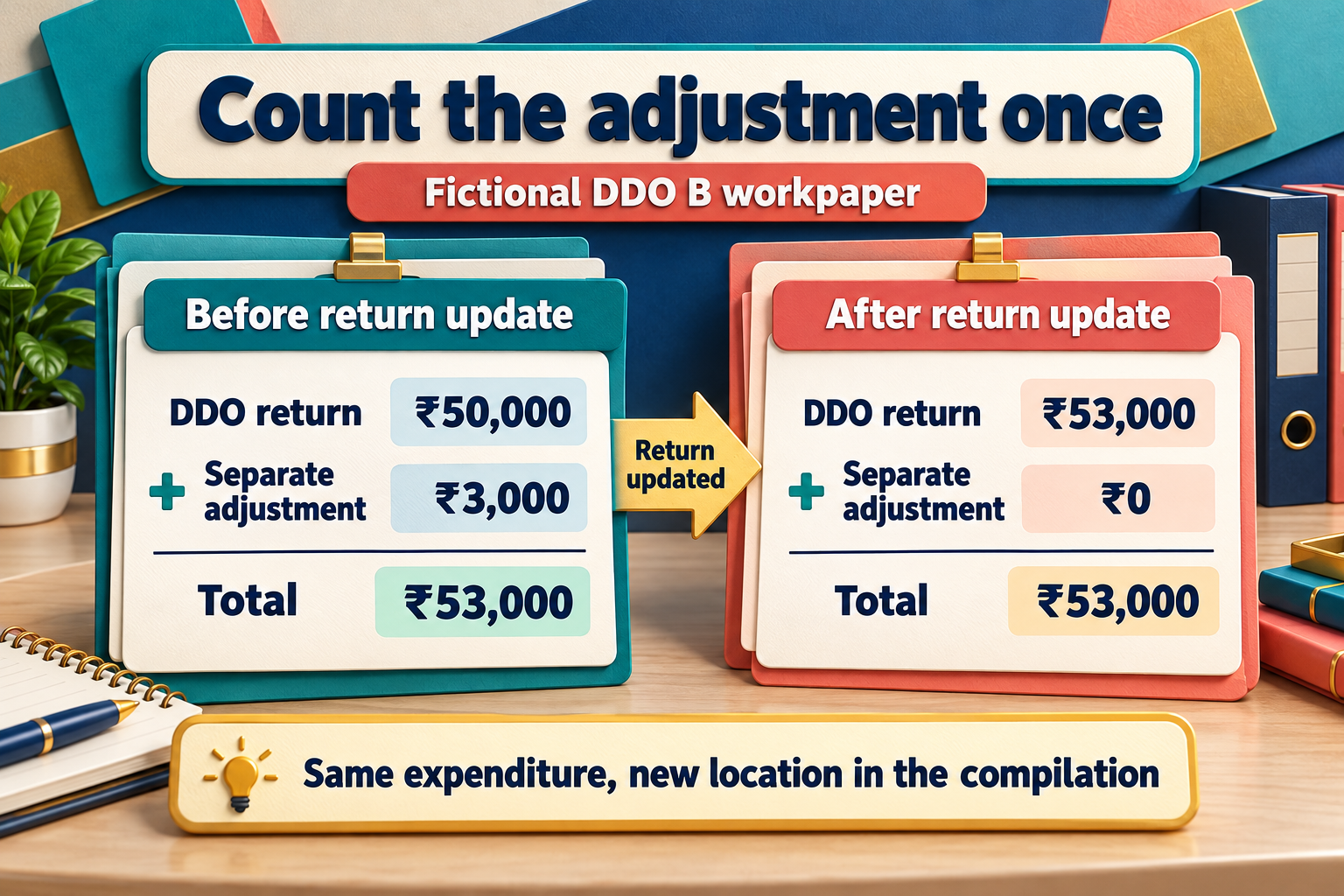
DDO B initially reports ₹50,000 of paid bills and has not yet reckoned a ₹3,000 book adjustment that the Accounts Officer communicated to the Controller. Because it affects B’s allocation, Rule 57(4)(vii) requires the Controller to communicate it to B. B then records the advised adjustment in the appropriate register and reconciles to ₹53,000. Before B’s updated return is received, the Controller can identify the ₹3,000 as an adjustment not yet reckoned by the DDO; after that update, it must move out of the separately added category.
Head Office’s own May expenditure is ₹20,000. A further ₹6,000 Accounts adjustment belongs to the separately provided central-adjustment unit and has not been reckoned by either DDO or in the Head Office’s ₹20,000. Its classification and authority are stipulated as valid. It is therefore separately incorporated once in the compilation.
5. Prove the compilation both before and after the return update
| Component | Before B updates its return ₹ | After B updates its return ₹ |
|---|---|---|
| A corrected return, including its ₹4,000 adjustment | 73,500 | 73,500 |
| B return | 50,000 | 53,000 |
| Head Office own figures | 20,000 | 20,000 |
| B adjustment not yet reckoned by B | 3,000 | 0 |
| Other central adjustment not elsewhere reckoned | 6,000 | 6,000 |
| May total | 152,500 | 152,500 |
The two correct views agree. Moving B’s ₹3,000 into its updated return changes the location of that amount in the compilation, not the overall expenditure. A’s ₹4,000 never belongs in the unreckoned-adjustment addition because A already included it. A separate proof is: paid bills ₹69,500 + ₹50,000 + ₹20,000 = ₹139,500; all three distinct book adjustments ₹4,000 + ₹3,000 + ₹6,000 = ₹13,000; complete expenditure = ₹152,500.
A flawed compilation instead adds A’s wrong ₹74,000, B’s ₹50,000, Head Office’s ₹20,000 and all ₹13,000 of Accounts adjustments. It reaches ₹157,000. The ₹4,500 overstatement consists of the ₹500 uncorrected retrenchment and the duplicated ₹4,000 adjustment. A balancing entry of − ₹4,500 would conceal two different errors. Correct the affected source figures and adjustment classification, then rebuild the total.
| Control allocation | May expenditure ₹ | April–May progressive ₹ | Available allocation balance ₹ |
|---|---|---|---|
| DDO A | 73,500 | 193,500 | 56,500 |
| DDO B | 53,000 | 133,000 | 47,000 |
| Head Office own spending | 20,000 | 50,000 | 50,000 |
| Central-adjustment unit | 6,000 | 6,000 | 64,000 |
| Total | 152,500 | 382,500 | 217,500 |
The total check is ₹230,000 opening progressive expenditure + ₹152,500 May = ₹382,500. Allocation less progressive expenditure gives ₹217,500. That balance is a control result on the stated case; it does not certify that all of it is free of future liabilities or available for any new purpose. Detailed liability-register duties under Rule 58 and later excess/surrender provisions remain for subsequent study.
6. Carry every return check through the chain
Under Rule 57(4)(iii), the DDO’s third-day return includes relevant inward-claim adjustments communicated directly by the PAO to the DDO rather than the Grant Controlling Officer. If there are no entries, send a nil statement. No paid bills is not the same as no entries when an advised adjustment exists.
The Controller records return receipt in GFR 6 and checks classification, progressive expenditure, available balance, grant limits and DDO signatures under Rule 57(4)(v). Defects must be rectified. After returns are complete and in order, the Controlling Officer compiles GFR 7 from the required sources and communicates adjustments affecting subordinate allocations. Upon receipt of all necessary returns, the Head of Department prepares the complete GFR 8 consolidated account. These are not interchangeable names for the same spreadsheet.
Rule 57(5) gives the Head of Department and Accounts Officer joint responsibility for monthly reconciliation. The PAO furnishes monthly expenditure extracts to each DDO, including cheque-drawing DDOs; May-to-March statements also carry progressive figures. DDOs compare the non-book-adjustment figures with their GFR 5 expenditure, investigate discrepancies with the PAO, enter advised book adjustments and furnish their agreement certificate by the stated deadline. A certificate of agreement must follow actual agreement, not simply the arrival of a deadline.
The Principal Accounts Officer, or the PAO where the rule’s whole-grant condition applies, sends the Ministry’s expenditure-versus-budget statement to the responsible Heads of Departments. Those figures are compared with GFR 8, differences are reconciled and the Head of Department furnishes the quarterly correctness certificate. Keep the DDO’s monthly certificate distinct from the Head of Department’s quarterly one.
7. Use the right date for the right step
| Requirement | Source | Date or trigger on the stated calendar |
|---|---|---|
| DDO dispatch of May account/return, including a nil statement where appropriate | 57(4)(iii); Form 5 Note 3 | 3 June 2024 |
| Reminder for DDO account not received | Form 6 Note 2 | If not received by 7 June 2024 |
| Department obtains May departmental figures in GFR 8 | 57(6) | By 15 June 2024 |
| DDO agreement certificate for May account | 57(5)(iii) | By 30 June 2024 |
| HoD quarterly correctness certificate for April–June | 57(5)(iv) | By 15 August 2024 |
| Watch receipt/defaults and pursue reminders | 57(8); Form 9 | Against each applicable prescribed due date; no single substitute deadline |
The third-day dispatch and seventh-day receipt/reminder test are different. Likewise, the Department’s fifteenth-day collection of figures does not wait until every DDO’s month-end agreement certificate deadline. Rule 57(6) permits subsequent corrections through plus/minus entries in progressive totals, preserving the record rather than silently overwriting it.
That sub-rule also states that, if the Accounts Office figures subsequently available are higher than departmental figures, the Accounts Office figures are assumed correct because appropriation accounts are based on booked figures. Apply that control direction while investigating and reconciling the discrepancy. It is not permission to ignore errors or sign an agreement certificate while known differences remain.
For example, departmental progressive expenditure ₹212,000 versus Accounts figures ₹219,000 leaves a ₹7,000 difference. Do not continue controlling the grant only against the lower amount to display extra headroom. Use the rule’s higher-booked-figure direction and pursue the evidence that explains or properly corrects the difference.
8. Add physical progress and exception follow-through
Rule 57(7) requires physical-progress statements for schemes, showing the scheme name, provision, progressive expenditure, physical progress and detailed reasons for financial/physical shortfalls or excesses. Rule 57(8) requires the GFR 9 broadsheet to watch the returns and address defaults.
If a separate illustrative scheme has a ₹600,000 provision, ₹382,500 expenditure and 40 completed units against 100 planned, financial utilisation is 63.75% while physical progress is 40%. The gap is a reason to examine timing, cost structure, quality and other evidence. It does not alone prove waste or success; front-loaded costs or a genuine delivery problem must be established from facts, not assumed to make the percentages agree.
9. Graded practice with complete solutions
Practice A: an adjustment already in the return
Question. A DDO return totals ₹48,000, including a ₹3,000 Accounts adjustment. The Controller has ₹12,000 own expenditure and a separate ₹2,000 adjustment not reckoned elsewhere. Find the correct compilation.
Solution. ₹48,000 + ₹12,000 + ₹2,000 = ₹62,000. Do not add the ₹3,000 again. If it were also added, the result ₹65,000 would overstate expenditure by ₹3,000.
Practice B: a return update changes location, not total
Question. A DDO initially reports ₹30,000; the Controller separately adds an advised ₹4,000 not yet reckoned by that DDO. The updated DDO return is ₹34,000. What must change in the compilation?
Solution. Use the updated ₹34,000 return and remove the separate ₹4,000 addition. Both proper views total ₹34,000. Keeping both would incorrectly give ₹38,000.
Practice C: presented versus passed bill
Question. A bill without other deductions is presented for ₹18,000, but the PAO passes ₹17,200 after a supported ₹800 retrenchment. What does the case require in the bill/expense control?
Solution. Preserve the ₹800 retrenchment note and the verified ₹17,200 passed/payment amount, then reconcile the related expenditure accordingly. Do not treat the full ₹18,000 presentation as proof of payment. Real bills with other deductions require their own gross/net analysis; this case expressly excludes them.
Practice D: the section boundary
Question. Revenue provision/expenditure are ₹300,000/₹306,000; capital provision/expenditure are ₹100,000/₹88,000. Is the ₹394,000 combined expenditure enough to show that no excess exists?
Solution. No. Combined provision is ₹400,000, but revenue has a ₹6,000 excess. Capital has ₹12,000 unused. Rule 57(3) does not permit inter-section re-appropriation to hide that excess. Obtain the appropriate authority/route rather than relying on the combined balance.
Practice E: separate the monthly and quarterly dates
Question. For July 2024 accounts, identify the DDO dispatch date, the monthly DDO agreement-certificate deadline, and the HoD quarterly certificate deadline for July–September.
Solution. Dispatch on 3 August 2024; monthly agreement certificate by 31 August 2024; quarterly certificate by 15 November 2024. These apply the stated source intervals, with no assumed holiday adjustment. The separate Form 6 reminder test is triggered if the account is not received by 7 August.
Practice F: no bills but an adjustment
Question. A DDO has no paid bills during a month but receives a valid advised ₹5,000 book adjustment affecting its allocation. May it send a nil statement merely because no bill was paid?
Solution. No. The advised adjustment is a relevant entry that must be accounted for and reconciled under the rule. A nil statement is for a month with no entries, not every month without paid bills. Ensure the Controller includes the adjustment exactly once.
10. Explained objective practice
MCQ A. What explains Cedar’s flawed ₹157,000 versus correct ₹152,500 May compilation? (a) Only the ₹3,000 B adjustment; (b) the ₹500 retrenchment error plus the duplicated ₹4,000 A adjustment; (c) omitting Head Office’s ₹20,000; (d) replacing May with April’s progressive total. Answer: (b). Those two errors total ₹4,500. Correct their distinct sources instead of entering an unexplained balancing figure.
MCQ B. Which statement matches the return controls? (a) GFR 6 is the consolidated expenditure account; (b) the DDO’s third-day return can wait until its month-end agreement certificate; (c) GFR 7 adds Accounts adjustments not already reckoned by DDOs; (d) an available capital balance automatically cures a revenue excess. Answer: (c). The other choices confuse the form, deadline or section boundary.
11. Written model and summary
Model answer. Correct A’s bill expenditure for the supported ₹500 retrenchment, retain its already included ₹4,000 adjustment once, and incorporate B’s ₹3,000 and the central ₹6,000 adjustment only where not already reckoned. May expenditure is ₹152,500 and April–May progressive expenditure ₹382,500, leaving ₹217,500 against the supplied ₹600,000 allocations. Track return arrival, classification, signatures and dates through the proper forms; reconcile with Accounts before certifying agreement. Grant/section boundaries and physical-progress evidence remain separate control checks.
Remember. Trace each amount to one place, update the source records, keep the correct progressive totals and use the correct return date. A compilation that balances without an evidence trail is not a completed reconciliation.