AAO Lesson 063: Identify genuine savings and act before year-end
AAO · Lesson 063 · English
Identify genuine savings and act before year-end
Study time: about 130 minutes including practice. Prerequisites: AAO-052, AAO-061, AAO-062.
Learning outcomes
- Derive genuine expected savings after outstanding commitments and remaining evidenced requirements.
- Distinguish forecast, surrender proposal, accepted surrender, and year-end lapse.
- Diagnose avoidable year-end spending while preserving valid obligations and prescribed expenditure plans.
1. Saving public money does not mean hiding obligations
A saving is a supported expectation that part of the provision will not be needed, not merely the difference between allotment and payments so far. Valid unpaid obligations and remaining requirements must be considered. Equally, provision should not be retained for speculative future excesses or exhausted on unnecessary purchases just to improve a spending percentage.
Lesson 061 built the commitment and forecast evidence. This lesson makes a different decision from that evidence: when a genuine saving is foreseen, what must be reported and surrendered, what does acceptance mean for the control record, and what happens to funds left unused at the close of the year? It uses every part of GFR Rule 62 without inventing a universal surrender deadline or quarterly spending percentage.
2. Preserve all four parts of Rule 62
| Provision | Selected requirement | Question to answer in the file |
|---|---|---|
| 62(1) | Departments surrender anticipated savings in their controlled Grants/Appropriations to the Finance Ministry by its prescribed dates before year-end. The Ministry communicates acceptance of accepted surrenders to Accounts before year-end. Unutilised funds lapse at the year close. | What was proposed, what was accepted, and what communication actually reached Accounts? |
| 62(2) | Savings and provision that cannot be profitably used are surrendered immediately when foreseen, without waiting for year-end. Savings are not held in reserve for possible future excesses. | Is the retained amount an evidenced requirement or only an unsupported contingency? |
| 62(3) | Avoid rush of expenditure, particularly in the closing months, as a breach of financial propriety. FAs ensure the stipulated Monthly Expenditure Plan and Budget Division guidelines are followed. | Does timing follow genuine need and the applicable plan, or an attempt to consume the balance? |
| 62(4) | FAs ensure adherence to the stipulated Quarterly Expenditure Plan and Finance Ministry guidelines. | Which actual dated plan/guideline applies, and is any required change properly dealt with? |
“Immediately when foreseen” and “by prescribed dates” are complementary controls. A Ministry’s final submission date does not give permission to wait until that date after an identifiable saving is already known. The selected rule does not supply one permanent calendar date, a universal March percentage or an automatic relaxation power. Actual yearly instructions and the applicable expenditure plans require separate verification.
Likewise, the source condemns a rush of expenditure; it does not establish that every payment in March is improper. An otherwise valid, due and properly funded bill should be examined on its facts. The test is not simply the name of the month or a desire to keep the reported expenditure low.
3. Original three-unit forecast at 30 November 2024
In fictional FY 2024–25, Cedar’s selected voted-revenue provision is ₹1,500,000. The source treatment remains the AAO examination baseline. The table supplies all relevant expenditure, current-year unpaid commitments and other remaining requirements, with no duplication. Later-year amounts remain valid obligations but are not expected to be paid in this financial year.
| Unit | Provision ₹ | Recorded expenditure ₹ | Current-year unpaid commitments ₹ | Other current-year needs ₹ | Later-year unpaid commitments ₹ | Forecast current-year total ₹ | Expected saving ₹ |
|---|---|---|---|---|---|---|---|
| A | 600,000 | 390,000 | 110,000 | 40,000 | 60,000 | 540,000 | 60,000 |
| B | 500,000 | 280,000 | 50,000 | 50,000 | 40,000 | 380,000 | 120,000 |
| C | 400,000 | 230,000 | 20,000 | 30,000 | 0 | 280,000 | 120,000 |
| Total | 1,500,000 | 900,000 | 180,000 | 120,000 | 100,000 | 1,200,000 | 300,000 |
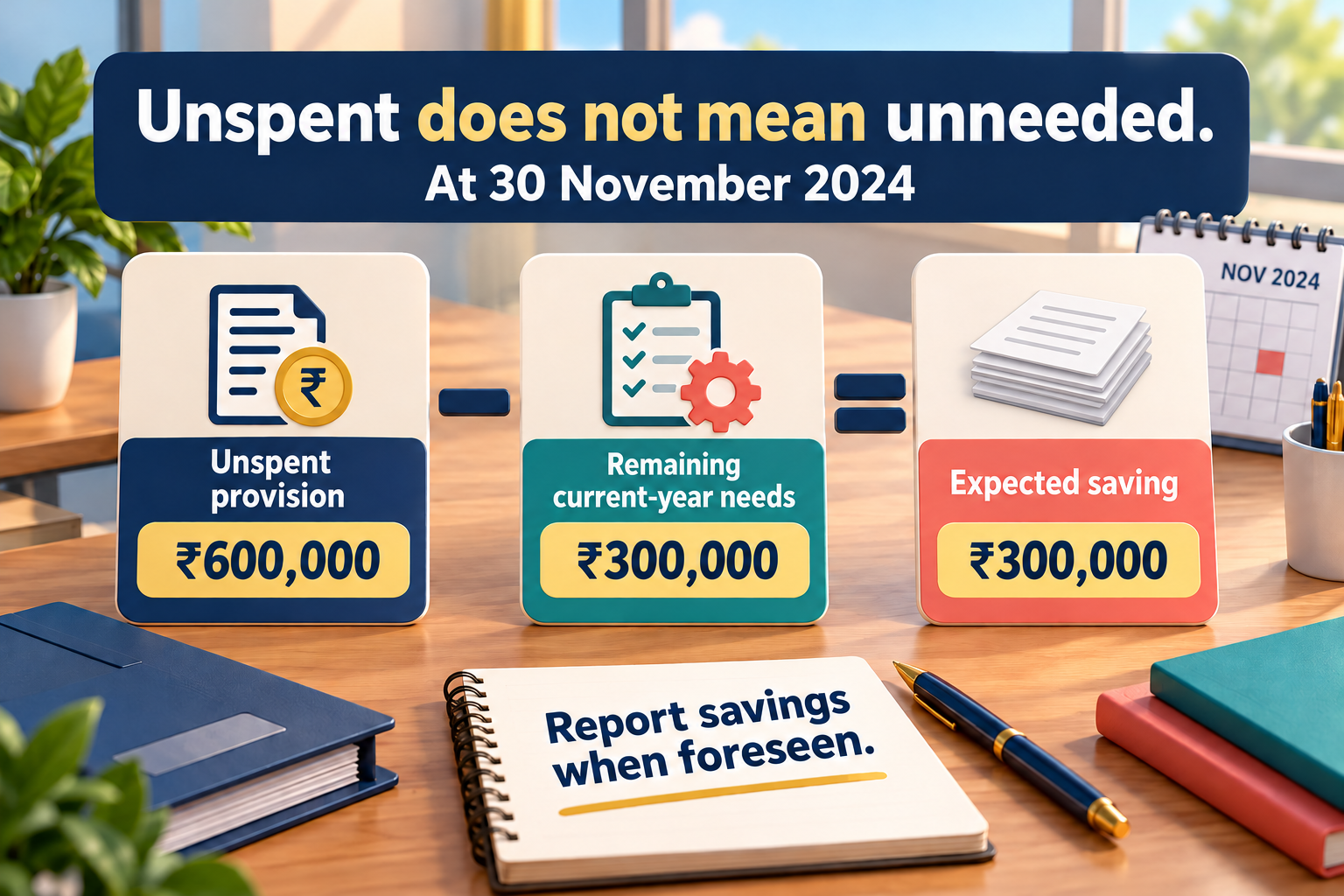
The first rough balance, ₹1,500,000 − ₹900,000 = ₹600,000, is not the expected saving. Of it, ₹300,000 is needed for the supplied current-year unpaid commitments and remaining needs. The supported expected saving is ₹300,000. The ₹100,000 later-year commitment is retained in the commitment record with its proper year; it is not written off because it is excluded from the current-year forecast.
The programme manager suggests retaining ₹80,000 of the saving “in case an unrelated unit needs something later”. No identified liability, supported requirement or competent funding proposal is supplied. That is the kind of reserve for possible future excess that Rule 62(2) does not permit. If a real need arises, examine it with current evidence through the applicable funding route; do not invent a requirement to preserve a balance.
Another suggestion is to order ₹100,000 of unnecessary equipment that cannot be usefully deployed, solely to reduce the reported saving. This would not become proper merely because a financial-year balance exists. It also introduces a classification and procurement issue that cannot be cured by calling the expenditure “urgent”. The correct response is to report the saving and follow the competent process, not to turn it into avoidable expenditure.
4. Track a revised proposal through acceptance
The office prepares a ₹300,000 surrender proposal from the 30 November evidence. Before acceptance, new reliable evidence on 3 December establishes another ₹30,000 current-year requirement in Unit A that was absent from the earlier file. It is otherwise valid, not already paid and not duplicated in any existing forecast. The forecast is revised immediately; the earlier amount is not defended merely because a document has been drafted.
| Date in the fictional case | Evidence/action | Forecast or control amount ₹ | What the stage establishes |
|---|---|---|---|
| 30 November | Complete forecast and initial expected saving | Forecast 1,200,000; saving 300,000 | Evidence for prompt surrender action |
| 3 December | New supported current-year requirement in A | Forecast 1,230,000; saving 270,000 | Revise the proposed saving by 30,000 |
| 4 December | Corrected proposal sent through the prescribed channel | Proposed surrender 270,000 | A proposal, not a claim that acceptance already occurred |
| 20 December | Finance Ministry accepts the supplied 270,000 surrender | Accepted surrender 270,000 | Record the actual acceptance |
| 22 December | Acceptance communicated to Accounts | Provision after accepted surrender 1,230,000 | Reconcile the control record to the accepted, communicated change |
| 12 March | Further 10,000 genuine saving becomes known | Forecast 1,220,000 | Prompt further surrender action; do not wait for lapse |
| 20 March / 21 March | Further 10,000 accepted and communicated before year-end | Cumulative surrender 280,000; remaining provision 1,220,000 | Record both stages and the cumulative position |
For the March example, assume the applicable fictional submission timetable allows the prompt 12 March proposal. That is a case assumption, not a prescribed nationwide deadline. The final current-year expenditure is stipulated to be ₹1,220,000. Total accepted surrender is ₹270,000 + ₹10,000 = ₹280,000, and ₹1,500,000 − ₹280,000 = ₹1,220,000. The final expenditure exactly matches the remaining provision.
The proposal and acceptance columns must not be collapsed. Before the required action occurs, the record should not say “accepted” or invent a Ministry communication. At the same time, an unprocessed proposal is not an excuse to spend the identified saving on a needless item. The forecast and the formal provision record serve related but different purposes.
If a further genuine requirement emerges, update the forecast and seek the applicable decision. Do not erase an accepted surrender or assume surrendered funds can be restored by an internal spreadsheet entry. Any subsequent funding action needs its own valid authority, timing and restrictions.
5. Understand lapse without using it as a delay strategy
In a separate final-outturn variation, suppose cumulative accepted surrender remains ₹280,000, but actual expenditure unexpectedly finishes at ₹1,215,000. Remaining provision is ₹1,220,000, leaving ₹5,000 unused at the year close. Under Rule 62(1), unutilised funds lapse at that close. This does not create a personal reserve, a bank balance available for next-year spending or an automatic addition to next year’s grant.
If the ₹5,000 saving had been foreseeable earlier, Rule 62(2) still required prompt surrender action rather than deliberately waiting for lapse. The variation isolates an unexpected final difference; it does not excuse withholding a known saving.
Nor does lapse extinguish a valid unpaid obligation. Suppose an otherwise valid ₹12,000 supplier liability remains unpaid at year-end. Its existence and the need for appropriate later-year provision and authority must be examined separately. One cannot delete the creditor’s claim because a budget allocation has lapsed, or charge a later payment against an expired provision simply to make the previous forecast appear exact. The case does not prescribe a legal limitation period or a settlement decision.
6. Diagnose year-end pressure with evidence
Consider three files received in March. File 1 contains an accepted, due ₹45,000 bill for services actually completed, with valid sanction, correct classification and available provision. File 2 proposes an advance ₹45,000 payment solely because the year is closing; no permissible advance terms or authority are supplied. File 3 proposes buying ₹45,000 of supplies despite adequate existing stock and no supported additional need.
The identical amounts and month do not make the cases identical. File 1 requires ordinary timely examination and payment controls. File 2 cannot acquire advance-payment authority from a spending target. File 3 needs a genuine requirement and proper procurement basis; consuming provision is not itself a useful purpose. Avoid inferring misconduct from these short files, but identify precisely what evidence or authority is missing.
Monthly and quarterly plans add another control layer. If the supplied March plan is ₹80,000 and supported March payments are ₹70,000, the ₹10,000 numerical difference does not authorise extra purchases. If legitimate March requirements are ₹95,000, the ₹15,000 plan difference must be addressed under the actual applicable instructions; the lesson does not invent a power to waive the plan or mechanically reject all otherwise valid liabilities.
7. Graded practice with complete solutions
Practice A: unspent is not unneeded
Question. Provision is ₹800,000, recorded expenditure ₹470,000, current-year unpaid commitments ₹160,000 and other non-overlapping current-year needs ₹90,000. Derive the expected saving.
Solution. Unspent provision is ₹330,000. Remaining current-year needs total ₹250,000. Forecast expenditure is ₹720,000 and expected saving ₹80,000. Reporting ₹330,000 as saving would ignore ₹250,000 of evidenced requirements.
Practice B: protect a valid unpaid obligation
Question. A manager calls ₹100,000 a saving because its bill has not yet been paid. Evidence shows the valid obligation is expected to be paid this year and it is absent from all other forecast lines. What correction is needed?
Solution. Include ₹100,000 once in the remaining current-year requirement and reduce the previously overstated saving by ₹100,000. Non-payment so far is not evidence that provision is unneeded. Verify timing and do not add the liability again if another line already contains it.
Practice C: later-year commitment
Question. A valid ₹70,000 commitment is supported as payable next year, not this year. May it be deleted from the register to support this year’s surrender proposal?
Solution. No. Keep the ₹70,000 obligation and correct year-wise timing. It is outside this year’s payment forecast on the supplied facts but remains relevant to next-year planning. Forecast classification and extinction of a liability are different decisions.
Practice D: spending a plan balance
Question. A fictional March plan is ₹200,000 and supported expenditure is ₹175,000. A clerk recommends ₹25,000 of unwanted stationery to hit the plan exactly. Assess.
Solution. The arithmetic gap is ₹25,000, but it supplies no need or procurement authority. Rule 62’s propriety and surrender principles do not make a plan a compulsory spending target. Examine the saving and applicable plan/reporting duties rather than create avoidable expenditure.
Practice E: holding a reserve
Question. Of ₹90,000 supported expected savings, an office proposes surrendering ₹60,000 and holding ₹30,000 against unspecified possible excesses. No actual requirement supports the retained amount. Explain.
Solution. Rule 62(2) does not permit holding savings in reserve for possible future excesses. The supplied facts support ₹90,000, not ₹60,000, as the saving for prompt competent surrender action. A later real requirement must be evidenced and addressed through the proper process.
Practice F: closing provision and lapse
Question. Original provision is ₹500,000, accepted surrender ₹80,000 and final expenditure ₹390,000. Calculate unused provision. Does it automatically add to next year’s allotment?
Solution. Provision after surrender is ₹420,000. Unused amount is ₹30,000. It lapses at the year close under the selected rule; it is not an automatic next-year allotment. If it was anticipated earlier, the prompt surrender duty also mattered. These figures do not decide whether any separate unpaid liability exists.
8. Explained objective practice
MCQ A. What is the main case’s saving before the 3 December new evidence? (a) ₹600,000 because that is unspent; (b) ₹200,000 after charging the next-year ₹100,000 to this year; (c) ₹300,000 after all supplied current-year needs; (d) ₹220,000 after retaining an unsupported ₹80,000 reserve. Answer: (c). The alternatives respectively ignore remaining needs, misplace later-year commitments, and retain a reserve that the facts do not justify.
MCQ B. A clear saving is identified well before the Ministry’s final surrender date. Which action best fits Rule 62? (a) Wait for the final date to preserve flexibility; (b) initiate the prescribed surrender action promptly and track actual acceptance/communication; (c) convert it into an advance without checking authority; (d) treat the proposal as an accepted surrender before any response. Answer: (b). It preserves both immediacy and documentary accuracy. The other choices delay a known saving, invent spending authority or misstate the stage of the process.
9. Written model and summary
Model answer. Cedar’s initial ₹600,000 unspent balance includes ₹300,000 of evidenced remaining current-year needs, leaving ₹300,000 expected savings. New evidence reduces that saving to ₹270,000 before acceptance, so the proposal is corrected. The later ₹10,000 saving is acted on promptly, giving cumulative accepted surrender ₹280,000 and final provision ₹1,220,000. Rule 62 requires timely surrender of foreseen savings, proper acceptance communication and avoidance of year-end rush. It does not permit retaining an unsupported reserve or making unnecessary purchases to consume provision. Any unused amount at the close lapses, while a valid unpaid obligation requires separate treatment.
Remember. Separate unspent, unneeded, proposed, accepted and lapsed amounts. Support requirements, update forecasts, follow the actual timetable and plans, and never use a spending percentage as a substitute for purpose and authority.