AAO Lesson 066: Identify New Service and prepare its approval case
AAO · Lesson 066 · English
Identify New Service and prepare its approval case
Study time: about 150 minutes including practice. Prerequisites: AAO-057, AAO-064, AAO-065.
Learning outcomes
- Classify supplied new-policy and capital-work facts using the dated pre-cutoff source.
- Apply verified boundary conditions without equating savings with Parliamentary authority.
- Prepare the purpose, alternatives, year-wise cost and requested-decision evidence for an original proposal.
1. Begin with the policy change, not the amount
A proposal may fit within an overall grant and still require Parliamentary action. GFR Rule 63 directs attention to New Service (NS) and New Instrument of Service (NIS). These concepts protect Parliament’s control over the purposes for which public money is used, not merely the arithmetic size of a Ministry’s total.
The dated source for this lesson is the Department of Economic Affairs (DEA) OM of 23 February 2024, read with its 18 March and 2 May 2024 clarifications. These instruments fall before the course’s 19 June 2024 cutoff. Their reproduction in a later Budget Circular is a source of the dated text, not permission to adopt that later circular wholesale. The older limits reproduced in the December 2023 GFR compilation have been superseded for this subject.
NS means expenditure arising from a new policy decision not previously brought to Parliament’s notice, including a new activity or a new form of investment. NIS concerns relatively large expenditure from important expansion of an existing activity. The definitions guide the application of the monetary tables. A fresh invoice is not automatically a new policy; an old programme title does not prove that a new activity was already before Parliament.
2. Ask three different questions
| Question | Evidence to obtain | What the answer establishes |
|---|---|---|
| What is changing? | Earlier policy/Parliamentary presentation and the actual new activity or expansion | Whether NS, NIS, an exception or a doubtful classification needs examination |
| Which dated financial category applies? | Relevant object head, original primary-unit appropriation and the proposed augmentation | Reporting or prior-approval route under the applicable table, with its conditions |
| How will the proposal be lawfully funded and implemented? | Eligible savings, sanction/delegation, approvals, year-wise costs and implementation evidence | Whether a proposed funding route can actually be used; classification alone is insufficient |
Keep these questions separate. A ₹12 crore new non-capital service does not escape prior approval merely because it is below ₹50 crore. The special ₹50 crore/₹100 crore bands apply to specified new works under the Capital section. Conversely, a small routine administrative purchase is not NS merely because it is being bought for the first time by one office.
The February OM applies to all Ministries, expressly including Railways, Defence and the Department of Posts. The object head is the primary unit of appropriation. For civil Ministries, the relevant original appropriation is at the 15-digit line; for non-civil Ministries, the final appropriation unit in the Detailed Demand is used. Lesson 067 develops the NIS calculation and the separate delegated-power tests.
3. The special New Service capital-work bands
Annexure A requires prior Parliamentary approval for all new services other than the specified new works under the Capital section. For that capital-work category, it lists six object heads: Machinery and Equipment; ICT Equipment; Buildings and Structures; Infrastructural Assets; Arms and Ammunitions; and Land. Classification and the actual substance must agree; a label on a proposal cannot manufacture an exception.
| Proposed augmentation | Selected NS financial-band result | Qualification |
|---|---|---|
| 50.00 | Does not exceed the lower reporting boundary in this table | This is not a blanket spending permission; other authority and funding conditions remain |
| 50.01 | Reporting category: above 50 and not exceeding 100 | Requires sufficient savings within the same section for the stated re-appropriation route |
| 75.00 | Reporting category | Same-section savings and all other applicable conditions must be established |
| 100.00 | Reporting category, because the upper boundary is inclusive | Do not convert “not exceeding” into “less than” |
| 100.01 | Prior Parliamentary approval category | Savings do not remove the prior-approval requirement |
| 12.00 for a new non-capital service | Prior Parliamentary approval category | The special Capital-work bands do not apply |
The row at exactly ₹50 crore means that this particular reporting band is not triggered. It does not settle whether the proposal meets the definition, whether another instruction applies, or whether the officer has power to authorise the expenditure. The same restraint applies to every threshold answer.
For the reporting category, paragraph 7(i) permits re-appropriation where sufficient savings exist within the same section, subject to reporting to Parliament. Ordinarily report through the ensuing supplementary batch; if that is not possible, add an annexure to the ensuing year’s Detailed Demands. A suitable explanation may also appear in the Notes on Demands where possible. Merely showing a higher Revised Estimate does not supply the necessary authority.
The 18 March clarification reiterates these bands and gives a specific transition for FY 2023–24 after its final supplementary batch. That historical transition is not a permanent date rule for every future year. Nor should the broad statement about prior approval be read in isolation so as to erase the expressly provided reporting category.
4. Original case: a new assisted-access service
The fictional Cedar Ministry proposes an Assisted Records Access Service that has not previously been brought to Parliament’s notice. It is a genuinely new non-capital service, not routine administration or expansion of an already approved activity. The case expressly assumes a voted Revenue classification; classification of a real proposal would require its actual records. The planned life is three financial years. All amounts below are in ₹ crore.
| Component | Year 1 | Year 2 | Year 3 | Total |
|---|---|---|---|---|
| Recurring service delivery | 4 | 7 | 8 | 19 |
| One-off non-capital launch and transition work | 2 | 1 | 0 | 3 |
| Total outlay | 6 | 8 | 8 | 22 |
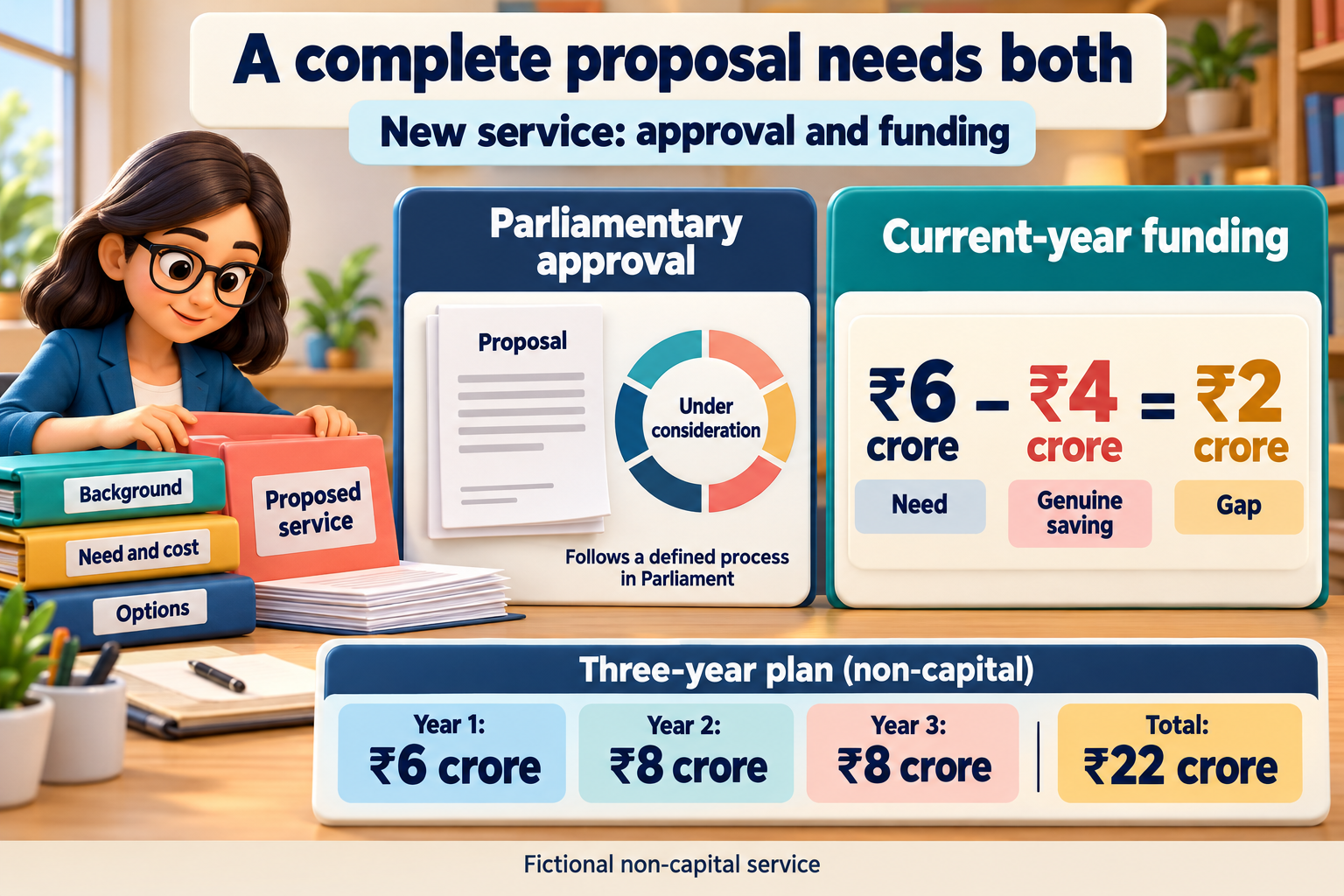
“One-off” does not by itself mean Capital. The launch items here are expressly assumed to be properly classified non-capital services, rather than asset acquisition. The total proposal is ₹22 crore, with ₹6 crore required in the current year. Neither the ₹6 crore current requirement nor the ₹22 crore overall cost takes this new non-capital service into the special Capital-work band. Prior Parliamentary approval is required under the selected NS category.
The file initially points to ₹5 crore of expected savings in the same Revenue-voted section. Of this, ₹1 crore remains needed for evidenced current-year obligations. The genuine available saving is therefore ₹4 crore. A further ₹3 crore is forecast under Capital-voted; it cannot be treated as an ordinary same-section donor. The current Revenue proposal still has a ₹2 crore cash funding gap after the identified ₹4 crore source.
| Item | ₹ crore | Treatment |
|---|---|---|
| Current-year proposal | 6 | Current funding requirement, not the whole three-year cost |
| Initially claimed same-section saving | 5 | Must be tested against remaining obligations |
| Obligations still needing funding within that amount | 1 | Deduct before declaring a saving |
| Evidenced same-section saving | 4 | Possible source subject to the actual authority and restrictions |
| Current-year cash gap | 2 | 6 − 4; supplementary proposal must explain it |
| Separate Capital-voted saving | 3 | Not added to the same-section source in this workpaper |
| Later-year requirement | 16 | 8 + 8; disclose future commitment, do not claim it funded now |
The result is a proposal for a Parliamentary route and funding decisions, not a sanction created by this lesson. A ₹4 crore internal source plus a ₹2 crore cash gap does not mean the Ministry may first spend ₹4 crore on the NS and seek approval only for the gap. The NS approval requirement and the source of funds must both be addressed.
5. Build the memorandum instead of submitting a bare total
Annexure II to Appendix 3 provides the memorandum structure. The table below is an original evidence checklist organised around that structure. “Not applicable” should be reasoned from the proposal, not used to hide a missing estimate.
| Required area | Original application in this case |
|---|---|
| Title, description and objectives | Define the new assisted-access service, beneficiaries and the specific access problem |
| Justification and alternatives | Compare using existing counters, a phased assisted model and a fully separate network; record costs, reach and service limitations rather than assert one is best |
| Implementation and timetable | Name the actual proposed executing agency, phases, measurable targets and completion date; do not presume agency approval |
| Nature and full financial implications | State the selected scheme category; show recurring 19, one-off 3, total 22 and the 6/8/8 year-wise phasing |
| Allocation and current provision | Explain absent current provision for this new service, the evidenced 4 same-section saving and 2 current gap |
| Foreign exchange; grant, loan or subsidy terms | State and justify that these are absent under the supplied case; if the design changes, supply component amounts and terms |
| Staff, works, stores and equipment | No new posts or Capital works are assumed here; verify staffing and delivery through existing arrangements, and disclose any real equipment or works requirement if found |
| Expected results and economic implications | Specify measurable service targets and evaluation evidence; a spending figure is not an outcome |
| Consultations and further information | Record NITI Aayog comments where relevant to a scheme and actual inter-departmental consultations, including unresolved issues |
| Decision points | Separate scheme/policy approval, the Parliamentary funding route, current-year additional provision and any implementing sanctions required |
A proper options analysis does not have to prove a predetermined answer. Suppose using existing counters costs less but fails to cover remote applicants. The note should identify the coverage evidence and any phased alternative rather than simply describe the cheapest option as economical. Conversely, an attractive new delivery model needs evidence of its incremental benefit and realistic cost.
6. Controls, exceptions and urgent cases
The Integrated Finance Division/Budget Unit must record the specified attracts/does-not-attract certificate when considering augmentation. PAOs examine each expenditure sanction from the NS/NIS angle. A PAO with doubt seeks the relevant Financial Adviser’s decision. Where Integrated Finance and the PAO disagree, a self-contained reference with the FA’s views goes to the Budget Division; the February OM makes its decision final for that reference.
Normal Government activities may fall outside these limits, including the illustrative administrative activities in paragraph 8. Transfers to State/UT Governments are exempt from these limits if the scheme is not new. The limits apply to voted expenditure. These exclusions concern NS/NIS limits; they do not remove the applicable appropriation, sanction, classification or other control requirements.
During a vote-on-account period its provision is not intended for NS expenditure. If urgency makes waiting impossible, the stated route is an advance from the Contingency Fund, with resumption on enactment of the whole-year Appropriation Act. More generally, the February OM prefers supplementary approval while Parliament is in session and confines recourse to the Fund then to extreme urgency. It describes a Ministerial statement to the Lok Sabha as far as possible before withdrawal, or soon afterwards where emergency prevents advance information, with the suggested corresponding Rajya Sabha procedure. Lesson 069 examines the actual Fund application and resumption rules.
Neither “urgent” nor “funds available” is a substitute for the competent process. This is an examination classification and memorandum exercise, not permission to draw from a Government fund.
7. Graded practice with complete solutions
Practice A: classify before testing the band
Question. A genuinely new voted non-capital service has a current requirement of ₹3 crore and eligible same-section savings of ₹5 crore. Is the surplus saving enough to dispense with prior Parliamentary approval?
Solution. No. The selected NS category requires prior approval for this new service. Savings address funding, not that approval condition. The workpaper shows no additional cash gap, but it must still propose the applicable Parliamentary route and other approvals.
Practice B: boundary and authority
Question. Three independent specified new Capital works require augmentations of ₹50 crore, ₹100 crore and ₹100.20 crore. Assume sufficient savings in the same section. State the NS band, without claiming a spending sanction.
Solution. Exactly 50 does not cross this table’s lower reporting boundary. Exactly 100 is in the reporting category. 100.20 is above 100 and therefore in the prior-approval category. All still need their applicable sanction, delegation, classification and lawful funding conditions.
Practice C: repair the cost schedule
Question. A new non-capital service costs 9, 12 and 10 crore over three years. Current recurring cost is 6 crore and one-off cost 3 crore. The claimed 8 crore same-section saving contains 2 crore of unmet obligations. Calculate total outlay, genuine saving and current cash gap.
Solution. Total outlay is 31 crore. Current cost is 9 crore. Genuine saving is 8 − 2 = 6 crore; the current gap is 9 − 6 = 3 crore. Disclose the remaining 22 crore in future years. The NS approval condition survives regardless of that calculation.
Practice D: a classification dispute
Question. Integrated Finance calls a proposal normal administration; the PAO identifies a possible new policy activity. What should the file contain and where does disagreement go?
Solution. Supply the actual policy change, earlier Parliamentary disclosure, object-head facts, amount and reasons for both views. The PAO seeks the FA’s decision on doubt. If disagreement remains between Integrated Finance and PAO, send a self-contained reference incorporating FA views to DEA Budget Division under paragraph 10. Do not solve the dispute by relabelling the invoice.
Practice E: reporting is a real duty
Question. A qualifying ₹80 crore new Capital-work augmentation has same-section savings and all required re-appropriation authority. The office merely inserts 80 crore in Revised Estimates. Has that completed the NS reporting requirement?
Solution. No. The reporting category entails the stated Parliamentary reporting process, ordinarily the ensuing supplementary batch, failing that an annexure to the ensuing year’s Detailed Demands. A Revised Estimate alone is insufficient. Confirm the actual dated reporting instructions rather than applying the FY 2023–24 transition to every year.
Practice F: distinguish a new scheme transfer
Question. Two voted transfers to a State Government are proposed. One continues an existing scheme; the other introduces a genuinely new scheme. Can both be declared exempt solely because the recipient is a State?
Solution. No. Paragraph 8(ii)’s exemption is conditional on the scheme not being new. The existing-scheme transfer can use that exclusion if the facts support it; the new scheme must be assessed under the definition and applicable route. Other financial authorities remain necessary in either case.
8. Explained objective checks
MCQ A. Cedar’s current cash gap is: (a) ₹1 crore, using the entire claimed saving; (b) ₹2 crore, after protecting the ₹1 crore obligations; (c) zero, by combining Capital and Revenue savings as an ordinary transfer; (d) ₹18 crore, deducting current savings from all three years. Answer: (b). Current need 6 less genuine same-section saving 4 gives 2. Option (a) ignores obligations; (c) ignores section restrictions and process; (d) confuses the current funding question with the whole-life disclosure.
MCQ B. Which memorandum is most decision-ready? (a) A total cost with a statement that funds exist somewhere in the grant; (b) only the first year’s cost because future costs are outside the current appropriation; (c) purpose, alternatives, implementation, full recurring/one-off and year-wise costs, current source/gap and separate decisions required; (d) a favourable performance forecast without the implementation or consultation record. Answer: (c). It connects policy, evidence, phasing and authority. The alternatives omit information needed to evaluate the proposal and its future consequences.
9. Model written answer and summary
Cedar proposes a new non-capital service not previously brought before Parliament. Under the 23 February 2024 NS guidelines, read with the pre-cutoff clarifications, it requires prior Parliamentary approval; the special new Capital-work bands do not apply. The proposed three-year outlay is ₹22 crore, comprising ₹19 crore recurring and ₹3 crore one-off expenditure, phased ₹6 crore, ₹8 crore and ₹8 crore. Of the claimed ₹5 crore current Revenue-voted saving, ₹1 crore remains committed, leaving ₹4 crore and a ₹2 crore current cash gap. Separate Capital-voted savings cannot be treated as an ordinary same-section source. The memorandum should explain objectives, alternatives, implementation, consultations, full financial implications and the separate approval/funding decisions sought. Until the applicable Parliamentary and competent financial processes are completed, the workpaper itself supplies no expenditure authority.
Remember: establish the policy change; select the dated category; test the exact boundary; preserve reporting or prior approval; and document a credible, year-wise funding proposal. Neither a small amount, a saving nor a Revised Estimate answers all five questions.