AAO Lesson 067: Test expansion proposals against the NIS line-item rules
AAO · Lesson 067 · English
Test expansion proposals against the NIS line-item rules
Study time: about 150 minutes including practice. Prerequisites: AAO-066.
Learning outcomes
- Identify the correct original-appropriation base and object-head category.
- Distinguish the NS/NIS Parliamentary route from the separate April re-appropriation reporting test.
- Evaluate boundary, exception and uncertain cases with documented reasons.
1. Expansion needs the right base
New Instrument of Service (NIS) concerns relatively large expenditure arising from important expansion of an existing activity. Unlike a simple “new item” label, this definition asks what the activity already was and how materially it is expanding. Lesson 066 covered genuinely new policy services. This lesson assumes the supplied cases are important expansions of existing activities and teaches the next task: choosing the correct line, original base and Parliamentary route.
Use the DEA OM of 23 February 2024 with its 18 March and 2 May 2024 clarifications. The limits are tied to the original appropriation at the 15-digit primary-unit line for civil Ministries, or the final unit in the Detailed Demand for a non-civil Ministry. A Ministry’s total grant, a later Revised Estimate and a similarly named object head under another line are not substitutes for that base.
All crore figures in this lesson are fictional. The cases do not certify any real office’s delegated authority. The source’s reporting category, prior Parliamentary approval category and separate re-appropriation powers must each be addressed.
2. Read the twelve-head table as a conditional rule
| Object-head code in the March clarification | Object head |
|---|---|
| 54 | Investments |
| 55 | Loans and Advances |
| 33 | Subsidies |
| 52 | Machinery and Equipment |
| 71 | Information, Computer, Telecommunications (ICT) equipment |
| 72 | Buildings and Structures |
| 73 | Infrastructural Assets |
| 75 | Arms and Ammunitions (Capital) |
| 78 | Land |
| 35 | Grants for creation of Capital Assets |
| 31 | Grants-in-aid General |
| 36 | Grants-in-aid Salaries |
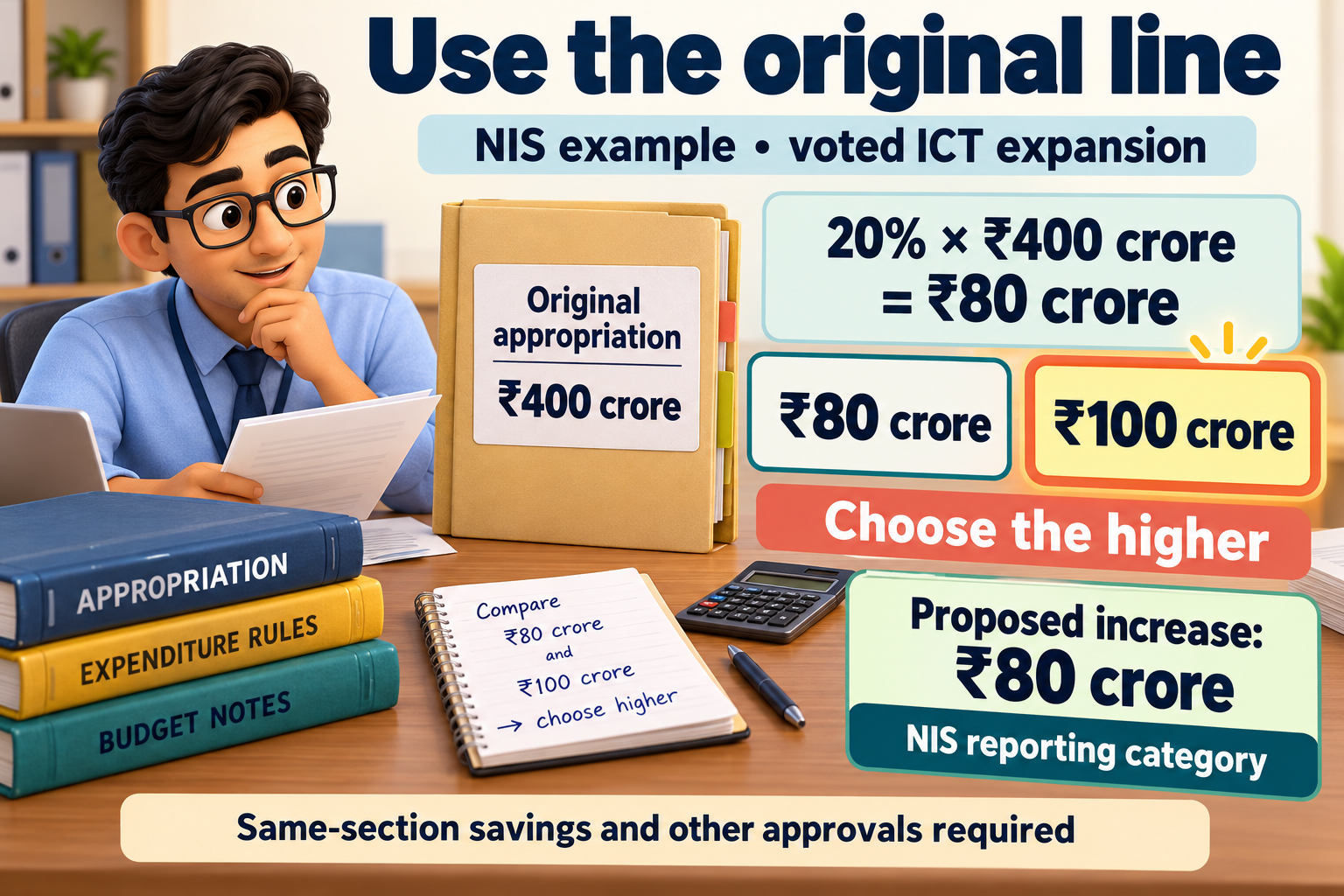
For these heads, compare the proposed augmentation with the higher of 20% of the original appropriation and ₹100 crore. Up to that higher amount falls in the reporting column; above it falls in the prior Parliamentary approval column. Both columns carry the condition about savings within the same section of the grant for the stated route. Do not read “OR” as permission to choose whichever threshold gives the desired answer.
Other object heads are to be decided on their merits using the definitions and the OM. Annexure B also identifies normal establishment categories and other case-specific treatment. This lesson does not replace the whole object-head matrix with the twelve-head formula. For example, a heading outside this list is not automatically exempt, and an expenditure described as routine still needs facts supporting that characterisation.
Write the test in three stages: first compute 20% of the correct original line; then select the larger of that figure and 100 crore; finally compare the augmentation, not the whole revised provision. Equality belongs to the reporting band. An amount just above the boundary belongs to prior approval.
3. Original case: distinguish two ICT lines
Cedar’s voted Capital section contains two separate 15-digit primary-unit lines with the same ICT object head. Their earlier digits identify different authorised activities. The case labels them Line A and Line B rather than inventing official account codes. A third charged line is shown only to prevent an invalid combined calculation. These are supplied classification facts, not a decision that all ICT expenditure has the same treatment.
| Line | Original appropriation | Proposed augmentation | 20% of original | Higher threshold | Selected result |
|---|---|---|---|---|---|
| A: voted ICT, important expansion | 400 | 80 | 80 | 100 | Reporting category |
| B: voted ICT, different existing activity | 800 | 160 | 160 | 160 | Reporting category at equality |
| B variation: independent alternative | 800 | 160.01 | 160 | 160 | Prior Parliamentary approval |
| C: charged ICT, separate appropriation | 200 | 20 | Not used for this voted NIS-limit test | Not applicable here | The OM limits apply to voted expenditure; other charged authorities remain |
Assume the voted cases have sufficient genuine savings within the same section. For A, 20% of 400 is 80, but the larger threshold is 100. The proposed 80 is in the reporting category. The resulting line provision would be 480, but 480 is not the augmentation being compared. Nor should 20% be recalculated on 480.
For B, 20% of 800 is 160, which exceeds the floor of 100. An augmentation of exactly 160 is reporting; the independent alternative of 160.01 crosses into prior approval. The two B rows are alternatives, not successive approvals to be added together.
The same object-head name does not merge A and B into a 1,200 crore base. The May clarification confirms assessment at the 15-digit primary-unit level whether lines fall within the same minor head or different minor heads, subject to general restrictions and delegated powers. Likewise, charged and voted appropriations are assessed separately. Exclusion from the voted NS/NIS limits does not authorise a transfer between charged and voted sections or waive any other control.
4. A second test is not a second name for the same test
Lesson 065 taught the 1 April 2024 re-appropriation OM’s separate Parliamentary reporting trigger: above the higher of 20% of Budget Estimates at the relevant primary unit and ₹100 crore. Its function differs from the February/March NIS table, whose reporting category is up to the higher amount and whose above-threshold category requires prior Parliamentary approval. An order may require consideration under both instruments.
| Original line/BE assumed identical | Augmentation | NIS test under February/March | April reporting trigger considered alone | Authority conclusion |
|---|---|---|---|---|
| 400 | 80 | Up to 100: reporting | 80 does not exceed 100 | Neither test supplies the competent sanction or delegated power |
| 800 | 160 | Up to 160: reporting | Equality does not exceed 160 | Other approvals and restrictions still apply |
| 800 | 160.01 | Above 160: prior Parliamentary approval | Above 160: reporting trigger crossed | Do not use later reporting as a substitute for the NIS prior approval |
| 700 | 120 | Up to 140: reporting | 120 does not exceed 140 | A large order may still exceed the separate delegated ceiling |
The final row demonstrates why “below the Parliamentary threshold” is an incomplete answer. A 120 crore augmentation may fit the NIS reporting column yet exceed the separately applicable delegated limit. The Ministry must obtain the required competent financial approval under the actual delegation and restrictions. This lesson does not infer a power from the threshold calculation.
The April OM also has conditions concerning orders after the last supplementary batch. As taught in Lesson 065, its phrase about such an order must remain tied to the qualifying order in its context. Do not invent a rule that every tiny late-year adjustment independently crosses that paragraph’s reporting threshold.
5. Build a classification and reporting record
Suppose Line A’s proposal file contains only “ICT expansion: 80 crore; original grant 2,000 crore; within 20%.” The arithmetic may be correct on 2,000, but the base is wrong. Repair the reasoning, not just the percentage label. Retrieve the approved original Line A appropriation of 400, preserve its full primary-unit identity, identify the activity expansion and document the 100 crore higher threshold.
| Field | Supported entry |
|---|---|
| Nature | Important expansion of the existing activity, with the earlier authorised scope attached |
| Classification | Voted Capital, ICT equipment, distinct Line A at primary-unit level |
| Original base | 400 crore, verified against the original appropriation for that line |
| Augmentation and resulting provision | 80 crore augmentation; 480 crore resulting provision |
| NIS comparison | 20% × 400 = 80; higher of 80 and 100 = 100; 80 is within reporting category |
| Same-section source | Attach evidenced savings and identify the donor lines; no cross-section assumption |
| Other authority | Check restrictions, delegation and any required Finance Ministry approval separately |
| Control and reporting | Record IFD/Budget certificate, PAO examination and the prescribed Parliamentary report route |
The IFD/Budget Unit certificate should state the actual classification conclusion and its basis. A bare tick in an “NS/NIS not applicable” box is inconsistent with these stipulated expansion facts. PAO examination remains a separate safeguard; unresolved disagreement follows the FA and Budget Division route explained in Lesson 066.
For a qualifying reporting case, the February OM provides ordinary reporting through the ensuing supplementary batch, failing which an annexure to the ensuing year’s Detailed Demands. The March OM’s FY 2023–24 transition is a dated instruction. A report should preserve the scheme/programme, appropriation unit/object head, relevant BE, amount of re-appropriation and explanatory remarks. Merely including a revised amount in estimates does not establish completion.
6. Diagnose common but plausible errors
| Error | Why it changes the conclusion | Repair |
|---|---|---|
| Use the total grant as the denominator | Combines unlike lines and can greatly inflate the threshold | Trace the original appropriation at the correct primary unit |
| Use the revised provision after augmentation | Moves the goalpost in response to the proposal being tested | Retain the original appropriation base required by the source |
| Treat exactly the higher limit as prior approval | Reverses the inclusive up-to boundary | Apply reporting at equality, with all stated conditions |
| Treat every other object head as exempt | The source directs merits-based assessment and supplies a broader matrix | Read the applicable row and actual definition |
| Treat NIS reporting as adequate for any order | Ignores delegation, donor restrictions and other approval conditions | Make the separate authority and funding checks |
| Combine charged and voted values | Uses a base Parliament approved in distinct sections | Keep the separate appropriations and applicable controls distinct |
Do not split a known proposal into artificial pieces to make the comparison look smaller. The actual expansion and proposed augmentation must be faithfully presented. This lesson does not invent an aggregation formula beyond the verified source; where staged proposals make the proper treatment uncertain, present the full facts for the competent interpretation rather than claiming that several small labels settle it.
One narrow source issue remains deliberately outside our examples. The 2 May clarification discusses Salaries-to-Allowances interchange, notes competing readings and asks DoE for a further decision. It does not supply an unqualified final answer to that corner. Keep it open until an applicable further decision is verified. It does not affect the ICT cases here or turn the separate Salaries-to-Office-Expenses restriction into an exemption.
7. Graded practice with complete solutions
Practice A: floor versus percentage
Question. A qualifying listed-head expansion has original appropriation 250 crore and augmentation 70 crore, with sufficient same-section savings. Compute the NIS threshold and band.
Solution. 20% × 250 = 50 crore. The higher of 50 and 100 is 100. The 70 crore augmentation is within the reporting category. Its 28% of the original base does not by itself put it in prior approval, because the higher monetary floor controls.
Practice B: the larger percentage controls
Question. Original appropriation is 900 crore. Compare independent augmentations of 180 and 181 crore.
Solution. 20% × 900 = 180 crore, greater than 100. At 180 the case is in the reporting band; at 181 it crosses into prior Parliamentary approval. The sufficient same-section savings assumption and other authority checks remain.
Practice C: wrong revised base
Question. An original 600 crore line is proposed to rise by 125 crore. An officer applies 20% to 725 and claims a 145 crore boundary. Diagnose the error.
Solution. The original base is 600, so 20% is 120 and the higher threshold is 120. An augmentation of 125 exceeds it and requires the prior-approval category. Using 725 incorrectly lets the proposal increase its own threshold.
Practice D: separate lines
Question. Two voted lines with the same object head have original provisions 100 and 1,000 crore. The first needs an important expansion of 110 crore. May the office combine them to obtain a 220 crore threshold?
Solution. No. Use the first line’s original appropriation at its primary unit: 20% is 20 and the higher threshold is 100. The 110 crore augmentation crosses it. The same object-head label does not combine distinct primary units into one base.
Practice E: reconcile the two reporting tests
Question. A 500 crore original line/BE receives a qualifying 100 crore augmentation. What do the NIS and April reporting comparisons say, considered separately?
Solution. Both calculations use a higher figure of 100, but their consequences differ. NIS equality belongs to its reporting category. The April test is strictly above the higher amount, so equality does not cross that particular trigger. The NIS reporting obligation is not cancelled by the April result.
Practice F: classification not supplied
Question. A proposed 20 crore expenditure under an object head outside the twelve-head list is described only as “special initiative.” What can be concluded from the amount alone?
Solution. No final NS/NIS classification. Obtain the policy/activity change, earlier approval, exact head and relevant matrix treatment. Other heads are assessed on merits; 20 crore alone proves neither exemption nor permission. Record uncertainty and use the prescribed FA/Budget Division route if necessary.
8. Explained objective checks
MCQ A. For a listed-head expansion, original appropriation is 750 crore and proposed augmentation is 151 crore. Which is correct? (a) Reporting, because 151 is below 20% of the revised 901; (b) prior approval, because 151 exceeds the higher threshold of 150; (c) reporting, because all augmentations over 100 only need a report; (d) prior approval based on the entire revised provision 901. Answer: (b). 20% of the original 750 is 150. The correct comparator is the 151 augmentation. Options (a) and (d) use the wrong base or quantity; (c) reverses the table’s distinction.
MCQ B. What does a correct NIS reporting-band answer establish? (a) That the Ministry has the necessary delegated power for that amount; (b) that same-section savings need not be identified; (c) the applicable Parliamentary category under the stated facts, leaving funding and other authority checks to be satisfied; (d) that inclusion in Revised Estimates completes reporting. Answer: (c). The monetary classification is one control. It does not replace the source, delegation, restrictions or actual reporting evidence.
9. Model written answer and summary
Line A is an important expansion of an existing activity under the listed ICT object head. Its original voted primary-unit appropriation is ₹400 crore and the proposed augmentation is ₹80 crore. Twenty per cent of the original is ₹80 crore; the higher threshold is therefore ₹100 crore. The proposal falls in the NIS reporting category, assuming the stated sufficient savings in the same section. The resulting ₹480 crore provision is not the base for this test. Record the IFD/Budget certificate, PAO examination, donor evidence and the separately necessary competent approvals, and complete the prescribed Parliamentary report. The April re-appropriation reporting test is a different control and does not erase the NIS reporting duty.
Remember: identify the activity, original line, object-head category and augmentation; compute the higher threshold; apply equality correctly; then check funding, delegation and reporting separately.