AAO Lesson 073: Control non-GeM small purchases and prevent splitting
AAO · Lesson 073 · English
Control non-GeM small purchases and prevent splitting
Study time: about 150 minutes including practice. Prerequisites: AAO-071, AAO-072.
Learning outcomes
- Verify the preconditions and dated limits for no-quotation and committee routes.
- Prepare a full purchase-committee evidence record and distinguish it from collecting three quotations.
- Aggregate the actual demand and diagnose attempted threshold avoidance.
1. Establish why the non-GeM route is available
A small value does not by itself justify buying outside GeM. Rule 147/149’s mandatory GeM requirement for available goods/services must be checked first. Rule 155 expressly conditions its purchase-committee route on the item not being available on GeM. This lesson assumes genuine non-availability for each worked case; a real file must establish that fact and retain the prescribed applicable evidence. We have not searched the live portal or generated any actual non-availability record.
The ordinary examination-baseline limits are ₹25,000 for Rule 154 and above ₹25,000 up to ₹2,50,000 for Rule 155. The later 10 July 2024 changes are outside the 19 June 2024 cutoff. Special relaxations for named scientific/research bodies require their own dated scope and conditions, including the pre-cutoff 20 May 2024 instrument; they are not transferred to an ordinary Department of Posts office in these exercises.
Rule 154 allows the specified small purchase without inviting quotations/bids on the competent authority’s prescribed personal-satisfaction certificate. Rule 155 uses a duly constituted Local Purchase Committee (LPC) of three members, at an appropriate level decided by the Head of Department, to survey the market and recommend the appropriate supplier. A three-member committee is not the same as three manufacturers on GeM or a rule that collecting three pieces of paper completes the purchase.
2. Match value, evidence and authority
| Whole relevant purchase value | Rule route | Essential evidence |
|---|---|---|
| ₹25,000 or less on each occasion | Rule 154, if the route is otherwise applicable | Competent authority’s prescribed certificate: requisite quality/specification, reliable supplier and reasonable price |
| Above ₹25,000 through ₹2,50,000 on each occasion | Rule 155, with GeM non-availability and other conditions | Proper three-member LPC, actual market survey, joint certificate and competent purchase decision |
| Above ₹2,50,000 | Not within the ordinary 154/155 monetary routes | Rule 158 bidding methods and the applicable detailed rules, subject to their actual exceptions |
| Artificial pieces of a known larger demand | Do not use separate small invoices to evade the necessary control | Rule 157 requires reference to the estimated total demand for the higher-authority sanction issue |
The certificate is not a ceremonial substitute for evidence. Under Rule 154 the authority must actually be satisfied about the specified facts. Under Rule 155 the members are jointly and individually satisfied about the goods’ quality/specification, prevailing market price, supplier reliability/competence and absence of debarment by DoE or the concerned Ministry/Department. The actual prescribed certificate format should be used where the rule requires it; the teaching workpapers below explain its support rather than replace the official format.
Rule 158 identifies advertised, limited, two-stage and single-tender enquiries and electronic reverse auctions as standard bidding methods outside the 154/155 cases. Its old reference to “Rule 140” is an apparent stale cross-reference in the selected compilation. Do not turn that into goods-purchase authority under a works rule. Use the relevant verified authority and procurement provisions.
Dated special-body contrast. The signed DoE OM of 20 May 2024 supersedes its cited 2021 and 8 January 2024 instruments. For exactly the bodies within its paragraph 2, it permits the Rule 154 route up to ₹1 lakh for any item and the Rule 155 route above ₹1 lakh up to ₹10 lakh, only when the required goods are unavailable on GeM. It does not amend the Rule 149 GeM bands.
The listed scope comprises the Departments of Science and Technology; Biotechnology; Scientific and Industrial Research; Atomic Energy; Space; the Ministry of Earth Sciences; DRDO; ICAR including its affiliated institutions and universities; the Department of Health Research including ICMR; and educational/research institutes conducting postgraduate/doctoral courses or research under a Ministry/Department, within the OM’s stated scope. Merely buying scientific-looking equipment does not make an ordinary postal office an eligible listed body.
Paragraph 4 separately addresses projects executed by State-level institutions or private universities/institutions/organisations even when funded by those listed bodies, and requires the concerned Ministry/Department/organisation to put appropriate financial controls in place. Do not extrapolate the special purchase powers to every funded recipient or assume that funding conditions disappear. The 31 March 2025 date in this OM belongs to its separate Rule 133(3) works relaxation, not a general expiry attached here to the 154/155 amendments. Its reproduced certificate also retains a reference to the Department of Commerce; this apparent stale label is not treated as a transfer of the verified Rule 151 DoE debarment-list authority.
3. Original small purchase: personal satisfaction needs a basis
Cedar needs 62 packs of a specified archive consumable for a genuine bounded requirement. The case expressly assumes the goods are unavailable on GeM and that no larger known demand has been divided. A reliable supplier offers the required packs at an all-inclusive ₹400 each, with acceptable delivery. The actual competent authority and funds are to be checked; they are not created by the example.
Total value is 62 × 400 = ₹24,800, within the ordinary Rule 154 limit. The file should show the requisition, specification/quantity, basis for supplier reliability and price reasonableness, and the competent authority’s actual prescribed certificate. “No quotation required under this route” does not mean “no reason to believe the price reasonable.” Applicable departmental instructions may require further evidence.
If the verified quantity becomes 63 before purchase, the same all-inclusive rate gives ₹25,200. That is above the ordinary Rule 154 ceiling. Do not retain a 24,800 certificate and place the extra pack on a separate 400 invoice to preserve the earlier route. Reassess the complete actual demand and use the applicable process.
4. Original LPC case: reconstruct the total before recommendation
A separate Cedar archive-protection requirement consists of goods expressly assumed unavailable on GeM. The planned items form one documented procurement need rather than separate demands invented for convenience. The duly constituted three-member LPC surveys the market. The following all-inclusive item prices plus the separately stated common delivery amount are supplied for an illustrative compliant offer.
| Item | Quantity | Rate | Extended amount |
|---|---|---|---|
| Archive boxes | 400 | 320 | 128,000 |
| Labelling rolls | 200 | 160 | 32,000 |
| Protective sleeves | 1,000 | 45 | 45,000 |
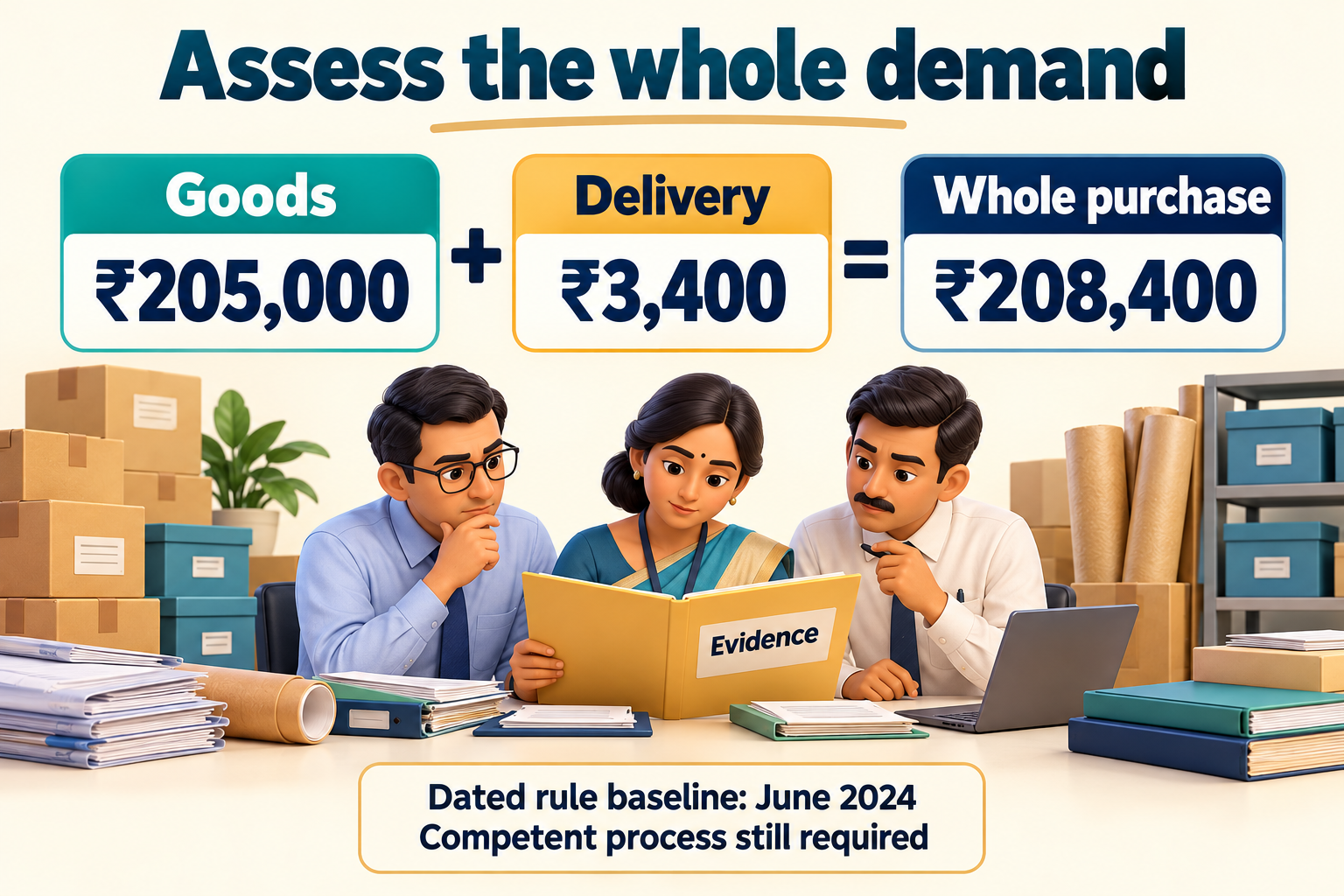
| Common delivery, charged once | 1 | 3,400 | 3,400 |
| Total | 208,400 |
The goods subtotal is ₹205,000; delivery adds ₹3,400 once, giving ₹208,400. This is above ₹25,000 and within ₹2,50,000, so the ordinary Rule 155 band is potentially available under the stated non-availability assumption. The whole total must be used, not only the price of a single box or the cheapest line.
The committee’s market review is broader than a sum. It tests whether the materials meet the actual preservation/size requirements, whether the supplier can deliver in the required period, whether the rate matches relevant market evidence and whether the supplier is reliable, competent and not debarred under the specified sources. Those findings must be genuine; unanimous signatures do not cure a missing check.
| Offer/evidence | Quoted package amount ₹ | Relevant finding | What can be concluded |
|---|---|---|---|
| Supplier A | 208,400 | Required goods and delivery supported; credentials and capacity records supplied for checking | Candidate for reasoned recommendation if all required checks are satisfied |
| Supplier B | 198,000 | Quoted boxes fail the stated essential material specification | Not an equivalent lower-priced compliant package |
| Supplier C | 211,000 | Meets supplied specification and delivery; same included-cost basis | Relevant compliant market comparison, subject to actual verification |
| Independent recent comparable record | 207,800 | Same stipulated quantity/specification/included-cost basis and comparable delivery context | Useful corroboration, not an automatic permissible-price cap |
A is ₹2,600 below C and ₹600 above the independently supplied comparable record. The ₹600 difference is about 0.289% of ₹207,800. That small difference is not a statutory tolerance, safe harbour or proof of reasonableness. The committee must establish the actual comparability and record why the market evidence supports the recommendation. The lesson does not invent an acceptable deviation percentage.
B is ₹10,400 below A but fails the stated requirement. Its lower amount does not make it the appropriate supplier. Do not relax an essential requirement after surveying prices merely to obtain a superficially cheaper result; if the original requirement is itself unjustified, reassess it transparently through the proper process rather than selectively waiving it for one offer.
5. Build the committee’s evidence record
| Condition | Original evidence question |
|---|---|
| Constitution and membership | Where is the actual order constituting the three-member committee at the level decided by the HoD? |
| Need and route | What is the genuine whole demand, value and actual GeM non-availability evidence? |
| Quality and specification | What samples, technical checks or documentary evidence establish the requisite goods? |
| Prevailing market rate | What survey and genuinely comparable included-cost evidence supports the recommendation? |
| Reliability and competence | What verified capacity, past-performance and delivery evidence supports this supplier? |
| Debarment | Were the applicable DoE and Ministry/Department records actually checked? |
| Joint and individual satisfaction | Do all members have a basis for the prescribed certificate, with disagreements resolved rather than hidden? |
| Purchase authority | Does the competent decision and funding record authorise the actual purchase under the applicable rules? |
The HoD’s role in constituting the committee does not mean every purchase recommendation is itself the purchase sanction. Keep constitution, survey, certificate, recommendation and competent decision distinct. If a member cannot support the price or quality conclusion, the appropriate response is further evidence or a revised recommendation, not a signature supplied to avoid delay.
Registration as a supplier is not an all-purpose substitute for this verification. Nor is an old clean debarment check conclusive forever. Lesson 074 studies supplier registration, debarment and integrity more closely; this case requires the actual applicable check without making an unsupported allegation about any real supplier.
6. Detect artificial splitting and scope changes
Rule 157 prohibits dividing a goods demand into small quantities to make piecemeal purchases so as to avoid the higher-authority sanction needed by reference to the total estimated demand. The known demand and purpose matter; the number of invoices alone is not the test.
| Facts | Calculation | Correct reasoning |
|---|---|---|
| A known 96,000 demand is divided into four 24,000 orders solely to avoid the required control | 4 × 24,000 = 96,000 | Treat the known total and actual authority/route; the purpose of division is impermissible |
| The 208,400 LPC proposal gains an essential extra goods requirement of 48,000 before purchase | 208,400 + 48,000 = 256,400 | Reassess the entire 256,400 requirement; it exceeds the ordinary LPC band |
| The same proposal instead removes a genuinely unnecessary 8,000 component with recorded approval | 208,400 − 8,000 = 200,400 | Use the revised actual requirement and evidence; do not describe legitimate scope correction as automatically splitting |
| Two unrelated needs arise at different times with no known combined requirement or avoidance purpose | Facts, not only invoice count, decide | Examine the actual needs and applicable instructions; do not invent a universal annual aggregation rule from 157 |
The 256,400 case exceeds the 250,000 ceiling by ₹6,400. It is not solved by keeping the committee order at ₹250,000 and issuing a separate ₹6,400 purchase. Route and authority should be assessed for the real requirement. Equally, reducing an unjustified feature or cancelling a genuinely unneeded item can be proper economy if the record supports it; the rule does not require buying unnecessary goods to preserve an earlier estimate.
7. Graded practice with complete solutions
Practice A: boundary values
Question. For ordinary eligible non-GeM cases with no special-body exception, classify ₹25,000, ₹25,001, ₹2,50,000 and ₹2,50,001.
Solution. 25,000 is within 154; 25,001 and 2,50,000 are in 155; 2,50,001 lies beyond those ordinary small-purchase bands and needs the applicable bidding route/exception. All other route, authority and evidence conditions remain.
Practice B: rebuild the package total
Question. A package contains 300 units at ₹420 and 200 units at ₹260, plus ₹2,500 delivery once. Calculate the total and ordinary potential band.
Solution. 126,000 + 52,000 + 2,500 = ₹180,500. This lies in 155’s ordinary band if genuine GeM non-availability and the other conditions are satisfied. The committee must assess the complete package rather than separately treating each unit as a 154 purchase.
Practice C: signatures without a survey
Question. Three nominated members sign a certificate copied from an earlier file, but none has checked current quality, rates or supplier status. Is three-member signature enough?
Solution. No. Constitution and signatures do not establish the required joint and individual satisfaction. Conduct and document the actual market/quality/reliability/competence/debarment checks before a supported recommendation. Do not certify findings that were not made.
Practice D: an added need
Question. A genuine ₹2,30,000 proposal gains ₹28,000 of necessary goods before ordering. Can the additional amount be treated as a separate small order to retain the committee route?
Solution. The known revised total is ₹2,58,000, ₹8,000 above the ordinary committee ceiling. A contrived split does not solve that issue. Reassess the actual procurement route and sanction for the full need.
Practice E: manufacturer versus committee
Question. An officer says the LPC must consist of representatives from three manufacturers because Rule 149 mentions three different manufacturers. Diagnose the confusion.
Solution. Rule 155’s LPC comprises three members at the appropriate level decided by the HoD. Rule 149(ii)’s different-manufacturer condition is a separate GeM comparison rule. Neither substitutes for the other, and supplier representatives are not what the stated committee rule describes.
Practice F: price evidence, not a percentage safe harbour
Question. A current comparable package price is ₹101,500 against a verified earlier ₹100,000. May an officer certify it reasonable solely because it is only 1.5% higher?
Solution. The increase is ₹1,500, or 1.5%, but no such automatic tolerance is supplied by these rules. Examine time, specification, quantity, included costs, delivery and market evidence. A percentage describes the difference; it does not replace a reasoned price finding.
8. Explained objective checks
MCQ A. Cedar’s LPC package total is: (a) ₹205,000, omitting common delivery; (b) ₹208,400, including delivery once; (c) ₹215,200, adding delivery to each goods line; (d) ₹128,000, considering only the largest item. Answer: (b). The three goods lines total 205,000 and one delivery charge adds 3,400. Incorrect grouping can change both funding and route analysis.
MCQ B. Which record best supports Rule 155? (a) Three signatures without current evidence; (b) the cheapest price despite failed essential specifications; (c) a duly constituted committee’s actual market and supplier checks supporting the prescribed joint certificate and competent purchase decision; (d) a GeM screenshot containing two sellers of one manufacturer, without a non-availability finding. Answer: (c). It connects the rule’s constitution, investigation, satisfaction and authority. The alternatives omit or confuse the necessary safeguards.
9. Model written answer and summary
On the expressly supplied genuine non-GeM facts, Cedar’s archive-protection requirement totals ₹208,400, within the ordinary pre 19 June 2024 Rule 155 band. A duly constituted three-member LPC must survey the market and support its joint and individual satisfaction about quality/specification, prevailing market rate, supplier reliability/competence and absence of the specified debarment. Supplier A is a candidate on the supplied compliant evidence, but the actual certificate and competent purchase decision require the complete record. The work should not be split to avoid the correct authority, and any scope change pushing the total beyond ₹2,50,000 must trigger reassessment of the route. Rule 154’s personal-certificate route and Rule 149’s GeM manufacturer comparison are different controls.
Remember: verify non-availability, value the whole demand, use the right dated route and ensure the certificate reflects real findings. Neither three signatures nor several small invoices replace those steps.