AAO Lesson 079: Control bid security through validity, refund and declaration schedules
AAO · Lesson 079 · English
Control bid security through validity, refund and declaration schedules
Study time: about 150 minutes including practice. Prerequisites: AAO-074, AAO-076, AAO-078.
Learning outcomes
- Compute bid security on the stipulated estimate and preserve eligibility/documentary gates.
- Track final bid validity and distinct unsuccessful-bid refund triggers.
- Apply the stated bid-securing declaration conditions without inventing sanctions.
1. Treat bid security as a controlled lifecycle
Bid security protects the procurement against withdrawal or alteration of a bid during its validity period in advertised or limited tender enquiries. Under GFR Rule 170, its amount, form, validity and return are separate questions. A receipt for the correct amount does not prove that the instrument lasts long enough. A still-valid instrument does not justify retaining it beyond the applicable return requirement.
This lesson uses the 19 June 2024 examination baseline and original fictional records. Amounts and dates are exercises, not instructions for an actual tender. The underlying MSE Procurement Policy, registration conditions and DPIIT recognition requirements must be separately checked when deciding a real exemption. The case stipulates certain eligibility findings solely to teach the security calculation and tracking controls.
Keep bid security separate from performance security. The former uses the estimated value of the goods under Rule 170; the latter’s selected rate and contract-value basis belong to Rule 171 and the next lesson. A successful bid does not transform the original estimate into the winning contract price for every purpose.
2. Read every component of Rule 170(i)
| Component | Dated rule | Original evidence check |
|---|---|---|
| Purpose and stage | Security accompanies bids in advertised or limited tender enquiries to guard against withdrawal/alteration during bid validity | Does the actual tender identify the required security or a permitted declaration route? |
| Exempt categories | The rule names MSEs as defined in the MSE Procurement Policy, suppliers registered with the Central Purchase Organisation or concerned Ministry/Department, and DPIIT-recognised startups | Verify the actual applicable category, scope and documents; a self-description such as small business is not the completed policy test |
| Amount | Ordinarily 2% to 5% of the estimated value of the goods; Ministry/Department determines and states the amount in the bidding documents | Use the supplied estimate and stipulated valid tender amount/rate, not a bidder’s later quoted price |
| Acceptable forms | Insurance Surety Bonds, Account Payee Demand Draft, Fixed Deposit Receipt, Banker’s Cheque, Bank Guarantee including e-Bank Guarantee from commercial banks, or acceptable online payment, safeguarding purchaser interests | Check the actual permitted form and authenticity/terms; this lesson does not certify an instrument |
| Validity | Normally 45 days beyond the final bid-validity period | Record the final validity date, then test the additional period; a changed final date requires a fresh adequacy check |
The word ordinarily qualifies the range, and normally qualifies the additional validity period. Those words are not an unrestricted power for a clerk to choose a different amount or duration. Any actual departure needs its applicable authority and terms. Conversely, do not rewrite the source as a single compulsory 2% or 5% rate for every case.
The list of instruments is not a claim that every document bearing a bank name is valid. Its issuer, amount, beneficiary, enforceable terms, expiry and applicable tender conditions require verification through the authorised process. No bank portal, guarantee or insurance instrument is executed or authenticated in this lesson.
3. Original amount and exemption workpaper
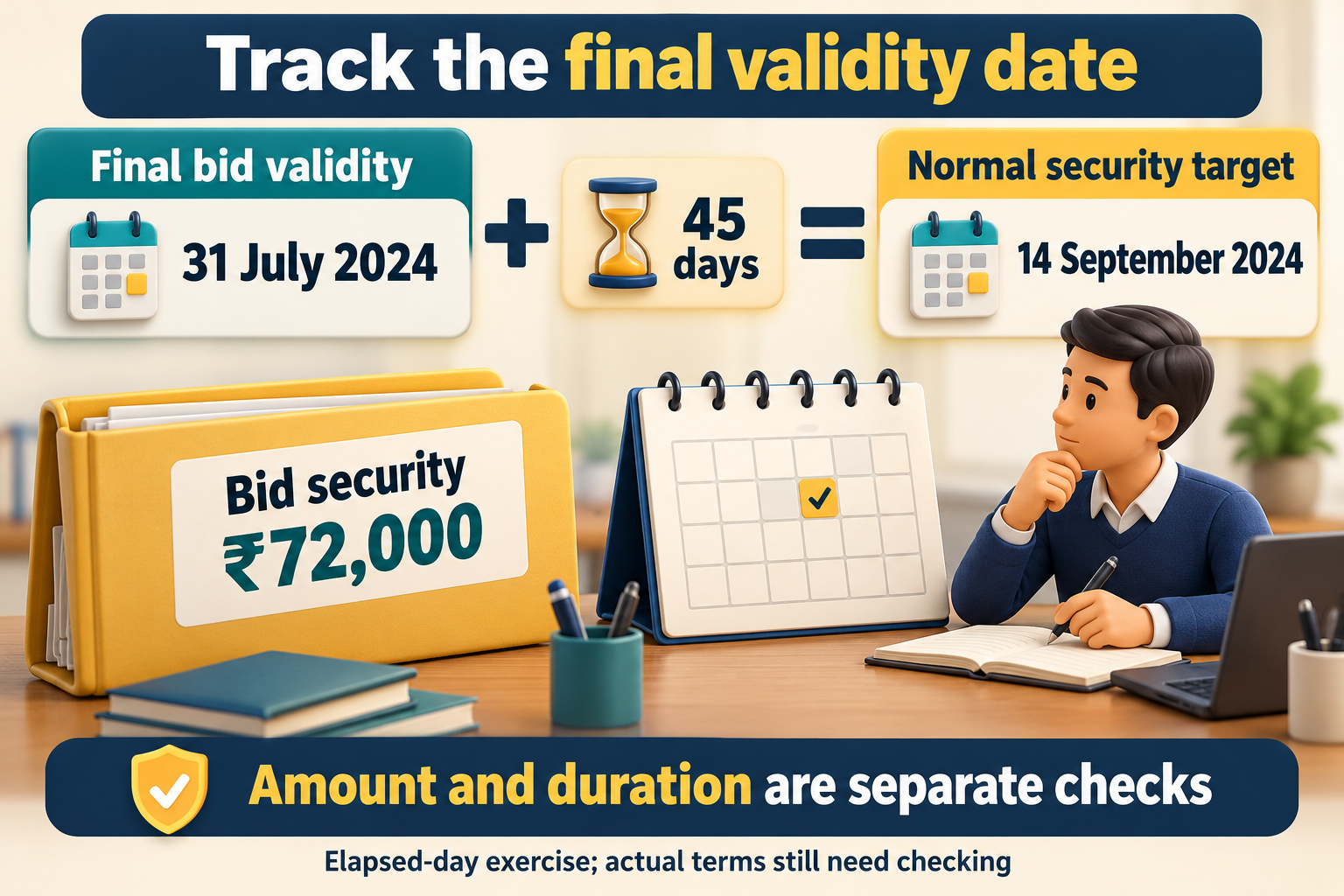
Cedar’s advertised goods procurement has an approved estimated value of ₹2,400,000. The supplied bidding document validly specifies ordinary bid security of 3%, or ₹72,000, for bidders not covered by an applicable exemption. Its chosen rate is within 2–5%. All cases below share that estimate; the quoted prices do not change this security amount.
| Bidder and supplied status | Quoted package price | Ordinary amount before exemption | Result for this exercise |
|---|---|---|---|
| Aster: ordinary non-exempt bidder | ₹2,200,000 | ₹72,000 | ₹72,000 required under the stated tender |
| Birch: actual applicable MSE-policy exemption verified in the fictional file | ₹2,260,000 | ₹72,000 | Exempt under the stipulated verified finding |
| Cypress: applicable DPIIT startup recognition and exemption established | ₹2,300,000 | ₹72,000 | Exempt under the stipulated verified finding |
| Dogwood: relevant qualifying registration with the stated Central Purchase Organisation established | ₹2,240,000 | ₹72,000 | Exempt under the stipulated verified finding |
| Elm: calls itself small; necessary applicability/recognition evidence absent | ₹2,180,000 | ₹72,000 | The claimed exemption is not established on the supplied record; apply the actual verification and tender process |
Three arithmetic checks keep the basis visible. Two percent of the estimate is ₹48,000; three percent is ₹72,000; five percent is ₹120,000. Computing 3% of Aster’s ₹2,200,000 quote gives ₹66,000, which is ₹6,000 short of the stipulated amount. Do not excuse that difference merely because its quote is lower than the estimate.
Elm’s row is deliberately unresolved rather than labelled guilty or finally rejected. The lesson has not supplied the complete applicable documentary and procedural rules for a real exemption claim. Establish the actual facts and follow that process. A published label does not permit inventing missing evidence, but a reviewer should not replace an open documentary question with an unsupported final sanction.
4. Final bid validity and the additional 45 days
The original final bid-validity date in Cedar’s supplied record is 30 June 2024. Using elapsed calendar days after that date, the normal additional 45 days end on 14 August 2024: 31 days in July and 14 days in August. This is a date arithmetic convention for the exercise, not an assertion about the interpretation of an actual instrument’s last-hour or claim-period wording.
An independently validly established extension later makes 31 July 2024 the final bid-validity date. This lesson does not prescribe the procedure or consent for obtaining that extension. It assumes the new date is properly established and tests the resulting security schedule. Forty-five days after 31 July is 14 September 2024.
| Instrument or record | Expiry or final date | Adequacy under the stipulated normal rule |
|---|---|---|
| Original bid validity | 30 June 2024 | Normal security target 14 August 2024 |
| Aster instrument A | 14 August 2024 | Meets the original date calculation |
| Alternative instrument B | 10 August 2024 | Four days short of the original target |
| Validly extended final bid validity | 31 July 2024 | New normal security target 14 September 2024 |
| Unchanged instrument A after extension | 14 August 2024 | 31 days short of the revised target |
| Revised instrument C | 14 September 2024 | Meets the revised date calculation, subject to actual terms/authenticity |
There are two independent gaps here: instrument B was already short against the original final date, while instrument A became inadequate for the longer period after the supplied extension. Do not describe both as the same error. The amount may remain ₹72,000 while the required coverage date changes.
Nor should the exercise’s 45 days be confused with the security issuer’s claim conditions or other applicable guarantee requirements. Exact instrument terms and enforceability are outside this arithmetic workpaper and require separate verification. A calendar calculation is necessary evidence, not complete legal authentication.
5. Refund triggers: classify the bidder before counting days
Rule 170(ii) says unsuccessful bidders’ securities should be returned at the earliest after final bid-validity expiry, and at the latest on or before the thirtieth day after contract award. It separately provides that unsuccessful first-stage bidders in two-packet or two-stage bidding receive return within 30 days of the declaration of first-stage results. Preserve the special early-stage route instead of making every failed technical bidder wait for the eventual contract.
The next table uses a separate original refund exercise with final bid validity ending 30 June 2024; do not import the extended July date from the preceding alternative. The ordinary award occurs on 5 July 2024. Dates use elapsed calendar days after the stated event at the same clock time; actual instrument/tender instructions still need checking.
| Record | Relevant event | Calculated outer date or trigger | Explanation |
|---|---|---|---|
| Unsuccessful technical bidder in a two-packet case | First-stage result declared 10 June 2024 | Within 30 days: 10 July 2024 | The special first-stage rule applies; do not wait for the general award route |
| Other unsuccessful bidder in the separate ordinary case | Final validity expires 30 June; award 5 July 2024 | Earliest after expiry; outer award-based date 4 August 2024 | Thirty days after 5 July is 4 August; this is a latest limit, not an instruction to delay |
| Proposed ordinary refund on 20 July | 20 days after 30 June; 15 days after award | Within the stated outer date | No reason is supplied for waiting this long; earliest-return duty still matters |
| Proposed ordinary refund on 5 August | 31 days after award | One day beyond the outer date | Does not meet the selected latest-return limit |
| Successful bidder | Performance security received on 12 July 2024 | Receipt is the Rule 171(iii) refund trigger | This cross-reference is separate from an unsuccessful-bidder deadline |
The successful-bidder row is a narrow Rule 171(iii) cross-reference; the next lesson develops the performance-security basis and duration. Do not retain both securities indefinitely simply because the bidder won. Equally, a request to return security before the applicable trigger needs its actual governing facts and rules; this lesson does not supply a blanket early-release power.
If an actual file presents conflicting or unusual event dates, do not silently invent a new deadline. Preserve both source requirements and obtain the applicable interpretation or instructions. The example deliberately uses coherent dates to teach the ordinary calculation, not to solve every possible extension/award edge case.
6. Bid-securing declarations have specified conditions and scope
Under 170(iii), Ministries/Departments may require a bid-securing declaration instead of bid security. The declaration accepts the stated consequence if the bidder withdraws or modifies its bid during validity, or if awarded the contract fails to sign it or to submit performance security by the deadline defined in the bidding document. The suspension period is the period specified in that document, and the eligibility restriction concerns contracts with the inviting entity.
Do not invent a universal two-year declaration penalty or convert an entity-specific restriction into all-Government debarment. A particular applicable tender might specify a period, but that fact must be supplied. The separate Rule 151/2021 debarment framework from Lesson 074 has its own grounds, authority and process; it cannot be substituted casually for this declaration.
Also read the conduct in context. Lesson 076 explains Rule 164(ii)(f)’s protection for an invited bidder unable to supply because of revised terms who declares a justified withdrawal. Do not label that expressly protected event an ordinary punishable withdrawal without examining the applicable provision. A declaration does not authorise ignoring a separate protection.
7. Six graded practices with full solutions
Practice A: identify the amount base
The estimate is ₹1,800,000 and a valid tender requires 2.5% bid security. A non-exempt bidder quotes ₹1,600,000 and offers ₹40,000 security. Compute the stipulated requirement and difference.
Solution. The requirement is 1,800,000 × 2.5% = ₹45,000. The supplied ₹40,000 is 2.5% of the quote, not the estimate, and is ₹5,000 short. Apply the actual tender and verification process; the arithmetic itself does not decide every procedural consequence.
Practice B: calculate a normal expiry
Final bid validity ends on 15 May 2024. Under the exercise’s elapsed-day convention, find the normal additional 45-day date.
Solution. There are 16 days after 15 May to 31 May, leaving 29 days in June. The date is 29 June 2024. Using 30 June would add 46 days under this convention; do not count the starting day twice.
Practice C: use the first-stage trigger
Technical-stage results are declared on 20 August 2024. The contract will be awarded much later. When is the 30-day outer date for unsuccessful first-stage securities?
Solution. 19 September 2024: 11 days after 20 August to 31 August and 19 days in September. The special first-stage rule supplies the trigger; a later award does not justify substituting a later ordinary-return date.
Practice D: interpret a declaration honestly
The fictional tender validly specifies a 12-month entity-specific suspension consequence under its bid-securing declaration. A drafter changes the explanation to “all-Government debarment for two years”. Is that a harmless paraphrase?
Solution. No. It changes both duration and scope. Rule 170(iii) refers to the specified period and the inviting entity’s contracts. Any separate wider debarment would require its own applicable grounds, authority and process. Do not impose it by rewriting a declaration summary.
Practice E: verify an exemption claim
A bidder describes itself as a startup in a brochure but supplies no established applicable DPIIT recognition or other exemption finding. Should the lesson’s author record exemption as proved?
Solution. No. The named rule category requires its actual qualifying facts. Record what is missing and apply the applicable verification/tender process. The brochure is neither sufficient proof nor, by itself, proof of a false statement. Do not invent either conclusion.
Practice F: distinguish earliest and latest return
In a separate ordinary case, final validity expires 31 August 2024 and award occurs on 5 September. Find the 30-day outer date. Does that date instruct the office to hold every unsuccessful security until then?
Solution. The outer date is 5 October 2024. No: the source also requires return at the earliest after final-validity expiry. The latest limit prevents excessive retention; it is not a mandatory waiting period.
8. Explained objective questions
MCQ A. Cedar’s validly extended final bid date is 31 July, but Aster’s security still ends on 14 August. Which statement is correct under the stated normal convention? (a) The original expiry remains sufficient because the amount is unchanged. (b) The normal revised target is 14 September, so the instrument is 31 days short. (c) The new target is 45 days after contract award regardless of bid validity. (d) The required amount automatically becomes 5% because the date changed.
Answer: (b). It uses the final validity date and retains the distinction between amount and duration. Option (a) confuses those controls; (c) uses the wrong event; (d) invents a rate change.
MCQ B. A two-packet bidder fails the technical stage, whose results were declared on 10 June. Which approach matches the selected rule? (a) Hold its security until 30 days after the eventual award, however late. (b) Apply the separate within-30-days first-stage return requirement, giving 10 July under the exercise convention. (c) Keep it automatically as compensation for technical failure. (d) Treat its security as the winner’s performance security.
Answer: (b). The special unsuccessful-first-stage rule is explicit. Option (a) ignores it; (c) invents forfeiture from technical failure alone; (d) confuses the bidder’s status and security purpose.
9. Written-answer model and summary
Prompt. Explain why a file needs separate security amount, expiry and return fields.
Model answer. Under the stipulated tender, a non-exempt bidder’s security is ₹72,000, calculated as 3% of the ₹2,400,000 estimate rather than its quote. An otherwise qualifying exemption needs verified applicable evidence. Validity is a separate control: the normal target is 45 days beyond final bid validity, so a valid extension from 30 June to 31 July changes the target from 14 August to 14 September without automatically changing the amount. Return depends on bidder status and the applicable event. Unsuccessful first-stage bidders in a two-packet/two-stage process have a separate 30-day result-based return rule; other unsuccessful bidders are subject to the earliest-after-expiry duty and award-based outer limit. The successful bidder’s bid security is refunded on receipt of performance security. Recording one generic “security complete” tick obscures these different requirements.
Summary. Verify the exemption or required amount, preserve the permitted form and actual terms, calculate coverage from the final bid-validity date, and apply the correct return trigger. A declaration uses its own stated consequence and scope, not an invented universal penalty.