AAO Lesson 083: Assess effective competition and control committee and validity risks
AAO · Lesson 083 · English
Assess effective competition and control committee and validity risks
Study time: about 135 minutes including practice. Prerequisites: AAO-074, AAO-079, AAO-082.
Learning outcomes
- Test lack of effective competition using evidence rather than bidder count alone.
- Separate a single effective offer from the original invitation method and actual contracting authority.
- Apply committee reporting-line and bid-validity controls in a dated plan.
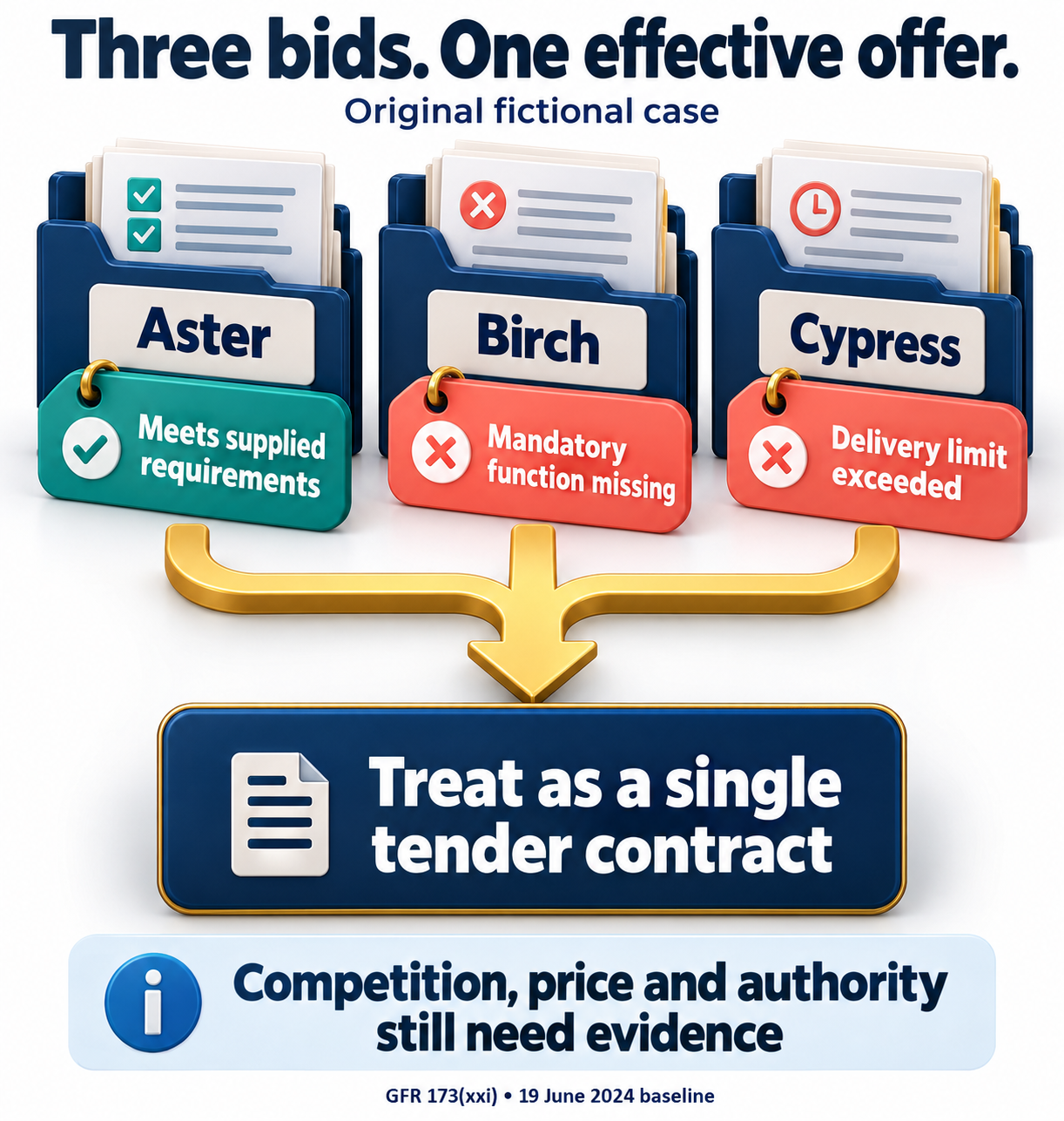
1. Count offers, then examine the actual competition
One effective offer creates questions about competition and authority, but the answer is not found by counting envelopes alone. Rule 173(xix) lists circumstances in which all bids or proposals may be rejected; clause (xx) explains why a single submitted bid can still arise from a valid process. Clause (xxi) separately determines how a limited or open tender with one effective offer is treated. Each clause answers a different question.
This lesson uses the 19 June 2024 examination baseline. In clause (xxii), the committee reporting-line restriction applies where estimated procurement value exceeds ₹25 lakh. The July 2024 increase to ₹50 lakh is later than this cutoff and is not substituted here. The ordinary example concerns a fictional public-office goods procurement. Actual departmental powers and external eligibility orders remain separate checks.
The new work is an evidence-based decision on effective competition, committee constitution and completion within bid validity. Lesson 082 already taught responsiveness and ranking; repeating its arithmetic would not establish these additional controls.
2. Separate the four rejection grounds from the single-bid tests
| Provision | What it requires or permits | Mistake to avoid |
|---|---|---|
| 173(xix)(a) | The procuring entity may reject all bids/proposals where effective competition is lacking | Treating a small number of bidders as conclusive evidence of that ground |
| 173(xix)(b) | The same possible route applies when all offers are not substantially responsive to the procurement documents | Selecting the cheapest failed mandatory offer merely to avoid a fresh process |
| 173(xix)(c) | It applies when prices are substantially above the updated estimate or available budget | Inventing a universal percentage definition of substantially |
| 173(xix)(d) | It applies where no technical proposal meets the minimum qualifying score | Lowering the published score after seeing the results |
| 173(xx) | A single submitted bid may still come from a valid process if advertisement/time are satisfactory, qualifications are not unduly restrictive, and price is reasonable against market values | Assuming single bid means automatically valid, or automatically invalid |
| 173(xxi) | An open or limited tender with only one effective offer is treated as a single tender contract | Confusing the original invitation method with the resulting contract treatment |
| 173(xxii) | Above the baseline ₹25 lakh estimate, no purchase-committee member should report directly to another member | Checking rank or job title alone instead of the actual reporting relationship |
| 174(i)–(iii) | Prescribe stage timeframes, use appropriate competent-approved delegation where necessary, and place the contract within original bid validity; discourage extensions except exceptionally | Letting internal delay silently extend a bidder’s offer |
| 174(iv) | Deleted in the verified baseline | Reintroducing an obsolete requirement from undated notes |
“May reject all” identifies a permitted response to the stated circumstances; it is not a command that every tender with one effective offer must be cancelled. Conversely, the possibility of a valid single-bid process does not establish price reasonableness or competent authority without evidence. Keep a separate finding for each issue.
3. Reconstruct the original competition file
Elm’s updated estimate is ₹2,800,000 for the complete common scope. The budget provision is ₹2,900,000. Advertisement and document availability records establish the required publication, with sufficient response time for this particular straightforward requirement. A documented market review establishes that the qualification criteria are proportionate rather than tailored to one supplier. These are supplied case findings, not conclusions inferred from the number of responses.
| Offer or evidence | Recorded fact | Consequence for this workpaper |
|---|---|---|
| Aster | Timely, meets the published mandatory requirements and stipulated eligibility; inclusive comparable total ₹2,760,000 | One effective offer for the complete scope |
| Birch | Timely, but the bid itself omits a mandatory function | Not an effective responsive offer; reasons retained |
| Cypress | Timely, but its offered delivery exceeds the published mandatory limit | Not an effective responsive offer; reasons retained |
| Advertisement and time file | Required publication, available complete documents and sufficient response time are evidenced | Supports the process finding; it does not cure Birch or Cypress |
| Qualification review | Documented requirements fit the need and are not unduly restrictive | Supports the competition assessment |
| Comparable market file | Two genuine current comparable market values are ₹2,740,000 and ₹2,820,000, inclusive of the same scope and terms | Evidence for a reasoned price assessment, not an automatic acceptable-price formula |
Three offers were received, but only Aster is effective on the supplied findings. Under 173(xxi), the resulting contract is treated as a single tender contract. That does not mean the original advertisement is retrospectively relabelled as a deliberate single-source invitation, or that a proprietary-article certificate has thereby been established. The selected rule also does not name the actual officer with sufficient departmental power; that authority must be separately verified.
For comparison, suppose the same satisfactorily advertised and non-restrictive process received only Aster’s bid. Clause (xx) means the process may still be considered valid when its three conditions are met. Its logic is not “one bidder is enough in every case”. An unsupported assertion that time was sufficient or the price was reasonable would leave the evidence incomplete.
4. Explain price reasonableness without inventing a safe percentage
| Comparison | Calculation | Bounded meaning |
|---|---|---|
| Offer against updated estimate | ₹2,800,000 − ₹2,760,000 = ₹40,000 below | Below estimate is relevant, but does not by itself prove a fair market price |
| Offer against available budget | ₹2,900,000 − ₹2,760,000 = ₹140,000 remaining | Funding margin is separate from competitive reasonableness |
| Mean of the two comparable market observations | (₹2,740,000 + ₹2,820,000) ÷ 2 = ₹2,780,000 | A descriptive mean of supplied evidence; not a prescribed evaluation formula |
| Offer against that mean | ₹2,780,000 − ₹2,760,000 = ₹20,000 below | About 0.7194% below this descriptive mean |
| Range check | ₹2,740,000 ≤ ₹2,760,000 ≤ ₹2,820,000 | Offer lies within the supplied comparable range |
The market observations are stipulated to be current, authentic and comparable in quantity, specification, tax, freight, installation and warranty. If one excluded delivery or concerned an obsolete model, the range would no longer support the same conclusion. A mean does not repair poor underlying evidence.
These facts support recording a reasoned finding of price reasonableness for the exercise. They do not create a rule that every price within a range or below an estimate must be accepted. There is no fixed “substantially higher” percentage in the selected 173(xix)(c) text. A decision must address the relevant estimate, budget, market and scope evidence rather than invent a universal tolerance.
5. Inspect the committee relationship, not just its size
Elm’s estimate of ₹2,800,000 exceeds ₹2,500,000 by ₹300,000. A purchase committee is constituted to recommend the procurement. Member P directly reports to member Q; member R has no such relationship to either. Adding R does not remove the P-to-Q reporting line. The proposed constitution conflicts with the selected baseline restriction and must be corrected through the competent process before relying on it.
In a corrected hypothetical constitution, Q is replaced by S, and verified reporting records show that none of P, R and S reports directly to another member. This addresses that specific relationship defect; it does not establish all expertise, conflict-of-interest or authority requirements. Do not confuse a direct reporting line with merely working in the same Ministry.
At an estimate of exactly ₹2,500,000, the word “exceeds” does not trigger this particular monetary condition. That narrow textual result is not permission to ignore other independence or integrity requirements. Nor may the office split a known requirement to evade a control.
6. Work backwards from original bid validity
All valid offers in this dated exercise remain valid through 30 June 2024. The date is stipulated by the actual bidding documents; it is not derived from a universal GFR validity period. The office sets a stage plan under Rule 174(i). Durations below are elapsed calendar-day intervals for scheduling, with no claim that they are statutory minimum processing periods.
| Stage | Planned completion | Elapsed interval from preceding stage |
|---|---|---|
| Evaluation workpaper complete | 28 May 2024 | Starting point |
| Price and authority checks complete | 7 June 2024 | 10 days |
| Competent decision complete | 17 June 2024 | 10 days |
| Contract placement complete | 24 June 2024 | 7 days |
| Original bid validity ends | 30 June 2024 | 6-day remaining margin |
The planned 28 May to 24 June path is 27 days, leaving six days before the supplied validity end. A seven-day delay in that path would move planned placement to 1 July, one day beyond the original validity. Calling it an “internal approval delay” would not extend the bidder’s offer.
Rule 174(iii) requires departments to ensure placement within original validity and discourages extension except in exceptional circumstances. If a real exception is needed, the applicable request, bidder response, associated security and approval procedure must be verified; this rule alone does not supply a fictional consent. Lesson 079’s security-validity work must also be revisited where applicable. Appropriate delegation under 174(ii) requires competent approval, not an evaluator’s unilateral expansion of authority to save time.
7. Six graded practices with complete solutions
Practice A: one bid and a restrictive qualification
A tender receives one bid. Its qualification condition requires experience with one named office, without a documented need, and the market review shows capable firms were excluded. Can the office establish validity simply because the price is below budget?
Solution. No. The selected single-bid test includes non-restrictive qualification criteria and satisfactory advertisement/time, not merely affordability. Investigate and decide on the actual defect through the proper process; the supplied price cannot cure the missing competition evidence.
Practice B: four submissions, one effective offer
Four bids are timely. Three fail mandatory published requirements and one remains effective. Does the original open invitation itself prove that ordinary competitive-contract treatment applies?
Solution. No. Rule 173(xxi) treats the resulting one-effective-offer contract as a single tender contract. Keep the original invitation history and separately check the authority and competition/price evidence. Do not invent a proprietary-source justification.
Practice C: apply the strict monetary boundary
Purchase committees at estimates ₹2,500,000 and ₹2,500,001 each contain one member directly reporting to another. Which triggers 173(xxii)’s monetary condition at the exam baseline?
Solution. ₹2,500,001 exceeds the threshold by ₹1; exactly ₹2,500,000 does not exceed it. Other applicable integrity and constitution requirements still govern both. The later ₹50 lakh threshold is not the selected cutoff rule.
Practice D: a price well above both supplied comparators
The updated estimate is ₹1,000,000, the available budget ₹1,100,000 and every responsive price at least ₹1,450,000. Compute the gaps and identify the relevant route without inventing a percentage safe harbour.
Solution. The lowest price is ₹450,000 or 45% above the estimate, and ₹350,000 or about 31.8182% above budget. These facts require a reasoned 173(xix)(c) assessment of substantially higher prices and the possible rejection-all route. The arithmetic alone does not turn either percentage into a universal legal threshold or authorise unfunded expenditure.
Practice E: a delayed contract plan
Original validity ends on 20 August. Planned placement is 16 August; an eight-day delay moves it to which date, and what problem arises?
Solution. Placement moves to 24 August, four days beyond original validity. Record and resolve the actual exceptional validity/authority issue through the applicable process; an internal note cannot create bidder consent. A routine habit of extensions conflicts with the rule’s stated discipline.
Practice F: no qualifying technical proposal
The published minimum technical score is 70. The three proposals score 62, 65 and 68 under the published method. Can the committee lower the minimum to 65 solely to produce a winner?
Solution. No. None meets 70, so 173(xix)(d)’s possible rejection-all circumstance is present. Lowering the published minimum after receipt would change the evaluation condition. The shortfalls are eight, five and two points; a near miss remains below the supplied threshold.
8. Explained objective questions
MCQ A. Elm receives three bids, but only one is effective. Which statement is supported? (a) Three envelopes automatically establish sufficient competition. (b) The resulting contract is treated as a single tender contract, with competition, price and authority still requiring their own evidence. (c) A proprietary-article certificate follows automatically. (d) All bids must be cancelled solely because only one is effective.
Answer: (b). It separates the resulting treatment from the original invitation and the remaining tests. Option (a) substitutes count for substance; (c) invents a distinct single-source justification; (d) turns a possible rejection route into an automatic count-based command.
MCQ B. A ₹2,800,000 procurement committee contains P, P’s direct supervisor Q and independent R. Which action addresses the specific baseline defect? (a) Add another independent member while retaining the same P-to-Q relationship. (b) Use a competent reconstitution that removes direct reporting between any committee members, while checking other requirements. (c) Apply the July 2024 ₹50 lakh threshold to the June cutoff. (d) Treat a below-estimate bid as curing the constitution defect.
Answer: (b). It removes the actual forbidden relationship. More members, a later threshold or a favourable price do not remove that existing line under the stated facts.
9. Written-answer model and recap
Prompt. Prepare a bounded conclusion for Elm before contract placement.
Model answer. Aster is the only effective offer after applying the supplied published requirements; the open-tender result is therefore treated as a single tender contract under Rule 173(xxi). Count alone does not prove lack of competition. The file supplies satisfactory publication and time, proportionate qualifications and comparable market evidence supporting the ₹2,760,000 price. The price is ₹40,000 below the updated estimate and ₹140,000 within the budget, but those margins do not replace the reasonableness assessment. The ₹2,800,000 estimate triggers the baseline committee restriction; P’s direct reporting to Q requires competent correction. Actual contracting authority must also be verified. The plan should place the contract by 24 June within the stipulated 30 June original validity, with exceptional-extension procedure verified if needed. These are conditions for the next decision, not a statement that an award has occurred.
Summary. Evidence determines effective competition; one effective offer determines the specified contract treatment. Correct committee relationships and a realistic validity plan protect the decision process without inventing new monetary powers or automatic outcomes.