AAO Lesson 089: Use least-cost selection for an appropriate standard assignment
AAO · Lesson 089 · English
Use least-cost selection for an appropriate standard assignment
Study time: about 120 minutes including practice. Prerequisites: AAO-087, AAO-088.
Learning outcomes
- Justify LCS from the nature and established methods of the assignment.
- Rank only responsive technically qualified proposals by evaluated cost.
- Explain why technical scores are not weighted again in LCS and why criteria cannot switch after receipt.
1. LCS uses technical qualification as a gate, not a second weighted contest
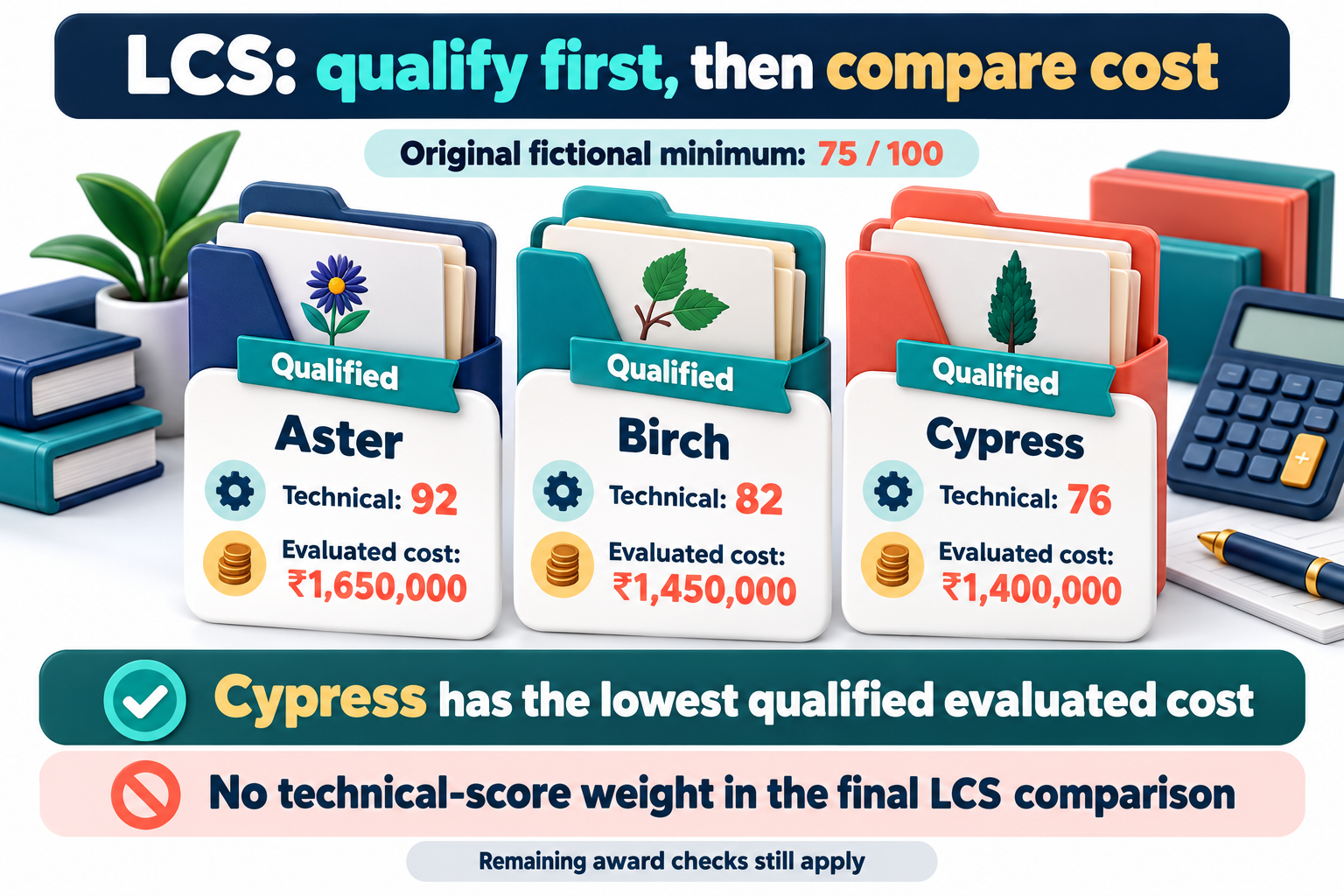
Rule 193 describes Least Cost System, or LCS, as appropriate for standard or routine assignments with well-established methodologies, practices and standards. Its examples include audits and engineering design of non-complex works. Unlike QCBS, the technical score has no weight in the final evaluation: the responsive technically qualified proposal with the lowest evaluated cost is selected.
This is not a rule to buy any consultancy at the lowest quoted figure. The assignment must fit the method, the proposal must be responsive and technically qualified, and the compared cost must use the actual published basis. A low fee from a failed proposal or one omitting required scope does not pass those controls.
The selected examination baseline is 19 June 2024. All assignment descriptions, qualification marks and costs here are original fictional facts. Statutory audit appointments, professional licences, actual standards, preference rules and delegated powers would need separate verification in a real case. No engineering design or actual audit is performed by this lesson.
2. Choose the method from the nature of the assignment
| Assignment facts | Selected rule-based assessment | Boundary |
|---|---|---|
| A repeatable non-complex design task with established methods, standards and a clear common deliverable | These supplied facts support considering LCS under Rule 193 | Still establish the required quality gate and complete cost basis |
| A specialist strategic study where the quality of the proposed approach is of prime concern | Consider the QCBS framework under Rule 192 on the actual facts | Do not force LCS merely because a price table would be simpler |
| An unexplained request to use the familiar incumbent | Does not establish either method suitability or an exceptional single-source ground | Convenience is not a substitute for the separately required justification |
| A standard assignment labelled “complex” without supporting facts | The title alone is not the assessment | Examine the actual content, methodology and quality needs before selecting a process |
Spruce’s fictional assignment is the first type: a defined, repeatable non-complex design deliverable with well-established methodology and standards. A documented capability and scope review supports the use of LCS, and the RFP announces it before receipt. The example does not claim that every engineering or audit assignment must use LCS; the qualifying characteristics matter.
The RFP states the mandatory deliverables and a minimum technical score of 75 out of 100 for responsive proposals. The marks are an original qualification device, not a universal LCS minimum in Rule 193. All other applicable eligibility conditions are stipulated as established for the qualifying proposals.
3. Apply the quality gate and preserve the actual qualifying pool
| Proposal | Supported technical score | Responsive on the supplied conditions | Financial-stage result |
|---|---|---|---|
| Aster | 92 | Yes | Qualifies |
| Birch | 82 | Yes | Qualifies |
| Cypress | 76 | Yes | Qualifies |
| Dogwood | 72 | Yes apart from the failed score gate | Does not meet the published 75 minimum; financial proposal not used |
Cypress is one point above 75 and qualifies. Dogwood is three points below and does not. The fact that Aster scores 16 points above Cypress does not create a final LCS quality bonus. The score has already performed the role specified in this RFP: determining whether the offered technical quality reaches the stated acceptable gate.
The CEC must still record its detailed acceptance and rejection reasons under Rule 189. “LCS” does not remove technical evaluation. Rule 190’s qualified financial-opening sequence also remains relevant; do not open Dogwood’s price merely to see whether rejecting it was expensive.
4. Compare the complete evaluated cost of qualified proposals
The published original cost basis comprises core professional services, the specified site visits and required model/document outputs. Each component is inclusive on the same stated basis, with no unlisted adjustment or tax-rate assumption. All three qualified bids cover the same scope; no omitted item, unresolved arithmetic discrepancy or preference adjustment is supplied.
| Qualified proposal | Core services | Required visits | Required outputs | Evaluated total | LCS cost rank |
|---|---|---|---|---|---|
| Aster | ₹1,450,000 | ₹100,000 | ₹100,000 | ₹1,650,000 | 3 |
| Birch | ₹1,250,000 | ₹100,000 | ₹100,000 | ₹1,450,000 | 2 |
| Cypress | ₹1,200,000 | ₹80,000 | ₹120,000 | ₹1,400,000 | 1 |
Cypress’s complete ₹1,400,000 is ₹50,000 lower than Birch and ₹250,000 lower than Aster. It is the lowest evaluated responsive technically qualified proposal under the supplied LCS model. The conclusion follows the announced process; it is not a statement that Cypress is best in every qualitative respect.
The ₹250,000 difference is about 15.1515% of Aster’s ₹1,650,000. That percentage describes the supplied comparison, not a legal saving threshold or proof that funds are available. Authority, price reasonableness and applicable external orders retain their actual requirements.
One proposed note says, “Aster has the best technical score, so give its quality 70% and price 30%.” That changes LCS into an unpublished QCBS-type contest. Rule 193 expressly gives technical score no weight in the final evaluation. A method that would have been considered before issue cannot be inserted after prices to favour the preferred result.
5. Distinguish a different hypothetical gate from a changed real competition
For a separate teaching variation only, suppose another RFP had announced a minimum of 80 before proposals were submitted and otherwise used the same supplied marks and costs. Aster and Birch qualify, while Cypress at 76 and Dogwood at 72 do not. Birch then has the lowest qualified cost at ₹1,450,000.
That variation costs ₹50,000 more than the main case’s qualifying leader because the acceptable-quality gate is different. It does not authorise raising Spruce’s actual 75 minimum after discovering Cypress’s price. The legitimate method design occurs at the appropriate stage and must be supported by the assignment’s needs.
Similarly, if a real proposal omits a mandatory output, do not simply add an evaluator’s invented price and call it responsive unless the actual published rules and applicable procedure support that treatment. Cost comparison is downstream of those substantive conditions. The original table expressly avoids that unresolved situation.
6. Record the conclusion without hiding the alternatives
| Issue | Recorded main-case finding | Unsupported shortcut rejected |
|---|---|---|
| Method suitability | Defined standard, repeatable, non-complex assignment with established methods; LCS announced | Using LCS for every consultancy because it is easy to calculate |
| Technical gate | Aster 92, Birch 82 and Cypress 76 meet the published 75 minimum; Dogwood 72 does not | Treating every shortlisted or timely bidder as qualified |
| Evaluated scope | All three totals include the same required service, visits and outputs | Ranking only the smallest visible component |
| Final LCS comparison | Cypress ₹1,400,000 is the lowest qualified evaluated total | Adding a hidden quality weight or switching method |
| Remaining decision | Complete actual authority, reasonableness and other applicable checks | Treating the educational ranking as an executed award |
An answer that says only “select the cheapest” misses the method’s central structure. Identify the appropriate assignment, announced gate, responsive qualified group and complete evaluated cost. That is why LCS can be applied rigorously without carrying forward a technical score as a final weight.
7. Six graded practices with complete solutions
Practice A: a higher mark does not receive a final LCS premium
The announced minimum is 80. Responsive P scores 94 at evaluated cost ₹900,000 and Q scores 81 at ₹850,000. Which leads under LCS?
Solution. Both qualify, and Q is lower by ₹50,000. P’s 13-point technical advantage does not add a final quality weight in LCS. The conclusion remains subject to actual other applicable checks.
Practice B: a low unqualified proposal
The minimum is 75. P scores 74, Q 79 and R 83. The qualified evaluated totals are Q ₹620,000 and R ₹650,000. May an analyst infer that P should be included because it is usually inexpensive?
Solution. No. P misses the gate by one point; its assumed price is not part of the qualified comparison. Q leads R by ₹30,000 among the supplied qualified proposals. Reputation for low prices does not repair the technical result.
Practice C: complete scope changes the apparent cheapest fee
Qualified P quotes ₹700,000 core services plus ₹80,000 required travel; Q quotes ₹740,000 with the same travel included. The published basis compares the full scope. Rank them.
Solution. P totals ₹780,000 and Q ₹740,000, so Q is lower by ₹40,000 despite the higher apparent core figure. Do not add the included travel a second time to Q or omit it from P.
Practice D: choose the method before issue
A proposed assignment requires a novel strategic approach, and a supported needs assessment says quality is of prime concern. Is its consultancy label alone sufficient reason to use LCS?
Solution. No. Rule 193’s suitability depends on standard/routine work with established methods. These supplied facts point to considering the QCBS framework under Rule 192, with an appropriately designed published process. The answer is a method assessment, not an automatic engagement approval.
Practice E: reject retrospective quality weighting
After an LCS competition, the highest technical scorer is ₹90,000 more expensive than the lowest qualified proposal. The committee proposes 80:20 quality/cost weights because 80% does not exceed the QCBS ceiling. Is that sufficient?
Solution. No. A QCBS ceiling does not convert a received LCS competition into QCBS. The announced LCS final comparison has no technical-score weight. An arithmetically permitted QCBS ratio does not establish authority to change the method after receipt.
Practice F: equal lowest evaluated costs
Two responsive qualified LCS proposals each have evaluated cost ₹500,000; their technical scores are 88 and 80. Does Rule 193 alone provide the actual tie-break rule?
Solution. No. The selected provision identifies the lowest evaluated cost but does not itself state a tie-break procedure. Use the applicable preannounced or otherwise verified rule; do not automatically invent a highest-score tie-break merely because the scores differ.
8. Explained objective questions
MCQ A. Which main-case reason supports Cypress’s leading position? (a) Its score 76 is the highest. (b) Every lowest core-service fee must be selected. (c) It is responsive, meets the published 75 gate and has the lowest complete evaluated cost, ₹1,400,000. (d) LCS ignores all technical conditions.
Answer: (c). It retains the quality gate and full cost basis. Cypress’s score is not highest, core price alone is insufficient, and technical evaluation remains necessary.
MCQ B. What distinguishes LCS from the selected QCBS model? (a) LCS gives no technical-score weight in final evaluation after responsiveness and technical qualification; the lowest evaluated qualified cost leads. (b) LCS opens every financial proposal before qualification. (c) LCS always requires an 80-point technical minimum. (d) LCS permits changing the final weights after prices are known.
Answer: (a). It states Rule 193’s distinction. The other alternatives invent a reversed sequence, a universal numerical minimum or retrospective weighting.
9. Written-answer model and recap
Prompt. Justify the main LCS ranking without claiming that technical quality is irrelevant.
Model answer. The supplied assignment is standard, repeatable and non-complex, with established methods, supporting the announced LCS approach. The CEC first applies the published technical and responsiveness requirements. Aster, Birch and Cypress score 92, 82 and 76 and meet the 75 minimum; Dogwood at 72 does not. The qualified complete evaluated totals are ₹1,650,000, ₹1,450,000 and ₹1,400,000. Cypress is lowest by ₹50,000 against Birch. Rule 193 gives no technical-score weight in the final evaluation, so Aster’s higher score does not create a hidden premium. Technical quality matters through the supported gate, and actual authority, reasonableness and external-order conditions remain to be completed. The ranking is not an executed award.
Summary. Match LCS to an appropriate assignment, establish acceptable technical quality and compare complete evaluated costs within the qualified group. Do not replace that process with either price-only shortcuts or unpublished quality weights.