AAO Lesson 091: Design a fair and objective public logo competition
AAO · Lesson 091 · English
Design a fair and objective public logo competition
Study time: about 110 minutes including practice. Prerequisites: AAO-081, AAO-086.
Learning outcomes
- Apply Rule 196 publicity, transparency, fairness and objectivity to an original design competition.
- Build an evidence-based evaluation record using expressly published fictional criteria.
- Keep jury notification wording and unresolved intellectual-property terms precise.
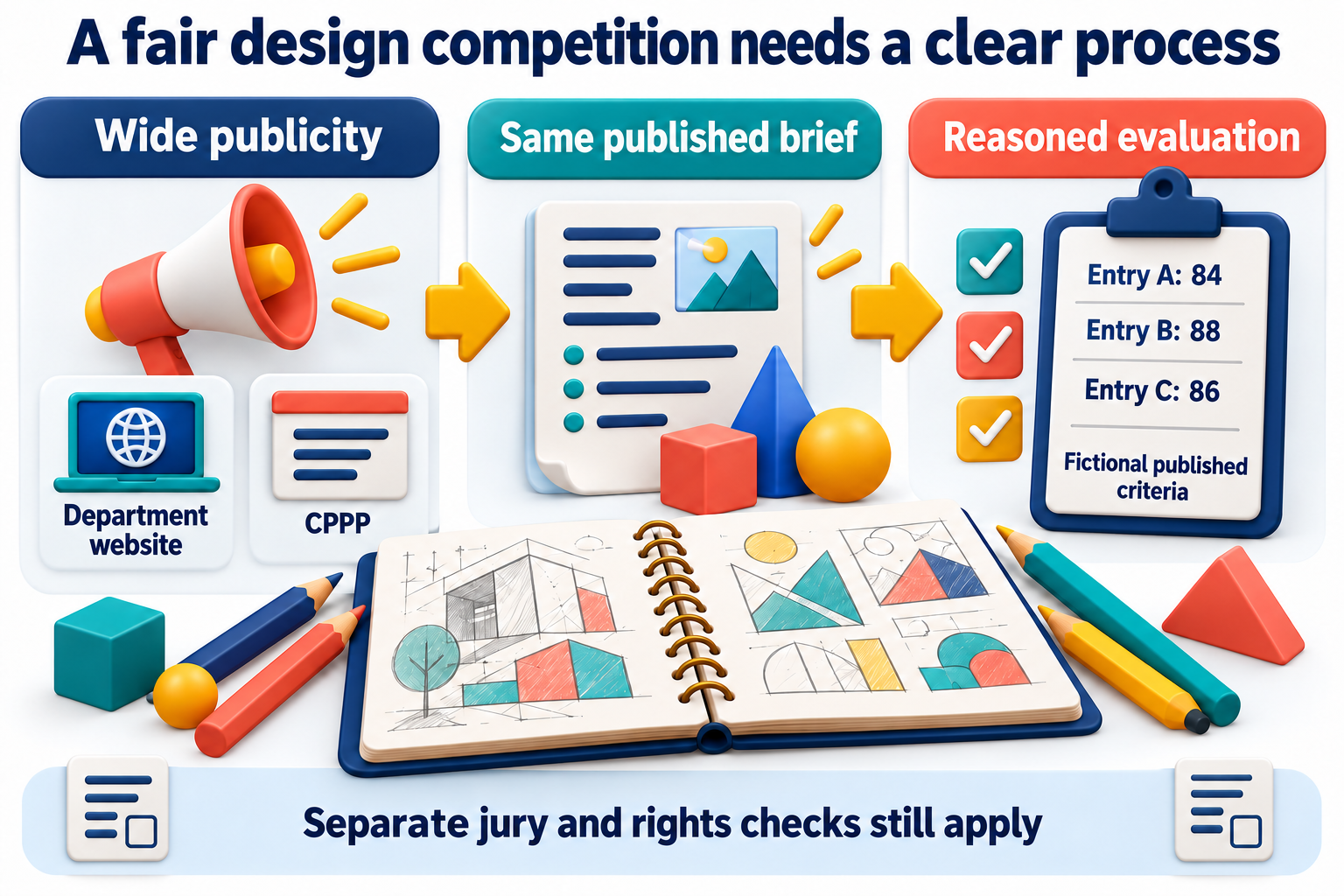
1. A public design competition needs an understandable process
Rule 196 requires competitions for symbols or logos to be transparent, fair and objective. It calls for wide publicity so information is accessible to all possible participants, including publication on the concerned Ministry or Department’s website and CPPP. Where selection is by a nominated expert jury, its composition may also be notified.
Those controls do not prescribe one logo style, jury size, scoring formula, prize amount or intellectual-property transfer. The original example below makes its own published design brief and evaluation criteria explicit. It is a proportionate application of the short rule, not an invented official competition manual.
The examination baseline is 19 June 2024. No actual logo is selected or commercial artwork copied. Names, entries and marks are fictional; rights, originality, prize, use and other actual competition terms would need their separately verified legal and administrative basis.
2. Original competition: equal access to the same brief
Laurel’s fictional public-information programme seeks a simple symbol for use on a website and printed information cards. The supplied published brief specifies the programme purpose, required formats, evaluation criteria and the submission arrangements. It does not require imitation of an existing government emblem or commercial brand.
| Record | Supplied fact | Assessment under the selected rule |
|---|---|---|
| Department website | Complete notice and accessible common brief published | One expressly identified publication channel is evidenced |
| CPPP | Competition notice published with the complete document location | The other expressly identified channel is evidenced |
| Wider publicity | Relevant public design and education networks receive the same notice | Supports access; it does not replace either required channel |
| Participant information | The purpose, formats, criteria and submission instructions are the same for everyone | Private improvements to one entrant’s brief would undermine fairness |
| Expert jury | A competent process nominates the fictional expert jury; the office elects to notify its composition | Rule 196 permits notification of composition; it does not say this is invariably mandatory |
Posting only in an office’s private messaging group would not establish the required wide public access or the two stated publication channels. Conversely, two upload acknowledgements alone do not prove that the linked brief was readable and complete. The record should connect the notice to the actual accessible information.
The case does not assume that every possible person actually read the notice. The rule’s access objective is not a promise of universal participation. Document the real publicity steps and resolve any material access defect through the applicable process.
3. Use the announced criteria and explain artistic judgment
Laurel’s original brief announces four criteria out of 100: relevance to purpose 40, legibility at the specified small size 25, usable monochrome reproduction 20 and adaptability to the two specified media 15. These are fictional criteria tailored to the case, not marks prescribed in Rule 196. The supplied jury record contains the actual reasoned assessment behind each award.
| Entry | Relevance /40 | Legibility /25 | Monochrome /20 | Adaptability /15 | Total /100 |
|---|---|---|---|---|---|
| Entry A | 34 | 20 | 18 | 12 | 84 |
| Entry B | 36 | 22 | 17 | 13 | 88 |
| Entry C | 32 | 21 | 19 | 14 | 86 |
Entry B totals 88, ahead of C by two points and A by four. The supplied record explains that B most closely conveys the brief’s purpose and remains clearer at the stated small size, while C performs better in the monochrome and adaptability tests. B’s relevance/legibility advantage of five points over C exceeds C’s three-point advantage in the other two categories, giving the two-point total difference.
Objectivity does not mean a design jury can avoid every expert judgment. It means the decision should follow the stated, relevant basis and be explainable from the assessed work rather than a hidden preference. A record saying only “B looks best” would not explain the published comparison as well as the criterion-based evidence.
A committee member now proposes adding ten points for a colour that was never part of the brief. That would change the basis after seeing the entries. The original teaching conclusion is to retain the published process and seek the proper handling of any genuine requirement change, not quietly adjust the marks to favour a preferred design. The precise amendment or rerun procedure is an external gate, not invented from Rule 196.
4. Record what the comparison establishes and what it does not
| Question | Supported record | Limit |
|---|---|---|
| Which entry leads this published scoring exercise? | B at 88, C at 86 and A at 84 | A numerical ranking alone is not every administrative or rights clearance |
| Why is B ahead? | Recorded advantages and weaknesses across all four announced criteria | Do not suppress the criteria where another entry did better |
| Was information accessible? | Actual website, CPPP and wider-publicity evidence | An internal assertion without accessible documents is insufficient evidence |
| Must jury composition always be notified under this sentence? | The text says it may also be notified when selection is by the nominated expert jury | Do not silently change may to must |
| Who owns or may use the selected design? | Resolve the actual verified competition and intellectual-property terms | Rule 196 alone does not state automatic ownership transfer |
The fictional scoring result can support the next competent decision, but it does not prove originality, permission to reproduce an existing mark, payment authority or automatic transfer of rights. Those questions must be resolved under the actual terms and applicable sources. No competition entrant’s artwork is supplied or reused here.
5. Six graded practices with complete solutions
Practice A: diagnose incomplete publicity
A notice is shared widely on social media, but neither the Department’s website nor CPPP carries it. Has the selected Rule 196 publication requirement been evidenced?
Solution. No. Wide circulation is useful, but it does not replace the two expressly included channels. Establish the required publications and accessible common information through the proper process.
Practice B: compute a published total
An entry receives 35, 23, 18 and 14 under Laurel’s original maxima. Find its total and difference from B’s 88.
Solution. Total 90, two points above 88. This is a separate scoring exercise; a later invented entry is not inserted into the already completed main case.
Practice C: preserve the wording on jury composition
A summary says Rule 196 invariably makes jury-composition notification compulsory. What precision is needed?
Solution. The selected sentence says the composition may also be notified where selection is by the nominated expert jury. Keep that permissive wording and check any separate applicable instruction rather than claiming the sentence itself always requires notification.
Practice D: hidden personal preference
After evaluation, a member wants to double the adaptability marks because a preferred entry performs best there. What would that do?
Solution. It would change the announced basis retrospectively. Apply the actual published criteria and use the proper process for any genuine change; do not manipulate weights after seeing which entry benefits.
Practice E: reasons across strengths and weaknesses
B scores two points less than C in monochrome performance but four more in relevance. Should the record omit B’s weaker category?
Solution. No. Record both findings and the complete published comparison. A reasoned decision can explain why the overall result favours B without pretending B leads every criterion. The two supplied differences alone do not replace the other categories.
Practice F: ownership is a separate gate
A selected design resembles a commercial mark, and the file says public selection automatically gives unrestricted ownership. Does Rule 196 itself establish that?
Solution. No. Verify originality, rights and actual use/transfer terms under the applicable sources before use. The selected GFR provision governs the competition’s fairness, objectivity and publicity; it does not itself resolve those legal rights.
6. Explained objective questions
MCQ A. Which conclusion follows from the original comparison? (a) B has the highest published-criteria total, 88, with other required clearances still separate. (b) B must be superior in every category because its total is highest. (c) The jury may add any new criterion after viewing the designs. (d) The total alone proves copyright ownership.
Answer: (a). The other choices respectively confuse an overall lead with every component, change the announced basis, or invent a rights conclusion.
MCQ B. Which publicity record best supports the selected rule? (a) Only a private office group receives the brief. (b) A verbal assurance says someone will eventually post it. (c) Website publication replaces CPPP because it is easier to access. (d) Both named channels and appropriate wider publicity provide the same accessible competition information.
Answer: (d). It keeps the expressly identified channels and the access objective together. The other alternatives omit or postpone an essential part of the supplied process.
7. Written-answer model and recap
Model answer. Rule 196 requires transparent, fair and objective design competition with wide publicity, including the Department website and CPPP. Laurel supplies the same accessible brief through those channels and additional networks. Its published original criteria produce totals A 84, B 88 and C 86, with recorded reasons for strengths and weaknesses. B leads by two points over C; unpublished colour preferences or retrospective reweighting should not replace the announced basis. Jury composition may also be notified where the stated jury arrangement is used; the rule does not make that sentence invariably mandatory. Actual rights, use, prize and other clearances remain separate. The scoring workpaper supports a reasoned next decision, not an automatic ownership or payment claim.
Summary. Make the opportunity accessible, use an understandable common basis and retain reasons for the design decision. Keep a short rule precise instead of adding fictional official requirements.