Quantum Computing Master Course — 045. Entanglement Swapping
Lesson 045: Entanglement Swapping
Smartyfy Quantum Computing Master Course
Prerequisites and objectives
Two systems can become conditionally entangled even if they never directly interacted. Entanglement swapping accomplishes this using two existing pairs and a joint measurement on their middle systems. You will derive the endpoint states, distinguish a recorded branch from an unconditioned ensemble, and identify the classical information needed to make the endpoint resource usable in a known form.
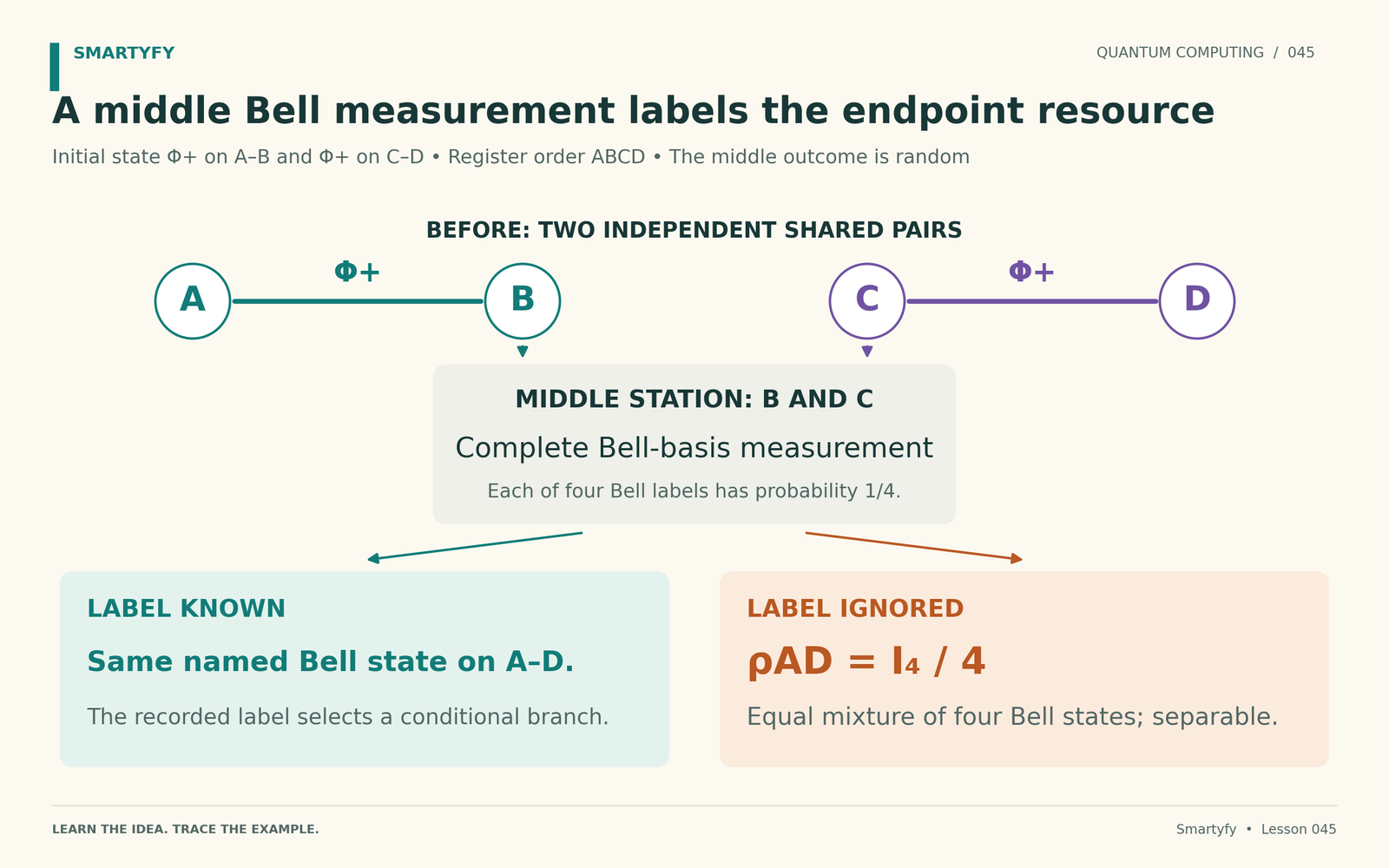
Use four named qubits A, B, C, D in that register order. Initially A and B share Φ+, and C and D share Φ+. The middle station holds B and C. A and D are the endpoints. We assume ideal pair preparation and the ability to make a complete Bell-basis measurement at the middle station.
Write the initial state explicitly
The state Φ+AB ⊗ Φ+CD equals (|0000⟩ + |0011⟩ + |1100⟩ + |1111⟩)/2 in ABCD order. All four amplitudes have magnitude one half, so the squared norm is one. There is entanglement within each source pair, but no initial entanglement between the independently prepared pairs.
To analyze a measurement on B and C, regroup each basis string into middle label BC and endpoint label AD. The four terms become |00⟩BC|00⟩AD, |01⟩BC|01⟩AD, |10⟩BC|10⟩AD, and |11⟩BC|11⟩AD, each with coefficient one half.
This is a relabeling of tensor factors for calculation, not a physical SWAP gate. Writing the subsystem names prevents the reordered expression from being confused with a change in which laboratory holds each qubit.
Resolve the middle systems in the Bell basis
Using Φ± = (00 ± 11)/√2 and Ψ± = (01 ± 10)/√2, the regrouped state becomes one half times Φ+BCΦ+AD + Φ−BCΦ−AD + Ψ+BCΨ+AD + Ψ−BCΨ−AD.
With these real Bell-vector conventions, all four coefficients are positive. You can verify the identity by expanding the products: cross terms from the plus and minus vectors cancel, leaving exactly the four matching computational labels above. Different phase conventions can change intermediate signs without changing physical predictions.
The middle Bell measurement therefore produces each label with probability one quarter. Conditioned on its label, the endpoints share the Bell state with the same name. The outcome is random, but every outcome leaves a maximally entangled endpoint state in this ideal model.
Implement the Bell measurement
At the middle station, apply CNOT B→C and then H to B, followed by Z measurements of B and C. The decoded bits (z,x) label Φ+, Ψ+, Φ−, and Ψ− as 00, 01, 10, and 11, respectively.
Because the measurement acts jointly on B and C, it is not equivalent to measuring them separately in Z and comparing the outcomes. Separate Z measurements identify classical labels and leave product endpoint states in this setup. The entangling measurement basis is the essential ingredient.
The middle station can transmit its two-bit label to an endpoint. A suitable local Pauli then converts the identified endpoint Bell state to Φ+. For example, apply X raised to x times Z raised to z on A, meaning Z first and X second. This inverts the encoding Z raised to z times X raised to x used to label the Bell states.
Worked example for the Ψ− outcome
Project the middle systems onto Ψ−BC = (|01⟩ − |10⟩)/√2. Only the second and third regrouped terms survive. Their endpoint vector is (|01⟩ − |10⟩)/(2√2), which has squared norm one quarter.
After normalizing, the endpoints are Ψ−AD. Applying Z on A changes this to Ψ+AD, and applying X on A then gives Φ+AD. The middle station’s label tells the endpoint which correction is appropriate.
A correction with the opposite X/Z order can differ by a global sign for this branch. That sign does not alter endpoint measurement probabilities. Nonetheless, deriving a correction from a stated convention is more reliable than memorizing a table without its subsystem and bit ordering.
What happens when the label is ignored
If the middle result is unavailable, the endpoint description averages the four Bell states with equal weights. Using the density notation ρ = Σj pj|ψj⟩⟨ψj|, this gives ρAD = I₄/4. Here I₄ is the four-dimensional identity; each projector |ψj⟩⟨ψj| describes one conditional pure state.
The same matrix is an equal mixture of the four product basis states 00, 01, 10, and 11. It is separable and yields independent maximally mixed local states. Thus an entangled conditional branch is not the same object as the ensemble obtained after forgetting its label.
This distinction removes the appearance of a remote instantaneous resource appearing in a locally detectable way. The endpoints need the classical label to identify or correct the shared state, and their individual statistics do not reveal which middle outcome occurred.
Why the protocol matters and what is assumed
Swapping provides a building block for distributing entanglement through intermediate stations. It combines existing correlations rather than sending a readable message through entanglement alone. A practical network must also prepare the pairs, synchronize operations, preserve stored states, communicate outcomes, and account for unsuccessful attempts.
Our ideal circuit implements a complete Bell measurement with deterministic gate operations. Some physical measurement architectures identify only a subset of Bell outcomes or introduce loss. Their success rates and resource costs must be stated separately; the ideal four-branch algebra does not guarantee a particular laboratory implementation.
Nor does delayed reporting of a middle result change already recorded endpoint data. Sorting endpoint records by the subsequently received label reveals conditional correlations in those records. It does not allow anyone to choose a past outcome or transmit a message into the past.
Four exercises with worked solutions
-
Condition on middle outcome Φ−. Give the endpoint state and a correction on A.
Solution. The normalized endpoint state is Φ−AD with probability one quarter. Applying Z on A changes the sign of its |11⟩ term and returns Φ+AD.
-
What endpoint state follows middle computational outcomes B = 0 and C = 1?
Solution. In the original expansion only |0011⟩ survives. Thus A = 0 and D = 1, giving the product |01⟩AD. This contrasts with a Bell measurement, which coherently combines middle labels.
-
Calculate the joint endpoint probability P(A = 0, D = 0) when all Bell labels are ignored.
Solution. The state is I₄/4, so every computational pair has probability one quarter. The local zero probabilities are each one half, consistent with their product one quarter.
-
Why does obtaining an entangled state in every recorded branch not prove that the unrecorded ensemble is entangled?
Solution. Mixing averages projectors, not vectors. In this case the four Bell projectors sum to the identity, and their equal mixture also has a product-state decomposition. Entanglement of components is not sufficient to classify their mixture.
Five explained multiple-choice questions
-
The joint measurement acts on: A. A and D. B. A and B. C. C and D. D. B and C.
Answer: D. Measuring the middle halves conditionally establishes endpoint correlations.
-
With a recorded Φ+ middle outcome, endpoints share: A. Φ+. B. I₄/4. C. Ψ−. D. |00⟩ only.
Answer: A. The Bell-basis expansion pairs identical labels under our convention.
-
Ignoring all middle outcomes gives endpoints: A. A coherent sum of Bell vectors. B. A uniform mixture I₄/4. C. A known pure Bell state. D. A zero vector.
Answer: B. Unrecorded mutually exclusive outcomes are averaged as probabilities over projectors.
-
Regrouping ABCD into BC and AD in the derivation is: A. A faster-than-light gate. B. A physical exchange of laboratories. C. A notational tensor-factor reordering. D. A measurement outcome.
Answer: C. Named subsystems retain their physical identities throughout the calculation.
-
Separate Z measurements of B and C are: A. Sufficient to preserve the same coherent branches. B. The same operation with different labels. C. Always a complete Bell measurement. D. A different measurement that leaves product endpoint branches here.
Answer: D. The Bell measurement resolves entangled basis vectors rather than individual computational labels.
Pitfalls and summary
Specify tensor order, measurement basis, branch probabilities, and available classical records. Swapping turns two shared pairs into a known endpoint pair only with appropriate conditioning or correction. It does not replace communication, and forgetting the label can remove the usable entanglement from the ensemble description.
Primary sources and further study
These sources support the definitions and context. The numerical examples, exercises, and explanations here were prepared for this lesson. Research papers are optional advanced reading.
- Żukowski and colleagues: Event-ready-detectors Bell experiment via entanglement swapping
- Bennett and colleagues: Teleporting an unknown quantum state via dual classical and Einstein-Podolsky-Rosen channels
- IBM Quantum Learning: Quantum information for multiple systems
- IBM Quantum Learning: Multiple systems and reduced states