AAO Lesson 001: Read the AAO exam correctly: papers, evidence and a workable study method
Study baseline: AAO LDCE 2024 notification dated 19 September 2024 and its corrigenda, including 6 November 2024. That examination was scheduled for 8–11 January 2025. The target examination year has not been specified. Check the official notification and amendments for your examination sitting; this is not a claim that the 2024 notice is the current syllabus for a later examination.
AAO • Lesson 001 • English
Read the AAO exam correctly: papers, evidence and a workable study method
Study time: about 50 minutes, including practice. Prerequisites: none.
Learning outcomes:
- Distinguish the notification year from the scheduled examination dates.
- Match a question to its required subjective, objective or practical response.
- Calculate a Paper V score and explain the rule-version baseline.
1. What this course prepares you for
This is an English teaching course for the Limited Departmental Competitive Examination for the Assistant Accounts Officer cadre of the Indian Posts and Telecommunications Accounts and Finance Service, Group B. The course develops understanding through explanations, worked cases and practical tasks. The official syllabus lists papers and topics; it does not prescribe a lesson count.
The verified baseline is the notification dated 19 September 2024, read with its corrigenda, especially the syllabus changes dated 6 November 2024. That notification scheduled the examination for 8–11 January 2025. A notification bearing “2024” and an examination scheduled in January 2025 are therefore compatible facts. Neither proves that a fresh 2025 or 2026 syllabus was issued. Your target examination year has not yet been specified, so future examination dates, eligibility and amended rules must be checked against the relevant future notice.
We use English for explanations and model answers. The notification permits English or Hindi, with one language used for a particular paper. This course is educational material, not an official publication or a decision on anyone’s eligibility.
2. Read the scheme as a set of tasks
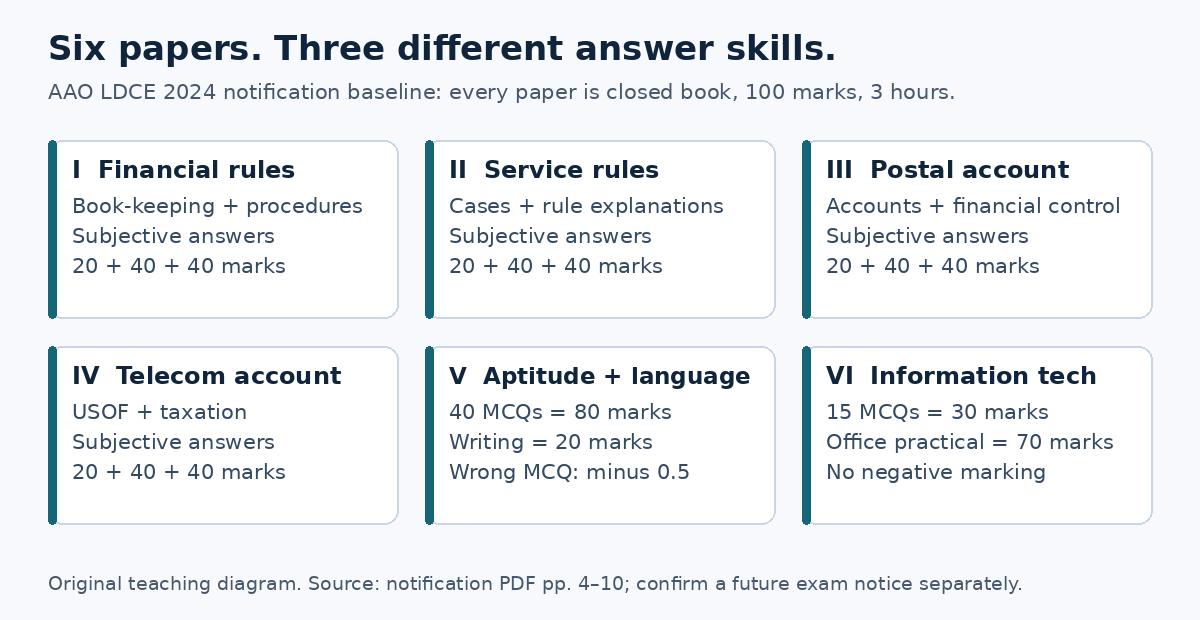
All six papers are without books. Each carries 100 marks and has a three-hour session in the notified calendar. Papers I–IV require written subjective answers. They are not four collections of MCQs. You must learn to show a calculation, explain a principle, apply a rule to the given facts and reach a reasoned conclusion.
| Paper | What you must produce |
|---|---|
| I: Financial Rules and Procedures & Book-keeping | One compulsory numerical question, then two answers from each of two groups of three questions. Marks: 20 + 40 + 40. |
| II: Service Rules | One compulsory case study or numerical question, then two answers from each theoretical group. Marks: 20 + 40 + 40. |
| III: Postal Account | One compulsory case study, numerical question or short notes, plus the specified choices in two groups. Marks: 20 + 40 + 40. |
| IV: Telecom Account, USOF and Taxation | One compulsory case study or numerical question and the specified theoretical choices. Marks: 20 + 40 + 40. |
| V: Logical, Analytical & Quantitative Abilities and Language Skills | 25 quantitative/data MCQs, 15 verbal/reading MCQs, a précis, an official letter and an office note. |
| VI: Information Technology | 15 MCQs plus outputs in Microsoft Excel, Word and PowerPoint, saved and printed as directed. |
The scheme expects clear, coherent subjective answers with references to relevant provisions where applicable. Learning only a rule number is insufficient: you also need its scope, conditions and effect. Equally, inventing a rule number makes an answer less reliable. In study, record the exact reference and practise recalling it alongside the principle.
Paper VI is a production task. In the notified scheme, the MCQ responses must be reproduced completely in Microsoft Word according to the question instructions. The practical allocation is Excel 30 marks, Word 20 and PowerPoint 20. Saving the correct output and checking the print instructions are part of completing the task.
3. Worked example: calculate the Paper V score
Fictional practice result: A learner answers 28 MCQs correctly, 8 incorrectly and leaves 4 blank. Their précis, letter and note receive 5, 5 and 4 marks respectively. Find their total.
- Check the question count: 28 + 8 + 4 = 40 MCQs.
- Correct answers: 28 × 2 = 56 marks.
- Incorrect answers: 8 × 0.5 = 4 marks deducted.
- Blank answers: 4 × 0 = 0.
- MCQ score: 56 − 4 = 52 out of 80.
- Writing score: 5 + 5 + 4 = 14 out of 20.
- Total: 52 + 14 = 66 out of 100.
The penalty is half a mark for an incorrect response, not half of the two marks awarded for a correct response. For Paper VI, the notification expressly specifies no negative marking; do not transfer the Paper V penalty to it. The writing maxima in Paper V are 7 for the précis, 7 for the letter and 6 for the note.
The notification lists qualifying marks in each subject of 30% for SC, ST and PwBD categories, and 40% for other categories. This is a minimum subject-wise condition for eligible candidates to be considered for the vacancy-year merit list. It is not a promise of selection, and a strong total does not erase a failure to meet a required minimum in one paper.
4. Keep a rule-version record
Annexure F includes amendments, rules and orders issued up to three months before the notification date. The ordinary date calculation gives 19 June 2024. The same annexure explicitly names the Delegation of Financial Powers Rules, 2024. Those rules were notified on 22 March 2024, published in the Gazette dated 26 March 2024, and came into force on 1 April 2024, before the cutoff. No chronology exception is needed for their inclusion. Do not silently replace DFPR 2024 with the 1978 rules, or silently move the cutoff for every other topic.
For each rule topic, keep four fields: the source title, the exact rule or paragraph, the amendment date and the examination baseline to which you are applying it. A modern website can contain useful current operational information while being unsuitable evidence for a historical examination cutoff. The 6 November corrigendum also changes some chapter references and adds topics, so a copy of the original annexure alone is incomplete.
Worked evidence decision: A handout labels establishment as FHB Volume I Chapter X. The original annexure did use that label, but the 6 November corrigendum changes it to Chapter IX. Your study record should use the corrected Chapter IX and note the corrigendum as its authority. Repeating the older label merely because the handout was printed recently is not a valid verification method.
5. Turn a study session into visible output
Use this sequence: understand one concept, solve an unseen example without help, check the complete working, then record why any error occurred. An accounting lesson should leave you with a balanced statement or a checked calculation. A rule lesson should leave you with a source-checked explanation and a short applied case. An IT lesson should leave you with an actual saved document, spreadsheet or presentation.
For an illustrative three-hour subjective rehearsal, reserve 15 minutes to read and choose questions, 150 minutes for five 20-mark answers and 15 minutes to review. That gives 30 minutes per answer. This is a teaching plan, not an official time allocation. Adjust it using evidence from your own practice: a numerical question may need a different share from an explanatory one.
6. Practice, then check
- Paper V: 31 correct, 6 wrong and 3 blank MCQs; writing marks are 6, 5 and 4. Calculate the total.
- Paper VI: 12 of 15 MCQs are correct; practical scores are 24 in Excel, 16 in Word and 15 in PowerPoint. Calculate the total.
- A learner says, “All papers are closed book, so there is no need to practise on a computer.” Explain the mistake in two sentences.
- A website calls this “the AAO 2025 syllabus” because the notified examination was scheduled in January 2025. What source label should your notes use?
Complete solutions
- 31 × 2 − 6 × 0.5 = 62 − 3 = 59. Writing = 6 + 5 + 4 = 15. Total = 74/100. The three blanks earn zero.
- MCQs = 12 × 2 = 24. No deduction applies to the other three. Practical = 24 + 16 + 15 = 55. Total = 79/100.
- Closed book restricts reference material; it does not change the required mode of response. Paper VI expressly requires Microsoft Office practical outputs, so knowledge must be practised through doing.
- Use AAO LDCE 2024 notification, dated 19 September 2024, as corrected. Separately record the scheduled dates, 8–11 January 2025; do not invent a syllabus revision from the year of those dates.
Common mistakes
- Assuming all six papers have the same question type.
- Counting a wrong Paper V MCQ as a one-mark penalty.
- Preparing only MCQs for subjective accounting and rules papers.
- Applying a current amendment without checking the examination baseline.
- Confusing minimum qualifying marks with guaranteed selection.
Summary and next step
Prepare three capabilities together: reasoned written answers, accurate objective work and usable computer outputs. Keep the notification, syllabus and corrigendum connected in your notes. Next, learn the accounting equation so that every later journal entry and statement has a checkable foundation.