AAO Lesson 006: From source documents to one defensible accounting entry
Study baseline: AAO LDCE 2024 notification dated 19 September 2024 and its corrigenda, including 6 November 2024. That examination was scheduled for 8–11 January 2025. The target examination year has not been specified. Check the official notification and amendments for your examination sitting; this is not a claim that the 2024 notice is the current syllabus for a later examination.
AAO · Lesson 006 · English
From source documents to one defensible accounting entry
Study time: about 80 minutes including practice. Prerequisites: AAO-002, AAO-003.
Learning outcomes
- Separate economic events from duplicate or corroborating documents.
- Prepare and explain purchase, agreed correction and settlement entries from a dated evidence file.
- Reconcile the supplier account and identify what incomplete evidence cannot establish.
1. The job is to identify events, not count papers
An invoice, delivery record, bank debit, supplier receipt and monthly statement can all concern the same purchase. Posting each document as a new expense would multiply one economic event into several expenses. The opposite mistake is also possible: seeing one payment and overlooking the earlier credit purchase. Your first task is to reconstruct what happened; your second is to record each distinct event once.
This lesson uses original commercial book-keeping examples to develop the evidence skills needed for AAO Paper I. It does not prescribe a government voucher form, retention period or sanction procedure. Those require the relevant government manual. Here, a source document is evidence about an event; an accounting voucher is the dated record explaining the debit, credit, amount and supporting references used for the entry. NCERT describes these concepts in Chapter 3, sections 3.1–3.1.1. The forms and cases below are our own teaching designs.
Keep three dates separate: the date printed on a document, the date of the economic event and the date the entry is prepared. They may coincide, but do not assume that they do. A document prepared later can support an earlier event. Equally, a document prepared in advance does not prove that the event has already occurred.
2. Read a document in a disciplined order
| Question | What the answer controls | What it does not prove by itself |
|---|---|---|
| Which entity's books are we keeping? | The perspective of every debit and credit. | A supplier's debit is not automatically our debit. |
| What event is evidenced? | Purchase, return, price correction, payment, receipt or another event. | A reminder or duplicate copy is not a fresh transaction. |
| When did that event occur? | The dated entry under the stated accounting assumptions. | The printing date is not always the recognition date. |
| What amount is supported? | Quantity, price, adjustment and balance calculation. | A typed total is not correct merely because it is on an invoice. |
| Which reference links it to previous records? | Matching and prevention of duplicate entries. | Equal amounts alone do not establish a match. |
Use both identifiers and substance. Two invoices may have the same amount but refer to different deliveries. Conversely, an invoice and payment may have different amounts because a credit note reduced the debt. An amount-only search can therefore create both false matches and missed matches.
An accounting voucher should let another reader reproduce your reasoning. For our exercises, record the voucher number, event date, accounts, amounts, narration and source references. A narration such as “being adjustment” is too vague. “Supplier price correction against invoice M241; credit note CN11” explains which obligation changed and why.
3. Worked file: one purchase, one correction and one settlement
Facts and assumptions. Maple Repair is a fictional private training business. We keep its books, not the supplier's books. There are no taxes, discounts, opening supplier balances or other transactions in this example. Materials are delivered, accepted and completely used on 3 May 2024, so their cost is treated as an expense in this teaching case.
| Reference | Date | Evidence |
|---|---|---|
| Invoice M241 and delivery record D83 | 3 May | Materials bought on credit for ₹8,400; delivered, accepted and used that day. |
| Email copy M241-COPY | 4 May | An exact copy of invoice M241, sent because the first email was not found. |
| Supplier credit note CN11 | 6 May | An agreed ₹900 reduction of the price on M241. No physical return occurs. |
| Bank payment P106 | 10 May | ₹7,500 paid against the balance on M241. |
| Supplier receipt R77 | 11 May | Acknowledges that same ₹7,500 payment, received on 10 May. |
| Supplier statement S5 | 31 May | Shows invoice ₹8,400, credit ₹900, payment ₹7,500 and closing balance zero. |
Step A: construct the event register
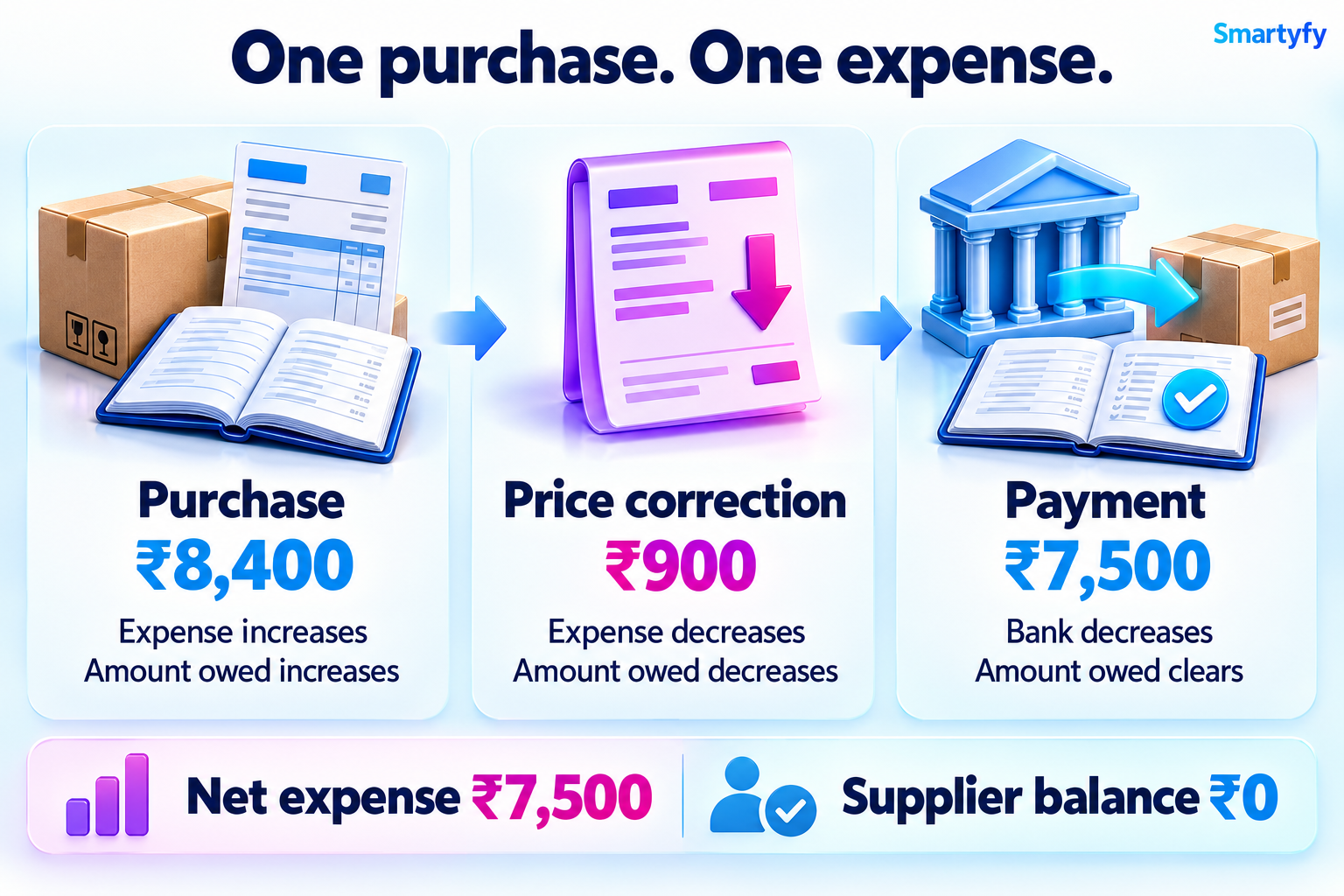
There are three accounting events: purchase/use, agreed price correction and settlement. There are seven documents or records, grouped into six evidence rows. The duplicate, receipt and statement support or repeat those three events; they do not create three more purchases or payments.
| Date and voucher | Debit | Credit | Amount | Why |
|---|---|---|---|---|
| 3 May, V01 | Materials expense | Supplier payable | ₹8,400 | Cost has been incurred and used; payment is still owed. |
| 6 May, V02 | Supplier payable | Materials expense | ₹900 | The agreed price reduction lowers both the obligation and the cost previously recorded. |
| 10 May, V03 | Supplier payable | Bank | ₹7,500 | Settlement removes the remaining liability and reduces bank funds. |
The supplier issues a “credit note” because of its own accounting perspective. In Maple's books the liability decreases, so Supplier payable is debited. The document's name is not an instruction to credit the supplier account in every entity's books.
Step B: prove the result through a supplier account
| Debit date/reference | Debit amount | Credit date/reference | Credit amount |
|---|---|---|---|
| 6 May, Materials expense, V02 | ₹900 | 3 May, Materials expense, V01 | ₹8,400 |
| 10 May, Bank, V03 | ₹7,500 | ||
| Total | ₹8,400 | Total | ₹8,400 |
Closing supplier balance is zero. Net materials expense is 8,400 − 900 = ₹7,500. Bank decreases by ₹7,500. Each journal balances, and aggregate journal debits and credits both equal 8,400 + 900 + 7,500 = ₹16,800. The total journal movement is not the expense: summing entries without considering account direction would misstate the result.
Step C: test a plausible wrong answer
A learner records the invoice correctly, ignores CN11, and debits Materials expense again when paying ₹7,500. The books then contain expense ₹15,900 and a supplier liability ₹8,400, although the bank movement is right. The correct expense is ₹7,500, so both expense and liability are overstated by ₹8,400. A correct bank figure has not made the accounts correct.
To repair the described books, first record the omitted price correction: debit Supplier payable ₹900, credit Materials expense ₹900. Next reclassify the settlement wrongly charged as an expense: debit Supplier payable ₹7,500, credit Materials expense ₹7,500. Do not credit Bank again: the actual payment was already recorded. The two repairs reduce the liability and expense by ₹8,400 each without changing cash.
4. A date conflict must be resolved from the facts
Suppose Maple receives an equipment invoice for ₹24,000 dated 15 May. Delivery and acceptance take place on 16 May. The exercise expressly states that ownership and the obligation arise on acceptance, and no advance is paid. Bank payment follows on 20 May.
Under those stated assumptions, the 16 May entry is Equipment debit ₹24,000, Supplier payable credit ₹24,000. On 20 May, debit Supplier payable and credit Bank by ₹24,000. The invoice date alone does not override the exercise's explicit event facts. The acquisition is also an asset in this case, whereas the completely used materials in the earlier case were an expense. Similar-looking invoices can represent different account effects.
If a real file does not establish when ownership, acceptance or the obligation arose, record the uncertainty and seek the relevant evidence or applicable accounting rule. Do not make the example's stated assumption into a universal rule that all purchases are recognised only on physical delivery. This lesson teaches the reasoning method, not every possible purchase contract.
5. Graded practice
Exercise A: classify the documents
A fictional business accepts and uses consumables for ₹3,600 on 5 June. The invoice is dated 4 June. The exercise states that its obligation arises on acceptance. It pays on 6 June. A duplicate invoice arrives on 8 June and a zero-balance supplier statement on 10 June. List the entries and explain which documents create no additional entry.
Exercise B: reconcile quantity and price evidence
An invoice charges 20 units at ₹260, total ₹5,200. Only 18 units are accepted and used. The supplier agrees that the missing two units will not be supplied and issues a credit note for ₹520. Assume the original ₹5,200 invoice was already entered as Consumables expense debit, Supplier payable credit. Nothing has been paid. Calculate the corrected expense and liability and give the correction entry.
Exercise C: decide what the evidence cannot prove
A bank statement shows a debit of ₹4,800 labelled “transfer”. A draft voucher describes it as “office repairs”, but the invoice and recipient details are missing. State what is known, what is unknown and why inventing an expense description is not an acceptable solution.
Exercise D: write a reasoned answer
In about 120–160 words, explain why entering every paper in Maple's six-row evidence file would be wrong. Include the three correct events, the supplier balance check and the treatment of the supplier's credit note. The word range is instructional, not an official AAO requirement.
6. Complete solutions
A. 5 June: Consumables expense debit ₹3,600, Supplier payable credit ₹3,600. 6 June: Supplier payable debit ₹3,600, Bank credit ₹3,600. The obligation and consumption occur on 5 June under the supplied facts; the earlier printing date is not the recognition event. The duplicate and statement support existing entries and create none. Closing supplier balance is zero; expense and bank payment are each ₹3,600.
B. Accepted cost = 18 × 260 = ₹4,680. Missing quantity = 2 × 260 = ₹520. Debit Supplier payable ₹520 and credit Consumables expense ₹520. Corrected expense and unpaid liability are both 5,200 − 520 = ₹4,680. Because the original entry already exists, recording a fresh ₹4,680 purchase would duplicate it. The agreed credit note supports this correction; do not silently assume acceptance of a deduction in an unresolved real dispute.
C. The statement supports a ₹4,800 outflow from the bank account. It does not, by itself, establish whether this was an expense, asset acquisition, liability settlement, advance, internal transfer or unauthorised event. Identify the recipient, payment reference, purpose and related records. Preserve the unmatched item for investigation using the applicable accounting procedure; this exercise does not authorise a particular government suspense head. A made-up repairs charge would conceal uncertainty and could distort both expenses and another account.
D. Model answer. The evidence file groups seven documents or records into six rows, but contains only three accounting events. The invoice and delivery record establish the ₹8,400 credit purchase of materials used by Maple. The duplicate invoice repeats that event. The supplier's agreed ₹900 credit note reduces the cost and the amount owed, so Maple debits its supplier liability and credits materials expense. The ₹7,500 bank payment settles the remaining liability. The later receipt acknowledges that payment and the statement summarises the account; neither creates another entry. The supplier account therefore has a credit of ₹8,400 and debits of ₹900 and ₹7,500, leaving no balance. Net expense and bank outflow are each ₹7,500. The direction of Maple's entry follows the effect in Maple's books, rather than the word “credit” printed on the supplier's document.
7. Error checks and summary
- Wrong perspective: identify whose books are being prepared before choosing the side of an account.
- Duplicate posting: match event references, dates and purpose; do not count documents as events.
- Payment charged twice: settlement of an existing payable reduces that payable rather than creating the same cost again.
- Unexplained date choice: state the event facts and accounting assumption supporting the date.
- Unsupported certainty: a missing document calls for an evidence question, not an invented narration.
You have mastered this lesson when another reader can follow your event register, reproduce each entry and reconcile the outstanding balance without asking which document you silently ignored. In the next lesson, use the same discipline to separate the period in which cash moves from the period in which income or expense belongs.