AAO Lesson 011: Classify acquisition costs, repairs and receipts
Study baseline: AAO LDCE 2024 notification dated 19 September 2024 and its corrigenda, including 6 November 2024. That examination was scheduled for 8–11 January 2025. The target examination year has not been specified. Check the official notification and amendments for your examination sitting; this is not a claim that the 2024 notice is the current syllabus for a later examination.
AAO · Lesson 011 · English
Classify acquisition costs, repairs and receipts
Study time: about 90 minutes including practice. Prerequisites: AAO-006, AAO-007, AAO-010.
Learning outcomes
- Build an equipment cost from directly attributable items while separating operating costs.
- Explain why invoice size, payment timing and the word repair do not decide classification.
- Trace classification errors through profit, asset balances and a correcting entry.
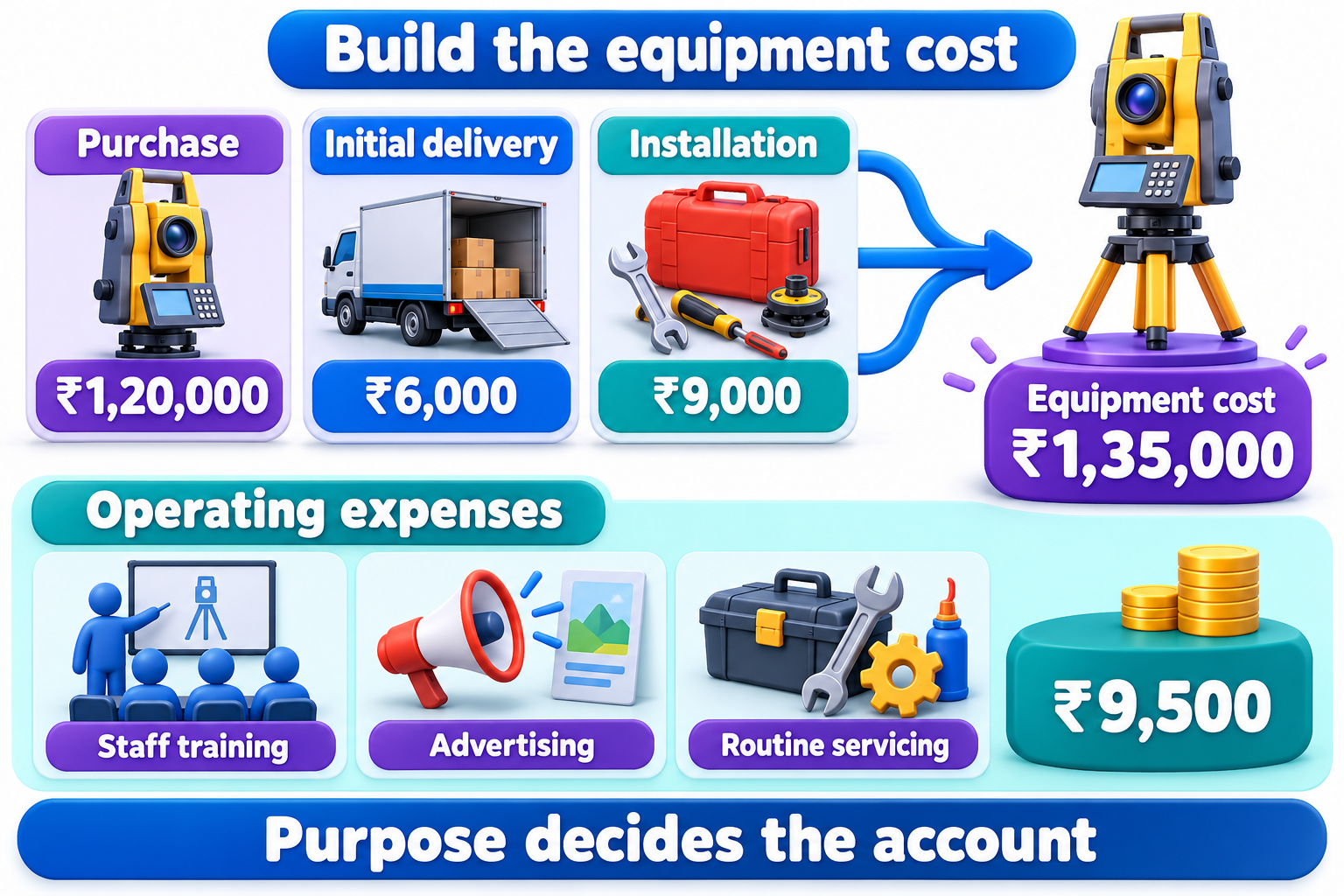
1. Classify the purpose, then choose the account
A payment of ₹20,000 does not become capital expenditure because it is large, and a payment of ₹500 does not automatically become an expense because it is small. First establish what the business obtained. Did it acquire equipment for continuing use, pay for an ordinary operating service, settle an existing liability, or withdraw funds for its owner? Those are different accounting events even when all four use Bank.
Lessons 006 and 010 showed individual purchases and a wrong equipment entry. This lesson goes further: one acquisition file contains several costs with different purposes. You must assemble the appropriate asset cost, identify expenses that happen around the purchase but do not belong in that cost, and prove the effect of a classification error.
These are original commercial-accounting exercises supporting AAO Paper I. They are not instructions for choosing a government capital head or exercising spending powers. The broad capital/revenue distinction is supported by NCERT section 8.2. For the specific equipment-cost boundary, the fictional business uses the selected principles of ICAI AS 10, revised 2016. AS 10 is supporting technical clarification here; the AAO notification does not separately name this entire standard as a compulsory block.
2. Four questions that prevent a shortcut answer
- Whose books and what purpose? A computer acquired for the business's own continuing use is different from an identical computer bought by a computer dealer for resale. The object alone does not name the account.
- What benefit or obligation is evidenced? An asset claim needs a supportable basis. Under the selected AS 10 principles, probable future economic benefits flowing to the business and reliable measurement of the cost are required. A manager's hope that an advertisement will help for years is not enough to add advertising to a machine's cost.
- What does the cost do? Costs necessary to bring the equipment to its intended location and operating condition can form part of acquisition cost. Staff training and launching a service are different activities. Ordinary servicing is different again.
- Has the related event already been recorded? Paying an equipment supplier later reduces a payable; it does not create the equipment a second time. Borrowing to fund the purchase creates a loan, not sales revenue.
AS 10 paragraphs 7, 12 and 16–21 provide the selected recognition, servicing and cost boundaries. Their application depends on facts. Labels such as “installation”, “repair” or “project expense” are clues to investigate, not substitutes for the invoice detail, purpose and actual work.
3. Worked file: Cedar Mapping Services
Cedar is a fictional private service business. At 1 May 2024 its only balances are Bank ₹2,50,000, proprietor's Capital ₹2,00,000 and Loan ₹50,000. All following payments use Bank. No GST, other taxes, discounts, restoration obligations, borrowing costs or other transactions apply. The acquisition meets the stated asset-recognition conditions. Cedar uses the cost model in this case. Costs and services below are reliably documented. The training, advertising and servicing are completed and consumed in May; none includes a prepayment for a future period.
| Item | Amount | Precisely stated purpose |
|---|---|---|
| Survey equipment purchase | 1,20,000 | Equipment acquired for several years of the business's own service work. |
| Initial delivery | 6,000 | Transport necessary to bring this equipment to the intended operating site. |
| Installation | 9,000 | Necessary assembly and installation before the equipment is capable of the intended operation. |
| Operator training | 4,000 | Training staff to use the equipment; no separate asset is acquired. |
| Service-launch advertising | 3,000 | Advertising the business's new service, rather than preparing the equipment itself. |
| Routine servicing | 2,500 | Ordinary servicing after the equipment is available for use; no qualifying replacement or additional component. |
During May, Cedar earns and collects service fees of ₹22,000. It also receives ₹8,000 for a separate job that will be performed entirely in June. At 31 May none of that advance has been earned. The case supplies a correctly determined May depreciation charge of ₹2,250; you are not asked to select a life, residual value, rate or starting date. There is no impairment. Later lessons examine those depreciation decisions.
Step A: assemble the equipment cost
Equipment cost = purchase ₹1,20,000 + necessary initial delivery ₹6,000 + necessary installation ₹9,000 = ₹1,35,000. All three help acquire or prepare the same equipment for its intended operation. Separate invoices do not necessarily mean separate expenses.
Step B: separate the period services
Training ₹4,000 + launch advertising ₹3,000 + routine servicing ₹2,500 = ₹9,500 of operating expenses in this case. Paying them near the purchase date does not turn them into equipment. Their exclusion follows the stated nature of the activities, not a numerical size threshold. Total cash paid is 1,35,000 + 9,500 = ₹1,44,500.
Do not generalise the servicing answer to every replacement or major inspection. AS 10 has separate requirements for such situations. Here the facts expressly say ordinary servicing and no qualifying replacement, so those additional rules are not needed to decide the case.
4. Record the effects without losing the evidence
| Event | Debit | Credit | Amount |
|---|---|---|---|
| Equipment purchase | Equipment | Bank | 1,20,000 |
| Necessary initial delivery | Equipment | Bank | 6,000 |
| Necessary installation | Equipment | Bank | 9,000 |
| Staff training | Training expense | Bank | 4,000 |
| Launch advertising | Advertising expense | Bank | 3,000 |
| Ordinary servicing | Repairs and servicing expense | Bank | 2,500 |
| May services earned and collected | Bank | Service revenue | 22,000 |
| June job advance received | Bank | Customer advance | 8,000 |
| Given May depreciation | Depreciation expense | Accumulated depreciation—equipment | 2,250 |
The accumulated-depreciation account keeps the equipment's original ₹1,35,000 cost visible while separately recording the ₹2,250 reduction in carrying amount. It is a deduction from the related asset, not a loan owed to a third party. Net equipment is ₹1,32,750. This presentation implements the supplied charge; it does not claim that ₹2,250 is a statutory or universally correct monthly depreciation amount.
The customer advance is also not interchangeable with the loan. Both are liabilities in this case, but one relates to an unperformed customer job and the other to financing. Neither is May service revenue. Likewise, the ₹2,00,000 opening proprietor capital is an ownership balance, not revenue earned during May.
5. Prove the cash, profit and position separately
| Question | Working | Answer |
|---|---|---|
| What is in Bank? | 2,50,000 − 1,44,500 + 22,000 + 8,000 | 1,35,500 |
| What is May profit? | 22,000 − 9,500 − 2,250 | 10,250 |
| What is equipment's carrying amount? | 1,35,000 − 2,250 | 1,32,750 |
| Total assets | Bank 1,35,500 + net equipment 1,32,750 | 2,68,250 |
| Liabilities and capital | Loan 50,000 + customer advance 8,000 + capital 2,00,000 + profit 10,250 | 2,68,250 |
Bank has fallen by ₹1,14,500, but that is not the business's loss. Much of the money bought equipment. Conversely, the ₹8,000 advance increases Bank without increasing May profit. These are specific explanations for different answers, not contradictions.
One more check uses the full account balances before closing revenue and expense accounts. Debits are Bank 1,35,500, Equipment 1,35,000, Training 4,000, Advertising 3,000, Servicing 2,500 and Depreciation expense 2,250: total ₹2,82,250. Credits are Capital 2,00,000, Loan 50,000, Revenue 22,000, Customer advance 8,000 and Accumulated depreciation 2,250: also ₹2,82,250. The balance-sheet asset total is lower because expenses are closed into profit and depreciation is presented as an asset deduction.
6. A balanced entry can put the cost in the wrong place
Suppose a draft accountant debits Equipment for all ₹1,44,500 of the six payments and credits Bank correctly. The supplied depreciation entry is correctly recorded separately at ₹2,250. Draft equipment cost is too high by ₹9,500 and the three operating expenses are missing. Draft profit is 22,000 − 2,250 = ₹19,750, overstated by ₹9,500. Net equipment is 1,44,500 − 2,250 = ₹1,42,250, also overstated by ₹9,500. Bank is correct.
Repair the classification with Training expense debit ₹4,000, Advertising expense debit ₹3,000, Servicing expense debit ₹2,500 and Equipment credit ₹9,500. This is a compound correction, developed further in Lesson 012. Do not credit Bank again: the original payments already reduced it. Corrected profit returns to ₹10,250 and equipment cost to ₹1,35,000.
Another draft could make the opposite error: charging the ₹9,000 necessary installation to ordinary installation expense. Under these facts, debit Equipment and credit that expense by ₹9,000. Profit and asset cost were each understated by ₹9,000 before correction, with the stipulated depreciation amount otherwise unchanged. In a real file, an incorrect asset cost can also affect a depreciation calculation; this exercise holds the supplied charge fixed to isolate the classification effect.
7. Graded decisions: explain before calculating
- Same object, different purpose. A computer dealer buys a laptop for ₹36,000 expressly for resale. A surveying firm buys an identical laptop for its own continuing operations. Are both Equipment?
- Credit acquisition. A machine satisfying the stated recognition conditions costs ₹45,000, delivered and acquired today with the whole price still payable. A learner says no capital item exists until payment. Give the correct entry and reason.
- Ambiguous description. An invoice says “overhaul ₹25,000” and nothing else. Is its size sufficient evidence of capital expenditure? What facts are needed?
- Separate refundable deposit. Cedar pays a refundable security deposit of ₹12,000 that is contractually recoverable separately from the equipment price. The problem states it is not consideration for acquiring the equipment. Does it increase equipment cost or May expense?
- Correct an error. Necessary initial transport ₹1,800 was debited to Transport expense and credited to Bank. It should form part of an acquired machine's cost under the supplied facts. Correct the entry without another bank movement.
- Rebuild a cost schedule. An acquired machine costs ₹72,000; necessary installation is ₹4,800 and initial delivery ₹2,200. Separately, ordinary staff training costs ₹1,500 and a completed launch advertisement ₹2,500. Calculate the asset cost, immediate expenses and total cash paid. There are no taxes or other adjustments.
Complete solutions
- No. Purpose matters. The dealer's laptop is merchandise for resale, whereas the surveying firm's laptop is equipment for its own use, assuming recognition conditions are met. Goods purchased for resale are handled through the chosen inventory/purchases system; their entire cost is not automatically a current expense if goods remain unsold.
- Debit Equipment ₹45,000; credit Supplier payable ₹45,000. The asset and obligation arise under the stated acquisition facts. Later payment will debit the payable and credit Bank. Payment timing does not change the nature of the acquisition.
- No. Find out what work was done: ordinary maintenance, replacement of a component, additional capacity, or another activity; establish relevant recognition conditions and any old component that might need removal. Do not invent a monetary cutoff or treat every large repair as an asset. The information is insufficient for a final classification.
- Debit Refundable deposit ₹12,000; credit Bank ₹12,000. A separately recoverable deposit is an asset of its own under the stipulated facts. It is neither equipment purchase consideration nor an expense already consumed. Do not transfer this commercial answer mechanically to a government account head.
- Debit Equipment ₹1,800; credit Transport expense ₹1,800. Bank was correct and remains unchanged. The correction increases the recognised equipment cost and removes the wrong expense.
- Asset cost = 72,000 + 4,800 + 2,200 = ₹79,000. Expenses = 1,500 + 2,500 = ₹4,000. Cash paid = ₹83,000. The three totals answer different questions; 79,000 + 4,000 independently checks the cash total.
8. Objective checks with explained distractors
Question A. In Cedar's stated case, equipment cost before depreciation is: (a) ₹1,20,000; (b) ₹1,35,000; (c) ₹1,44,500; (d) ₹1,32,750.
Answer: (b). Purchase, necessary delivery and installation make ₹1,35,000. Option (a) omits qualifying acquisition costs. Option (c) adds unrelated operating services. Option (d) is the carrying amount after the given depreciation, not original cost.
Question B. After the draft capitalises all six payments, which repair is appropriate? (a) Credit Bank ₹9,500 again; (b) debit the three expenses and credit Equipment ₹9,500; (c) debit Equipment again; (d) leave the entry because total debits equal credits.
Answer: (b). The error concerns classification, not the recorded bank outflow. Option (a) duplicates cash reduction; (c) increases the misstatement; (d) mistakes arithmetical agreement for correct accounting.
9. Write a reasoned examination explanation
Prompt. Explain why an acquisition file cannot be classified solely by the size or timing of its payments. Apply Cedar's figures and identify one limit of your answer.
Model answer. Classification follows the documented purpose and applicable recognition basis. Cedar's purchase ₹1,20,000, necessary delivery ₹6,000 and installation ₹9,000 form equipment cost of ₹1,35,000 under the stated commercial framework. Training, advertising and ordinary servicing of ₹9,500 are separate operating expenses, although paid around the acquisition. A later payment may simply settle an existing liability. Capitalising all six payments would overstate equipment cost and profit by ₹9,500 with the supplied depreciation charge held fixed; the correction changes Equipment and expense accounts, not Bank again. A vague overhaul description would require more evidence about the work and recognition conditions. This answer does not determine a government capital head, spending authority or a generally applicable depreciation amount.
Retain the method: identify purpose, read the facts, separate cost from expense and settlement, then prove both the financial effect and the correcting entry.