AAO Lesson 017: Build and reconcile an analytical petty-cash book
AAO · Lesson 017 · English
Build and reconcile an analytical petty-cash book
Study time: about 100 minutes including practice. Prerequisites: AAO-006, AAO-016.
Learning outcomes
- Analyse vouchers into distinct expense columns and reconcile cash remaining.
- Separate expense recognition from establishment and replenishment of the fund.
- Handle evidence-dependent discrepancies, duplicate vouchers and fund changes.
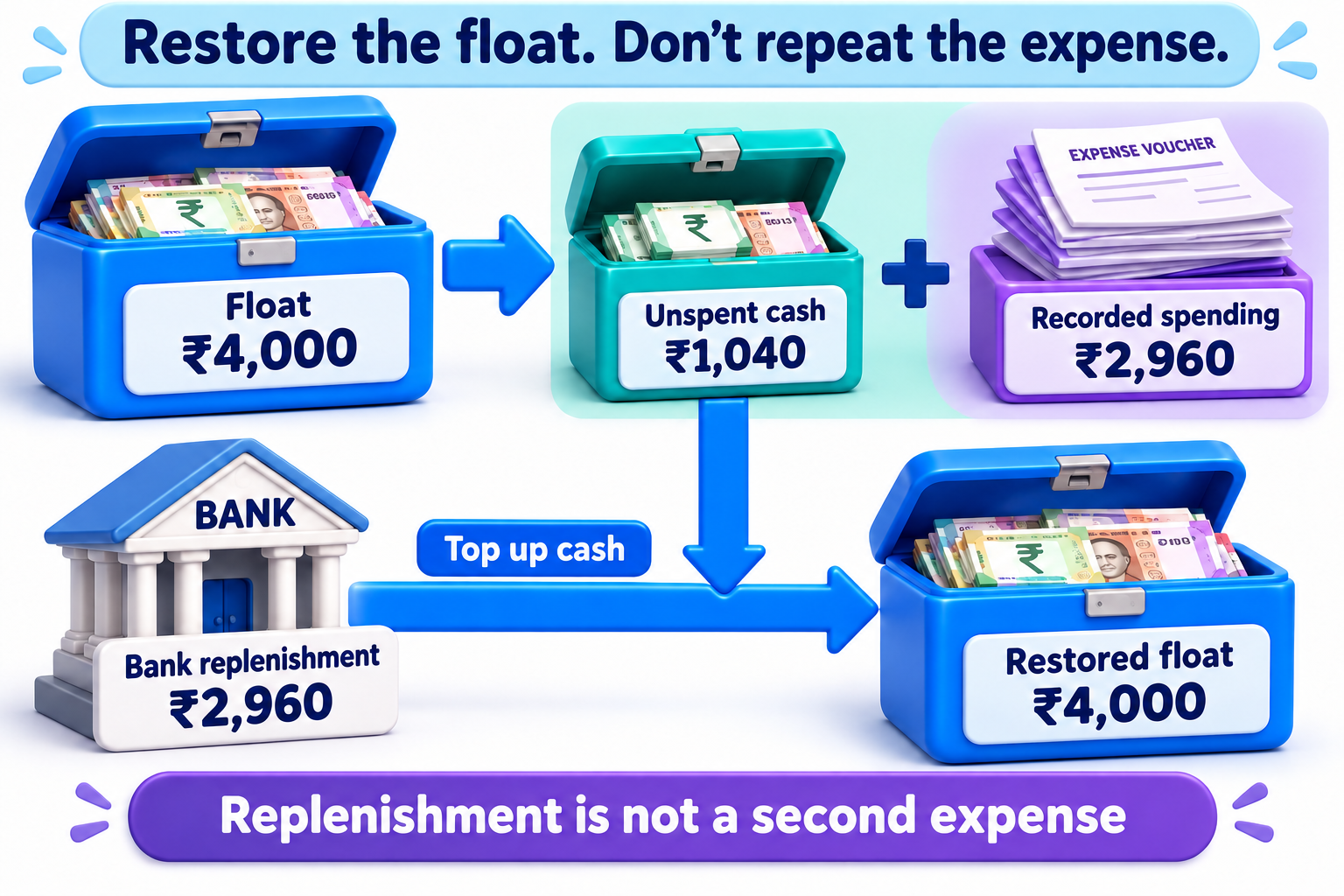
1. Know what the float represents
A petty-cash float is money set aside for small business payments. Establishing the float changes where the business holds its money; it does not create an expense. An expense arises from the supported use of resources. Replenishment supplies more money to the petty cashier after spending has been accounted for. Keeping these three events separate prevents the most common double count.
This lesson continues the debit and credit reasoning of lessons 006 and 016. You will build an analytical petty-cash book, prove its balance against the vouchers, post category totals, and distinguish a documented correction from an unexplained difference. The worked business, Maple Workshop, and every amount and question are fictional.
Scope and convention. This is commercial book-keeping, not a government imprest rule, prescribed form, cash limit or sanction power. Maple uses a separate Petty Cash ledger account and periodic expense posting. Every listed purchase is a completed current business service or a supply consumed in June. There is no unused stock, prepayment, tax, employee advance or private purchase. Under these facts, the analytical columns represent current expenses.
The conceptual source is NCERT Financial Accounting I, section 4.1.3, printed pages 109–114, PDF pages 11–16. Its discussion of analysis is on printed page 110/PDF 12, posting on printed page 111/PDF 13, and the journal illustration on printed page 113/PDF 15. Our cases apply those principles with original data.
2. Establish the evidence before entering numbers
At the start of 1 June, Maple has Bank ₹20,000 and Petty Cash nil. It transfers ₹4,000 from Bank to establish the float. The following ten supported payments are the complete June petty-cash activity. The voucher identifiers are unique. The date belongs to the actual payment, and the description explains its business purpose sufficiently to select a column.
| Date | Voucher | Supported payment | Amount | Analysis category |
|---|---|---|---|---|
| 3 June | J01 | Local travel to collect workshop materials | ₹180 | Travel |
| 5 June | J02 | Stationery used for June job sheets | ₹450 | Stationery and Printing |
| 7 June | J03 | Postage for dispatched business letters | ₹260 | Postage and Courier |
| 10 June | J04 | Completed courier delivery | ₹320 | Postage and Courier |
| 12 June | J05 | Completed workshop cleaning | ₹240 | Cleaning |
| 15 June | J06 | Business travel to a customer site | ₹210 | Travel |
| 18 June | J07 | Completed routine repair | ₹600 | Repairs |
| 21 June | J08 | Printing of June work instructions | ₹350 | Stationery and Printing |
| 24 June | J09 | Local business travel | ₹190 | Travel |
| 27 June | J10 | Envelopes used in June dispatches | ₹160 | Stationery and Printing |
Envelopes belong to Stationery and Printing in this exercise because the defined category includes consumed stationery. Their use for dispatch does not automatically turn the purchase into postage. State a consistent classification and use it throughout. A useful book preserves the trail from payment to voucher to category to ledger rather than merely producing a correct grand total.
3. Build the analytical petty-cash book
The receipt column records money entering petty cash. Each payment appears once in the total-paid column and again as analysis across expense columns. These are two descriptions of the same payment, not two payments. Here each voucher uses one category; a genuinely mixed voucher could be divided, provided its category amounts sum to the paid amount.
| Date and reference | Received | Paid | Travel | Stationery / Printing | Postage / Courier | Cleaning | Repairs | Cash remaining |
|---|---|---|---|---|---|---|---|---|
| 1 June Bank float | 4,000 | — | — | — | — | — | — | 4,000 |
| 3 June J01 | — | 180 | 180 | — | — | — | — | 3,820 |
| 5 June J02 | — | 450 | — | 450 | — | — | — | 3,370 |
| 7 June J03 | — | 260 | — | — | 260 | — | — | 3,110 |
| 10 June J04 | — | 320 | — | — | 320 | — | — | 2,790 |
| 12 June J05 | — | 240 | — | — | — | 240 | — | 2,550 |
| 15 June J06 | — | 210 | 210 | — | — | — | — | 2,340 |
| 18 June J07 | — | 600 | — | — | — | — | 600 | 1,740 |
| 21 June J08 | — | 350 | — | 350 | — | — | — | 1,390 |
| 24 June J09 | — | 190 | 190 | — | — | — | — | 1,200 |
| 27 June J10 | — | 160 | — | 160 | — | — | — | 1,040 |
| Totals | 4,000 | 2,960 | 580 | 960 | 580 | 240 | 600 | 1,040 closing |
Cross-cast the analysis: ₹580 + ₹960 + ₹580 + ₹240 + ₹600 = ₹2,960. Independently add the ten voucher amounts and obtain the same ₹2,960. The expected cash is ₹4,000 − ₹2,960 = ₹1,040. The running-balance column is a learning aid; it should never become negative in this fully funded cash example.
If a traditional two-sided presentation is required, place balance c/d ₹1,040 alongside the payment-side balancing amount to make both sides ₹4,000, then bring ₹1,040 down as the next opening balance. Balance c/d is cash retained, not an eleventh expense. Keep it outside the expense-analysis columns.
4. Post the economic effects only once
The following journal-equivalent schedule explains Maple’s stipulated periodic method. It is not an instruction to duplicate entries already posted from another book. The voucher rows accumulate evidence during June; the category totals are posted at period end. Posting every voucher to expense ledgers and then posting these totals would count expenditure twice.
| Date and stage | Debit | Credit | Reason |
|---|---|---|---|
| 1 June establish float | Petty Cash ₹4,000 | Bank ₹4,000 | One money asset increases as another decreases. |
| 30 June post verified expenses | Travel ₹580; Stationery and Printing ₹960; Postage and Courier ₹580; Cleaning ₹240; Repairs ₹600 | Petty Cash ₹2,960 | Recognise the five consumed categories and reduce recorded petty cash. |
| 30 June replenish after count | Petty Cash ₹2,960 | Bank ₹2,960 | Transfer money to restore the agreed ₹4,000 float. |
Each expense account receives a debit because the supplied facts establish current consumption. Petty Cash receives the corresponding credit because currency left that fund. Replenishment debits Petty Cash, not those expenses again. The initial transfer likewise cannot be charged to expense merely because it appears among Bank payments.
The three stages have total debits ₹4,000 + ₹2,960 + ₹2,960 = ₹9,920, matched by total credits ₹9,920. This is journal turnover, not expense. Debit turnover contains both transfers and consumption. Maple’s June expense remains ₹2,960.
5. Reconcile cash and explain the bank movement
First count actual currency and compare it with the expected ₹1,040. In the base case the count agrees, so reimbursement of ₹2,960 restores ₹4,000. The accompanying illustration expresses this simple restoration: ₹1,040 already held plus ₹2,960 newly supplied equals ₹4,000.
| Stage | Bank | Petty Cash | Combined money | Expense recognised |
|---|---|---|---|---|
| Opening | ₹20,000 | ₹0 | ₹20,000 | ₹0 |
| Float established | ₹16,000 | ₹4,000 | ₹20,000 | ₹0 |
| Expenses posted, before replenishment | ₹16,000 | ₹1,040 | ₹17,040 | ₹2,960 |
| After replenishment | ₹13,040 | ₹4,000 | ₹17,040 | ₹2,960 |
Bank outflow is ₹6,960, comprising the first ₹4,000 transfer and the ₹2,960 top-up. It is not ₹6,960 of expense. The independent proof is opening combined money ₹20,000 less actual expenditure ₹2,960 equals closing combined money ₹17,040. Replenishment changes the split between Bank and Petty Cash but leaves that combined amount unchanged.
A complete trial balance needs other opening accounts that this selected exercise does not provide. Do not invent capital or unrelated balances just to turn this reconciliation into a full set of financial statements.
6. Investigate differences without inventing their cause
Unknown shortage. Suppose physical currency is ₹1,010 while the book expects ₹1,040. The difference is ₹30. Recount, examine the cut-off, match vouchers, check arithmetic and establish whether any payment was omitted or duplicated. A difference alone does not prove theft, an employee debt or a particular expense.
If only the verified ₹2,960 is reimbursed, physical money becomes ₹1,010 + ₹2,960 = ₹3,970. The unexplained ₹30 remains. Do not call the float fully restored or silently reimburse ₹2,990 to hide the discrepancy. Any accounting treatment for the unresolved difference needs evidence and the applicable process, neither of which is supplied here.
Separate confirmed omission. Now discard the shortage scenario. In a new alternative, a verified additional ₹60 printing payment was made from petty cash, completely omitted from the book, and not included in any aggregate. Record debit Stationery and Printing ₹60, credit Petty Cash ₹60 if the original totals were already posted. Revised expenses are ₹3,020; the stationery category is ₹1,020; cash is ₹980. Reimburse ₹3,020 to restore ₹4,000. This correction follows evidence of an actual missing payment.
Duplicate voucher. In another independent alternative, J04 was entered and posted twice, although only one ₹320 courier payment occurred. Wrong expenses become ₹3,280 and wrong book cash ₹720; actual cash remains ₹1,040. Reverse only the duplicate: debit Petty Cash ₹320, credit Postage and Courier ₹320. The correction restores expenses ₹2,960 and book cash ₹1,040 without creating a cash receipt from an outside person.
7. Change the float without changing expense
The general transfer calculation is target float minus verified cash currently held. With Maple’s base-case ₹1,040 remaining, a ₹5,000 target requires ₹3,960: ordinary replenishment ₹2,960 plus a ₹1,000 increase in the fund. Debit Petty Cash ₹3,960 and credit Bank ₹3,960. Expense remains ₹2,960.
A reduced target of ₹3,000 instead requires ₹1,960: ₹2,960 spent less a ₹1,000 reduction in the target. The cashier still retains the existing ₹1,040, which becomes ₹3,000 after the transfer. These are alternatives, not successive June transactions. If verified cash exceeded a reduced target, returning the excess would be a transfer out of Petty Cash, not negative expense.
In an exam answer, identify whether the question asks for expenditure, reimbursement, closing currency or a revised float. They can be related without being identical. The shortcut “reimburse the amount spent” works only when the target is unchanged and the cash reconciliation contains no unresolved difference.
8. Five graded exercises with worked explanations
Exercise A Basic reconciliation 3 marks
A separate fund starts at ₹3,000. Verified current expenses are ₹2,000 and the count agrees with the book. Find cash remaining and the transfer needed to restore the same float.
Answer: cash remaining is ₹3,000 − ₹2,000 = ₹1,000 (1 mark). Reimbursement is ₹3,000 − ₹1,000 = ₹2,000 (1). The transfer debits Petty Cash and credits Bank; the ₹2,000 expense is recognised only once under the chosen posting method (1). Reimbursing ₹3,000 would overfund it.
Exercise B Diagnose a transfer 4 marks
Maple retains the base-case ₹1,040, but receives a fresh ₹4,000 instead of the calculated replenishment. Find the resulting currency and excess above the agreed float.
Answer: currency becomes ₹1,040 + ₹4,000 = ₹5,040 (1 mark). The excess is ₹5,040 − ₹4,000 = ₹1,040 (1). The correct replenishment would have been ₹2,960 (1). The extra transfer is money retained in the fund, not additional expense; a properly documented return would debit Bank and credit Petty Cash ₹1,040 (1).
Exercise C Repair a category 4 marks
J07’s ₹600 repair was posted to Cleaning. All other entries are correct. State the wrong category totals, correction and effect on total expenditure.
Answer: Cleaning is wrongly ₹240 + ₹600 = ₹840 and Repairs is nil (1 mark). Debit Repairs ₹600 and credit Cleaning ₹600 (1). This gives Cleaning ₹240 and Repairs ₹600 (1). Total expenses remain ₹2,960 and cash remains ₹1,040 before replenishment because the payment itself was recorded correctly (1).
Exercise D Trace an apparent omission 5 marks
A ₹60 printing receipt appears to lack an obvious standalone row. Investigation proves that it was already included in a supported combined voucher and the posted stationery aggregate. Should another expense entry be made?
Answer: no additional ₹60 should be posted (1 mark). Trace the receipt to the combined voucher (1), that voucher to the analysis row (1), and that row into the posted total (1). Improve the cross-reference if needed, while preserving the existing amount (1). A second debit to expense and credit to Petty Cash would overstate spending and understate cash. This evidence differs from the wholly omitted payment in section 6.
Exercise E Revise the target 5 marks
A ₹2,500 fund has spent ₹1,440, leaving verified cash ₹1,060. The business sets a new target of ₹3,200. Calculate the transfer and explain its parts.
Answer: transfer ₹3,200 − ₹1,060 = ₹2,140 (2 marks). It comprises ₹1,440 replenishment plus ₹700 increase in the target (1). Debit Petty Cash ₹2,140 and credit Bank ₹2,140 (1). The expense is still ₹1,440, not ₹2,140 or ₹3,200, because changing the amount of currency held does not consume resources (1).
9. Two multiple-choice checks
MCQ 1. After Maple’s correct base-case replenishment, which statement is true? A. Bank outflow and expense both equal ₹6,960. B. Petty Cash is ₹4,000 and expense is ₹2,960. C. Petty Cash is ₹6,960 because both transfers are receipts. D. Combined money is ₹20,000 because replenishment reverses expense.
Answer: B. A treats initial funding as consumption. C ignores the ₹2,960 paid out. D mistakes an internal transfer for recovery of spent money. The independent money proof gives ₹17,040, not ₹20,000.
MCQ 2. Actual cash is ₹1,010 against a ₹1,040 book balance, with no known cause. What follows? A. Debit employee receivable ₹30 immediately. B. Record printing expense ₹30. C. Investigate the ₹30 difference and keep it visible. D. Reimburse ₹2,990 and declare the records reconciled.
Answer: C. A and B invent a debtor or expense without evidence. D can restore physical currency while leaving the book error unexplained. A correct calculation does not establish the nature of an unexplained transaction.
10. A structured model answer
Question, 10 marks: “Using Maple’s base case, prepare the petty-cash analysis, calculate replenishment, explain the postings and prove closing money.”
- State scope and convention, 1 mark: the ₹4,000 float is an internal money transfer; all ten vouchers are current business expenses under periodic posting.
- Show analysis, 3 marks: Travel ₹580; Stationery and Printing ₹960; Postage and Courier ₹580; Cleaning ₹240; Repairs ₹600. Cross-cast to ₹2,960 and retain dated voucher references.
- Reconcile and replenish, 2 marks: expected and counted cash ₹1,040; transfer ₹2,960; restored Petty Cash ₹4,000.
- Explain entries, 2 marks: establish with Petty Cash debit and Bank credit ₹4,000; debit the five expenses and credit Petty Cash ₹2,960; replenish with Petty Cash debit and Bank credit ₹2,960. No duplicated expense.
- Prove money, 2 marks: Bank ₹13,040 plus Petty Cash ₹4,000 equals ₹17,040, also ₹20,000 less expenses ₹2,960. Bank outflow ₹6,960 is not the expense total.
Final self-check: have you distinguished vouchers from currency, analysis from additional payments, period totals from repeated postings, and evidence from assumptions? Those distinctions make the answer defensible even when the examiner changes the amounts.