AAO Lesson 027: Revise depreciation estimates using a dated evidence trail
AAO · Lesson 027 · English
Revise depreciation estimates using a dated evidence trail
Study time: about 110 minutes including practice. Prerequisites: AAO-026.
Learning outcomes
- Distinguish new useful-life or residual-value information from a mistaken calculation.
- Recalculate future charges from carrying amount and remaining service under explicit assumptions.
- Explain prospective treatment and identify evidence needed before changing consumption estimates.
1. A changed estimate is a new forecast, not a rewritten history
A depreciation schedule is built from estimates. Service records may later support a longer useful life, a lower residual amount or a different consumption pattern. Your task is to identify what changed, when it changed and which carrying amount remains to be allocated. Repeating the original formula with a new denominator can produce a polished but incorrect answer.
Scope. These original fictional cases use commercial accrual accounts, the cost model and administrative equipment with separate accumulated depreciation. Prior charges are correct unless a question explicitly identifies an error. There are no impairment losses, revaluations, new components, additions, taxes or disposals. A revision is supported by the stated evidence, not by a desire to reach a profit target. This is selected bookkeeping instruction under the dated AAO-2024 course baseline, not a universal standard-applicability or government-accounting rule.
For the stipulated treatment, a genuine estimate change affects the change period and relevant future periods. A calculation mistake is a different issue. Keep the distinction visible before calculating; the word “revised” on a spreadsheet does not tell you which event occurred.
2. The evidence file and the date of change
Aster Archive Services acquired an administrative scanning unit for ₹1,20,000, available from 1 April 2020. Initial expected useful life was six years and residual value ₹12,000. Straight-line depreciation was appropriate. Aster’s financial year ends on 31 March, and its recorded charges through 31 March 2023 are correct.
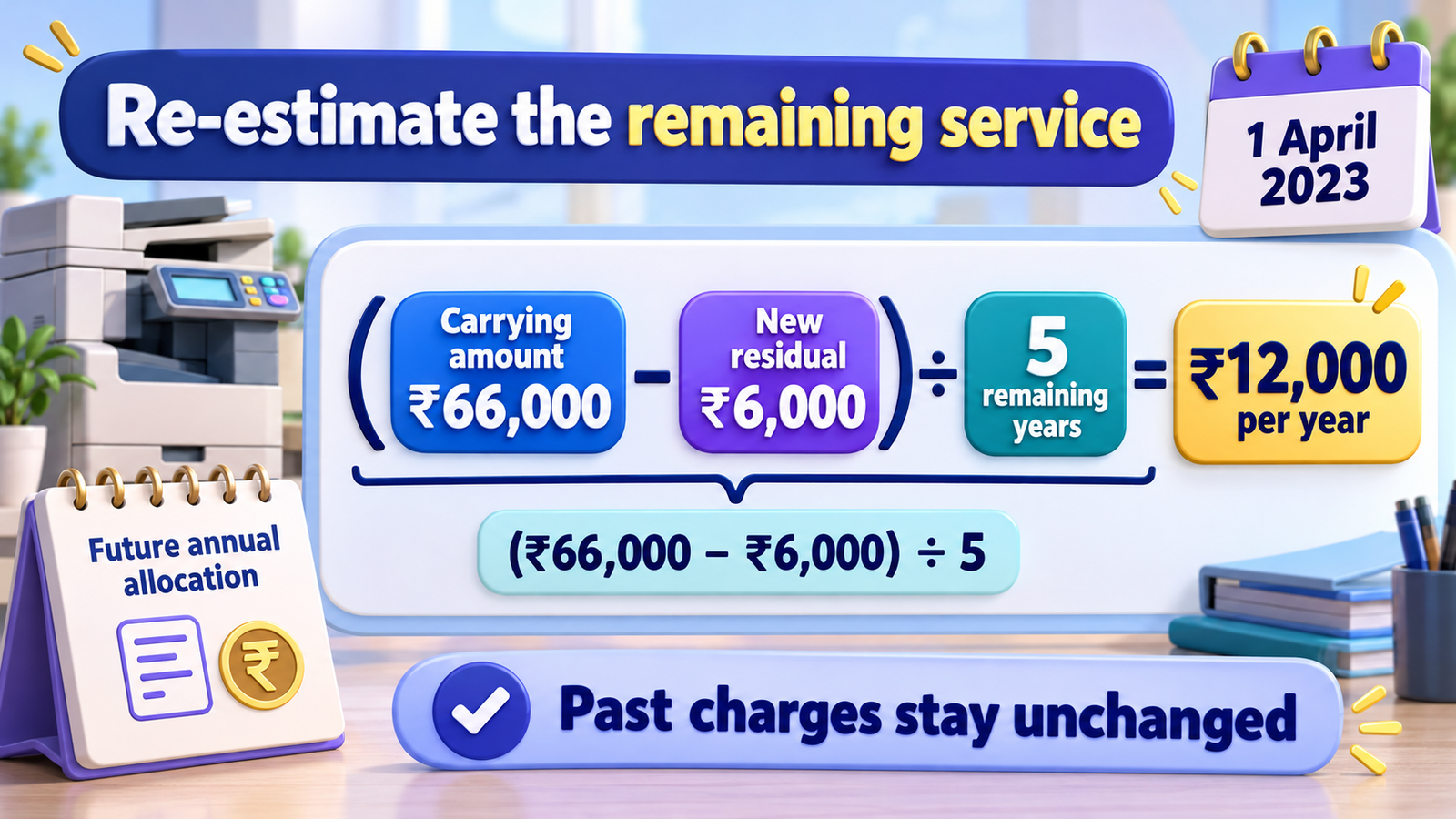
On 1 April 2023 a new service assessment becomes available and changes expectations from that date. Three years of operating records and a newly confirmed support arrangement indicate five further years of useful service, rather than the previously expected three. Updated end-of-service resale evidence supports a ₹6,000 net residual. The expected consumption during those remaining five years is even. No evidence available when earlier accounts were prepared was ignored, and the case stipulates no impairment.
| Question | Evidence supplied | Accounting significance |
|---|---|---|
| Was the original calculation wrong? | No; it used the then-reasonable six-year life and ₹12,000 residual correctly. | No mathematical error to reverse. |
| When did expectations change? | New assessment effective 1 April 2023. | The three completed years stay under their old estimates. |
| What is the remaining life? | Five years from the change date. | Use five, not eight and not the former three. |
| What remains at the end? | ₹6,000 net residual. | Deduct this from the change-date carrying amount. |
| Has the pattern changed? | Even consumption remains supported. | Keep straight-line while changing life and residual. |
An extension of useful life and a reduction in residual can occur together. The first tends to spread the remaining allocation over more periods; the second increases the amount remaining to allocate. Calculate both effects together instead of assuming that every longer life must produce a particular percentage reduction in expense.
3. Establish the unchanged starting point
The original annual charge was (₹1,20,000 − ₹12,000) ÷ 6 = ₹18,000. At 31 March 2023, three full charges total ₹54,000. Therefore the change-date carrying amount is ₹66,000. This is the bridge between the old workpaper and the new one.
| Year ended | Charge | Accumulated depreciation | Carrying amount |
|---|---|---|---|
| 31 March 2021 | ₹18,000 | ₹18,000 | ₹1,02,000 |
| 31 March 2022 | ₹18,000 | ₹36,000 | ₹84,000 |
| 31 March 2023 | ₹18,000 | ₹54,000 | ₹66,000 |
Do not credit ₹54,000 back to income because the equipment is expected to last longer. Those charges record the past allocations made using the then-current evidence. Nor is ₹66,000 a new invoice price: cost remains ₹1,20,000 in the asset ledger.
The unchanged balances need verification, not blind trust. Agree cost to the asset card, the three charges to previous schedules and accumulated depreciation to the ledger. If this reconciliation fails, resolve that difference separately before using the balance as the start of a prospective schedule.
4. Allocate only the amount that remains
At 1 April 2023 the remaining depreciable amount is ₹66,000 − ₹6,000 = ₹60,000. Divide it by the five remaining years: ₹12,000 per year. The service life now ends on 31 March 2028. That end date follows from the new five-year horizon, not from changing an old year’s label.
| Year ended | Opening carrying amount | Charge | Closing accumulated depreciation | Closing carrying amount |
|---|---|---|---|---|
| 31 March 2024 | ₹66,000 | ₹12,000 | ₹66,000 | ₹54,000 |
| 31 March 2025 | ₹54,000 | ₹12,000 | ₹78,000 | ₹42,000 |
| 31 March 2026 | ₹42,000 | ₹12,000 | ₹90,000 | ₹30,000 |
| 31 March 2027 | ₹30,000 | ₹12,000 | ₹1,02,000 | ₹18,000 |
| 31 March 2028 | ₹18,000 | ₹12,000 | ₹1,14,000 | ₹6,000 |
Full-life proof: past charges ₹54,000 + future charges ₹60,000 = ₹1,14,000, equal to cost ₹1,20,000 less the revised residual ₹6,000. Eight years of service will ultimately have occurred, but the five remaining years carry only the amount that remains after the three completed years.
A common wrong answer is (₹1,20,000 − ₹6,000) ÷ 8 = ₹14,250 for every year. Applied backwards it would replace past depreciation ₹54,000 with ₹42,750 and invent a ₹11,250 reversal. That treats a new estimate as if it had been known at acquisition. Applied only forwards for five years it would allocate ₹71,250 from a remaining depreciable amount of ₹60,000. Either use fails the reconciliation.
5. Entries, ledgers and financial effect
The assessment alone causes no immediate entry in Aster’s stipulated case. Update the dated asset schedule and supporting estimate record. During the year ended 31 March 2024 the new annual allocation is recorded: debit Depreciation expense ₹12,000 and credit Accumulated depreciation ₹12,000. At closing, debit Profit and loss ₹12,000 and credit Depreciation expense ₹12,000.
| Account | Debit side | Credit side | Equal totals |
|---|---|---|---|
| Equipment cost | 1 April 2023 Balance b/d ₹1,20,000 | 31 March 2024 Balance c/d ₹1,20,000 | ₹1,20,000 |
| Accumulated depreciation | 31 March 2024 Balance c/d ₹66,000 | 1 April 2023 Balance b/d ₹54,000; 31 March Depreciation expense ₹12,000 | ₹66,000 |
| Depreciation expense | 31 March Accumulated depreciation ₹12,000 | 31 March Profit and loss ₹12,000 | ₹12,000 |
The following year’s opening balances are cost ₹1,20,000 debit and accumulated depreciation ₹66,000 credit. The expense account opens at zero. The ₹54,000 net asset at 31 March 2024 independently agrees with ₹66,000 opening carrying amount less ₹12,000 current consumption.
If this year’s operating surplus before depreciation is ₹50,000, revised profit is ₹38,000. Continuing the old annual charge would have produced ₹32,000, so the current-year effect of the revision is ₹6,000 higher profit and carrying amount. This comparison explains the effect; it does not justify the change. Do not multiply ₹6,000 by five as a universal future benefit: the old schedule had only three years left, while the new one has five.
A concise case note could state that a dated service review extended remaining life to five years and reduced residual to ₹6,000; depreciation for 2023–24 is ₹12,000, ₹6,000 lower than under the former estimates, with ₹12,000 annually planned for the next four years if estimates remain unchanged. This is an original instructional note, not a complete statutory disclosure template. A reader should be able to reconstruct the change from the numbers.
6. A change during a year needs two time segments
Separate case: Meridian’s administrative equipment has a verified carrying amount of ₹42,000 on 1 April 2023. Its existing straight-line schedule has residual ₹6,000 and three remaining years, giving ₹12,000 annually. A new assessment changes expectations from 1 October 2023 only. At that date, residual becomes ₹4,000 and remaining life becomes four years. The case explicitly uses equal monthly allocation and has no impairment.
First charge the six months before the change: ₹12,000 × 6/12 = ₹6,000. Carrying amount at 1 October is therefore ₹36,000. Now calculate the new annual amount: (₹36,000 − ₹4,000) ÷ 4 = ₹8,000. The next six months cost ₹4,000. Total 2023–24 depreciation is ₹10,000 and closing carrying amount ₹32,000.
| Period | Basis | Charge | Closing carrying amount |
|---|---|---|---|
| April–September 2023 | Old ₹12,000 annual amount × 6/12 | ₹6,000 | ₹36,000 |
| October 2023–March 2024 | New ₹8,000 annual amount × 6/12 | ₹4,000 | ₹32,000 |
| Year ended March 2025 | 12 months at new amount | ₹8,000 | ₹24,000 |
| Year ended March 2026 | 12 months at new amount | ₹8,000 | ₹16,000 |
| Year ended March 2027 | 12 months at new amount | ₹8,000 | ₹8,000 |
| April–September 2027 | Final 6 months | ₹4,000 | ₹4,000 |
The post-change allocation is ₹4,000 + ₹8,000 + ₹8,000 + ₹8,000 + ₹4,000 = ₹32,000, exactly ₹36,000 less residual ₹4,000. A year-end-only journal may debit expense and credit accumulated depreciation ₹10,000, supported by both segments. If ₹6,000 was already posted at September, only the further ₹4,000 remains to post. A workpaper total is not automatically the additional adjustment.
Do not use ₹42,000 as October’s opening amount: six months have been consumed. Do not apply ₹8,000 retrospectively to April either. The explicitly stated change date separates the two calculations. If the question gives only “reviewed during the year” without a reliable effective date, say what information is missing before inventing a half-year convention.
7. Method review: evidence can change the pattern too
Separate case: Quartz Support has equipment costing ₹96,000, available on 1 April 2020, with four-year life and ₹6,000 residual. Its initial front-loaded service assessment supported 50% diminishing balance. Correct charges were ₹48,000 for 2020–21 and ₹24,000 for 2021–22, leaving ₹24,000 on 1 April 2022.
New operating evidence from that date supports even consumption across the two remaining years. Residual stays ₹6,000. Under the stipulated current AS 10 treatment, this supported method change is an estimate change. The remaining ₹18,000 is allocated ₹9,000 in each remaining year, giving carrying amounts ₹15,000 and ₹6,000. Each year’s entry is debit Depreciation expense and credit Accumulated depreciation ₹9,000, followed by the expense-closing transfer.
Quartz does not recompute its first two years as straight-line. That would substitute ₹22,500 per year for charges totalling ₹72,000 and manufacture a ₹27,000 reversal. Its earlier pattern was supported at the time; a later pattern change does not make those earlier charges mistaken. The evidence must concern consumption. A drop in sales revenue caused only by a selling-price discount would not, by itself, establish a new service-consumption pattern.
Changing straight-line to diminishing balance is also different from changing cost-model measurement to revaluation. Our cases change allocation estimates within a continuing cost model. Do not use this lesson as authority for an unexamined measurement-policy change.
8. Error or estimate? Diagnose before prescribing treatment
Compare Aster’s new assessment with a different discovery: the original card clearly said six years and ₹12,000 residual, but a clerk calculated (₹1,20,000 − ₹12,000) ÷ 6 as ₹16,000. There is no new useful-life evidence. The correct quotient was ₹18,000 from the start, so the annual ₹2,000 shortfall is a calculation error, not an estimate revision.
If it is caught in the same still-open period before the expense has been closed, the missing charge can be posted as debit Depreciation expense and credit Accumulated depreciation ₹2,000. If the error relates to previously issued financial statements, first identify the applicable reporting framework, period, materiality and required presentation. This lesson does not prescribe one universal retrospective correction entry across frameworks. In particular, do not disguise a prior error as a new remaining-life estimate to spread it conveniently into later years.
The practical evidence question is: “Was the earlier answer reasonable and correctly calculated using information available then?” New service experience may change a forecast. A transposed cost, omitted asset or wrong formula indicates an error to investigate. Both may be discovered on the same day, but their causes and treatment must remain distinct.
9. Graded practice with full solutions
- New remaining amount. Carrying amount at the change date is ₹50,000. New residual is ₹5,000 and remaining life three years. Even consumption is supported. Find the revised annual charge and final carrying amount.
- Old versus new evidence. Aster’s original estimate was correctly applied. A trainee wants to reverse ₹11,250 at 1 April 2023 using an eight-year total-life calculation. Explain the error and give the correct immediate entry, if any.
- Mid-year adjustment already partly posted. In Meridian’s case, ₹6,000 depreciation was correctly posted by 30 September 2023. What is the additional year-end entry? What would happen if ₹10,000 were added instead?
- Shorter life. An asset has carrying amount ₹70,000 and residual ₹10,000. Old remaining life was five years. New supported remaining life is three years, with even consumption unchanged. Find old and new annual charges and the first full-year profit effect.
- Residual safeguard. Carrying amount is ₹9,000. A supported new residual estimate is ₹11,000. Under the stipulated cost model, find the depreciation charge while that relationship remains unchanged. Is an immediate ₹2,000 gain created?
- Classify and quantify. A valid current-year card has cost ₹72,000, residual ₹12,000 and life five years, but an unclosed expense account contains ₹10,000. There is no new estimate. Find the correction. Then distinguish a later new service assessment extending remaining life.
Answers
1. (₹50,000 − ₹5,000) ÷ 3 = ₹15,000 annually. Three charges total ₹45,000, leaving ₹5,000. The calculation starts with carrying amount at change, not original cost. No unprovided earlier figures are needed.
2. ₹11,250 is the difference between correct past charges ₹54,000 and an invented ₹42,750 allocation under information known only later. It is not an earned gain or a supported reversal. No immediate entry arises from this estimate revision in the stipulated case; update the workpaper and recognise ₹12,000 depreciation over the next year.
3. Debit Depreciation expense and credit Accumulated depreciation ₹4,000. The year’s required ₹10,000 includes the ₹6,000 already posted. Adding a further ₹10,000 would create a ₹16,000 total, understate carrying amount and profit by ₹6,000, and count the pre-change segment twice.
4. Old annual charge was ₹60,000 ÷ 5 = ₹12,000; new charge is ₹60,000 ÷ 3 = ₹20,000. For an otherwise identical full year, profit and closing carrying amount each fall ₹8,000 relative to continuing the old estimate. The stronger charge follows shorter remaining service, not an immediate write-off of all ₹60,000.
5. The depreciation charge is zero while residual is at least carrying amount. Do not calculate negative depreciation of ₹2,000 or recognise an upward asset revaluation merely from this residual estimate. Review the estimates when relevant evidence changes; if residual later falls below carrying amount, determine the allocation using the then-current facts.
6. Correct annual depreciation is (₹72,000 − ₹12,000) ÷ 5 = ₹12,000. The current open period is short by ₹2,000: debit Depreciation expense and credit Accumulated depreciation ₹2,000. A subsequent genuinely new service assessment would instead revise the allocation of the verified remaining balance from its change date. It would not validate the earlier arithmetic mistake.
10. Objective checks and model answer
A. Aster’s 2023–24 depreciation after the supported revision is: (a) ₹18,000; (b) ₹14,250; (c) ₹12,000; (d) ₹22,800.
Answer: (c). (₹66,000 − ₹6,000) ÷ 5 = ₹12,000. (a) retains the old amount; (b) spreads original cost less new residual over eight total years; (d) divides original cost less new residual by five, ignoring ₹54,000 already allocated.
B. Quartz’s supported 2022 method revision requires: (a) reversing ₹27,000 past depreciation; (b) ₹9,000 annually for the remaining two years; (c) retaining the former diminishing-balance charges of ₹12,000 then ₹6,000 for the two remaining years; (d) expensing the entire ₹24,000 carrying amount immediately.
Answer: (b). Remaining amount is ₹24,000 − ₹6,000 = ₹18,000 over two years. (a) rewrites correct history; (c) retains the former pattern despite the supported new even-consumption assessment; (d) mistakes a changed pattern for complete loss of future service.
Written prompt. Explain Aster’s revision using the date, evidence, calculation, entry and error distinction.
Model answer. Aster’s new assessment is effective 1 April 2023. Its three earlier annual charges of ₹18,000 were correct, giving accumulated depreciation ₹54,000 and carrying amount ₹66,000. The supported five-year remaining life and ₹6,000 residual leave ₹60,000 to allocate, or ₹12,000 annually. There is no immediate gain or reversal. The next annual entry debits depreciation and credits accumulated depreciation ₹12,000; cost remains ₹1,20,000 and carrying amount becomes ₹54,000. This is a new estimate based on new service evidence. A wrong original quotient would instead be an error requiring separate investigation under the applicable reporting framework.
Source checks. Original cases and calculations apply selected provisions of ICAI AS 10, paragraphs 53, 56, 58–59, 62–65 and 84, together with ICAI AS 5, paragraphs 17–24 and 27. The latter distinguishes errors from new estimates and supports change-period/future-period recognition. Do not import a legacy textbook retrospective method-change exercise into these expressly current-AS-10 cases.