AAO Lesson 047: Build and roll forward a warranty provision
AAO · Lesson 047 · English
Build and roll forward a warranty provision
Study time: about 110 minutes including practice. Prerequisites: AAO-046.
Learning outcomes
- Derive a class-level warranty estimate from explicit claim and cost evidence.
- Separate prior-cohort utilisation, estimate reversal and new-cohort expense in a dated provision ledger.
- Explain why a later settlement need not create the same expense twice.
1. An uncertain claim is not the same as no obligation
A seller may not know which customer will ask for a repair, yet past sales can already have created an obligation for the group of customers. This lesson moves from identifying a provision to building its estimate and ledger. The essential distinction is between the probability for one product and the probability of some expenditure for the whole class of warranties.
The fictional case uses AS 29 liability-provision principles and explicitly supported expected repair costs. It does not introduce insurance, tax deduction, separately sold service contracts, extended-warranty revenue or government accounting. The sales prices and all ordinary sales entries have already been recorded correctly. We are accounting only for the stipulated assurance-type repair obligations accompanying those completed sales.
2. Read the dated evidence file
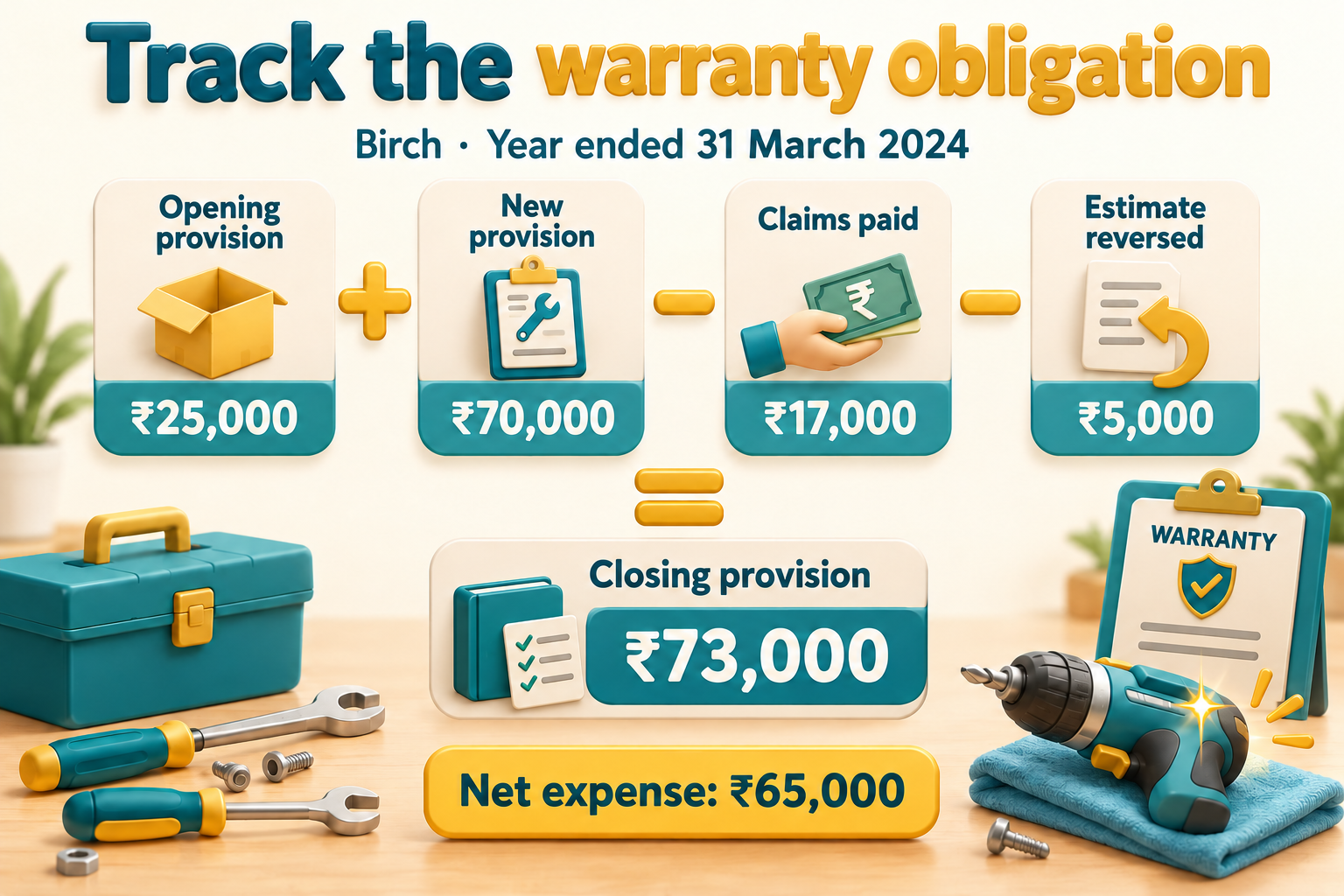
Birch Tools reports for the year ended 31 March 2024. Opening warranty provision on 1 April 2023 was ₹25,000 for products sold in earlier periods, called the old cohort. Valid repairs on that cohort cost ₹17,000, paid through Bank during the year. At 31 March 2024, a documented review estimates ₹3,000 still needed to settle remaining old-cohort obligations. The original estimate was reasonable when made; the reduction is a current estimate update, not a deliberately created excess or a discovered prior-period error.
During the current year Birch sold 1,000 additional tools with repair warranties. These are the new cohort. No new-cohort repair expenditure has yet been incurred or recorded. At year end all relevant obligations remain within coverage. Reliable engineering and claims evidence supports the following mutually exclusive expected outcomes for each unit. For this pool, management’s supported best estimate is the probability-weighted repair cost. It is probable that the class as a whole will require settlement. Those are explicit case assumptions, not conclusions established by the arithmetic alone.
| Outcome for one unit | Expected proportion | Expected units out of 1,000 | Cost per affected unit ₹ | Expected total cost ₹ |
|---|---|---|---|---|
| No qualifying repair | 80% | 800 | 0 | 0 |
| Minor repair only | 15% | 150 | 200 | 30,000 |
| Major repair only | 5% | 50 | 800 | 40,000 |
| Total | 100% | 1,000 | — | 70,000 |
The expected number of repairs is not a list of already submitted invoices. It translates the supported distribution into a pool estimate. Because the categories are mutually exclusive, the same unit is not charged both a minor and a major repair. The equivalent per-unit expected cost is 80% × ₹0 + 15% × ₹200 + 5% × ₹800 = ₹70; 1,000 × ₹70 = ₹70,000. Do not apply the 20% combined repair frequency again to that answer: the probabilities are already included.
3. Write the recognition argument before the entry
Past event and present obligation: the tools were sold with the stated warranty, giving customers the repair entitlement. A forecast of next year’s tool sales would not create today’s warranty provision for those unsold tools. Probable outflow: the supplied class-level evidence establishes probable settlement; a 20% chance for one tool does not defeat recognition for a large class. Reliable estimate: the supported categories and costs allow a reasonable estimate of the remaining obligation.
AS 29 calls for a best estimate; it does not make every provision equal to the largest possible bill, nor does this lesson impose the pool formula on every individual disputed obligation. Here the expected-cost method is explicitly appropriate for the class. Selecting ₹800,000 because every tool could theoretically need a major repair would ignore the evidence; selecting nil because no current claims have arrived would ignore the existing obligations.
4. Separate utilisation, reversal and a new charge
| Date/ref | Debit | Credit | Amount ₹ | Explanation |
|---|---|---|---|---|
| During year, J 1 | Warranty provision: old cohort | Bank | 17,000 | Settle previously provided qualifying costs. No repeat expense. |
| 31 March, J 2 | Warranty provision: old cohort | Warranty expense: estimate reversal | 5,000 | Residual before review is 25,000 − 17,000 = 8,000; reduce it to supported 3,000. |
| 31 March, J 3 | Warranty expense: new cohort | Warranty provision: new cohort | 70,000 | Recognise remaining obligations from current completed sales. |
J 1 debits a liability because the obligation is being discharged. J 2 also debits the liability, but credits the current expense account because part of the previous estimate is no longer required. J 3 creates the new liability and its current charge. Their similar account names do not make them the same transaction. If separate reversal-income presentation is selected, the overall profit effect must remain the same; this case uses a reduction of warranty expense.
| Movement | Old cohort | New cohort | Total |
|---|---|---|---|
| Opening provision | 25,000 | 0 | 25,000 |
| Additional provision | 0 | 70,000 | 70,000 |
| Used for qualifying expenditure | (17,000) | 0 | (17,000) |
| Unused estimate reversed | (5,000) | 0 | (5,000) |
| Closing provision | 3,000 | 70,000 | 73,000 |
| Debit date and reference | Debit ₹ | Credit date and reference | Credit ₹ |
|---|---|---|---|
| During year, Bank: J 1 | 17,000 | 1 April 2023, balance b/d | 25,000 |
| 31 March 2024, expense reversal: J 2 | 5,000 | 31 March 2024, new-cohort expense: J 3 | 70,000 |
| 31 March 2024, balance c/d | 73,000 | — | — |
| Total | 95,000 | Total | 95,000 |
| — | — | 1 April 2024, balance b/d | 73,000 |
The closing liability is ₹73,000, but the current net expense is ₹70,000 − ₹5,000 = ₹65,000. Cash paid is ₹17,000. The movement identity is opening liability ₹25,000 + net expense ₹65,000 − qualifying cash settlements ₹17,000 = closing liability ₹73,000. The increase in liability, ₹48,000, is not the entire current expense because ₹17,000 was used during the year.
If Birch’s profit before these warranty movements was ₹92,000, its profit after the net warranty charge would be ₹27,000. This supplementary profit figure excludes tax and other changes. The ₹17,000 payment has already reduced Bank; charging it to profit again on top of the ₹65,000 would incorrectly reduce profit to ₹10,000.
5. Continue the ledger without reopening the same expense
For a separate follow-on exercise, assume genuinely new April information raises the cost of settling the remaining old cohort from ₹3,000 to ₹3,200. It does not provide evidence of a different condition at the March reporting date. On 12 April, top up the old provision by ₹200: Dr Warranty expense / Cr Warranty provision. Pay the ₹3,200: Dr Warranty provision / Cr Bank. The old-cohort provision then closes to nil.
On 20 April, pay ₹6,000 for qualifying new-cohort repairs: Dr Warranty provision / Cr Bank. No re-estimate of its remaining costs is required by the supplied April facts. The new-cohort provision falls from ₹70,000 to ₹64,000. Combined April cash payment is ₹9,200, current April expense is ₹200, and closing combined provision is ₹64,000. Check ₹73,000 + ₹200 − ₹9,200 = ₹64,000. A later reporting-date review may change that estimate; the unused balance is not permission to stop reviewing evidence.
6. Prepare a useful movement note
Assume for this exercise that Birch prepares the full selected AS 29 provision disclosures and does not use any entity-size exemption. A concise original note can state: “Warranty obligations cover repair of qualifying defects in products already sold. Opening provision was ₹25,000; additional provisions were ₹70,000; qualifying expenditure used ₹17,000; unused estimates reversed ₹5,000; closing provision is ₹73,000. Settlement is expected within the remaining warranty periods, assumed here to be the next twelve months. Claim frequencies and repair costs are key estimation uncertainties. No reimbursement is expected.”
The note and ledger serve different purposes. The ledger establishes double entry; the note explains the obligation, uncertainty and movements. Do not net utilisation and reversal into one unexplained ₹22,000 reduction. A payment settles a claim; a reversal revises the estimate. They should remain distinguishable even though both reduce the provision.
7. Error diagnosis
All repairs expensed again. If J 1 was incorrectly Dr Warranty expense / Cr Bank, correct with Dr Warranty provision ₹17,000 / Cr Warranty expense ₹17,000. Bank was already correct; crediting it again would double the payment. Closing estimate treated as an extra charge. Posting another ₹73,000 in addition to the existing ₹8,000 residual creates an ₹81,000 liability. Reconcile the old residual and new cohort before posting. Provision used for office repainting. An unrelated ₹2,000 repainting payment cannot be hidden in warranty utilisation. If it was, restore the warranty liability and record the appropriate repainting expense with Dr Repainting expense / Cr Warranty provision ₹2,000, assuming ordinary current servicing facts.
8. Graded practice with full solutions
Practice A: a changed cost distribution
Question. For an independent pool of 600 units, 85% require no repair, 10% require a ₹300 repair and 5% require a ₹900 repair. Categories are mutually exclusive and the expected-cost method is supported. Calculate the provision.
Solution. Expected minor units 60 × ₹300 = ₹18,000; major units 30 × ₹900 = ₹27,000. Total = ₹45,000, or 600 × (₹30 + ₹45). The unused 510 expected units have zero cost. Do not calculate 15% × ₹45,000, because that would apply the frequency twice.
Practice B: reconcile before charging
Question. Opening provision ₹18,000; qualifying payments ₹11,000; required closing provision for all remaining obligations ₹9,000. There are no other movements. What is the current net adjustment?
Solution. Remaining ledger credit = ₹7,000. Add ₹2,000 by Dr Warranty expense / Cr Provision. Check ₹18,000 + ₹2,000 − ₹11,000 = ₹9,000. The payment is not added to current expense again.
Practice C: a reversal instead
Question. Use the same opening and payment figures, but required closing provision is ₹4,500.
Solution. The residual is still ₹7,000; reverse ₹2,500 with Dr Provision / Cr Warranty expense. Closing ₹4,500 = opening ₹18,000 − use ₹11,000 − reversal ₹2,500. A debit expense would move the liability in the wrong direction.
Practice D: distinguish an overrun from a double charge
Question. A separately tracked obligation has provision ₹2,000. New information in the next period establishes final settlement ₹2,350, which is paid immediately. Give entries and period expense.
Solution. Top up Dr Warranty expense ₹350 / Cr Provision ₹350; then Dr Provision ₹2,350 / Cr Bank ₹2,350. The liability clears. Alternatively one combined entry debits Provision ₹2,000 and Expense ₹350 and credits Bank ₹2,350. The next-period expense is ₹350, not ₹2,350 and not zero.
Practice E: unsold products
Question. Management adds expected warranty costs ₹12,000 for tools it plans to manufacture and sell next year. There are no sales or other obligating events for those tools at the present reporting date. Should this be added to the current provision?
Solution. No. The assumed future sales have not created a present obligation. Exclude ₹12,000 from the warranty estimate for completed sales. The business can still use that figure for budgeting; a budget and a recognised liability answer different questions.
Practice F: sensitivity rather than hidden prudence
Question. In the main 1,000-unit case, suppose the supported major-repair cost changes from ₹800 to ₹900, with probabilities unchanged. What changes?
Solution. The 50 expected major repairs now cost ₹45,000 instead of ₹40,000, so the new-cohort estimate rises ₹5,000 to ₹75,000. Combined closing provision becomes ₹78,000 and current net expense ₹70,000 after the same ₹5,000 old-cohort reversal. This follows changed evidence. An arbitrary extra ₹5,000 “safety margin” without support is a different proposition and is not justified by this sensitivity.
9. Explained objective practice
MCQ A. Which main-case amount is the current net warranty expense? (a) ₹17,000; (b) ₹48,000; (c) ₹65,000; (d) ₹73,000. Answer: (c). ₹70,000 new charge less ₹5,000 reversal. The other figures are cash use, increase in liability and closing liability respectively.
MCQ B. Which fact is decisive against the argument that a 20% individual repair probability means no provision? (a) every unit is certain to fail; (b) the class as a whole has a probable outflow and the other recognition conditions are met; (c) the provision balance always equals sales revenue; (d) management prefers stable profits. Answer: (b). Class-level assessment is appropriate for similar obligations. Neither certainty for every unit nor a preferred earnings figure is required.
10. Written model and summary
Model answer. The current sales with warranties create the stipulated present obligations. Class-level evidence supports a probable outflow and reliable ₹70,000 new-cohort estimate. The old provision falls from ₹25,000 through ₹17,000 utilisation to ₹8,000 before review, then is reduced ₹5,000 to its supported ₹3,000 closing requirement. Total closing provision is ₹73,000; current net expense is ₹65,000. The provision movement and the cash movement are separately reconciled, and the note distinguishes additions, use and reversal.
Remember. Identify the cohort, derive the remaining obligation, use the provision only for its own qualifying expenditure, and compare the required closing estimate with the ledger balance already present. Recognition, measurement, settlement and disclosure are related steps, not interchangeable amounts.