AAO Lesson 055: Report and investigate losses without prejudging responsibility
AAO · Lesson 055 · English
Report and investigate losses without prejudging responsibility
Study time: about 130 minutes including practice. Prerequisites: AAO-051, AAO-053.
Learning outcomes
- Identify initial/final reporting stages and distinguish applicable threshold and serious-irregularity routes.
- Reconcile a fictional shortage, subsequent recovery and remaining loss without treating repayment as erasure of the event.
- Separate evidence-led responsibility, write-off authority and remedial controls.
1. Report the suspicion; investigate the conclusion
A shortage report is not a conviction, a recovery is not erasure of the event, and a reporting threshold is not a write-off power. These distinctions matter because a single loss file may need immediate protection of records, several reporting routes, an investigation, proper accounting, recovery action, a competent disposal decision and improvements to controls.
This lesson applies GFR 2017 Rules 33–38 using the verified pre-cutoff text. Rule 32 is mentioned only as a cross-reference for remission of Audit disallowances and writing off overpayments to Government servants. The actual delegation schedules, Appendix 1 and applicable Personnel instructions require separate study; this lesson supplies neither a departmental write-off ceiling nor a substitute disciplinary procedure. The cases are fictional and do not allege wrongdoing by real people.
2. Build the reporting route before applying an amount shortcut
Rule 33(1) covers loss or shortage of public money, departmental revenue or receipts, stamps, opium, stores and other property held by or for Government. The cause and manner of discovery do not by themselves remove the reporting duty. The ordinary immediate route is from the concerned subordinate authority to the next higher authority, the Statutory Audit Officer and the concerned Principal Accounts Officer. Reporting remains relevant even when the responsible party has made the loss good.
The rule does contain specific exceptions. They should be read accurately, rather than silently dropped or expanded into permission to ignore irregularities.
| Provision | Precisely bounded treatment | What must not be inferred |
|---|---|---|
| 33(1)(i)(a) | Revenue lost through assessment mistakes discovered too late for a supplementary claim need not be reported under this stated exception | This does not mean every revenue shortage or every assessment error is exempt. |
| 33(1)(i)(b) | Underassessment caused by a local legal interpretation being overruled after the statutory time limit is covered by the stated exception | A delay in collection alone does not establish these facts. |
| 33(1)(i)(c) | Refunds allowed because the claims were time-barred are within the stated exception | The exception is not authority to allow an otherwise unauthorised refund. |
| 33(1)(ii) | Petty losses whose value does not exceed ₹10,000 fall within this stated reporting exception | The amount does not create a write-off power or cancel another applicable reporting route. |
| 33(2) | Serious irregularities go to the Financial Adviser or Chief Accounting Authority of the concerned Ministry/Department, and to the Controller General of Accounts (CGA) | Do not suppress a serious-irregularity route merely because an amount is small. |
| 33(7) | All Government-money losses from erroneous/irregular cheques or irregular accounting of receipts are reported to CGA with the circumstances | A small value does not remove this expressly stated route; the object includes remedying procedural defects. |
Rule 33(3) makes reporting a two-stage process. Send an initial report as soon as suspicion of loss arises. After investigation, send the final report to the authorities identified in sub-rules (1) and (2), as applicable, explaining the nature and extent, the errors or neglect of rules through which it occurred, and prospects of recovery. “We have not yet fixed responsibility” is a reason to label the initial facts provisional, not a reason to conceal the suspicion until a final conclusion is available.
Under Rule 33(4), the complete report travels through proper channels to the Head of Department. That authority disposes of it within the actual delegated powers; matters beyond those powers go to the Finance Ministry. Never replace this competence check with the reporting limits below.
3. Work through the Meridian cash evidence file
On 6 June 2024, a surprise count at the fictional Meridian Service Office finds ₹64,000 cash. The record presented for checking shows ₹86,500. No other cash movements occur during the reconciliation interval. The authorised checker preserves the signed count sheet and records the apparent ₹22,500 difference. An initial report is sent promptly under the applicable route, explicitly saying that document verification is underway and that no final responsibility has been determined.
On 7 June, independently verified payment evidence proves that a lawful ₹4,000 cash payment had already been made but omitted from the cash record. It is a real outflow supported by the payee acknowledgement and payment authority, not an invented voucher created to eliminate a shortage. The properly corrected accountability figure is ₹82,500. The investigation establishes no further recording difference affecting the count; the substantiated cash shortage is therefore ₹18,500.
| Step | Calculation | Amount and meaning |
|---|---|---|
| Initial apparent difference | ₹86,500 − ₹64,000 | ₹22,500, provisional while evidence is checked |
| Correct the omitted legitimate payment | ₹86,500 − ₹4,000 | ₹82,500, corrected expected cash at the count |
| Substantiated shortage at the count | ₹82,500 − ₹64,000 | ₹18,500, after the specified record correction |
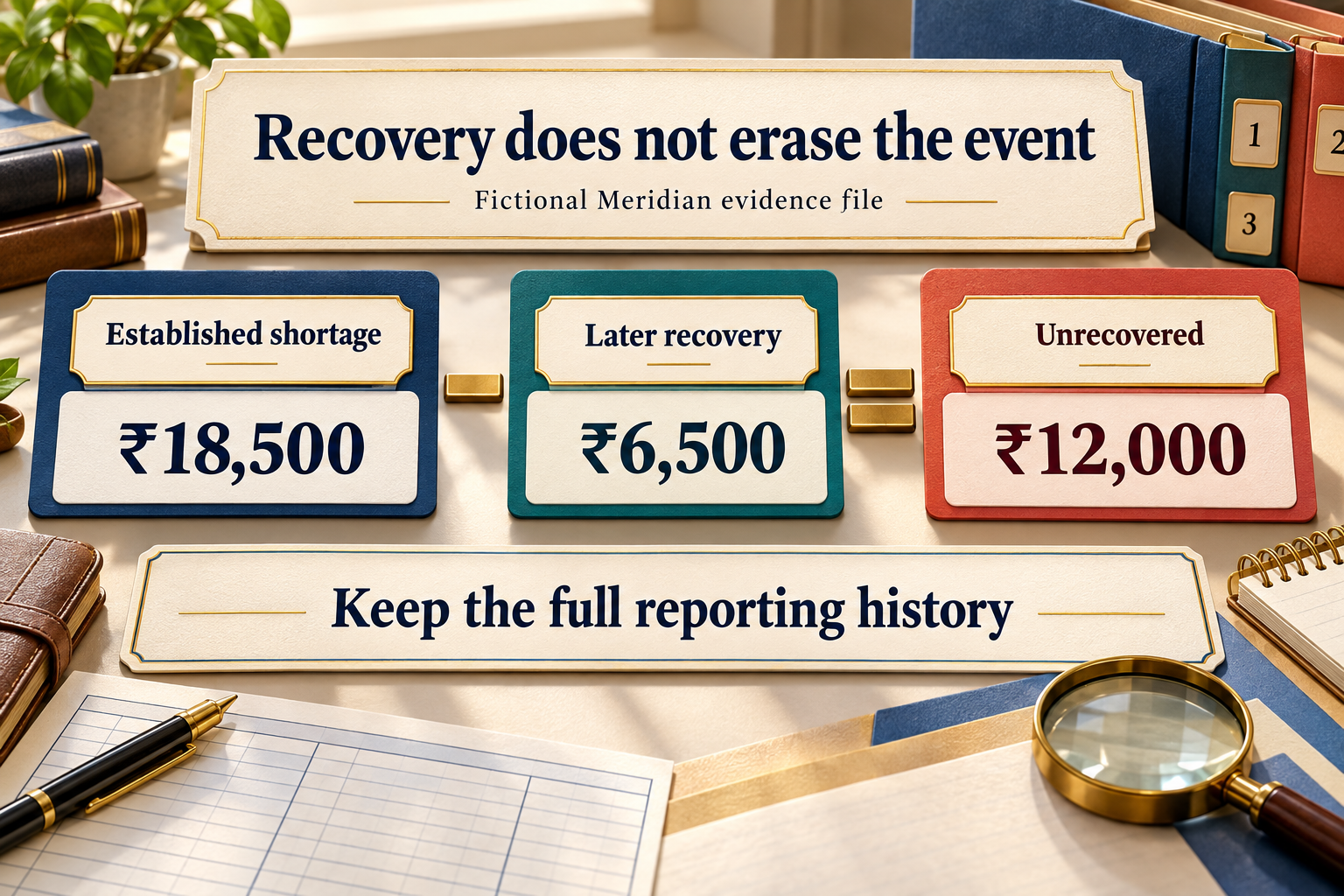
| Subsequent verified recovery on 10 June | ₹18,500 − ₹6,500 | ₹12,000 remains unrecovered |
| Separate accountability cross-check | ₹64,000 found + ₹6,500 recovered + ₹12,000 unrecovered | ₹82,500, the corrected original accountability amount |
The ₹4,000 is not a recovery. It explains why the initial record overstated the cash that should have been present. Conversely, the ₹6,500 received on 10 June is a later recovery evidenced by an authorised receipt and verified credit under the applicable procedure. It does not change the physical cash found on 6 June, and it must not be entered again as a second correction to the original count.
The final report should show the chronology: initial apparent difference ₹22,500; substantiated payment omission ₹4,000; established shortage ₹18,500; recovery ₹6,500; remaining amount ₹12,000. Giving only the net remaining ₹12,000 hides the scale and history of the event. Giving ₹22,500 as an established loss after verifying the payment omission overstates it by ₹4,000.
These are memorandum reconciliation amounts. The case does not prescribe a suspense head, a cash-book rectification technique, a recovery classification or a write-off journal. Record corrections and receipt credits must follow the separately applicable accounting procedure. Preserve a clear audit trail; do not alter the original evidence silently. The numerical control cannot determine who caused the shortage.
4. Separate a report from a finding of responsibility
Rule 37 makes an officer personally responsible for loss caused by that officer’s fraud or negligence. For another officer’s fraud or negligence, the responsibility extends only so far as the officer’s own action or negligence is shown to have contributed to the loss. The required departmental proceedings follow Appendix 1 and applicable Personnel instructions.
For Meridian, the mere facts that Officer A handled cash, Officer B supervised the unit, or someone paid ₹6,500 do not by themselves establish the necessary fraud, negligence, contribution or allocation of responsibility. The enquiry must examine actual duties, custody and access, relevant approvals, reconciliations, handovers, records and explanations. A proposed finding needs supported causal reasoning and the applicable process; a balanced arithmetic table is not a disciplinary order.
As an instructional evidence distinction, a documented failure to perform an assigned verification that demonstrably allowed a loss to continue is more relevant than a job title alone. But even that fact requires investigation and proper proceedings before a final responsibility decision. Do not divide ₹12,000 equally between two employees merely because two names appear on the file.
5. Apply the other loss routes without changing their thresholds
Rule 34 supplements Rule 33 for material loss or destruction of Government property from fire, theft, fraud and similar events. Losses above ₹50,000 due to the specified suspected causes must be reported to Police as early as possible. When a case is referred, assist the investigation and obtain the formal Police investigation report. Exactly ₹50,000 does not satisfy “above ₹50,000”; that observation does not decide obligations under other laws, orders or facts.
Rule 35 deals specifically with immovable property lost through fire, flood, cyclone, earthquake or another natural cause. Where the loss exceeds ₹50,000, the subordinate authority reports it at once to Government through the usual channel. The rule sends other losses to the next higher authority immediately. Read applicable overlapping provisions together rather than treating one route as a substitute for every other route.
| Fictional fact | Selected GFR consequence | Boundary |
|---|---|---|
| Routine petty stores loss ₹10,000; no serious irregularity or special-route facts supplied | Within the not-exceeding-₹10,000 exception in 33(1)(ii) | Proper records, control and competent disposal still require attention. |
| Ordinary cash shortage ₹10,001; no stated exception | The petty-loss exception no longer fits; apply the ordinary 33(1) route | Do not round down to obtain an exception. |
| Serious control manipulation causing a ₹9,000 loss | Apply 33(2)’s serious-irregularity escalation | Do not rely solely on the petty amount. |
| ₹2,000 Government-money loss caused by irregular receipt accounting | Report the circumstances to CGA under 33(7) | This expressly covers all such cases. |
| ₹75,000 stores destruction from suspected fire | Apply 33 and the additional 34 Police route promptly | Follow the referred Police case and obtain its formal investigation report. |
| ₹50,000 property loss from suspected theft | Not above the numerical threshold in 34; apply 33 where no exception and check other applicable requirements | This is not a declaration that Police must never be informed. |
| ₹65,000 building damage from a flood | Rule 35: report at once to Government through usual channel; apply other relevant loss reporting | The immovable-property and cause facts matter. |
| ₹50,000 immovable-property loss from a natural cause | The exceeding-₹50,000 trigger in 35 is not met; its other-loss route goes immediately to next higher authority | No rounding up and no inferred write-off authority. |
Rule 36 requires the detailed report after full enquiry into cause and extent to go to Government through proper channels, with a copy or abstract simultaneously to the Audit Officer and Pay and Accounts Officer. Keep these recipients distinct from the Principal Accounts Officer named in Rule 33(1). A final report is not simply an initial report with its heading changed: it should now contain the supported findings and updated recovery position.
6. Recovery, temporary redraw and disposal are separate decisions
Rule 33(5) permits an amount lost through misappropriation, defalcation, embezzlement and similar circumstances to be redrawn on a simple receipt pending investigation, recovery or write-off, with approval of the authority competent to write off that loss. This is not an automatic permission for a cashier to replenish a shortfall. The supplied Meridian arithmetic alone neither establishes the specified cause nor identifies the competent approving authority. A redraw also does not end the investigation or prove that the original loss has been recovered.
Under Rule 33(6), where Government-servant culpability is involved, the loss is borne by the Central Government department or State Government concerned with the transaction; cash recoveries from the erring officials are credited to the department or State that sustained it. Do not divert a recovery to an unrelated office merely because that office collected it. Exact account classification remains a separate verified procedure.
Rule 32 directs remission of Audit disallowances and write-off of overpayments to the Delegation of Financial Powers Rules and instructions. It gives no numerical ceiling in the sentence itself. Likewise, ₹10,000 and ₹50,000 in this lesson cannot be recycled as a Head of Office’s write-off powers. Identify the type of case, current applicable delegation, conditions and competent decision before disposal.
Rule 38 calls for prompt action through detection, reporting, write-off and final disposal, with particular attention to action against delinquents and remedial measures that strengthen controls. Promptness does not mean skipping evidence or proceedings. Keep a dated action register so that an unresolved recovery, awaited report or control improvement is not mistaken for a closed file.
7. Draft an evidence-led report and follow-through note
| Record | What the fictional file should contain | Why it matters |
|---|---|---|
| Initial report, 6 June | Count ₹64,000; record ₹86,500; apparent difference ₹22,500; discovery time, preserved evidence and immediate actions; figures provisional | Reports suspicion promptly without claiming a final cause or person. |
| Verified correction, 7 June | Authority and acknowledgement supporting the omitted ₹4,000 payment; corrected expected cash ₹82,500 | Separates a book error from the established shortage. |
| Final factual report after enquiry | Established shortage ₹18,500; supported cause findings and relevant rule/control failures; evidence and explanations; recovery prospects | Supplies substance beyond the first suspicion. |
| Recovery update, 10 June | ₹6,500 authorised receipt and verified credit; ₹12,000 unrecovered; no unsupported promise that the remainder is collectible | Preserves both gross event and updated recovery position. |
| Disposal and control tracker | Competent authority/delegation check; investigation and other reports; proper proceedings; corrective actions with owners and verification | Prevents recovery arithmetic from being treated as complete case disposal. |
Illustrative factual paragraph. “The initial 6 June comparison showed a provisional ₹22,500 difference. Verified evidence of an omitted lawful ₹4,000 payment reduces expected cash at that count to ₹82,500. Cash actually counted was ₹64,000, establishing an ₹18,500 shortage on the supplied evidence. A later ₹6,500 recovery leaves ₹12,000 unrecovered. The report preserves both stages; responsibility and disposal require the applicable evidence-based proceedings and competent authority.” This is an original teaching paragraph, not a prescribed Government form.
8. Graded practice with complete solutions
Practice A: correct the evidence, not the threshold
Question. A count finds ₹46,000 against a record balance of ₹60,000. Verification proves an omitted lawful payment of ₹3,500. A later recovery is ₹2,000. Reconcile all stages and explain whether the original ₹14,000 was a final loss.
Solution. Initial apparent difference = ₹60,000 − ₹46,000 = ₹14,000. Correct expected cash = ₹60,000 − ₹3,500 = ₹56,500. Established shortage = ₹56,500 − ₹46,000 = ₹10,500. After the ₹2,000 recovery, ₹8,500 remains. The original ₹14,000 was provisional, not the final substantiated amount. The established loss exceeded ₹10,000; later recovery does not rewrite that event into an ₹8,500 petty loss. Report the chronology and apply the relevant routes.
Practice B: two similar-looking ₹50,000 cases
Question. Compare (i) ₹50,000 stores loss from suspected theft and (ii) ₹50,001 stores loss from suspected theft. Assume no Rule 33 exception. What follows from Rule 34 alone?
Solution. The ordinary Rule 33 reporting applies on the stated assumptions. Only the second amount is above ₹50,000 and therefore meets Rule 34’s stated mandatory Police-reporting threshold. The ₹1 difference matters because the text says “above”, not “at least”. For the first case, assess other legal or departmental requirements; the calculation does not establish a prohibition on Police reporting. Neither amount grants write-off power.
Practice C: fully made good before the final report
Question. A reportable ₹24,000 shortage is fully recovered before investigation ends. The clerk proposes deleting the event from the loss report. Decide.
Solution. Do not delete it. Rule 33(1) expressly retains reporting even when the loss has been made good. Show the ₹24,000 event, the verified ₹24,000 recovery and zero unrecovered balance. That zero does not prove there was no irregularity or complete the responsibility, disposal and control work.
Practice D: a small irregular receipt loss
Question. Irregular accounting of receipts causes a ₹3,200 Government-money loss. A trainee relies only on the petty-loss exception. What route has been missed?
Solution. Rule 33(7) requires all such cases to be reported to CGA with their circumstances so that defects in rules or procedure can be addressed. If the evidence also establishes serious irregularities, consider the additional 33(2) route. The small amount alone cannot dispose of these specific facts.
Practice E: responsibility is not an equal split
Question. A cashier and supervisor appear in a file concerning a ₹12,000 remaining loss. An officer proposes ₹6,000 recovery from each because there are two names. What is missing?
Solution. The proposed equal split has no supplied causal evidence. Under Rule 37, examine each person’s fraud or negligence and, for another’s misconduct, the extent of contribution through that person’s own action or negligence. Follow the prescribed proceedings. Arithmetic division supplies neither a finding nor authority for recovery.
Practice F: redraw versus recovery
Question. A clerk wants to redraw a suspected ₹18,500 loss on a simple receipt, citing Rule 33(5), but has no approval from the authority competent to write it off. The clerk calls the redraw “recovery of the loss”. Identify the two defects.
Solution. The required competent approval is missing; the provision is not a self-executing replenishment power. Also, a permitted redraw pending investigation/recovery/write-off is different from recovering the original loss. Establish the rule’s factual applicability, obtain the required competent decision and preserve the continuing investigation and accountability trail.
9. Explained objective practice
MCQ A. In Meridian, which final numerical presentation is best? (a) Report only ₹12,000 because it remains unpaid; (b) retain ₹22,500 as established loss despite the verified omitted payment; (c) show ₹22,500 provisional difference, ₹4,000 record correction, ₹18,500 established shortage, ₹6,500 recovery and ₹12,000 remaining; (d) treat the ₹4,000 payment omission and ₹6,500 recovery as two reductions of the original record without preserving dates. Answer: (c). It keeps both chronology and distinctions. Option (a) hides the event, (b) ignores established evidence, and (d) confuses correction of the original expectation with a later receipt.
MCQ B. Which conclusion correctly reads the selected rules? (a) Exactly ₹50,000 meets Rule 34’s “above” threshold; (b) a ₹9,000 serious irregularity can be disposed of solely under the petty-loss exception; (c) full recovery makes the initial report unnecessary; (d) an initial report is made when suspicion arises, while the final report follows investigation. Answer: (d). The other choices respectively misread the threshold, overlook the serious-irregularity route and overlook the made-good provision.
10. Written answer structure and summary
For a subjective problem, organise the answer into facts and provisional figures; applicable reporting routes; investigated reconciliation; responsibility and competent disposal; recovery and remedial follow-through. Cite the exact sub-rule that answers the question. If a fact such as the cause, seriousness, immovable nature or delegated authority is missing, state the conditional conclusion rather than invent it.
Remember. Report suspicion promptly, preserve the evidence, update the amount transparently and keep recovery distinct from correction. Apply the strict threshold words and the additional routes. Responsibility needs proven contribution and proper proceedings; disposal needs actual competence. No reporting exception, recovery figure or neat reconciliation completes the entire case by itself.