AAO Lesson 077: Build a defensible single-source and proprietary-article file
AAO · Lesson 077 · English
Build a defensible single-source and proprietary-article file
Study time: about 130 minutes including practice. Prerequisites: AAO-071, AAO-073, AAO-075.
Learning outcomes
- Apply each single-source ground to the evidence actually supplied.
- Complete the required proprietary-article certificate fields without treating an opinion as proof.
- Reconcile compatibility, emergency and price evidence in a structured decision note.
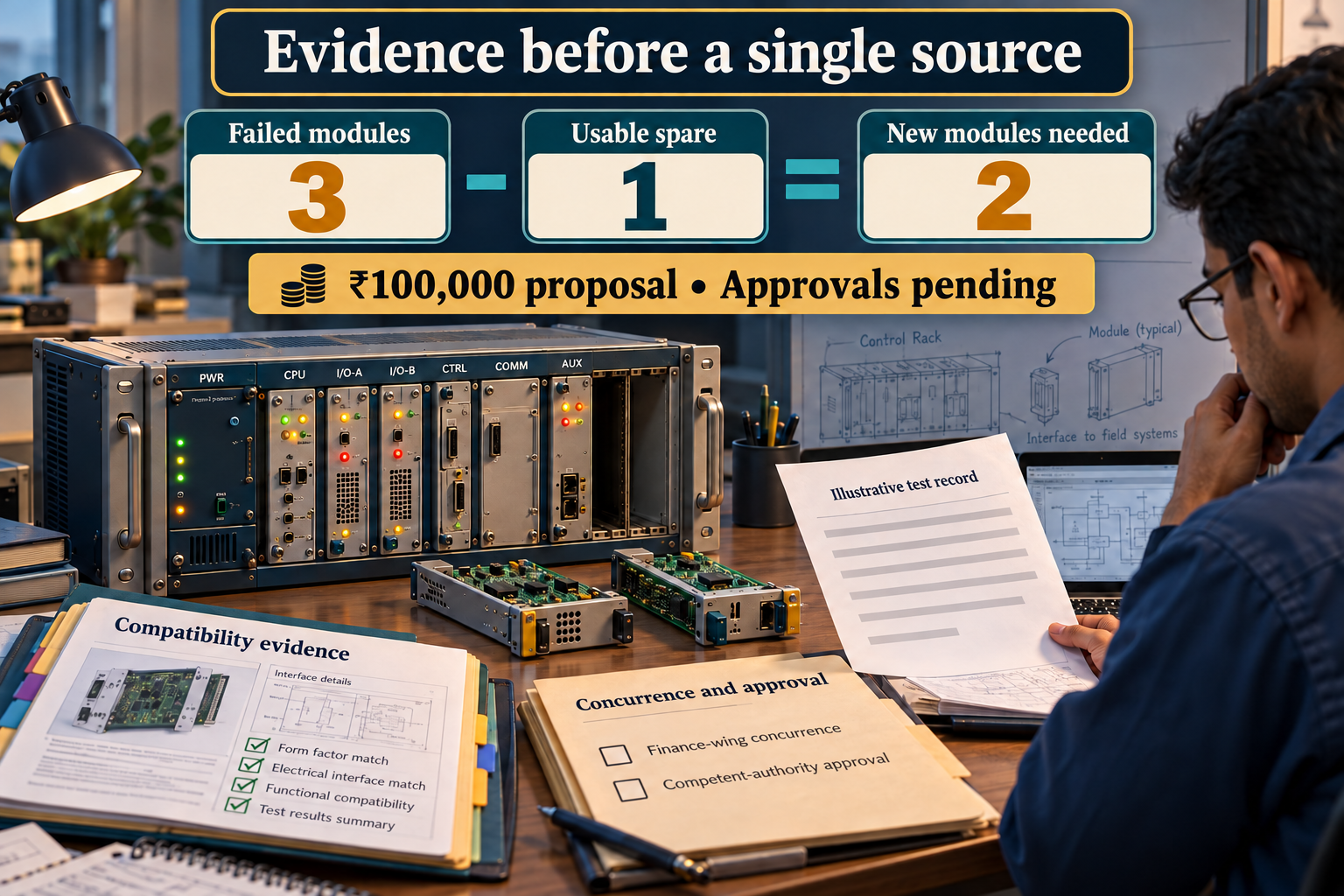
1. A single source needs a reasoned factual foundation
Choosing one firm removes an important source of comparison and competitive pressure. GFR Rule 166 therefore identifies particular circumstances in which single-source procurement may be used. An existing relationship, a short list, a convenient brand or an unused budget does not by itself establish one of those circumstances.
This lesson develops an original evidence file rather than a model sanction. The examination baseline is 19 June 2024; the equipment, firms, tests, prices and records below are fictional. Earlier lessons supply the need, whole-demand, GeM, publication and integrity controls. A Proprietary Article Certificate, or PAC, is not a substitute for those other applicable requirements. Underlying departmental delegations, specialised orders and an actual operational decision require their own verification.
2. Preserve all three Rule 166 grounds
| Limb | Stated circumstance | Evidence and control question |
|---|---|---|
| (i) | The user department knows that only a particular firm manufactures the required goods | What reliable product/manufacturing evidence supports the claim for the actual required goods, rather than merely a preferred brand? |
| (ii) | An emergency makes it necessary to purchase the required goods from a particular source; record the reason and obtain competent-authority approval | What establishes both the emergency and the necessity of that particular source? |
| (iii) | Standardisation of machinery or spare parts for compatibility with existing equipment, on competent technical-expert advice and competent-authority approval, requires purchase only from a selected firm | Which existing equipment, interfaces and technical findings make that selection necessary? |
The grounds are alternatives, although a real case may have facts relevant to more than one. Do not copy all three into a note as if extra labels cure weak evidence. State the ground relied on, the facts that support it, the missing evidence and the decision that the competent authority must make.
Under (i), knowing the manufacturer of the currently installed product is not the same as establishing that only that firm’s product can meet the actual requirement. Also distinguish a manufacturer from its dealers or agents. A sole-manufacturer finding does not, by itself, prove that a particular reseller is the only available commercial source. Applicable seller-selection, authorisation and purchasing conditions still need examination.
Under (ii), “urgent” describes only part of the required reasoning. The source must also be necessary in the emergency on the actual facts. A deadline created by avoidable delay should not be used as a bare assertion that no alternative could supply. Record the operational consequence, time available, verified alternatives and competent decision instead of retrospectively inventing urgency.
Under (iii), standardisation is tied to compatibility, competent technical advice and approval. It is not a general rule to buy the same brand forever. A materially equivalent alternative may require reconsideration of the technical conclusion. Conversely, an apparently cheaper component is not equivalent merely because its external dimensions look similar.
3. PAC: complete the four fields with evidence, not decoration
The note to Rule 166 requires the prescribed PAC before procurement under (i) and (iii), as applicable. It does not express that same PAC requirement for every emergency under (ii). An emergency still needs its recorded reasons and competent approval; the absence of the note’s PAC requirement is not an exemption from the rest of the procurement process.
| Field | What the source form asks for | How to review the supporting file |
|---|---|---|
| (i) | Identify the firm manufacturing the indented goods | Connect the actual part/model and required quantity to reliable manufacturing evidence |
| (ii) | Give the reasons why no other make or model is acceptable | Use the requirement and technical findings; “preferred brand” is not a technical explanation |
| (iii) | Record finance-wing concurrence to the proposal with its reference | Verify that the referenced concurrence exists and covers this proposal/version |
| (iv) | Record competent-authority approval with its reference | Verify the authority and scope, then the indenting officer’s signature, date and designation as required by the form |
A reference number is not proof by itself. If the finance note concerns an earlier quantity or a different component, it does not automatically support a changed proposal. Do not invent a date, signature, concurrence or approval to make a draft look complete. A classroom draft should state “pending” where the evidence is absent.
The PAC’s specific form fields should be read with the chosen ground. The selected Rule 166 text does not create a separate monetary exemption from sanctions, nor does it authorise a purchase merely because the proposed price is below an available allocation. Authority and funding remain independent controls.
4. Original compatibility and quantity file
Cedar operates a specialised document-control rack with twelve installed modules. Three have failed. A verified usable spare can replace one failed module immediately, leaving two modules to procure. There is no separate authorised spare-stock requirement in this case. The functional aim is to restore the three affected positions, not replace every failed unit with a new purchase while leaving the existing spare unused.
The required interfaces and tests were defined by a competent technical expert. The names below are fictional. The initial review identifies a genuine evidence gap in the proposed single-source conclusion; the second review supplies new test results rather than merely changing the wording.
| Candidate or record | Initial evidence | Proper implication |
|---|---|---|
| Orion module O-12 | Manufacturer identity and successful operation with the existing rack established | Supports compatibility of O-12; does not alone prove absence of acceptable alternatives |
| Nova module N-8 | Lower quoted module price, but its control protocol fails the stipulated interface requirement in the supplied test | Lower price cannot cure the stated technical failure |
| Pine module P-4 with adapter | Supplier claims compatibility; no competent load/recovery test is yet available | Keep this as an unresolved alternative, not a proven failure or proven equivalent |
| Existing usable spare | Serial record and functional test establish one compatible spare | Deduct one from the three replacements needed |
| Later expert report on Pine | New stipulated tests demonstrate failure to recover safely under the defined load condition; reasons and results are documented | The supplied evidence now supports rejecting that alternative on this technical issue; still obtain the actual required concurrence and approval |
After the later test, the fictional expert advises that O-12 is the only acceptable module among the established relevant alternatives for this rack’s required compatibility. That advice supports a proposal under 166(iii), subject to the competent decision and other applicable controls. It is not a universal market finding about Orion or a rule that one failed test always proves every alternative impossible.
The distinction between the two reviews is important. Before the Pine test, the no-other-make statement is not established by the supplied record. After the test, the file has additional relevant evidence. A good answer identifies the earlier gap and the new evidence, rather than claiming that the original unsupported conclusion was always correct.
5. Quantity and comparable-price workpaper
| Item | Calculation | Amount or quantity |
|---|---|---|
| Failed positions to restore | 3 | 3 modules |
| Verified usable spare | 1 | 1 module |
| New modules required | 3 − 1 | 2 modules |
| Current module cost | 2 × ₹46,000 | ₹92,000 |
| Required installation | 2 × ₹4,000 | ₹8,000 |
| Current whole proposal | ₹92,000 + ₹8,000 | ₹100,000 |
| Incorrect purchase of all three new modules | 3 × (₹46,000 + ₹4,000) | ₹150,000 |
| Avoidable proposed outlay from ignoring the spare | ₹150,000 − ₹100,000 | ₹50,000 |
Using the spare is not a cash receipt or a new saving already realised; it reduces this proposed new outlay under the stated facts. If a separate authorised spare requirement later emerges, record and reassess that changed need instead of concealing it. Do not split the two new modules into separate orders merely to avoid a whole-demand sanction requirement.
A recent comparable earlier purchase cost ₹44,000 per module plus ₹3,500 installation, or ₹47,500 per installed module. Two comparable units would therefore have cost ₹95,000. The new ₹100,000 proposal is ₹5,000 higher, or 5,000 ÷ 95,000 × 100 = 5.2632% above that historical comparator. The difference needs explanation through the actual current circumstances and evidence; it is not automatically reasonable or unreasonable at a universal tolerance.
The allocation available for this properly classified activity is stipulated as ₹102,000. The proposal would leave ₹2,000, but this arithmetic proves only that particular allocation comparison. It does not prove price reasonableness, the PAC facts, concurrence or competent sanction. The ₹50,000 unnecessary third-module proposal cannot be defended simply by saying it is technically the same model.
6. Assemble a reviewable decision file
| Record | Current supplied status | What the answer should say |
|---|---|---|
| Need and stock | Three failures and one usable spare verified | Two new modules required on these assumptions |
| Technical advice | Later expert report supports the stated compatibility conclusion | Attach the actual findings and identify 166(iii), rather than merely citing the brand |
| Manufacturing evidence | O-12 manufacturer verified | Connect the named manufacturer to the indented goods |
| Alternative investigation | Nova failure and later Pine failure documented within the stated scope | Explain these findings and retain the scope limitation |
| Price comparison | Current whole proposal ₹100,000; comparable earlier equivalent ₹95,000 | Seek an evidence-based explanation for ₹5,000 difference; no automatic tolerance |
| Finance concurrence | Not yet obtained in the supplied file | PAC field remains pending; do not fabricate a reference |
| Competent approval | Not yet obtained in the supplied file | Proposal is not ready to be represented as approved procurement |
Now consider an independent emergency variation. A compatible emergency replacement is required within 48 hours to restore a stipulated essential function. The file documents why failure to restore within that time has the stated consequence, verifies that only source R can deliver the required item within that window, records the reason for selecting R, and obtains the actual competent approval. These are the facts that would support analysis under 166(ii). If another source S can deliver the same compliant item in 36 hours, the assertion that R is necessary must be reconsidered. A familiar supplier’s promise alone does not settle the question.
Publication and bid-receipt controls are also separate. Lesson 075 explains that Rule 159 covers notices to a single party unless the relevant exception is actually available; choosing a single-source route does not itself supply a blanket secrecy exemption. The applicable process must still be assessed from the dated rules and orders.
7. Six graded practices with complete answers
Practice A: choose the factual ground
A department has reliable evidence that only Firm X manufactures the actual required goods. In a different case, several goods exist but a competent expert establishes that only a selected firm’s spare is compatible with the installed machine, and the competent authority approves. Identify the relevant limbs and the PAC requirement.
Solution. The first engages 166(i); the second engages 166(iii). The note requires the PAC before procurement under these limbs, as applicable. Keep the manufacturing fact separate from the compatibility fact. Neither conclusion establishes all other authority, funding or price conditions.
Practice B: repair the quantity proposal
Five installed units have failed; two compatible usable spares are verified. No extra reserve-stock requirement is supplied. A new unit costs ₹28,000 and installation ₹2,000 each. Find the new requirement and compare it with buying all five new.
Solution. The need is 5 − 2 = 3 new units. Whole installed cost is 3 × ₹30,000 = ₹90,000. Buying five would cost ₹150,000, overstating the proposed outlay by ₹60,000. This is a conditional needs comparison, not cash income or an already realised saving.
Practice C: diagnose a weak PAC
A draft identifies the manufacturer but says “same brand as last time” for no-other-make reasons. Finance concurrence and approval fields contain only proposed future dates. Is it complete?
Solution. No. The technical/other factual basis for rejecting other makes is unsupported, and proposed dates do not evidence actual concurrence or approval. Mark those fields pending, obtain the relevant evidence and decisions, and do not present the draft as a signed completed certificate.
Practice D: reconsider an emergency source
The file says only R can restore service within 48 hours. Verified new evidence shows S offers the same compliant supply in 36 hours. May the author continue stating that urgency necessarily requires R?
Solution. Not on that assertion alone. The new evidence undermines the stated exclusivity of R within the time window. Reassess the source necessity and other actual grounds. Do not automatically award to S either: capability, terms, authority and the applicable procedure still need consideration.
Practice E: use a comparable price reference
A previous installed-equipment package cost ₹76,000. The current genuinely comparable package is ₹80,000. Find the increase and explain what it proves.
Solution. The increase is ₹4,000, or 4,000 ÷ 76,000 × 100 = 5.2632%. This quantifies the comparison; it does not create a universal acceptable percentage. Verify comparability and explain the current change through actual evidence. Available funds alone do not establish reasonableness.
Practice F: distinguish a manufacturer from a dealer
The PAC evidence establishes that only manufacturer M produces the compatible component. Two verified authorised dealers can supply it on materially different terms. Does that fact prove dealer A is the only commercial source?
Solution. No. The manufacturing conclusion concerns M’s goods. It does not eliminate the two supplied dealer possibilities. Examine the actual applicable seller-selection and purchasing requirements and compare relevant terms rather than convert a manufacturer statement into an unsupported dealer monopoly.
8. Explained objective questions
MCQ A. Before the later Pine test, what best describes Cedar’s file? (a) The PAC is complete because the installed product is Orion. (b) The alternative-compatibility claim remains unresolved, so the proposed no-other-make conclusion needs further evidence. (c) Pine must be accepted because it claims compatibility. (d) A lower price alone establishes that Nova’s failed interface is acceptable.
Answer: (b). It distinguishes a claim from a verified finding. Option (a) assumes the result from past use; (c) treats a supplier’s assertion as proof; (d) ignores the stipulated functional requirement.
MCQ B. After technical evidence improves, the ₹100,000 proposal fits within ₹102,000 but lacks finance concurrence and competent approval. Which conclusion is supported? (a) The ₹2,000 balance automatically authorises the purchase. (b) The file has a supported technical proposal and a funding comparison, while the stated concurrence/approval gates remain pending. (c) The historical ₹95,000 comparator legally fixes the maximum current price. (d) The PAC note eliminates the need to establish a whole demand.
Answer: (b). Evidence gates do not substitute for each other. Option (a) turns budget arithmetic into authority; (c) invents a binding historical-price ceiling; (d) ignores the actual quantity and whole-demand controls.
9. Structured written decision note
Prompt. Write an evidence-led recommendation for Cedar after the later compatibility test, keeping approval status accurate.
Model answer. Three failed positions require restoration, and one verified usable spare reduces the new requirement to two modules. The current installed proposal is ₹100,000. The later competent technical report supports the stated O-12 compatibility conclusion and records why the relevant tested alternatives fail, supporting consideration under Rule 166(iii) within that evidence scope. The PAC must identify the manufacturer and give those reasons, with the required finance concurrence and competent approval references before procurement. Both decisions remain absent from the supplied file and should be marked pending. The comparable earlier two-unit equivalent was ₹95,000; the ₹5,000, approximately 5.2632%, increase needs explanation through current evidence. The ₹102,000 allocation comparison leaves ₹2,000 but does not itself prove price reasonableness or sanction. Reassess any changed stock, alternative or seller evidence and preserve the other applicable procurement requirements.
Summary. Name the precise ground, prove the relevant factual condition, establish the whole need, record actual concurrence and approval, and evaluate price on comparable evidence. A complete-looking certificate cannot repair missing facts.