AAO Lesson 086: Build a complete consultancy RFP and protect proposal receipt
AAO · Lesson 086 · English
Build a complete consultancy RFP and protect proposal receipt
Study time: about 145 minutes including practice. Prerequisites: AAO-085, AAO-076.
Learning outcomes
- Reconcile all nine RFP components with the TOR, criteria, formats and proposed contract.
- Develop a usable submission and midterm/final-review plan.
- Keep timely technical and financial proposals separate through the ordinary opening sequence.
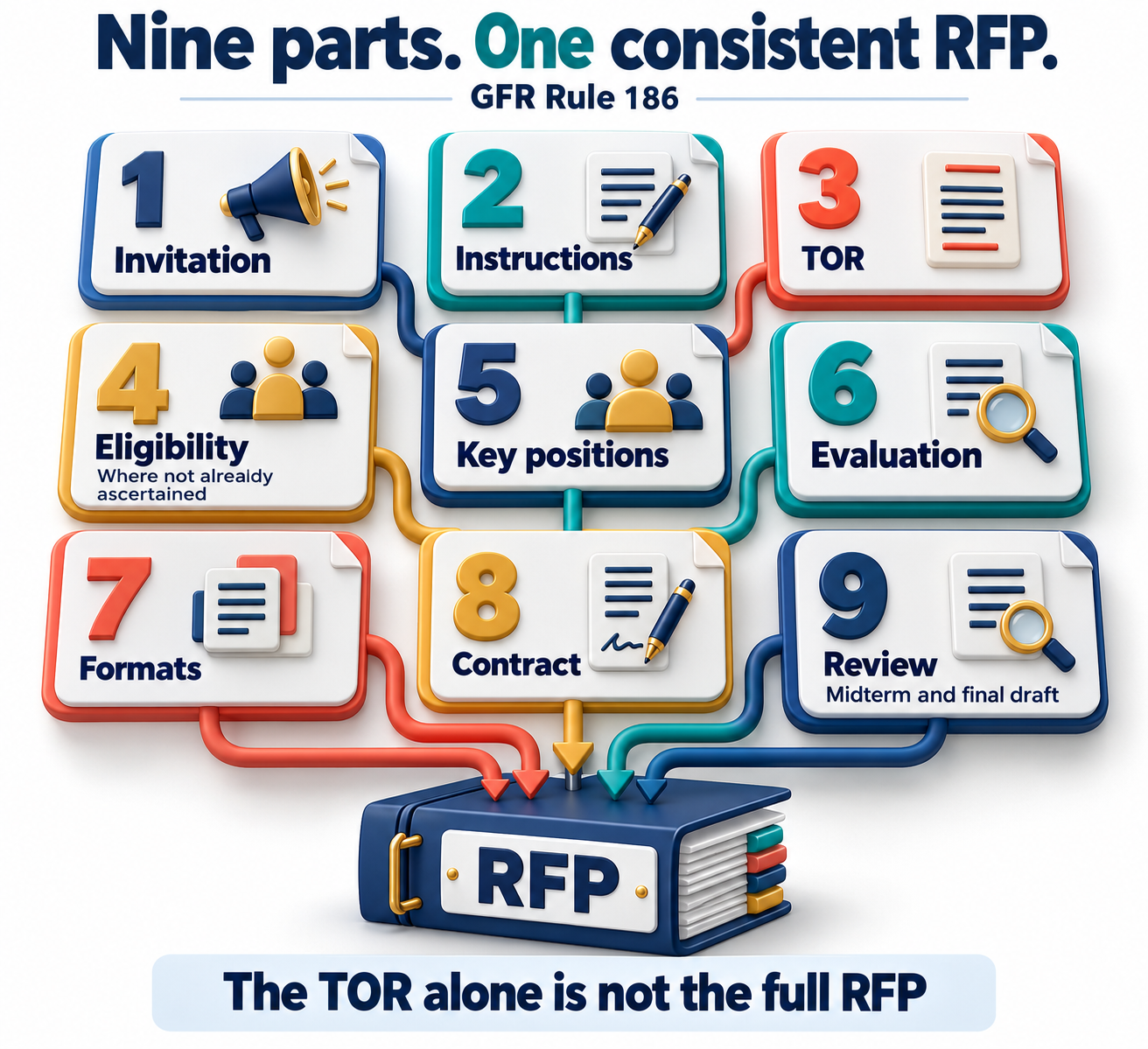
1. A TOR is necessary, but it is not the complete request for proposals
Lesson 085 developed the need, source process, shortlist and terms of reference. Rule 186 takes the next step: a Request for Proposal, or RFP, is issued to shortlisted consultants to obtain technical and financial proposals. It includes the TOR, but also tells respondents how to submit, what evidence and formats to use, how proposals will be evaluated, what contract is proposed and how work will be reviewed.
A file containing an excellent TOR and a blank price sheet can still be incomplete. Missing procedure or evaluation information can make submissions inconsistent even when every consultant understands the general objective. This lesson reconstructs that complete invitation and its receipt sequence through an original fictional case.
The selected examination baseline remains 19 June 2024. No actual consultant, tender portal, contract or confidential submission is accessed here. The stated timetable, monetary amounts and contractual milestones are teaching assumptions rather than GFR-prescribed values. External eligibility, preference, data and detailed consultant instructions require their own verification.
2. Reconcile all nine RFP components
Northbank’s fictional study has a valid four-consultant shortlist and a defined ten-week service-process diagnostic. The source/shortlist stage is expressly supplied as complete; this lesson does not infer it from the fact that four envelopes eventually arrive. The office must invite technical and financial proposals from that shortlist using a consistent RFP.
| Component | What Northbank puts in the invitation | Why a TOR alone cannot replace it |
|---|---|---|
| (i) Invitation letter | Assignment identity, inviting office and the addressed shortlisted consultant | Connects the issued invitation to the actual shortlist |
| (ii) Information to consultants | Submission method, required contents, deadline, place and stated procedural instructions | A scope description does not tell a consultant how to make a valid submission |
| (iii) TOR | The bounded objectives, tasks, schedule, Ministry inputs and outputs | Defines what the consultant is being asked to do |
| (iv) Eligibility/prequalification where not already ascertained through EOI | State any still-required published evidence and accurately identify what the completed EOI already established | Do not invent a new undisclosed barrier or omit an unresolved requirement |
| (v) Key positions | Identify the positions whose CVs and experience will be evaluated | A generic request for a company brochure does not identify the evaluated personnel |
| (vi) Evaluation criteria and selection procedure | Publish the technical criteria, qualification gate and actual selected evaluation method | Respondents must not discover the selection method after submitting |
| (vii) Standard technical/financial formats | Separate forms with defined units and common priced scope | Prevents incompatible totals and accidental disclosure of a financial proposal in technical material |
| (viii) Proposed contract terms | The proposed scope, review, delivery and commercial obligations in their proper document | A stated fee alone does not explain the proposed contractual commitments |
| (ix) Midterm and final-draft review procedure | Who supplies comments, how the midterm progress is reviewed and how the final draft is examined | A final completion date does not establish the review process |
The qualification component is expressly conditional: Rule 186(iv) refers to criteria where they have not already been ascertained through EOI. Record what remains to be verified; do not assume that repeating every earlier certificate is invariably required by this clause, or that EOI clearance proves every later proposal condition.
Rule 186 specifies the RFP’s necessary contents, not a universal scoring formula, fee scale or contract template. Where the example uses a numerical rule or milestone, it must be clearly part of the fictional published RFP. Detailed actual procedures still need their applicable sources.
3. Repair contradictions before issuing the same usable document
The draft Northbank file contains the following problems. The correction exercise occurs before issue; it is not permission to alter received proposals or conceal a later material amendment. If an issued document needs change, the applicable transparent amendment and time controls must be followed.
| Draft defect | Why it is consequential | Pre-issue correction |
|---|---|---|
| Invitation says receipt by 10:00; submission instructions say 12:00 on the same date | The two places define conflicting deadlines | Adopt one authorised deadline and reconcile every relevant occurrence |
| TOR requires two workshops; financial format has one workshop line limited to one event | One bidder may price one event and another two | Use a common two-workshop priced scope with clear units |
| Evaluation section names the study lead and analyst; CV template asks only for the lead | The analyst criterion lacks a matching evidence field | Add the analyst’s required CV/experience information to the technical format |
| Contract draft says week 8 final delivery; TOR says a ten-week study | Delivery and pricing assumptions conflict | Reconcile the approved ten-week sequence throughout |
| Review section states only “satisfactory report” | No usable midterm or final-draft review process is supplied | Define the responsible reviewers, required evidence, comment route and response stages |
Correcting the number of workshops is not merely formatting. If the common inclusive price of each workshop is ₹50,000 in an illustrative costing worksheet, one event costs ₹50,000 and two cost ₹100,000. A ₹50,000 scope omission can distort comparison even when every addition in the price sheet is correct.
After repair, the office keeps one authorised version and issues the same substantive terms to all four shortlisted consultants. A document identifier and issue record help prove that fact, but a label alone does not prove that the actual attachments matched. The evidence should connect the letter, technical format, financial format, TOR and proposed terms.
4. Make the review procedure usable without promising automatic acceptance
Northbank’s original ten-week plan starts on 1 July 2024. For this fictional contract-drafting exercise, each labelled project week is a seven-day block, so week 1 is 1–7 July. The schedule is a defined project convention, not a rule about Government working days, holidays or statutory due dates.
| Project point | Date under the supplied convention | Specified evidence/process |
|---|---|---|
| End of week 2 | 14 July 2024 | Inception workplan and method note; designated office reviewer consolidates comments |
| End of week 5 | 4 August 2024 | Midterm progress pack, completed fieldwork evidence, emerging issues and dependency log |
| End of week 8 | 25 August 2024 | Analysis workpaper and traceable findings for technical examination |
| End of week 9 | 1 September 2024 | Final draft, with a consolidated comment-and-response process defined in the RFP |
| End of week 10 | 8 September 2024 | Final outputs and response matrix addressing the recorded comments |
The midterm pack is not the final report, and receipt of either is not automatic acceptance. The proposed procedure identifies who checks what and how unresolved points are handled under the actual terms. For example, a response matrix can link each office comment to a changed section or a reasoned explanation. It does not allow a reviewer to demand unrelated new work without the proper process.
Nor does Rule 186(ix) prescribe these exact five dates or authorise a payment merely because a document was emailed. Actual acceptance criteria, contract authority and payment conditions must be separately established. The schedule is useful because it makes the dependencies visible before proposals are sought.
5. Protect the ordinary technical/financial proposal sequence
Under Rule 187, proposals should ordinarily be invited through a two-bid system: technical and financial proposals are sealed separately, placed in a larger sealed envelope and submitted at the specified place by the specified date and time. The Ministry or Department opens the technical proposals first at the specified date, time and place. Actual electronic implementations need their own applicable instructions; this is the rule’s stated ordinary document sequence, not a fabricated portal workflow.
Rule 188 says proposals received after the specified date and time should not be considered. The case supplies authoritative receipt timestamps at the named office; it does not leave postal despatch time, server clock or receipt evidence disputed. The stated deadline is 20 June 2024 at 10:00. Dates later than the examination cutoff are fictional events illustrating the selected rule, not later amendments.
| Shortlisted consultant | Authoritative receipt time | Separate sealed proposals | Selected next treatment |
|---|---|---|---|
| Aster | 20 June, 09:50 | Technical and financial inside sealed outer cover | Timely; technical proposal goes to the scheduled first opening |
| Birch | 20 June, 09:59 | Technical and financial inside sealed outer cover | Timely; technical proposal goes to the scheduled first opening |
| Cypress | 20 June, 10:00 exactly | Technical and financial inside sealed outer cover | At the stipulated deadline, not after it |
| Dogwood | 20 June, 10:00:01 | Technical and financial inside sealed outer cover | Late by one second; do not consider under Rule 188 |
Three proposals are timely and one late. An inexpensive-looking Dogwood covering letter does not erase its recorded late receipt. For the three timely cases, the first opening concerns the technical proposals; it does not establish technical qualification or authority to open every financial envelope. Rule 190, examined next, links financial opening to the Consultancy Evaluation Committee’s actual technical qualification finding.
A sound receipt record identifies the submission without prematurely converting the financial proposal into evaluation data. A sealed financial cover is not proof that its amount is reasonable, just as a timely outer envelope is not proof of technical responsiveness. The selected facts satisfy only the controls actually stated.
6. Six graded practices with complete solutions
Practice A: distinguish TOR from the complete RFP
A file has all five TOR parts, but no evaluation procedure, key-position list or proposed contract terms. Is the excellent TOR enough for Rule 186?
Solution. No. Add the missing components under clauses (v), (vi) and (viii), while checking all nine components. The TOR defines the assignment; it does not replace the instructions and terms by which proposals are sought and selected.
Practice B: handle the conditional eligibility component
The EOI has already ascertained the stated corporate eligibility, but the RFP’s published key-person qualification still requires proposal-specific evidence. What should the file distinguish?
Solution. Record the corporate matters already established and the still-required key-person evidence. Rule 186(iv) does not justify inventing new undisclosed criteria, and EOI clearance does not automatically verify a later proposed person’s qualifications. The key-position and format sections should align.
Practice C: quantify a scope mismatch
The approved TOR calls for three original workshops at an illustrative inclusive ₹40,000 each. A draft financial form instead prices two. What omission must be repaired before issue?
Solution. Required workshop scope totals ₹120,000; two events total ₹80,000. The missing event represents ₹40,000. Correct the common scope and units before issue. The arithmetic does not authorise adding an unpriced event to a real contract later.
Practice D: apply the supplied receipt clock
The authoritative deadline is 15 July at 15:00:00. P arrives 14:59:59, Q at 15:00:00 and R at 15:00:02. Which is late?
Solution. R is after the deadline by two seconds. P is one second before and Q is at the deadline. These supplied exact timestamps remove clock disputes; the lesson does not invent a universal grace period or equate despatch with receipt.
Practice E: identify the premature opening
Three technical proposals have been opened, but the CEC has not yet declared any consultant technically qualified. The office proposes opening all prices to help decide technical marks. What is wrong?
Solution. It reverses the protected sequence and prejudges the later technical-qualification gate. Complete the applicable technical evaluation and recorded findings first; financial access is governed by the selected Rule 190 sequence, not curiosity about price. The detailed evaluation follows in Lesson 087.
Practice F: make midterm review meaningful
A proposed review clause says only “submit a final report in week 10”. What addition is needed for the selected Rule 186(ix) control?
Solution. Define the midterm progress review and final-draft review procedure, including the responsible office inputs and comment/response process. A single final date does not describe either review. The specific timetable and acceptance consequences must be set in the actual RFP and proposed terms.
7. Explained objective questions
MCQ A. Which proposed pre-issue correction is most defensible? (a) Leave conflicting deadlines and apply whichever rejects more bidders. (b) Keep a one-workshop price format although the TOR requires two. (c) Reconcile deadline, scope, key-person evidence and proposed contract in one authorised common RFP. (d) Omit the evaluation method until the likely prices are known.
Answer: (c). It gives consultants a consistent published basis. The other alternatives create ambiguity, incomparable scope or an undisclosed selection method.
MCQ B. In the main receipt diary, what is established for Cypress at 10:00? (a) Its proposal is at the supplied receipt deadline, while technical qualification and later financial opening remain separate. (b) It is automatically the selected consultant because it met the deadline exactly. (c) Its financial proposal may be opened before technical evaluation because the envelope was timely. (d) It is late because only earlier timestamps can ever be accepted.
Answer: (a). The stated rule excludes receipt after the deadline; the case stipulates the exact authoritative time. Timeliness does not establish qualification, ranking or award.
8. Written-answer model and recap
Prompt. Identify the main controls before and immediately after Northbank receives proposals.
Model answer. Issue a complete, consistent RFP to the valid shortlist. Its nine components include invitation and submission information, TOR, any eligibility matters not already ascertained, evaluated key positions, criteria/selection method, separate standard formats, proposed contract and midterm/final-draft review procedure. Resolve the conflicting draft deadline, workshop count, CV fields and delivery dates before issue. The ordinary Rule 187 sequence keeps technical and financial proposals separately sealed and opens the technical proposals first. At the stipulated 20 June 10:00 deadline, Aster, Birch and Cypress are timely; Dogwood at 10:00:01 is late under Rule 188. Timely receipt does not itself establish technical qualification or financial-opening eligibility. The next CEC stage must make and record those findings under its applicable criteria.
Summary. Prepare a complete invitation, remove contradictions and keep proposal receipt separate from qualification and selection. A correct total or timely envelope cannot repair a missing procedure.