Quantum Computing Master Course — 051. Algorithms and Computational Problems
Lesson 051: Algorithms and Computational Problems
Smartyfy Quantum Computing Master Course
Prerequisites and objectives
The communication module described what particular protocols accomplish with specified resources. Algorithm analysis uses the same discipline for computational tasks. You will distinguish a problem from an algorithm and an implementation, specify input and output requirements, and identify the cost model needed before discussing a quantum advantage.
No new quantum gate is required in this lesson. Instead, we organize the questions that later circuits must answer: What is given? What must be returned? How is correctness checked? What resources are counted? What comparison would support the claimed improvement?
Three different objects
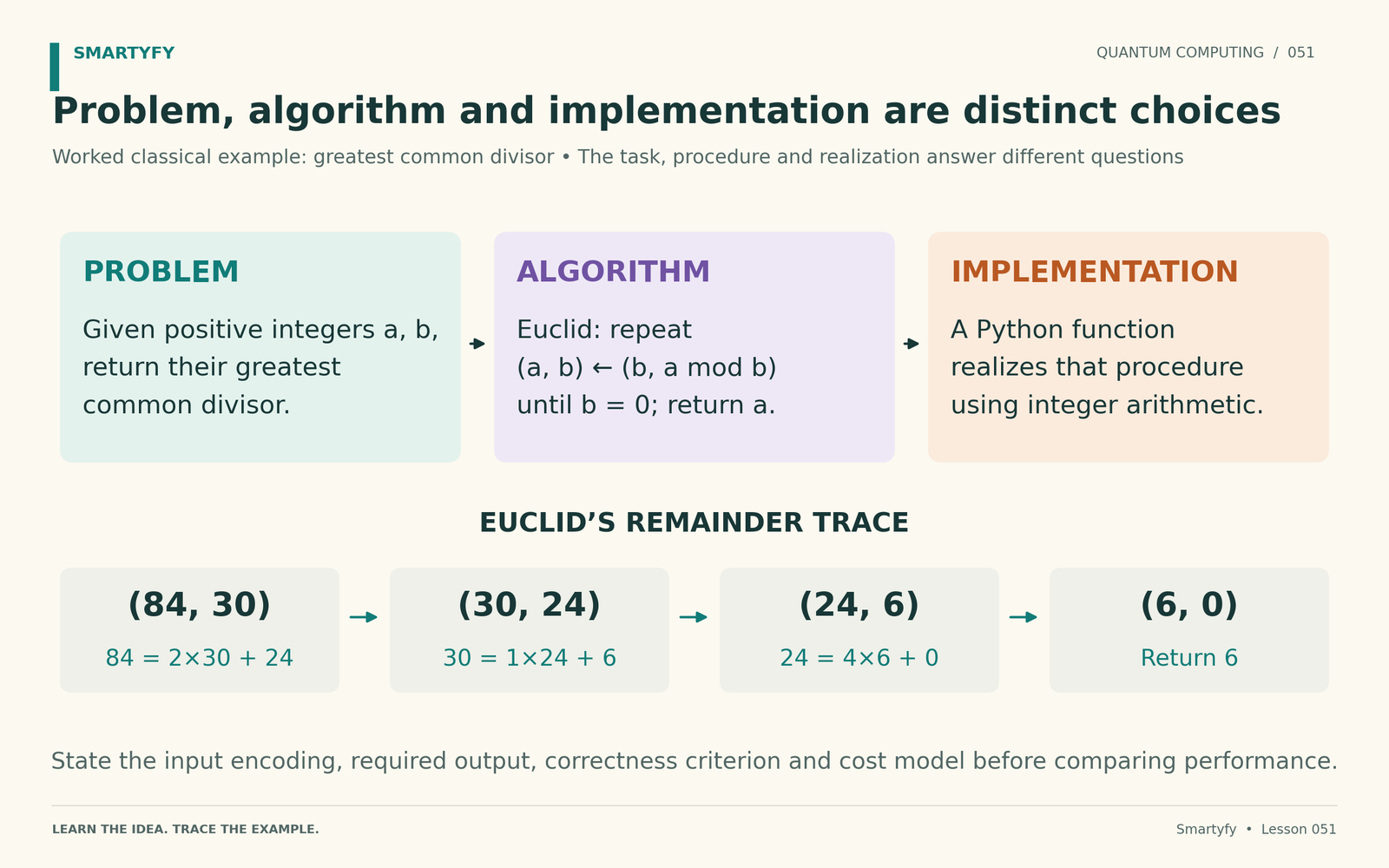
A computational problem specifies a family of allowed inputs and acceptable outputs. An algorithm is a finite description of a procedure that solves those instances under an explicit model. An implementation realizes that procedure using a programming language, circuit representation, compiler, simulator, or physical device.
For example, “given two positive integers, return their greatest common divisor” is a problem. Euclid’s repeated-remainder procedure is an algorithm. A Python function implementing that procedure is one implementation. Changing the programming language need not change the underlying algorithm.
Conversely, running two mathematically different procedures on the same hardware can change the algorithm while leaving the implementation platform fixed. This separation helps avoid attributing every observed timing difference to a fundamental quantum-computational improvement.
Specify the input representation
An integer can be given in binary, decimal, or unary notation. A list can be stored explicitly, accessed through a query interface, or supplied as a prepared quantum state. These representations expose different operations and may have very different preparation or access costs.
A problem involving an integer N does not automatically have input size N. With binary input, the number of digits grows roughly as log₂N. A database with N explicitly stored records, by contrast, has a representation whose length generally scales with the number and size of those records.
Quantum amplitude encoding is another representation choice: a normalized list is represented by amplitudes of a state. Writing down that mathematical state does not automatically provide an efficient circuit to prepare it. Loading, normalization, and access assumptions belong in the problem specification.
Specify the output and correctness criterion
A decision problem returns yes or no. A search problem returns an object satisfying a condition. A function problem returns a specified value or string. A sampling problem returns outcomes according to a desired distribution. These tasks can be related, but they are not interchangeable.
For an approximate numerical task, state the error tolerance and how it is measured. For a randomized or quantum algorithm, state the probability of satisfying that tolerance. A procedure correct with probability two thirds per run has a different guarantee from one that is always exact.
Output size can itself limit runtime. If the requested answer contains a million classical entries, writing those entries requires output work. A quantum state that encodes them is not the same deliverable as a readable classical list of all entries.
Worked example with a classical algorithm
Take input integers 84 and 30. Euclid’s procedure repeatedly replaces (a,b) with (b,a mod b) until b = 0. Here 84 = 2×30 + 24, 30 = 1×24 + 6, and 24 = 4×6 + 0. The algorithm returns six.
Correctness follows from an invariant: the common divisors of a and b are the same as those of b and a mod b. Since a = qb + r, a divisor of a and b divides r, and a divisor of b and r divides a. The final nonzero value therefore preserves the original greatest common divisor.
Termination is a separate argument. Each nonzero remainder is smaller than the previous divisor, so a decreasing sequence of nonnegative integers cannot continue indefinitely. A convincing algorithm explanation supplies both correctness and termination, not only a successful example.
This example also illustrates cost-model care. Counting remainder operations is useful, but a remainder on thousand-bit integers costs more than one on tiny integers. A bit-operation analysis must account for the arithmetic implementation.
Queries and full computational cost
In a query model, an algorithm accesses a function or dataset through a specified oracle, and each call is charged as a query. A quantum query is a coherent operation on basis labels, with behavior defined on superpositions by linearity. It is not a free opportunity to read all function values as classical output.
A query advantage compares the numbers of accesses needed under that access model. To claim an end-to-end runtime advantage, one must also account for implementing the oracle, preparing inputs, performing other gates, extracting outputs, and classical processing.
These extra costs can preserve, reduce, or remove an advantage. Query models remain valuable because they isolate a precise computational resource and permit rigorous comparisons. Their conclusions should be stated at the level actually proved.
What makes a quantum algorithm quantum
A quantum algorithm uses allowed quantum operations to organize amplitudes and interference, then obtains a useful classical result or quantum output according to its specification. Merely replacing classical bits with basis-state qubits does not guarantee any improvement.
A reversible implementation of ordinary arithmetic may be a necessary subroutine inside a quantum algorithm. Its role is to operate coherently on an input superposition without discarding information that later interference needs. The following lessons develop that capability before introducing more algorithmic examples.
The existence of a large state space is also not an efficiency proof. A state with many amplitudes cannot generally reveal every amplitude in one measurement. The algorithm must arrange that accessible outcomes answer the intended question with adequate success probability.
Design a fair comparison
Compare algorithms solving the same task, with comparable input access and output quality. State whether the classical comparator is deterministic, randomized, exact, or approximate. An advantage against one simple baseline is not automatically an advantage against every classical method.
Distinguish a proved lower bound from the absence of a currently known faster method. A theorem ruling out a class of algorithms is stronger than a literature comparison. Hardware timings on a few small instances are useful implementation observations, but do not alone establish asymptotic scaling.
A clear algorithm report therefore includes its specification, model, correctness argument, resource estimate, comparison baseline, and evidence boundaries. These details make later speedup statements intelligible rather than promotional.
Four exercises with worked solutions
-
Classify “find a marked database item,” “Grover search,” and “a simulator circuit using that search.”
Solution. The first describes a search problem once the access and success conditions are supplied. The second names an algorithmic approach. The third is an implementation that can test the algorithm’s model without being quantum hardware.
-
Run Euclid’s procedure on 35 and 15.
Solution. 35 = 2×15 + 5 and 15 = 3×5 + 0, so the result is five. The common-divisor invariant and decreasing remainders justify the result and termination.
-
An algorithm returns one sample from a distribution. Has it returned a table of every probability?
Solution. No. A sample is one outcome. Estimating many probabilities requires repeated data and an accuracy specification; producing a complete classical table is a different output task.
-
A quantum method uses fewer oracle calls but a costly state-preparation step. What must an honest claim include?
Solution. It can state the query reduction under the given access model. An end-to-end claim must additionally include preparation, oracle implementation, other operations, measurement, and output processing at comparable accuracy.
Five explained multiple-choice questions
-
A computational problem primarily specifies: A. Steps taken by one particular implementation. B. Processor instructions available on one machine. C. Runtime of one implementation on one input. D. Allowed inputs and acceptable outputs.
Answer: D. The task specification precedes a choice of algorithm or implementation.
-
One successful example proves an algorithm correct on all inputs: A. Only with binary inputs. B. Whenever the output is short. C. No, a general argument is still needed. D. Always.
Answer: C. Testing examples and proving a family-wide guarantee serve different purposes.
-
A query count measures: A. The number of specified oracle accesses. B. The number of amplitudes read out. C. All physical runtime automatically. D. The full cost of loading arbitrary data.
Answer: A. Other costs require additional accounting.
-
A sampling task returns: A. Every probability exactly. B. Outcomes governed by a target distribution. C. A guaranteed deterministic label. D. A copy of the entire input database.
Answer: B. Samples and complete probability tables are different deliverables.
-
A fair speed comparison should use: A. Different accuracy targets without disclosure. B. Only gate names. C. Any convenient classical straw man. D. Comparable tasks, input access, and output guarantees.
Answer: D. Otherwise a difference may come from changing the problem rather than improving its solution.
Pitfalls and summary
Keep problem, algorithm, and implementation distinct. Specify representation, correctness, success probability, and output form before counting resources. Quantum advantage is a claim about a well-defined comparison, not an automatic consequence of superposition or a successful small demonstration.
Primary sources and further study
These sources support the definitions and context. The numerical examples, exercises, and explanations here were prepared for this lesson. Research papers are optional advanced reading.
- IBM Quantum Learning: Quantum algorithmic foundations, introduction
- IBM Quantum Learning: Quantum query algorithms, introduction
- Peter Shor: Polynomial-Time Algorithms for Prime Factorization and Discrete Logarithms on a Quantum Computer
- Lov Grover: A fast quantum mechanical algorithm for database search