Quantum Computing Master Course — 059. Lower Bounds and Speedup Claims
Lesson 059: Lower Bounds and Speedup Claims
Smartyfy Quantum Computing Master Course
Prerequisites and objectives
An algorithm’s upper bound shows what one method can accomplish. A lower bound shows what every method in a specified class must spend. Confusing these two statements is a common source of exaggerated speedup claims. You will prove a small adversary lower bound, interpret a standard quantum search bound, and audit comparisons involving different input access or accuracy.
The phrase “every method” always has a scope. It may mean deterministic decision trees, randomized query algorithms, quantum query algorithms, or circuits over a specified gate set. A lower bound outside the relevant model does not automatically constrain the implementation being discussed.
Upper bounds describe constructions
If a supplied algorithm solves a task using at most n² gates, it establishes an O(n²) upper bound. Another algorithm might use n log n gates or fewer. The first construction does not prove that quadratic work is necessary.
Benchmarking several implementations also supplies evidence about those implementations, not a theorem ruling out all other approaches. A phrase such as “best known classical method” reports the state of knowledge and the comparison performed; it is not equivalent to “best possible classical method.”
A matching lower bound can make an algorithm asymptotically optimal within the stated model. Even then, constant factors, memory, parallel depth, precision, and physical implementation may differ among optimal algorithms.
Worked lower bound by indistinguishable inputs
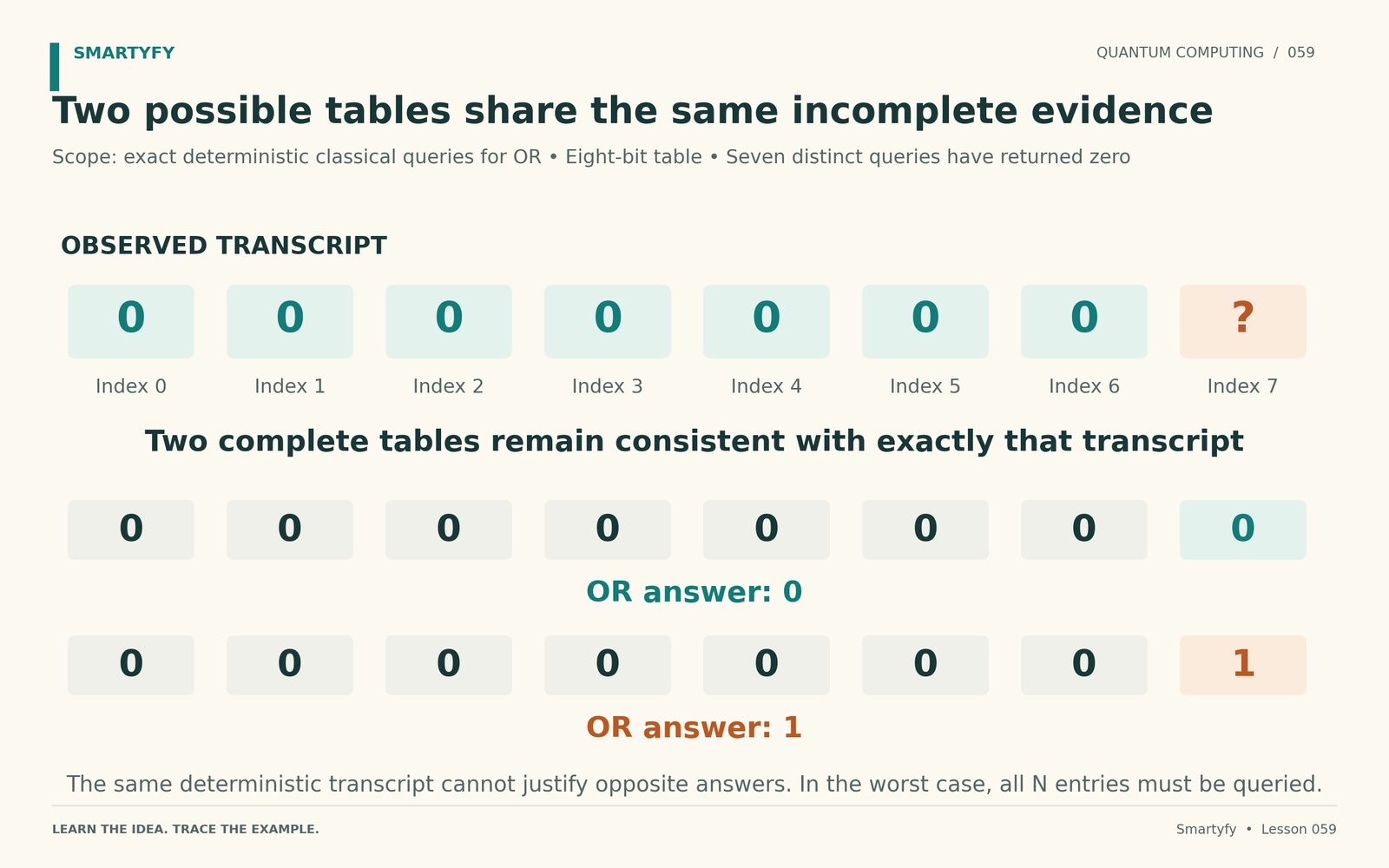
Let an unknown table contain N bits f(0),…,f(N−1). The task is to decide whether any bit equals one, using exact deterministic classical queries. Suppose an algorithm stops after querying fewer than N distinct entries and has seen only zeros.
At least one entry j remains unqueried. The observed transcript is consistent with the all-zero table and also with a table whose only one is at j. The correct answers are different, but the deterministic algorithm has received the same information.
It must therefore give the same output on both transcripts and be wrong on one. Any always-correct deterministic algorithm has a worst-case requirement of N queries. Querying every entry gives a matching N-query upper bound, so the exact deterministic query complexity is Θ(N).
The argument also works under the promise of either zero or one marked entry. It does not apply unchanged if the promise guarantees exactly one marked entry and the task merely asks whether one exists, because that decision answer would already be known.
Randomized and quantum comparisons
Allowing bounded error changes the algorithm class. For unstructured OR or search with standard black-box access, randomized classical algorithms still need a number of queries proportional to N in the worst case for constant success guarantees. Proving that statement requires a probabilistic lower-bound argument, not merely repeating the deterministic transcript proof.
Quantum algorithms can solve the corresponding unstructured search task with O(√N) queries, and a matching Ω(√N) quantum query lower bound is known. The square-root improvement is therefore asymptotically optimal in that black-box model.
This does not say quantum computers need √N physical seconds, nor does it rule out faster methods for structured inputs available through a richer interface. It identifies the cost of querying an otherwise unstructured oracle under the specified success conditions.
Use the same task on both sides
Suppose one algorithm returns an exact answer and another returns an approximation within a chosen tolerance. Their runtimes cannot be compared meaningfully without discussing the difference in output quality. The same issue arises when one succeeds with probability 0.51 and another with probability 0.999.
For search, specify whether a marked item is guaranteed to exist, whether the number of marked items is known, and whether the algorithm must detect absence. For sampling, specify the distance between the produced and target distributions. For numerical output, specify absolute or relative error.
These details are not technical decorations. They determine which algorithms are eligible and which lower bounds apply. A faster solution to an easier task does not establish an advantage on the harder task.
Worked comparison with an explicit cost ledger
Consider a hypothetical search among N=1,048,576 candidates. A classical baseline uses N predicate evaluations. A quantum query estimate scales like √N=1024 coherent oracle uses, suppressing algorithm-dependent constants for this illustrative scaling calculation.
If each coherent oracle costs one thousand elementary gates, the oracle portion alone is roughly 1,024,000 gates under that estimate. If state preparation adds two million gates, the total already exceeds three million gates before other operations and repetitions are counted.
This arithmetic does not prove that the quantum implementation is slower: classical predicate evaluation has its own cost and gate types are not physical time units. It proves only that reporting “1024 operations versus a million” would conceal the stated implementation costs.
A fair report keeps the query improvement and the end-to-end uncertainty separate. The abstract advantage can be valid even when a particular practical advantage has not been demonstrated.
Preprocessing, amortization, and hidden information
Some algorithms spend substantial effort preparing a data structure or quantum resource that is reused across many queries. This can be a legitimate amortized comparison. State how many subsequent tasks share the preparation, what updates invalidate it, and whether the comparator receives equivalent preprocessing opportunities.
If preprocessing requires the answer to the very instance being solved, it cannot be dismissed as harmless setup. Likewise, an oracle compiled from a hidden string must not leak that string directly to the solver while the classical comparator is forced to query blindly.
Data-access assumptions can dominate the result. An explicit array, a sparse-entry query interface, and a ready-made amplitude-encoded quantum state are different resources. A comparison should either align them or clearly label the extra assumptions.
What oracle lower bounds do not prove
A black-box lower bound treats the oracle’s internal structure as inaccessible. A real problem may supply a short formula, symmetry, geometry, or algebraic structure that an algorithm can exploit. Applying a black-box bound to that richer input without justification would be incorrect.
Conversely, demonstrating an oracle separation is mathematically significant without proving an unconditional separation between standard complexity classes. The scope of the theorem is part of its content, not a qualification to omit from a headline.
When reading a speedup claim, identify the strongest statement actually supported: a demonstrated implementation improvement, an asymptotic upper-bound comparison, a query separation, or an optimality theorem with a matching lower bound.
Four exercises with worked solutions
-
An exact deterministic OR algorithm queries seven entries of an eight-bit table and sees zeros. Why can it not stop?
Solution. The final entry may be zero or one. Both tables match the transcript but require different decisions, so one more query is necessary on that branch.
-
Does an O(n³) algorithm prove an Ω(n³) lower bound?
Solution. No. The construction gives an upper bound only. A faster algorithm may exist; necessity requires a separate argument covering every allowed method.
-
Compute the illustrative total of 1024 oracle uses at 1000 gates each plus 2,000,000 preparation gates.
Solution. The sum is 1,024,000 + 2,000,000 = 3,024,000 gates, before any omitted costs. It remains a model-dependent gate ledger rather than a hardware time measurement.
-
A table is supplied as a short formula revealing its marked index. Does an opaque-oracle search lower bound automatically apply?
Solution. No. The solver has richer access and may exploit the formula. The lower bound applies only if the information access matches its assumptions.
Five explained multiple-choice questions
-
A lower bound constrains: A. Every conceivable physical process without assumptions. B. One implementation only. C. Every algorithm within its stated model and task. D. Only the oldest algorithm.
Answer: C. Its quantified scope must be explicit.
-
The deterministic OR adversary uses: A. Two tables consistent with the same incomplete transcript. B. An average over uniformly random truth tables. C. A restriction to nonadaptive classical queries. D. The runtime of the best implementation found so far.
Answer: A. Indistinguishable observed inputs with different correct answers force another query.
-
The standard quantum unstructured-search query scaling is: A. Θ(N²). B. Θ(√N) for constant-success black-box search. C. Θ(log N) universally. D. Θ(1) for arbitrary N.
Answer: B. The known upper and lower query bounds match asymptotically in that model.
-
“Best known” and “best possible” are: A. Both lower bounds by definition. B. Always synonyms. C. Distinguished only by processor speed. D. Different strengths of claim.
Answer: D. Knowledge of current constructions is not a universal impossibility theorem.
-
Amortizing preparation is fair when: A. Its cost is omitted without explanation. B. Only quantum methods may preprocess. C. Reuse and comparison assumptions are explicitly accounted for. D. Preparation already contains the answer secretly.
Answer: C. Shared setup can be meaningful, but its scope and cost must remain visible.
Pitfalls and summary
Separate constructions from impossibility proofs, match tasks and error guarantees, and state the access model. A speedup can be rigorous at the query level while its practical value remains unestablished. Strong claims need equally explicit assumptions and evidence.
Primary sources and further study
These sources support the definitions and context. The numerical examples, exercises, and explanations here were prepared for this lesson. Research papers are optional advanced reading.