MRINDiGi APPSC Academy
Your APPSC preparation starts here
A dedicated home for Group 1 and Group 2 preparation. Choose your track, plan your study time, and return for published lessons as the academy grows.
Browse published lessonsAPPSC Group 1
Choose your Group 1 preparation track, set a study routine, and find published lessons as they are added.
Explore Group 1APPSC Group 2
Choose your Group 2 preparation track, set a study routine, and find published lessons as they are added.
Explore Group 2Group 1 lessons
Group 1 Lesson 0037 - Chemical Reactions: Equations and Conservation [G1-SCI-005]
GROUP 1 · SCIENCE · G1-SCI-005 · LESSON 0037
Chemical Reactions: Equations and Conservation
Keep chemical identity fixed, count each element, and define what crosses the boundary of the account.
Study time: 70–90 minutes. This is a paper lesson. Equations identify model substances; they are not instructions to obtain, mix, heat or ignite chemicals. All particle inventories and weighing records below are fictional. Unless stated otherwise, assume an ordinary chemical reaction, a complete account of the stated substances, and the ideal outcome specified in the question.
Syllabus connection: This develops a chemistry foundation within the broad Science and Technology section of the dated official 2018 Group I Screening Paper II-B syllabus, PDF page 6. No exact numbered chemistry row, current 2026 detailed syllabus or addendum effect has been newly verified. Wider science coverage remains incomplete.
Learning goals
- Separate an observation from a justified claim about a new substance.
- Read formulas, coefficients, states and conditions without changing chemical identity.
- Audit atom inventories and the boundary of a mass account.
- Distinguish a balanced equation from a claim about actual speed, completeness or energy.
1. Ask what changed, and what the record establishes
The selected NCERT physical and chemical change passages distinguish a change of physical properties from formation of new substances. Water changing between ice and liquid, by itself, does not establish a chemical reaction. Colour, temperature or gas observations can be useful evidence, but a description must identify what happened before assigning a cause.
Consider three invented notebook entries: “the sample became warm”; “the sample became warm while the surrounding room also warmed”; and “the recorded starting substances were replaced by identified products”. These are different amounts of information. The first does not isolate the source of warming; the second supplies a competing explanation. The third addresses substance identity, although the quality of that identification would still matter in a real investigation.
A worksheet saying “bubbles appeared, therefore a particular new gas was formed” has skipped a step. The observation alone does not name the gas or exclude another explanation. Conversely, absence of a dramatic visible change is not a logical proof that the substances remained identical. For an exam question, use the supplied evidence and conditions; do not add an unreported test.
2. Read the equation before calculating
In the selected NCERT equation passages, reactants appear before the arrow and products after it. Coefficients count whole formula entities; subscripts belong to a substance’s formula. State labels include (s), (l), (g) and (aq), and stated conditions may appear beside the arrow.
Use the paper equation 2H2(g) + O2(g) → 2H2O(l). Read it as two hydrogen molecules and one oxygen molecule corresponding to two water molecules in the stated model. The plus sign separates substances on one side; the arrow records the direction being described. It is not an equals sign allowing terms to be moved across it like an algebra exercise.
The (g) label says gas. It does not say that matter has left the account. The (aq) label means dissolved in water; it does not mean that the named substance is a pure liquid. Conditions and states carry information separate from the atom totals. An answer can have correct atom arithmetic and still misread the described physical situation.
3. Preserve the formula; multiply the whole entity
For H2O, the absent subscript after O means one oxygen atom per molecule. The coefficient in 2H2O multiplies both elements: four hydrogen atoms and two oxygen atoms in total. Replacing the formula by H2O2 changes the substance represented; it is not an acceptable balancing step.
Parentheses make the same bookkeeping more visible. One formula unit of Ca(OH)2 contains one Ca, two O and two H atoms. Thus 3Ca(OH)2 accounts for Ca = 3, O = 6 and H = 6. Multiplying only the calcium by three would ignore the scope of the coefficient. The word “formula unit” avoids assuming every compound is a collection of separate molecules.
Try a two-stage annotation: first write the atoms within one formula entity, then multiply each entry by its coefficient. This keeps the symbol’s internal structure separate from the number of entities. If a proposed solution changes an internal subscript, return to the stated substances before checking its numbers.
4. Balance with an explicit atom ledger
Begin with H2 + O2 → H2O. Hydrogen counts match at two, but oxygen counts do not: two before the arrow and one after. Put coefficient two before water. Product counts become H = 4 and O = 2, so hydrogen now needs coefficient two on the reactant side.
| Element | Reactant count | Product count |
|---|---|---|
| H | 2 × 2 = 4 | 2 × 2 = 4 |
| O | 1 × 2 = 2 | 2 × 1 = 2 |
The smallest positive whole-number coefficients are 2 : 1 : 2. Multiplying all three by two gives 4 : 2 : 4, which also balances, but is not the smallest set. Reducing all coefficients by their common factor preserves the ratio. Reducing just one coefficient does not.
The ledger tests each element separately. Matching only the total number of atoms could hide an imbalance between elements. In an ordinary chemical reaction, the accounting rearranges atoms among substances; it does not allow an extra oxygen atom to be supplied by renaming a hydrogen atom.
5. An equation ratio is not the whole starting inventory
A fictional particle card contains 6 H2 molecules and 4 O2 molecules. Suppose only the written water-forming reaction occurs and proceeds as far as these discrete counts permit. Each complete reaction group uses two hydrogen molecules and one oxygen molecule. Six hydrogen molecules permit three groups, whereas four oxygen molecules could support four.
Only three complete groups can therefore be carried out: six hydrogen molecules and three oxygen molecules are consumed, six water molecules are formed, and one oxygen molecule remains. The equation has not failed because an unreacted substance remains. The original supply did not have the equation’s exact consumption ratio.
Check all atoms, including leftovers. Initially H = 12 and O = 8. The water contains H = 12 and O = 6; the remaining O2 contributes two more oxygen atoms. The final totals match. Counting just products while omitting unused starting material would make a complete system look incomplete.
Initially there are ten molecules; finally there are seven: six water and one oxygen. Molecule number is not conserved in this model; the number of each kind of atom is. This distinction explains why coefficients are not generally required to sum to the same number on the two sides.
6. Mass accounting needs a stated boundary
Imagine a fictional closed apparatus of mass 80 g containing 45 g of starting substances. Its initial combined mass is 125 g. A record says that 9 g of the contents becomes gas and remains inside. Under the stated ordinary-reaction, no-flow model, the combined mass is still 125 g. Changing where matter is located within the boundary is not exporting it.
Now consider a separate hypothetical record in which exactly 9 g of gas crosses out of that boundary, with no other input or output. The remaining apparatus and contents total 116 g. Adding the exported 9 g restores the complete 125 g account. This is a boundary calculation, not a recommendation to release gas.
If an actual reading differed, possible omitted transfers or measurement limitations would need investigation. The conservation principle does not justify inventing a particular missing pathway without evidence. Always name whether the answer refers to one selected product, remaining contents, or the complete apparatus and its transfers.
7. Coefficient ratios are not automatically mass ratios
Use a deliberately stipulated school model in which one H atom has mass 1 unit and one O atom has mass 16 units. For the balanced water equation, two H2 molecules have mass 4 units, one O2 molecule has mass 32 units, and two H2O molecules have mass 36 units. The account is 4 + 32 = 36.
The entity ratio is 2 : 1 : 2; the corresponding mass ratio here is 4 : 32 : 36, or 1 : 8 : 9. Applying 2 : 1 : 2 directly to gram quantities would confuse counts with masses. These stipulated masses are used only for the arithmetic model; precise atomic-mass work is outside this lesson.
A second original model stipulates that 12 g of carbon combines completely with 32 g of oxygen to form 44 g of carbon dioxide. If the initial oxygen supply is instead 48 g, with no other reactions, 16 g remains. Final material is 44 g product plus 16 g oxygen, equalling the original 60 g total. Calling 44 g the entire final mass would omit the unused reactant.
8. Classify the written change, then state its limits
Three concise NCERT examples provide classification practice: C + O2 → CO2 combines reactants into one product; CaCO3 → CaO + CO2, with heat stated, splits one reactant; Fe + CuSO4 → FeSO4 + Cu illustrates displacement. These written patterns are combination, decomposition and displacement respectively.
In the decomposition example, “heat” is a condition and energy input, not an extra chemical element to put into the atom table. In the displacement example, the stated products matter: the pattern does not license replacing iron with any arbitrary metal while keeping the same outcome. This is classification of supplied equations, not an experiment plan.
Exothermic means net heat is released; endothermic means energy is absorbed in the described change. A balanced equation alone supplies no numerical heat amount. It also does not establish how quickly the process occurs, whether the supplied conditions permit it, or whether every available reactant is converted. Keep atom balance, energy description and actual outcome as separate questions.
Applied paper task: repair an incomplete inventory
A learner starts with 10 H2 and 4 O2 molecules and claims the final account is “8 water molecules; nothing else”. Use the same ideal water-forming model. Identify the omitted material, check each element, and decide whether 4 : 2 : 4 is balanced or is the smallest whole-number equation ratio.
Check: four complete groups consume eight H2 and four O2, producing eight H2O and leaving two H2. Hydrogen totals are 20 initially and 16 + 4 finally; oxygen totals are eight on both sides. The 4 : 2 : 4 ratio is balanced, but reduces to 2 : 1 : 2. A correct product count can coexist with an incomplete material account.
Ten original questions with explanations
-
In 2H2 + O2 → 2H2O, which substances are the reactants?
- Water only
- Hydrogen and water
- Hydrogen and oxygen
- Oxygen and water
Answer: C. Reactants are before the arrow: hydrogen and oxygen. Water is the product. The coefficients count entities; they do not move water to the reactant side.
-
What atom inventory does 3Ca(OH)2 represent?
- Ca = 3, O = 6, H = 6
- Ca = 3, O = 2, H = 2
- Ca = 1, O = 6, H = 6
- Ca = 3, O = 3, H = 6
Answer: A. One formula unit has one Ca and two of both O and H. Multiplying the entire formula by three gives 3, 6 and 6. The subscript outside parentheses applies to both symbols inside.
-
What is the smallest positive whole-number coefficient set for H2 + O2 → H2O, keeping those formulas?
- 1 : 1 : 1
- 1 : 2 : 1
- 4 : 2 : 4
- 2 : 1 : 2
Answer: D. With 2 : 1 : 2 there are four H and two O atoms on each side. The 4 : 2 : 4 set also balances but has a common factor of two, so it is not the smallest set.
-
A learner replaces H2O with H2O2 to make an oxygen count match. What is the error?
- Coefficients may never exceed one
- The product formula and therefore the stated substance were changed
- Oxygen may not appear in products
- Every balanced equation must have equal molecule totals
Answer: B. Balancing the given reaction adjusts numbers of whole formula entities. Changing the subscript changes the product being described; it does not repair the original equation.
-
A fictional apparatus plus contents initially weighs 125 g. Exactly 9 g leaves as gas, with no other transfers. What is the remaining mass within the boundary?
- 125 g because no gas has mass
- 134 g
- 9 g
- 116 g
Answer: D. The remaining mass is 125 − 9 = 116 g. Including the exported 9 g restores the complete 125 g account. A closed version retaining that gas would instead remain 125 g.
-
What does (aq) beside a substance mean?
- The substance is necessarily a gas
- The substance is a pure liquid
- The substance is dissolved in water
- The reaction must be instantaneous
Answer: C. Aqueous notation describes a substance in water solution. It is a state description, not a coefficient, purity claim or statement about reaction speed.
-
How is C + O2 → CO2 classified by its written pattern?
- Combination
- Decomposition
- Displacement
- A physical state change only
Answer: A. The supplied reactants form a single product, the combination pattern. This classification by itself gives no numerical heat output or time needed.
-
CaCO3 → CaO + CO2, with heat supplied, illustrates which pattern?
- Combination of two reactants
- Decomposition of one reactant
- Changing a coefficient into a subscript
- Disappearance of the carbon atoms
Answer: B. One reactant gives two products in the stated thermal decomposition. Ca, C and O still balance; heat is not an additional element in the formula ledger.
-
Which description matches Fe + CuSO4 → FeSO4 + Cu?
- Water changing its physical state
- Iron displacing copper from the stated compound
- Two reactants forming only one product
- A proof that every metal displaces copper
Answer: B. The written reaction shows iron replacing copper in the compound and copper appearing as a product. It is a particular displacement example, not a rule that every metal gives this outcome.
-
Which conclusion follows from the isolated statement “the colour changed”?
- The exact new substance has been identified
- The balanced equation is known
- All starting material was consumed
- More context is needed before identifying the change and its cause
Answer: D. A single visible observation does not supply identities, an equation or completeness. Interpret it alongside the stated starting materials, products and evidence rather than inventing an unreported test.
Primary reading and limits
NCERT Science X, Chemical Reactions and Equations, reprint 2026–27: selected equation/balancing/state paragraphs, printed 2–5; brief classification and energy definitions, printed 6–8 and 11. NCERT Science VII, Physical and Chemical Changes, reprint 2024–25: selected definitions, printed 48 and 51. Source activities, exercises and diagrams are not reproduced. Particle cards, mass records, stipulated-mass comparisons, questions and explanations here are original. Bonding, ionic/redox accounting, reaction rates, equilibrium, precise atomic masses and practical chemistry remain outside this foundation.
Group 1 Lesson 0036 - Plate Tectonics: Boundaries, Earthquakes and Landforms [G1-GEO-005]
GROUP 1 | GEOGRAPHY | G1-GEO-005 | LESSON 0036
Plate Tectonics: Boundaries, Earthquakes and Landforms
Use relative motion and several kinds of evidence to explain a boundary, without turning a long-term rate into an earthquake forecast.
Study time: 65-80 minutes. Every unnamed site, distance, age and rate in the exercises is fictional. Values illustrate ideal models; they are not current measurements, local hazard estimates or instructions for responding to an earthquake.
Syllabus connection: A physical-geography foundation within broad Screening Paper I-D, Geography, one-based PDF page 4 of the official dated 2018 Group I syllabus, using the retained independently verified historical section map. No exact numbered tectonics item is asserted. The detailed 2026 notification and addendum remain unverified; latest wording and whole-section completion are not certified.
Learning goals
- Distinguish a lithospheric plate from a continent and from the crust alone.
- Classify divergent, convergent and transform motion.
- Separate oceanic subduction from continental collision.
- Interpret fault-slip, landform and seafloor evidence together.
- Calculate a stated ideal relative displacement with correct units and limits.
1. What is moving?
The rigid lithosphere includes the crust and the uppermost mantle. A tectonic plate is a moving portion of this lithosphere, not merely a continent. A plate can carry both continental and oceanic areas. Thus a coastline is not automatically a plate boundary, and a political map cannot be used as a map of moving plates. The selected NCERT interior-of-the-Earth passages distinguish the lithosphere from the weaker asthenosphere below it.
The contrast is mechanical as well as positional. Rock can remain mostly solid yet deform slowly over geological time. The USGS tectonics overview describes rigid plates above hotter, slowly flowing material. Do not picture continents floating on a worldwide liquid ocean, or continental blocks simply cutting through stationary ocean floor.
To read a boundary arrow, choose the relationship being described. Two plates can both move while their distance increases, decreases or remains approximately constant along a boundary. For classification, the important question is their motion relative to each other. An arrow labelled east is incomplete unless its reference and the other side’s movement are understood.
2. Divergence: separation and new oceanic lithosphere
At a divergent boundary, plates separate. At an oceanic spreading ridge, material rises, magma cools and new oceanic lithosphere forms. Older material moves away from the ridge. The mechanism connects a landform, relative motion and a sequence of ages; it is more informative than memorising a ridge name alone. NCERT’s plate-tectonics section uses the Mid-Atlantic Ridge as an example.
For an ideal symmetrical case, matching strips on opposite sides can preserve comparable ages and magnetic records. Their repeated arrangement supports a history of spreading. One rock sample cannot by itself establish an entire ocean’s history: position, age and the relationship to other samples matter. A pattern is especially useful when independent observations fit the same explanation.
Formation at a ridge does not mean Earth must continuously gain a new outer shell without any recycling. A global explanation must also account for lithosphere returning into the interior elsewhere. Think in terms of linked processes, while avoiding the assumption that every individual plate must keep a constant shape or size.
3. Convergence has more than one outcome
Convergence means motion towards one another. Where oceanic lithosphere descends beneath another plate, subduction links a descending slab with a trench and associated deformation. The USGS overview explains that fluids released from the descending material can promote melting in the mantle above it. The whole oceanic slab does not have to melt instantly to produce magma.
The identity of the interacting lithosphere matters. Oceanic-continental and oceanic-oceanic convergence can involve subduction. Continental collision requires a different emphasis: compression, shortening and crustal thickening. The National Park Service’s collision explanation connects these processes with collisional mountain ranges, including the Himalaya.
In a continent-continent collision, saying only that one side disappears like an oceanic slab misses the mountain-building process. Nor should every mountain range be labelled a volcanic arc. The relevant questions are what is colliding, how the crust deforms and which observations support that interpretation. A single word, convergence, is a starting category rather than a complete geological history.
The NPS sequence also illustrates an important historical distinction: oceanic subduction can precede continental collision as an intervening ocean closes. Different stages can therefore leave different evidence. An earlier volcanic rock need not establish that a present collision zone is simply a currently active oceanic volcanic arc.
4. Transform motion: sideways does not mean inactive
At an ideal transform boundary, plates move horizontally past one another. The boundary itself is not a site of net creation or destruction of lithosphere in the way a spreading ridge or subduction zone is. This classification concerns the relative motion; it does not mean friction disappears or that earthquakes cannot occur.
Compare three imaginary arrow pairs. Arrows pointing away from a dividing line represent divergence; arrows pointing towards it represent convergence; arrows parallel to it and directed past one another represent transform motion. Rotate the page and the compass directions change, but the relative-motion category does not. Classifying by north, south, east or west alone is therefore unreliable.
5. Fault slip, stored strain and earthquake evidence
The USGS earthquake explanation describes an earthquake as sudden slip on a fault. Rough fault surfaces can remain locked while surrounding rocks deform. A slip releases stored energy, including energy carried by seismic waves. The subsurface starting location is the focus or hypocentre; the epicentre is its projection at the surface.
A long-term plate-motion average is not a schedule of identical daily slips on every fault. This distinction matters whenever a question divides centimetres per year by a calendar interval and then claims to know the next event. A regional motion and a specific fault’s sequence are different descriptions. The calculation may be correct while the proposed earthquake inference is unsupported.
Many earthquakes concentrate near plate boundaries, but the word many or most must not be silently changed to all. The USGS overview also recognises activity away from boundaries. Conversely, the absence of an earthquake during a short observation period does not prove that no tectonic movement or strain exists.
6. Worked boundary dossier: combine clues
Fictional site R: A ridge has newly formed oceanic rock, with progressively older matching bands on either side and movement away from its axis. The combination supports a divergent spreading interpretation. A ridge shape alone would be a weaker basis; the motion and age relationships make the case stronger.
Fictional site S: Oceanic lithosphere descends beneath another plate, beside a trench and a belt of related volcanic activity. This supports subduction. Site T instead contains two converging continental blocks with shortened, thickened crust. That supports collision. Both involve convergence, but copying the same complete landform description to both would lose the crucial distinction.
Fictional site U: Two blocks move laterally past one another, with fault-slip earthquakes and no net lithosphere production at the ideal boundary. Transform is the appropriate category. The earthquakes do not turn U into a spreading ridge. Likewise, the absence of an identified volcanic chain does not by itself make a boundary transform; the motion remains the decisive supplied clue.
7. Worked rate case: units and reference frames
Assume two fictional plates separate at a constant relative rate of 4 centimetres per year for 2,000,000 years. Distance = rate x time = 8,000,000 centimetres. Because 100 centimetres = 1 metre and 1,000 metres = 1 kilometre, 100,000 centimetres = 1 kilometre. The calculated relative separation is therefore 80 kilometres.
This is not 8 kilometres, and it is not 8,000,000 kilometres. Attach units at every stage. The result depends on a constant average rate and on the stated relative-motion model. It describes accumulated displacement in the exercise, not the timing or magnitude of an earthquake.
Now change the wording: each flank moves away from an ideal stationary ridge at 2 centimetres per year in opposite directions. The two flanks separate at 2 + 2 = 4 centimetres per year. If a question already provides their relative separation as 4, adding it twice would be an error. Draw or state the reference before choosing the arithmetic.
Fictional age check: On each flank, rock 20 kilometres from the ridge is 1 million years old and rock 40 kilometres away is 2 million years old. Either pair gives a flank average of 20 kilometres per million years = 2 centimetres per year. Symmetry then gives 4 centimetres per year between opposite matching flanks in this ideal model. These are invented compatible values, not measurements of the Mid-Atlantic Ridge.
8. What the model can and cannot predict
The USGS prediction FAQ distinguishes an exact earthquake prediction, specifying time, location and magnitude, from a probability over an area and interval. A plate-boundary map or an average rate alone does not supply such an exact prediction. This limit does not make geological evidence useless; it specifies the kind of conclusion the evidence can support.
In an exam statement, underline the scope words: all, only, always, most, can and must. Most activity near boundaries is compatible with exceptions. A mechanism that can produce a volcanic belt is not a guarantee that every convergent setting has the same belt. An ideal numerical answer is conditional on the supplied model. These distinctions are part of geographical explanation, not merely tricks for eliminating options.
Applied task: Classify the four fictional sites above, name the decisive observation for each and state one claim not established by that observation. Then recompute the relative displacement for 3 centimetres per year over 2 million years. The answer is 60 kilometres under the same constant-rate assumption; it still supplies no earthquake date.
Ten original practice questions with explanations
-
Which description best identifies a tectonic plate?
- A moving lithospheric portion that may contain continental and oceanic areas.
- Only the exposed land of one continent.
- Exactly the same thing as a country’s territory.
- Only a liquid layer beneath the crust.
Answer: A. Plates include crust and uppermost mantle. Neither coastlines nor political borders define them, and a plate is not a liquid body.
-
Which statement about the asthenosphere avoids the misleading liquid-ocean picture?
- All rock below the crust must be liquid.
- Only liquid material can deform over long periods.
- Rigid continents cut through completely stationary ocean floor.
- Hotter, weaker, mostly solid rock can flow slowly over geological time.
Answer: D. Slow deformation of solid rock is compatible with long geological timescales. A mechanical contrast between rigid plates and weaker material does not require a global liquid ocean.
-
A fictional oceanic ridge has plates moving apart and progressively older rock away from its axis. Which interpretation fits?
- Continental collision with no spreading.
- Divergence with new oceanic lithosphere formed at the ridge.
- Transform movement defined solely by its eastward direction.
- No relative movement because a ridge exists.
Answer: B. Separation, formation and the age pattern agree with spreading. The interpretation uses several supplied clues rather than the landform name alone.
-
Two continental blocks converge and the crust shortens and thickens. Which conclusion is most appropriate?
- Every such mountain must be a volcano.
- It is necessarily a divergent boundary.
- Continental collision can build a collisional mountain range.
- The entire continental crust must instantly melt.
Answer: C. Compression and thickening explain the collisional setting. Convergence is not a universal instruction to draw the same oceanic subduction and volcanic-arc diagram.
-
What distinguishes an ideal transform boundary?
- Lateral relative motion without net lithosphere creation or destruction at that boundary.
- Motion apart that necessarily creates a new ridge.
- The guaranteed absence of earthquakes.
- The compass direction north, regardless of relative motion.
Answer: A. Transform describes movement past one another. Fault locking and slip can still occur, and compass orientation is not the classification rule.
-
Why compare rock ages and magnetic patterns on both sides of a spreading ridge?
- One matching sample predicts the next earthquake date.
- Magnetic patterns establish every resident’s local hazard.
- A repeated spatial pattern tests a spreading explanation better than an isolated sample.
- Any two equal ages prove every plate has constant speed forever.
Answer: C. Relationships among samples can support a historical process. They do not remove the need for broader evidence or establish an exact event forecast.
-
At a constant relative separation of 4 centimetres per year for 2 million years, what is the ideal displacement?
- 8 kilometres.
- 800 kilometres.
- 8,000,000 kilometres.
- 80 kilometres.
Answer: D. 4 x 2,000,000 = 8,000,000 centimetres; dividing by 100,000 gives 80 kilometres. The number is conditional on the stated constant relative rate.
-
Two fictional flanks move away from a stationary ridge at 2 centimetres per year each in opposite directions. Their relative separation rate is:
- 0 centimetres per year because the rates match.
- 4 centimetres per year.
- 2 centimetres per year.
- 1 centimetre per year.
Answer: B. Opposite outward motions add: 2 + 2 = 4. Equal magnitudes do not mean zero separation; the directions and reference matter.
-
A global map shows earthquake concentration near many boundaries and some earthquakes elsewhere. Which statement fits?
- Every earthquake occurs exactly on a boundary line.
- Boundary concentration can coexist with activity away from boundaries.
- Exceptions prove plates cannot move.
- Every mapped earthquake marks a volcano.
Answer: B. A dominant spatial pattern does not require every observation to lie on an ideal line. Neither universal boundary location nor universal volcanism follows.
-
What can a stated long-term average plate rate alone establish about the next earthquake?
- Its exact date.
- Its exact magnitude and surface location.
- A guarantee that each day releases an identical earthquake.
- None of those exact event claims; displacement calculations and event prediction are distinct.
Answer: D. A rate can support a conditional motion calculation. An exact prediction requires event-specific information that the average does not provide; probabilistic assessment is a different kind of statement.
Sources and coverage limits
Full selected passages read: NCERT Distribution of Oceans and Continents, reprint 2026-27, printed 29-33/one-based PDF 3-7, on seafloor evidence and plates/boundaries; Interior of the Earth, reprint 2026-27, printed 22-23/PDF 5-6, on lithosphere/asthenosphere. No full-chapter exercise audit or current plate-count/rate ranking is claimed.
Additional primary bodies read: USGS tectonics overview, rigid plates, mantle flow, ridge and subduction paragraphs; USGS earthquake science, fault-slip and cause paragraphs; NPS collisional ranges, introduction/development and stage captions, updated 11 February 2020; USGS prediction FAQ, opening distinction between prediction and probability. These support concepts, not a current local hazard forecast.
All exercise datasets and questions are original. Detailed seismic-wave analysis, magnitude scales, regional fault histories, volcanic hazards and disaster response require separate study. This is partial physical-geography coverage, not the whole geography syllabus.
Group 1 Lesson 0035 - Nineteenth-Century Social Reform: Education, Print and Debate [G1-HIS-008]
GROUP 1 | HISTORY | G1-HIS-008 | LESSON 0035
Nineteenth-Century Social Reform: Education, Print and Debate
Compare the argument, the institution and the evidence of change before turning a reform campaign into a success story.
Study time: 65-80 minutes. Unnamed notices, letters, school accounts and quantities below are fictional exercises, not recovered nineteenth-century documents. Discriminatory historical opinions are examined critically, never endorsed.
Syllabus connection: A foundation for History and Culture, broad Screening Paper I-A, one-based PDF page 2 of the official dated 2018 Group I syllabus, using the retained independently verified historical map. No exact numbered reform item is claimed. The detailed 2026 notification and addendum remain unverified; this lesson does not certify current wording or whole-section completion.
Learning goals
- Distinguish textual criticism, public persuasion, education, association and legislation.
- Connect selected reformers with a specific issue or intervention.
- Recognise women as writers and organisers with their own arguments.
- Separate publication, participation and implementation when judging evidence.
- Explain why a legal milestone is important without making it the end of social history.
1. Reform is a question about relationships and power
For each campaign ask four questions: what arrangement was challenged, who could speak about it, what method was proposed, and what result can be demonstrated? These questions prevent a list of famous names from replacing explanation. A demand to change marriage restrictions, a demand to open learning opportunities and a demand to confront caste hierarchy can intersect without being identical programmes.
Keep three levels distinct. An aim describes desired change; a method describes action; an outcome requires evidence. Writing an appeal is a method. Its stated aim may be educational access. A classroom register might establish one outcome, but neither the appeal nor the register alone proves equal opportunity across an entire region. This distinction lets us acknowledge an intervention while investigating its reach.
2. Selected historical anchors: compare methods
NCERT’s selected reform passages connect Rammohun Roy and the Brahmo Sabha with criticism of unjust practices. Roy opposed sati using textual argument; NCERT dates a ban to 1829. Vidyasagar argued for widow remarriage, followed by legislation in 1856, amid continuing opposition. Phule challenged caste inequality; the Satyashodhak Samaj promoted equality, while his Gulamgiri appeared in 1873. These are different kinds of milestones: an association, an argument, a legal measure and a publication.
Textual argument tries to undermine the claim that a practice is required by an authoritative tradition. An equality argument questions an unequal relationship even when its defenders invoke custom. Institutional action creates a place or organisation through which people can act. These approaches can reinforce one another; using an older text does not by itself mean opposing every change, and writing a new book does not by itself create a school.
The Ministry of Culture’s 2019 Vidyasagar commemoration highlights both education and widow-remarriage work. For revision, connect him with these concrete fields rather than an unlimited claim that one individual transformed every woman’s life. Ask what evidence would establish each field separately: an educational institution, a published intervention and a legal record answer different questions.
3. Print widens an argument; it does not settle it
NCERT’s Print Culture, section 7 presents vernacular newspapers and tracts as arenas of disagreement. It pairs Roy’s Sambad Kaumudi, published from 1821, with the opposing Samachar Chandrika. Print was available to competing positions. The same medium could circulate criticism and resistance to criticism.
Consider why the medium matters. Several identical copies allow people in different places to discuss a recognisable argument. A reply can refer to a passage, and another edition can respond. Yet producing copies still leaves questions about price, delivery, language and access. A publication’s intended audience need not match its actual audience. Reading a polemic does not establish agreement with it.
A historian should therefore distinguish the existence of a public controversy from its numerical reach. A surviving issue is direct evidence that particular words were published. It may reveal an editor’s priorities and the audience being addressed. It is a much weaker basis for saying what every household thought. Opposing publications can establish disagreement without establishing which side had majority support.
4. Education: access, learning and authorship
Section 8.1 of Print Culture describes home learning, schools and women’s writing. Rashsundari Debi learned privately and later produced Amar Jiban; Tarabai Shinde and Pandita Ramabai criticised women’s unequal circumstances. Their writings make women sources of interpretation, not merely people described by male campaigners. The selected reform chapter also identifies Shinde’s Stripurushtulna and Ramabai’s shelter and training work for widows.
Access is more than a building with an open door. In an analytical school case, examine admission, time available, travel, fees, language and continuity. Enrolment records a connection with an institution; attendance records presence on specified occasions; a learning assessment addresses another question. None is a substitute for the others. Such distinctions help interpret educational claims without inventing a nineteenth-century statistic.
Authorship also changes the historical question. Instead of asking only what a reformer proposed for women, ask what women argued about their own conditions. A woman writer may challenge the terms on which a debate is being conducted. One author’s voice still cannot stand for all women, whose situations and priorities differed. Treat both her intervention and that limit seriously.
5. Caste criticism and the meaning of equality
Phule’s intervention brings the organisation of hierarchy into the discussion. Do not reduce an anti-caste argument to a request that excluded people behave differently. Ask instead who controls admission, status and authority, and what arrangement the critic wants altered. Nor should a history answer reproduce a polemic’s account of ancient origins as an independently established modern finding.
Compare two hypothetical proposals. The first permits excluded learners to enter a classroom but reserves all decisions for an established elite. The second also gives learners a role in setting its rules. Both change something, but they change different relationships. This comparison is an original conceptual exercise, not an attribution of either exact scheme to Phule. It helps specify what an assertion about equality actually means.
Connections between caste and gender require care. A general statement about one category can hide differences within it. Conversely, noting differences does not make discrimination unimportant. A sound answer identifies the particular restriction, the people contesting it and the evidence available. Avoid describing any caste or religious community as naturally uniform, inferior or permanently resistant to change.
6. Worked archive exercise: two documents, two jobs
Fictional dossier: Document A is an 1874 school committee notice inviting applications and promising evening classes. Document B is an 1875 letter by a resident opposing the proposal on the ground that household arrangements will be disturbed. Neither is an actual quotation or a document by a named historical reformer.
A establishes that the committee announced a programme. To show classes actually operated, seek a timetable, accounts or attendance records. B establishes an expressed objection by its author. To establish a widespread response, seek independently dated letters, meeting records or other evidence with a defined scope. A notice and an objection together reveal a dispute, not the eventual enrolment or a census of opinion.
Next examine authorship and purpose. The committee wants applicants and perhaps support; the letter writer wants a proposal resisted. Those purposes can shape emphasis. Bias does not make every statement false, but it tells us what to test. If both mention the same address, that agreement is useful; it still does not corroborate their competing predictions about social consequences.
7. Worked record exercise: a denominator is part of the claim
Fictional print ledger: A campaign prints 200 pamphlets, distributes 160 and retains 40. The distributed share is 160 divided by 200, multiplied by 100 = 80%. This is an inventory result. It is not the percentage of residents persuaded. Copies, recipients, readers and supporters are different quantities; one recipient might receive several copies, and several people might encounter one copy.
Fictional school ledger: There are 48 applications and 36 admissions. The admission share among applicants is 36/48 = 75%. It does not measure the share of all eligible children admitted, because that population is unspecified. If 27 of the 36 admitted learners attend a particular session, attendance among those admitted is also 75%, but it describes a different numerator and denominator.
The equal percentages are deliberately misleading if their labels are removed. Neither tells us how many completed a course. A good historical sentence states the unit, period and population. Do not multiply an institution’s register into a region-wide literacy rate or present these invented numbers as evidence about actual nineteenth-century schools.
8. Law, social response and a disciplined timeline
Use 1829, 1856 and 1873 as anchors for distinct interventions already identified, not as three steps on an automatic ladder of universal progress. A ban, a law enabling remarriage and a critical book are not interchangeable. Nor does the passage of a law establish that an affected person could exercise a choice without opposition or practical difficulty.
Evaluate a legal change through separate questions: what obstacle did the measure address, what conduct or choice did it concern, and what later evidence demonstrates its use? This lesson does not reproduce statute clauses, describe current marriage law or claim that no community had practised remarriage before 1856. Historical legislation must be read within its own jurisdiction and setting before making a broader legal assertion.
Revision task: Write a six-sentence comparison of two interventions. Name one issue and one method for each; explain one similarity and one difference; identify a suitable outcome source; finish with a limit on what that source can show. Use a precise verb such as argued, published, established or legislated instead of the unsupported phrase changed everything.
Ten original practice questions with explanations
-
A nineteenth-century writer argues that an oppressive custom is not required by authoritative texts. Which method is being used?
- A complete enumeration of public opinion.
- An attendance audit.
- Proof that legislation has been implemented everywhere.
- Textual reinterpretation used in a reform argument.
Answer: D. The argument contests the authority claimed for a practice. It does not itself count opinion, operate a school or demonstrate universal implementation.
-
Which pairing fits the historical anchors in this lesson?
- Vidyasagar: authorship of Gulamgiri.
- Vidyasagar: education and widow-remarriage advocacy.
- Phule: editing every opposing newspaper.
- Ramabai: proof that all women shared one opinion.
Answer: B. The official Culture note connects Vidyasagar with both fields. The alternatives transfer a publication to another person or make unjustified universal claims.
-
What does the existence of a newspaper opposing a reforming newspaper most directly establish?
- Competing positions entered print.
- Every reader rejected reform.
- All families could read either paper.
- The opposition held a measured majority.
Answer: A. Publication demonstrates an articulated position and a public exchange. Readership, literacy and majority support need additional evidence.
-
Why read women reformers’ writings alongside proposals made about women?
- One woman must represent every woman.
- Authorship removes the need to examine purpose.
- It reveals women as interpreters and critics of their own circumstances.
- It proves there was no opposition.
Answer: C. Authorship supplies an intervention by the writer, rather than only another person’s account of her needs. Its scope and perspective still require examination.
-
A fictional ledger records 200 pamphlets printed and 160 distributed. Which conclusion is justified?
- 80% of residents supported the campaign.
- 80% of printed copies were distributed.
- 160 unique people read and agreed.
- 40 people opposed the campaign.
Answer: B. 160/200 x 100 = 80%. The ledger counts copies, not residents, agreement or opponents. Stock remaining cannot be translated into an opinion count.
-
Which proposed evidence best tests whether the fictional committee’s promised classes actually met?
- The notice alone, regardless of later records.
- A modern assumption about every reformer.
- The colour of the surviving notice.
- Dated class attendance records assessed alongside accounts and timetables.
Answer: D. These records address operation and can be compared for consistency. An announcement states an intention; it cannot alone prove delivery.
-
Which sequence correctly orders the lesson’s selected milestones?
- Gulamgiri; 1856 remarriage legislation; 1829 anti-sati measure.
- 1856 legislation; Gulamgiri; 1829 measure.
- 1829 measure; 1856 legislation; Gulamgiri in 1873.
- All three were a single event.
Answer: C. The years give that chronological order. The three milestones also differ in form, so ordering them does not prove identical purposes or outcomes.
-
A fictional school admits 36 out of 48 applicants. What can be calculated?
- A 75% admission share among applicants.
- A 75% literacy rate in the whole region.
- A 75% course-completion rate.
- That all eligible children applied.
Answer: A. 36/48 x 100 = 75%. The denominator is applicants; neither the region’s population nor completion information is supplied.
-
Which is the strongest assessment of a reform law’s historical significance?
- A law instantly eliminates every social obstacle.
- If opposition remains, the law did nothing.
- A law is identical to a newspaper editorial.
- Identify the legal intervention, then examine evidence of its use and social response.
Answer: D. Legal change and social practice require related but distinct evidence. Continuing difficulty neither proves universal success nor makes every legal intervention meaningless.
-
A reformer’s polemic offers an account of ancient social origins. How should a historian first treat it?
- As automatically verified archaeology.
- As an attributed argument, distinguishing its contemporary purpose from proof of ancient events.
- As the belief of every member of the writer’s community.
- As useless solely because it argues a position.
Answer: B. A polemic is evidence of an intervention and viewpoint. Its claims about remote history need independent corroboration; having a purpose does not make the document worthless.
Sources and coverage limits
Selected full passages read: NCERT Women, Caste and Reform, reprint 2024-25, printed 79-83 and 86-88, one-based PDF 2-6 and 9-11; Print Culture and the Modern World, reprint 2026-27, section 7, printed 121-122/PDF 19-20, and section 8.1, printed 124/PDF 22; Ministry of Culture’s 26 September 2019 Vidyasagar note, historical-role paragraphs. These are selected textbook and official commemorative accounts, not a claim to have read every original reformer’s work.
Historical anchors are brief paraphrases; comparisons, dossiers, quantities and questions are original. Wider regional movements, detailed organisational histories, colonial education policy and twentieth-century campaigns require further lessons. Current legal rules, a complete list of reformers and whole-syllabus completion are outside this lesson.
Group 1 Lesson 0034 - Mensuration: Perimeter, Area, Volume and Units [G1-APT-006]
GROUP 1 · APTITUDE · G1-APT-006 · LESSON 0034
Mensuration: Perimeter, Area, Volume and Units
Choose the quantity first, then defend the dimensions, boundaries and assumptions in the answer.
Study time: 75–90 minutes. All dimensions and purchasing situations below are invented paper models. Dimensions are exact within each model; surfaces are flat or ideal right circular cylinders. Ignore thickness, joints, wastage and gaps only where stated. These calculations do not establish a real structure’s strength, safe capacity or construction requirements.
Syllabus connection: This lesson develops the broad mental-ability foundation of the dated official 2018 Group I Screening II-A syllabus, PDF page 5. No exact numbered mensuration row or current 2026 detailed syllabus/addendum verification is claimed. This focused lesson does not complete aptitude.
Learning goals
- Select a boundary length, covered area, exposed surface or internal volume from the question.
- Use perpendicular heights, radii and compatible units.
- Handle cut-outs, shared faces, open containers and scale changes.
- Check what a numerical answer assumes, including whether shapes can actually fit.
1. Decide what is being measured
A fence follows a boundary; a floor covering occupies a region; a container encloses space. The corresponding answers use length units, square units and cubic units. Write the requested quantity before substituting numbers. A correct multiplication answering the wrong question still gives the wrong result.
For a rectangle with length l and width b, perimeter P = 2(l + b), whereas area A = lb. A model rectangle 12 m by 9 m therefore has boundary length 42 m and area 108 m2. Neither result measures how much water a tank could hold: a third dimension is missing.
Another rectangle, 2 m by 19 m, also has perimeter 42 m, but its area is only 38 m2. Thus a specified perimeter does not by itself determine area. Rearranging a fixed boundary can change the enclosed region. The selected NCERT perimeter and area passages support the measurement distinctions; the cases here are original.
2. Convert the unit at the correct power
Because 1 m = 100 cm, a square metre contains 100 rows of 100 square centimetres: 1 m2 = 10,000 cm2. A cubic metre contains 100 layers in each of three directions: 1 m3 = 1,000,000 cm3. Applying only the factor 100 to an area or volume loses dimensions.
Convert all linear measurements to one unit first. A rectangular panel 1.5 m by 80 cm has area 1.5 × 0.8 = 1.2 m2, equivalently 150 × 80 = 12,000 cm2. Both routes agree. The unsupported product 1.5 × 80 has mixed units, so writing 120 m2 afterwards cannot repair it.
Capacity is often expressed in litres: 1 cm3 = 1 mL, 1,000 cm3 = 1 L, and 1 m3 = 1,000 L. Cubic metres and litres describe volume; square metres describe area. Keep a unit beside every intermediate result, especially when a question switches from container dimensions to liquid quantity.
3. Build areas from non-overlapping regions
A triangle of base b and perpendicular height h has area bh/2; a parallelogram has area bh. The height is measured perpendicular to the chosen base, including its extension when needed. It is not automatically a sloping side. For an original triangle with base 15 m and perpendicular height 8 m, the area is 60 m2.
Draw a labelled sketch of an irregular region and partition it into rectangles or triangles that cover it once. Alternatively, subtract a known excluded region from an enclosing shape. Do not subtract the same piece twice or leave an unlabelled overlap. The rectangle and triangle reasoning appears in NCERT sections 6.6–6.8; no textbook exercise is reproduced here.
Take an 18 m by 12 m rectangle and remove a 6 m by 4 m rectangle from one corner, with each removed side lying along an outer edge. Remaining area = 216 − 24 = 192 m2. The new boundary, however, is still 60 m: two old boundary lengths 6 m and 4 m disappear, and two notch edges of those same lengths replace them.
An internal rectangular hole is different. Its area is subtracted too, but its edge is a separate inner boundary. Whether fencing includes that inner boundary depends on the question. Likewise, when two adjoining regions share a line, that line is counted in both separate perimeters but disappears from the outside boundary of their union.
4. Distinguish a circular arc from the whole boundary
For radius r, diameter d = 2r, circumference C = 2πr and circular area A = πr2. Radius and diameter are both lengths, but replacing r by d without dividing by two doubles the circumference calculation and quadruples the area calculation. Retain π symbolically unless an approximation is specified.
For the following model only, use π = 22/7 as a stated approximation. A semicircular sheet of radius 3.5 cm has a curved arc of 11 cm and a straight diameter of 7 cm. Its complete perimeter is therefore 18 cm, while its area is half of 38.5 cm2, or 19.25 cm2. Half a circumference is only the arc, not the entire perimeter of the sheet.
If exact π were retained, those results would instead be 3.5π + 7 cm and 6.125π cm2. These expressions identify exactly where the approximation enters. NCERT’s selected circle passages distinguish circumference, semicircular arc and covered region; different decimal approximations must not be mixed silently.
5. Surface area means the faces actually included
A cuboid has three pairs of rectangular faces. Its closed total surface area is 2(lb + bh + hl); its four side faces total 2h(l + b). A cube with side a has six equal square faces and closed area 6a2. An open top, an unpainted base or a door opening changes which areas belong in the sum.
In a fictional room 6 m long, 4 m wide and 3 m high, four walls cover 2 × 3 × (6 + 4) = 60 m2. Exclude a door of 2 m2 and windows totalling 3 m2: paintable wall area is 55 m2. Adding the ceiling adds another 24 m2; adding the floor would answer a different specification.
For walls alone, two coats and an invented coverage of 11 m2 per litre per coat require 55 × 2 / 11 = 10 L in an ideal, no-waste model. The two coats double the treatment area, not the geometric wall area. Actual purchasing would additionally depend on real coverage, surface condition, pack sizes and wastage; those inputs have not been supplied.
Joining solids also changes exposure. Two identical cubes joined flush along a complete face have two faces hidden at the join. Add their separate surface areas, then subtract the two hidden face areas. Their volumes still add because no solid interiors overlap. This distinction prevents counting an internal contact surface as something available to paint.
6. Volume, internal capacity and cylindrical models
For a cuboid, V = lbh; for a cube, V = a3. Use internal dimensions for container capacity. An empty rectangular model tank with internal dimensions 1.2 m by 0.75 m by 0.5 m encloses 0.45 m3, or 450 L, up to the full model height. Three-fifths of that volume is 270 L. External dimensions alone would not reveal how much space the walls occupy.
A right circular cylinder has circular bases with their centres aligned perpendicular to the bases. With internal radius r and height h, its volume is πr2h. Its curved surface area is 2πrh. A closed ideal cylinder adds two circular ends; an open-top one adds just one base. Specify the model before choosing a total-area formula.
Use the stated approximation π = 22/7 for a thin-walled, open-top model with r = 0.7 m and h = 1.5 m. Curved area = 6.6 m2; one base adds 1.54 m2, giving 8.14 m2 of ideal material. Internal volume is 2.31 m3, or 2,310 L. These are different quantities even though they use the same dimensions.
7. Scaling, tiling and the limits of a volume quotient
When every corresponding length in similar figures or solids is multiplied by k, lengths scale by k, areas by k2 and volumes by k3. At k = 1.5, the factors are 1.5, 2.25 and 3.375. This requires all relevant lengths to scale together: doubling only a cylinder’s height doubles its volume, whereas doubling only its radius multiplies volume by four.
Area ratios can count tiles only when their arrangement works under the stated conditions. A 6 m by 4 m rectangle can be covered exactly by 25 cm by 20 cm rectangles aligned with the corresponding sides: 24 fit along the length and 20 along the width, giving 480 tiles without gaps or overlaps. The area quotient agrees: 24 / 0.05 = 480.
A volume quotient provides a necessary upper bound on the number of non-overlapping objects, not a general packing proof. Check shape, orientation and dimensions. Stacking small cubes with faces parallel to a cuboid’s faces allows a count along each axis; wasted strips can prevent the upper bound from being attained.
Applied task: audit a proposed answer
A fictional worksheet claims that a 1.5 m by 80 cm panel has area 120 m2, and that doubling every edge of a box doubles its capacity. Correct both claims with units and scale factors. Then list the faces included when the room in section 5 has walls and ceiling painted, and calculate its ideal two-coat requirement at the same coverage.
Check: panel area is 1.2 m2; the similar box’s capacity multiplies by eight. Room treatment includes 55 + 24 = 79 m2, so two coats require 158/11 L, approximately 14.36 L, before any real-world allowances. No floor is included. A numerical area without this face specification is incomplete.
Ten original questions with explanations
-
Which conversion is correct for 2.4 m2?
- 240 cm2
- 2,400 cm2
- 240,000 cm2
- 24,000 cm2
Answer: D. Each metre contributes a factor 100 along two dimensions: 2.4 × 1002 = 24,000 cm2. The length conversion factor alone is insufficient.
-
A 24 m by 16 m rectangle loses an 8 m by 5 m corner rectangle, aligned with its outer edges. What are the remaining area and boundary length?
- 344 m2 and 80 m
- 344 m2 and 106 m
- 384 m2 and 80 m
- 344 m2 and 54 m
Answer: A. Area is 384 − 40 = 344 m2. The lost outer lengths 8 and 5 are replaced by new notch lengths 8 and 5, leaving perimeter 2(24 +16) = 80 m.
-
A triangle has base 12 cm and perpendicular height 5 cm; another side measures 13 cm. What is its area?
- 60 cm2
- 78 cm2
- 30 cm2
- 32.5 cm2
Answer: C. Use half the base times its perpendicular height:12 × 5 /2 = 30 cm2. The 13 cm side is not the perpendicular height for that base.
-
Using the stipulated approximation π = 22/7, what is the complete perimeter of a semicircular sheet of radius 7 cm?
- 22 cm
- 36 cm
- 44 cm
- 154 cm
Answer: B. The curved arc is πr = 22 cm, and the straight diameter is 14 cm. Add both boundary portions:36 cm. The area would have square units.
-
A thin open-top cuboidal box is 8 cm by 5 cm by 3 cm. Ignoring thickness and joins, what area of material forms its base and four sides?
- 158 cm2
- 118 cm2
- 40 cm2
- 120 cm2
Answer: B. Base 40 plus two 8-by 3 faces 48 plus two 5-by 3 faces 30 equals 118 cm2. A closed top adds 40;120 cm3 would be volume.
-
Two solid cubes of side 4 cm are joined flush along a whole face. What is the exposed surface area?
- 192 cm2
- 176 cm2
- 128 cm2
- 160 cm2
Answer: D. Separate surfaces total 2 × 6 ×16 = 192. Two contact faces, each 16 cm2, become internal, leaving 160 cm2.
-
An ideal cubical container has internal edge 20 cm and contains three-quarters of its full capacity. How much liquid is present?
- 6 L
- 8 L
- 60 L
- 0.6 L
Answer: A. Full internal volume is 8,000 cm3 = 8 L. Three-quarters is 6 L. Use internal dimensions and divide cubic centimetres by 1,000.
-
A right cylindrical model has internal diameter 2.8 m and internal height 2 m. Using π = 22/7, what is its full capacity?
- 24,640 L
- 1,232 L
- 12,320 L
- 12.32 L
Answer: C. Radius is 1.4 m, giving volume(22/7) ×1.42 ×2 = 12.32 m3. Multiply by 1,000 to obtain 12,320 L.
-
Every corresponding edge of a cuboid is tripled. What are its surface-area and volume factors?
- 3 and 3
- 6 and 9
- 9 and 9
- 9 and 27
Answer: D. Similar scaling by 3 multiplies every face area by 32 = 9 and volume by 33 = 27. This is not a change to just one dimension.
-
How many 2 cm cubes can fit in a 3 cm by 3 cm by 3 cm box when their faces must remain parallel to the box faces and cubes may not overlap?
- 3
- 1
- 2
- 4
Answer: B. Each 2 cm cube extends more than half the box length in each axis. Two such intervals necessarily overlap on every axis, so two cubes would overlap in space. One fits; the volume bound floor(27/8) = 3 is not attainable under this orientation restriction.
Primary reading and limits
NCERT Ganita Manjari Grade9 PartI, chapter6: selected perimeter/circle arc passages, sections6.6–6.8 and the selected circle-area formula reasoning, printed119,125,130–133,145–146. NCERT MathematicsVIII Mensuration, reprint2024–25: selected core definitions and formula reasoning, sections9.3–9.6, printed108–118. Figures and exercises are not copied. All worked dimensions, options and applied tasks are original. Cone/sphere/frustum methods, surveying and site-specific design remain outside this foundation.
Group 1 Lesson 0033 - Electric Circuits: Current, Voltage, Resistance and Power [G1-SCI-004]
GROUP 1 | SCIENCE | G1-SCI-004 | LESSON 0033
Electric Circuits: Current, Voltage, Resistance and Power
Use a circuit’s connections, units and stated conditions to explain where charge flows and energy changes form.
Study time: 65-80 minutes. All cases are invented paper models of ideal steady direct-current circuits. Sources maintain the stated terminal voltage, wires have negligible resistance and resistors stay at the stated constant resistance. These are conceptual exercises, not instructions to connect equipment to household mains or repair electrical installations.
Syllabus connection: This physical-science foundation supports broad Paper II-B, Science and Technology, one-based PDF page 6 of the official dated 2018 Group I screening syllabus, using the retained independently verified historical section map. An exact numbered electricity item is not asserted. The detailed 2026 notification and addendum remain unverified; this lesson does not certify latest wording or complete science coverage.
Learning goals
- Distinguish charge, current, potential difference, resistance, power and energy.
- Apply Ohm’s law with its physical conditions stated.
- Recognise series and parallel connections from paths and shared nodes.
- Check current and voltage calculations before calculating power.
- Explain why a conclusion can change when voltage rather than current is held fixed.
1. Follow the charge through a closed path
A circuit is a conducting path through which charge can flow. In our simple source-and-resistor model, a closed switch completes the path; an open switch interrupts it and the steady current is zero. The source can still have a potential difference across its terminals when the path is open. Voltage therefore does not, by itself, prove that a current is flowing through a particular branch.
In metallic conductors, mobile electrons carry charge. Conventional current is assigned the direction positive charge would move, opposite to electron motion in the metal. This convention does not change the arithmetic of a correctly labelled circuit. Nor are electrons fuel which a resistor consumes. Charge continues around the steady circuit while the source supplies energy that components transfer into other forms.
NCERT’s Electricity chapter defines current as charge passing a cross-section per unit time. For a constant current, I = Q/t, where Q is charge in coulombs, t is time in seconds and I is in amperes. One ampere means one coulomb per second. If a current varies, Q divided by the elapsed time gives its average over that interval, not necessarily its value at every instant.
Worked case: In a fictional steady circuit, 18 C passes a marked cross-section in 6 s. Current is 18/6 = 3 A. At that same constant rate, the charge passing in 20 s is Q = It = 3 x 20 = 60 C. These values concern charge crossing a location; they do not count how much energy a component receives.
2. Voltage is energy per unit charge
Potential difference compares two points. Its magnitude can be expressed as energy transferred per unit charge: V = E/Q, so E = VQ. Here E is energy in joules, not the unit watt. One volt is one joule per coulomb. It is clearer to say voltage across a resistor and current through it than to treat both as substances travelling down a wire.
If 8 C transfers 24 J between two points in an invented example, the potential difference is 24/8 = 3 V. The charge and energy numbers are different quantities with different units. A source maintaining 6 V supplies 6 J per coulomb in this ideal model, but the amount of charge flowing each second still depends on the connected circuit.
In a circuit diagram, an ammeter measures current and is placed in series with the branch being examined. A voltmeter compares two points and is placed in parallel across them. An ideal ammeter has negligible resistance; an ideal voltmeter draws no current. These are measurement models used to interpret diagrams. They do not make an arbitrary real meter connection safe, or remove the need for appropriate real equipment and procedures.
3. Resistance and the conditions behind Ohm’s law
For an ohmic resistor under constant physical conditions, including temperature, potential difference is proportional to current: V = IR. Resistance R is measured in ohms; one ohm is one volt per ampere. Thus I = V/R and R = V/I. The relationship is not a claim that every device has the same constant resistance at every temperature or operating point.
Consider invented readings for the same resistor at unchanged temperature: 2 V with 0.4 A, 4 V with 0.8 A and 6 V with 1.2 A. Each ratio V/I is 5 ohms. On a graph with I on the horizontal axis and V on the vertical axis, the straight-line slope is 5 V/A, or 5 ohms. Reversing the axes gives a different slope; a graph question must specify which quantity is plotted where.
A resistor does not increase its resistance merely because you substitute a larger current into R = V/I while silently leaving voltage unchanged. For this same ohmic resistor, increasing the applied voltage makes current change proportionally. A filament that heats up significantly need not maintain a constant V/I ratio, so applying the simple model to it requires an explicit approximation.
4. Geometry matters, but name what stays the same
For a uniform wire, R = resistivity x length / cross-sectional area, at the specified temperature. Resistivity characterises the material and is different from the resistance of a particular piece of wire. A longer wire of the same material and area offers more resistance; a larger cross-sectional area at the same length offers less. Statements about thickness need the material, length and temperature qualifications.
Ratio case: A fictional wire has resistance 8 ohms. A second wire of the same material and temperature has twice the length and twice the cross-sectional area. Its resistance ratio is 2/2 = 1, so it also has 8 ohms. If only the length doubled, the result would instead be 16 ohms. Doubling a circular wire’s diameter would multiply its area by four, not two; diameter and area are different inputs.
5. Series means one path, not equal voltage drops
Two resistors are in series when they lie on the same unbranched current path. In the steady model, the same current passes through both; charge does not accumulate continuously between them. Their equivalent resistance is Rtotal = R1 + R2. The potential differences add to the voltage across the combination. Each individual drop is I times that resistor’s resistance.
Original series case: Resistors of 3 ohms and 9 ohms are in series across an ideal 6 V source. Their total is 12 ohms, so current is 6/12 = 0.5 A through both. The drops are 0.5 x 3 = 1.5 V and 0.5 x 9 = 4.5 V. Their sum is 6 V. The unequal drops are consistent with equal current because the resistances differ.
A claim that the first resistor uses up current would predict different steady currents in the same unbranched path and conflict with charge conservation. Energy is transferred in the resistors, while current remains the same through them. If the only path is opened, neither series resistor carries a steady current in this simple model.
6. Parallel means shared endpoints, not equal branch currents
Parallel branches connect between the same two nodes, so they share the same potential difference. For two positive resistances, 1/Rtotal = 1/R1 + 1/R2. The total current is the sum of branch currents. Different branch resistances generally produce different currents, even though the voltage is equal. Merely drawing components next to one another does not establish their electrical connection; trace their endpoints.
Original parallel case: A 12-ohm resistor and a 6-ohm resistor share the two terminals of an ideal 6 V source. Branch currents are 6/12 = 0.5 A and 6/6 = 1 A. Total current is 1.5 A; equivalent resistance is 6/1.5 = 4 ohms. Checking reciprocals gives 1/12 + 1/6 = 3/12 = 1/4, confirming 4 ohms.
The equivalent is smaller than either positive branch resistance. Adding another conducting branch across the same ideal voltage source increases total current, without changing that stated source voltage. If one branch opens, another complete branch can still conduct. Real source limitations and heating may change actual behaviour; our model deliberately excludes those additional effects.
7. Power is a rate; energy includes duration
Electrical power is energy transferred per second. For the steady DC cases, P = VI, in watts. For an ohmic resistor this can also be written P = I squared x R or P = V squared / R. These are compatible forms after using V = IR; they are not instructions to hold both current and voltage fixed while changing resistance independently.
Return to the series case. Total power is 6 x 0.5 = 3 W. The 3-ohm resistor transfers 0.5 squared x 3 = 0.75 W; the 9-ohm resistor transfers 2.25 W. The sum is 3 W. In a purely resistive teaching model this electrical energy becomes thermal energy; the charge itself has not disappeared.
At constant power, E = Pt. The 3 W circuit operating for 10 minutes transfers 3 x 600 = 1,800 J. Expressed in kilowatt-hours, it is 0.003 kW x 1/6 h = 0.0005 kWh. One kWh equals 3.6 million joules. A kilowatt is a power unit; a kilowatt-hour is an energy unit, not power multiplied by a price.
Controlled comparison: Across the same ideal 6 V, a 6-ohm resistor has power 36/6 = 6 W; a 12-ohm resistor has 36/12 = 3 W. Higher resistance lowers power when voltage is fixed. At the same fixed current of 1 A, however, their powers would be 6 W and 12 W. The different conclusion follows from a different controlled quantity, not a contradiction between formulas.
8. Diagnose an answer before trusting its arithmetic
First mark the two nodes and any branches. State which resistances and source voltage are fixed. Solve current and voltage before choosing a power expression. Check units and an independent relationship: series voltage drops should add; parallel branch currents should add. Then include duration only if energy is requested. A plausible-looking number with the wrong unit or denominator can still answer a different question.
Practice task: Use two 6-ohm resistors and an ideal 6 V source on paper. Find total resistance, current and power first in series and then in parallel. Explain why changing connections changes source current even though no resistor value changes. State the ideal-source assumption instead of predicting how an unspecified real battery would behave.
Ten original MCQs with explanations
-
A constant current transfers 18 C through a cross-section in 6 s. What is its value?
- 108 A.
- One-third ampere.
- 12 A.
- 3 A.
Answer: D. I = Q/t = 18/6 = 3 C/s = 3 A. Multiplying charge by time gives the wrong relationship and units.
-
In an invented case, 8 C transfers 24 J between two points. What is the potential difference?
- 192 V.
- 3 V.
- One-third volt.
- 16 V.
Answer: B. V = E/Q = 24/8 = 3 J/C. Voltage compares energy per charge; it is not the total energy or total charge.
-
Which arrangement describes the ideal measurement model?
- Ammeter in series with the branch; voltmeter across the two points.
- Ammeter across the source as an unrestricted extra branch.
- Both meters must replace the source.
- A voltmeter measures charge per second directly.
Answer: A. Current is measured through a branch, potential difference between points. This is diagram interpretation, not permission to try arbitrary real equipment connections.
-
An ohmic resistor at unchanged temperature carries 0.4 A at 2 V. What current is predicted at 6 V?
- 0.4 A.
- 0.2 A.
- 1.2 A.
- 12 A.
Answer: C. R = 2/0.4 = 5 ohms. With that constant R, I = 6/5 = 1.2 A. The constant-temperature and ohmic assumptions are part of the question.
-
In the 3-ohm and 9-ohm series case across 6 V, what is the voltage across the 9-ohm resistor?
- 6 V.
- 3 V.
- 4.5 V.
- 1.5 V.
Answer: C. Total resistance is 12 ohms and current is 0.5 A. The required drop is 0.5 x 9 = 4.5 V, leaving 1.5 V across the other resistor.
-
What total current flows in the 12-ohm and 6-ohm parallel case across an ideal 6 V?
- 1.5 A.
- 0.5 A.
- One-third ampere.
- 18 A.
Answer: A. Branch currents are 6/12 = 0.5 A and 6/6 = 1 A; adding gives 1.5 A. Adding the resistances would incorrectly treat the network as series.
-
A steady circuit has 6 V across it and carries 0.5 A. What is its electrical power?
- 12 W.
- 3 J regardless of time.
- 0.083 W.
- 3 W.
Answer: D. P = VI = 6 x 0.5 = 3 W. This is 3 J each second; total energy still depends on the operating duration.
-
A constant 3 W circuit operates for 10 minutes. How much energy is transferred?
- 30 J.
- 1,800 J.
- 180 J.
- 3 kWh.
Answer: B. Convert 10 minutes to 600 seconds, then E = 3 x 600 = 1,800 J. Minutes cannot be inserted into watts times seconds without conversion.
-
A resistor changes from 6 ohms to 12 ohms while its ideal applied voltage remains 6 V. What happens to its power?
- It halves from 6 W to 3 W.
- It doubles because P = I squared x R with I silently assumed unchanged.
- It must stay at 6 W.
- It becomes 72 W.
Answer: A. At fixed V, P = V squared/R: 36/6 = 6 W and 36/12 = 3 W. Current changes, so the fixed-current comparison is inapplicable.
-
A uniform wire has resistance 8 ohms. At the same material and temperature, both length and cross-sectional area double. What is the new resistance?
- 32 ohms.
- 16 ohms.
- 8 ohms.
- 4 ohms.
Answer: C. R is proportional to length divided by area under the stated conditions. The ratio is 2/2 = 1, so the original resistance is unchanged.
Source notes and limits
The primary teaching source is official NCERT Science, Chapter 11: Electricity, reprint 2026-27. Full selected passages were read on current and potential difference (one-based PDF pages 1-3; printed 171-173), Ohm’s law (PDF 5-6; printed 175-176), resistance geometry (PDF 8; printed 178), series and parallel networks (PDF 11-17; printed 181-187), and power and energy (PDF 21-22; printed 191-192). No whole-chapter exercise audit is claimed.
All datasets, network values and questions here are original. The practice task gives 12 ohms, 0.5 A and 3 W in series, versus 3 ohms, 2 A and 12 W in parallel. Actual devices may heat, have nonlinear behaviour or encounter source limits. AC circuits, electrical installations, fuse selection, repairs, semiconductor devices and generation systems remain outside this lesson. Conceptual circuit coverage is partial science coverage.
Group 1 Lesson 0032 - United Nations: Organs, Decisions and Collective Security [G1-POL-006]
GROUP 1 | INTERNATIONAL RELATIONS | G1-POL-006 | LESSON 0032
United Nations: Organs, Decisions and Collective Security
Identify the organ, the Charter power and the kind of action before interpreting what the United Nations has done.
Study time: 65-80 minutes. All voting totals and unnamed documents below are fictional teaching cases. They describe Charter concepts, not the legality of a current conflict or a current Council membership list.
Syllabus connection: This international-relations foundation connects to broad Paper I-B, Constitution, Polity, Social Justice and International Relations, one-based PDF page 3 of the official dated 2018 Group I screening syllabus, using the retained independently verified historical section map. No exact numbered UN item is asserted. The detailed 2026 notification and addendum remain unverified; latest wording and whole-section completion are not certified.
Learning goals
- Recognise the six principal organs and distinguish their functions.
- Read General Assembly recommendations separately from its organisational powers.
- Apply a stated General Assembly voting denominator and basic Council voting rules.
- Distinguish peaceful settlement, non-force enforcement and armed measures.
- Interpret a resolution through its organ, wording and Charter basis rather than its headline alone.
1. Begin with purposes and an institutional map
The UN Charter connects maintaining international peace with friendly relations, cooperation and respect for human rights. Article 2 includes sovereign equality, peaceful settlement and restrictions on the threat or use of force. These principles operate alongside the Charter’s specific powers and qualifications. Sovereign equality does not mean that every organ has identical voting rules; shared purposes do not make every UN body interchangeable.
Article 7 establishes six principal organs: the General Assembly, Security Council, Economic and Social Council, Trusteeship Council, International Court of Justice and Secretariat. It also permits subsidiary organs under the Charter. A list of programmes, agencies or committees is therefore not automatically a list of principal organs. Start by identifying the institution named in the actual document.
The General Assembly brings together all UN Members under Article 9. The Security Council has the primary peace-and-security responsibility described in Article 24. The Economic and Social Council can initiate studies and reports and make recommendations on matters such as economic, social, educational and health cooperation under Article 62. These functions are connected, but studying a development problem and deciding on enforcement measures involve different powers.
The Trusteeship Council has functions under the Charter’s trusteeship arrangements; Article 87 addresses reports, petitions and visits to trust territories. This identifies its Charter role, not a claim that it currently administers every territory. Article 92 identifies the International Court of Justice, or ICJ, as the principal judicial organ. The Secretariat comprises the Secretary-General and staff; Article 97 calls the Secretary-General the chief administrative officer, appointed by the Assembly upon the Council’s recommendation. It is not a popularly elected world presidency.
2. What the General Assembly can do
Article 10 allows the Assembly to discuss matters within the Charter’s scope and make recommendations, subject to Article 12. A recommendation can express an important collective position and influence debate without being the same kind of act as a Council enforcement decision. Its political significance should not be confused with the particular legal power being exercised.
The Assembly also has organisational powers. Under Article 17 it considers and approves the UN budget, and the organisation’s expenses are borne by Members as apportioned by the Assembly. These are specific Charter functions, not merely an appeal to states about an external policy. Thus the shortcut that every Assembly act is only a non-binding recommendation loses important distinctions.
Article 12(1) limits Assembly recommendations concerning a dispute or situation while the Council exercises its assigned functions concerning it, unless the Council requests a recommendation. Read the actual clause and relevant practice for a concrete problem. Merely seeing an item on a Council agenda is not enough for this introductory lesson to decide every question about Assembly competence.
3. A vote needs the right denominator
Article 18 gives each Assembly Member one vote. Important questions require a two-thirds majority of members present and voting; the listed categories include budgetary questions and recommendations concerning peace and security. Other questions use a majority of members present and voting, including decisions about additional categories requiring two-thirds. Do not replace the stated denominator with the total UN membership or the number of delegates in the room.
Original voting case: A fictional important budgetary question has 90 members present and voting, with 60 voting yes and 30 no. Two-thirds of 90 is 60, so the affirmative threshold is met. If instead 59 vote yes and 31 no, the same threshold is not met. The case explicitly supplies the present-and-voting count; it does not require a current membership figure or an inference from a photograph of the chamber.
Separate three ideas: a state has one vote; a particular question has a decision rule; and the decision’s effect depends on its legal character. An impressive vote total does not transform a recommendation into an armed-force authorisation or move a question from one organ to another. The power and the voting test must both be identified.
4. The Council’s responsibility and the meaning of a decision
Article 24 confers primary responsibility for international peace and security on the Security Council. Primary does not mean the other organs have no relevant work. Under Article 25, Members agree to accept and carry out Council decisions in accordance with the Charter. Keep that obligation distinct from the unsupported claim that every sentence in every Council document is a binding instruction.
The Council can also make recommendations: Article 39 itself distinguishes making recommendations from deciding measures. Read the operative wording, the Charter power and whom the text addresses. The title resolution alone does not answer every legal-effect question. Nor should binding Council decisions automatically be reduced to voluntary requests simply because the organisation depends on Member action to implement them.
Document task: In two invented extracts, document A recommends renewed talks, while document B states a Council decision applying a specified non-force measure under Article 41. Record the organ, the action verb, the addressee and the stated power. Do not infer the same legal character merely because both extracts concern the same fictional dispute.
5. Council voting: procedure, negative votes and abstentions
Article 27 gives each Council member one vote. Procedural decisions require nine affirmative votes. Other matters have a nine-affirmative-vote requirement and a special role for permanent members. The article also requires a party to a dispute to abstain in decisions under Chapter VI and Article 52(3). Classification of a real matter and application of its rules need more than a headline.
The Council’s official voting explanation distinguishes a permanent member’s negative vote on a non-procedural matter from abstention. A negative permanent vote can block adoption; abstention does not itself constitute that veto, and adoption can occur with the required nine favourable votes. Do not apply the permanent-member veto to a matter explicitly stated to be procedural.
Original comparisons: If a fictional procedural proposal gets eight affirmative votes, it lacks the required nine; nine meets that affirmative-vote test. For a separate fictional Chapter VII proposal on a non-procedural matter, nine affirmative votes do not overcome a permanent member’s negative vote. By contrast, where nine vote yes, a permanent member abstains and no permanent member votes against, the abstention is not itself a veto. These examples test stated rules, not the voting history of a current crisis.
6. Peaceful settlement is a set of methods
Article 33 concerns disputes whose continuation is likely to endanger international peace and security. Parties should first seek a solution through peaceful means such as negotiation, enquiry, mediation, conciliation, arbitration, judicial settlement or regional arrangements. The Council may call upon parties to use such means. Mediation is not a synonym for imposing an economic restriction.
For an invented river dispute, exchanging proposals and accepting a mediator illustrate a search for peaceful settlement. A shared description of talks does not prove that a settlement has already been reached. Judicial settlement is another distinct route; identifying the ICJ as a principal organ does not, by itself, establish its jurisdiction in any unspecified case. Under Article 96, the Assembly and Council may request ICJ advisory opinions on legal questions; that function should not be confused with voting on sanctions.
7. Collective security does not always mean armed force
Article 39 gives the Council the task of determining a threat to the peace, breach of the peace or act of aggression, and making recommendations or deciding measures under Articles 41 and 42. This is a Charter framework for collective action, not a guarantee that every crisis produces identical measures or outcomes.
Article 41 concerns measures not involving armed force, including interruption of economic relations and severance of diplomatic relations. Such measures can be serious enforcement measures; non-force does not mean the same thing as an optional conversation. Conversely, calling every sanction an armed attack erases the distinction the Charter makes.
Article 42 addresses armed action when the Council considers Article 41 measures would be inadequate or have proved inadequate. Both possibilities matter. The text does not require that every imaginable non-force measure first be tried to exhaustion before the Council can assess inadequacy. This lesson explains the provision without deciding whether a real use of force satisfies international law.
Collective security through Council action is also different from collective self-defence. Article 51 recognises individual or collective self-defence if an armed attack occurs against a Member, until the Council has taken necessary peace-and-security measures, and requires immediate reporting of measures to the Council. This is not an unlimited licence for any force whenever a state invokes the phrase. Detailed legal conditions and contemporary claims require separate analysis.
8. Read the institutional claim, then assess the outcome
A headline saying the UN acted leaves questions unanswered: which organ, under which provision, using which decision rule, to do what? Then distinguish adoption from implementation and implementation from success. A validly adopted measure is not proof that every state has implemented it or that a conflict has ended. Equally, implementation difficulties do not establish that the Charter contains no relevant duties.
Revision task: Classify three fictional actions: parties accepting mediation; a Council decision interrupting specified economic relations; and consideration of armed measures because non-force measures would be inadequate. Connect them to Article 33, Article 41 and Article 42 respectively. Write one sentence explaining why this classification does not substitute for reading an actual resolution and its legal context.
Ten original MCQs with explanations
-
Which institution is a principal UN organ under Article 7 and the principal judicial organ under Article 92?
- The Assembly’s budget committee considered as a separate principal organ.
- Every regional organisation.
- The International Court of Justice.
- Every national supreme court.
Answer: C. The ICJ is expressly named in both provisions. A subsidiary committee or a national court does not become a principal UN organ merely because it performs important work.
-
What is the basic General Assembly vote allocation in Article 18?
- One vote for each Member.
- Votes proportional to population.
- Extra votes for every additional delegate.
- Permanent members each cast five Assembly votes.
Answer: A. Article 18 gives each Member one vote. The number of representatives and the special Council voting arrangements are separate questions.
-
An important question has 90 members present and voting. What is its two-thirds affirmative threshold?
- 45.
- 59.
- The total current UN membership, regardless of attendance.
- 60.
Answer: D. 90 x 2/3 = 60. The supplied denominator is members present and voting, so 59 affirmative votes would not meet it.
-
Which description of the Council’s Article 24 responsibility is precise?
- Every other organ is forbidden from any peace-related work.
- It has primary responsibility for international peace and security.
- It is identical to the Secretariat’s administrative role.
- It replaces the Charter’s purposes and principles.
Answer: B. Primary responsibility identifies the Council’s central role without erasing the distinct Charter functions of other organs.
-
A proposal is explicitly classified as procedural and receives eight affirmative Council votes. Which conclusion follows from Article 27?
- It has not reached the required nine affirmative votes.
- Eight is automatically sufficient.
- A two-thirds Assembly calculation alone settles it.
- Its subject automatically becomes an armed operation.
Answer: A. Procedural decisions require nine affirmative votes. This question does not ask the learner to classify an actual disputed item.
-
A fictional non-procedural Chapter VII proposal gets nine affirmative votes, with a permanent member abstaining and no permanent negative vote. What does the abstention alone do?
- It necessarily counts as a veto.
- It changes the proposal into an Assembly vote.
- It does not itself veto adoption under the official voting explanation.
- It reduces every affirmative vote to zero.
Answer: C. Permanent abstention differs from a permanent negative vote. With the required nine favourable votes, abstention does not itself prevent adoption.
-
Which measure belongs to the category described in Article 41?
- Only informal conversation.
- Every armed operation automatically.
- An unrestricted personal decision of the Secretary-General to wage war.
- A specified interruption of economic relations without armed force.
Answer: D. Article 41 concerns non-force measures, including economic restrictions. They should not be confused either with armed action or with mere mediation.
-
Which reading of Article 42 avoids adding an unsupported prerequisite?
- Every imaginable sanction must always be exhausted first.
- The Council may consider that Article 41 measures would be inadequate or have proved inadequate.
- Article 42 is the rule for counting Assembly delegates.
- Any state can replace Council consideration with a headline.
Answer: B. The wording covers prospective inadequacy as well as demonstrated inadequacy. It does not contain the absolute exhaustion rule in option A.
-
Parties to a fictional dispute accept a mediator and exchange settlement proposals. Which provision’s methods does this illustrate?
- Article 17’s budget approval.
- Article 33’s peaceful settlement.
- Article 42’s armed action by definition.
- Article 97’s appointment of the Secretary-General.
Answer: B. Mediation and negotiation are among peaceful means. Entering talks is different from imposing enforcement measures or proving a final settlement.
-
Which method is best for interpreting a document described as a UN resolution?
- Assume every resolution has identical binding effect.
- Assume no Council decision can create an obligation.
- Read the headline and ignore its organ and wording.
- Identify its organ, power, operative wording and addressees before assessing its effect.
Answer: D. Articles 10, 17, 25 and 39 illustrate different functions and acts. A blanket label cannot replace interpretation of the actual document and legal context.
Primary sources and boundaries
Selected displayed Charter clauses were read in the UN Office of Legal Affairs’ official Repertory: Articles 7, 9-10, 12(1), 18, 24(1), 25, 27, 33, 39, 41-42, 51, 87 and 92. Article links above identify the relevant bodies. The Council’s Voting System page, sections on required votes and veto, supplies the abstention explanation. Reading selected clauses is not a complete audit of UN practice or case law.
The UN’s certified 1945 Charter and ICJ Statute PDF was used for selected unamended provisions: Articles 1-2 on one-based PDF page 3; Article 17 on pages 5-6; Article 62 on pages 12-13; and Articles 92-99 on pages 17-18. Its original composition and voting numbers must not replace amended Article 27 and the Council’s official voting explanation. No current officeholder, elected-member roster, conflict judgement or automatic jurisdiction over every dispute is claimed. The original cases teach partial institutional foundations, not completion of international relations.
Group 1 Lesson 0031 - Groundwater: Aquifers, Recharge and Water Budgets [G1-ENV-002]
GROUP 1 — ENVIRONMENT — G1-ENV-002 — LESSON 31
Groundwater: Aquifers, Recharge and Water Budgets
Follow water through a subsurface system, distinguish its storage from its movement, and test what an accounting statement establishes. Allow about 75–90 minutes for the explanations, original paper models and ten questions. No drilling, recharge construction or water-safety experiment is required.
Dated syllabus placement: A broad environmental foundation within Screening Paper II-B, PDF page 6 of the official 2018 Group-I syllabus, using saved official section/page verification. No numbered groundwater item is asserted. The current 2026 detailed notification and addendum effect remain unverified. This lesson covers selected principles, not the whole environment area.
Learning goals
- Explain aquifers without picturing every subsurface store as an underground river.
- Separate porosity, permeability, saturation and pressure-level observations.
- Distinguish infiltration from recharge and recharge from water already stored.
- Balance a defined aquifer account with consistent units and boundaries.
- Recognise why neither a wet season nor a balanced account proves sustainable use.
1. The spaces, the water and the formation are different
Groundwater commonly occupies pores between grains and openings within rock. In a saturated zone those available spaces are filled with water; above it, an unsaturated zone can contain both water and air. Moist soil therefore does not mean that every pore beneath the surface forms part of one saturated aquifer.
The USGS groundwater-flow explanation uses a sponge comparison rather than a universal underground-river picture. Cavities and channels do exist in some settings, but that does not make them the model for all groundwater. Water can move through connected openings in materials that look solid from the surface.
An aquifer is a water-bearing geological formation able to store and transmit usable quantities of water. The USGS glossary’s aquifer and porosity entries distinguish the formation from a tank of freely available water. A large volume of water in pores does not show that all of it can be released, reached or used.
Porosity concerns the share of a material’s bulk volume occupied by voids. Permeability concerns how readily fluid can pass through its connected openings. Tiny or poorly connected pores can hold water without transmitting it readily. Thus two materials with similar total pore space need not support the same flow.
In a fictional specimen, voids occupy 24 cubic centimetres of a total 120 cubic centimetres. Porosity is 24 / 120 = 20%. This denominator includes both solid material and voids. The calculation is not a pumping-yield test: it supplies neither the connected fraction nor the water that would drain under the conditions of an actual aquifer.
2. A water-level reading needs a system and a reference
In an unconfined aquifer, the water table is the upper surface of the saturated zone. A confined aquifer lies beneath material that restricts flow, and its water can be under pressure. A water level associated with pressure is not automatically the physical top of a freely exposed water surface throughout that aquifer. Confining layers are not a guarantee of perfect isolation.
The glossary’s artesian entry explains that water may rise above the level where it is encountered without necessarily flowing out at the ground surface. Avoid the shortcut that every confined aquifer produces a flowing well. Likewise, depth or pressure alone does not establish drinking-water quality, a local yield or suitability for a particular use.
For an invented observation, depth to the same water surface increases from 8 metres to 10 metres below an unchanged reference point. The surface is now 2 metres lower. Saying that the depth increased and saying that the level fell are compatible. State the reference and the direction before interpreting the sign.
Those readings alone do not give a volume lost. We have not supplied aquifer area or the relationship between level and stored water. Nor does one reading identify the cause: observation timing, local pumping conditions and the kind of system matter. A seasonal recovery at one point cannot by itself establish that the whole system’s longer-term account is balanced.
3. Surface entry is not the same as aquifer replenishment
USGS’s infiltration explanation separates water entering soil from water moving farther down to replenish aquifers. Some infiltrated water remains shallow, is used by plants or returns to the atmosphere. Rainfall, infiltration and aquifer recharge are therefore different quantities.
Rainfall characteristics, soil condition, existing saturation and land cover influence the pathway. A photograph of water disappearing from a surface patch cannot establish how much reached a specified aquifer, how long that took or what happened to its quality. Recharge can also connect with surface-water bodies; boundaries are not always the lines shown on an administrative map.
Consider a fictional area model: 50 millimetres of rain falls uniformly on 200,000 square metres. Convert depth to 0.05 metre. Rain volume is 0.05 × 200,000 = 10,000 cubic metres. Multiplying 50 directly by the area would mix millimetres and metres and inflate the result a thousandfold.
Now assume for this model only that 18% of that volume becomes recharge to the defined aquifer during the chosen accounting period. Then recharge is 0.18 × 10,000 = 1,800 cubic metres. The 18% is an invented input, not a recommended coefficient for a locality. The remaining volume is not automatically all surface runoff; its other destinations have not been divided up here.
A proposal can change surface infiltration without achieving the assumed aquifer recharge. Evidence about pathways, timing and quality is needed to connect the two. This is why counting structures or collecting rainfall totals is different from measuring the effect of a groundwater intervention.
4. Build the account around one boundary and period
A water budget records water entering and leaving a system and the resulting storage change. The UNOOSA/PSIPW Space4Water definition, reproducing the USGS water-budget explanation, also emphasises measurement uncertainty. For a complete volume account, closing storage = opening storage + total inflow − total outflow.
Before using that identity, draw the boundary. Our next example covers only a specified aquifer compartment during one month. All entries are volumes in cubic metres accumulated over that same month, not a mixture of daily rates and monthly totals. The listed pathways form the complete invented account; there are no omitted returns or other transfers.
| Entry | Direction or role | Cubic metres |
|---|---|---|
| Opening storage | Stock at start | 120,000 |
| Recharge | Inflow | 18,000 |
| Lateral groundwater inflow | Inflow across boundary | 4,000 |
| Pumping | Outflow | 17,000 |
| Groundwater discharge to stream | Outflow | 7,000 |
| Lateral groundwater outflow | Outflow across boundary | 3,000 |
Total inflow is 22,000; total outflow is 27,000. Storage changes by −5,000, leaving 115,000 cubic metres. Opening storage is not another inflow during the month: it was already inside the boundary at the start.
The stream entry counts only groundwater crossing from our compartment to the stream. It is not the whole river’s flow. If the accounting boundary enclosed both that aquifer and the stream, their internal exchange would need different treatment. Counting an internal transfer as a new external supply can make water appear twice.
Pumping of 17,000 is less than recharge of 18,000, yet storage falls in this complete model because other outflows matter. A rule comparing only those two entries misses the rest of the system. A real assessment also needs evidence about how the flows themselves respond to change.
5. Arithmetic balance is a result, not a guarantee
Change only pumping to 12,000 while holding every other model entry fixed. Outflow becomes 12,000 + 7,000 + 3,000 = 22,000, equal to inflow. Storage stays at 120,000 for that month. This is a conditional accounting result, not a certified withdrawal limit or an instruction to pump that amount.
The USGS water-budget-myth explanation cautions that a budget alone cannot measure groundwater sustainability. A total can conceal where or when a change occurs. Quality, effects on connected waters, access and acceptable consequences require their own evidence; unchanged total storage does not answer all of them.
NCERT Water Resources, chapter 4, places depletion, water quality and conservation within management. Here that context supports asking both how much water exists and what condition it is in. We do not adopt the chapter’s dated totals, state rankings or broad claims of guaranteed improvement from recharge methods.
In a model review, ask whether a claimed extra inflow is new to the chosen boundary, whether a return flow was counted consistently, and whether observations cover comparable periods. If the figures disagree with measured closing storage, report the discrepancy before choosing a cause. An unlisted pathway, a boundary mistake and measurement error are hypotheses to investigate.
Ten original MCQs with explanations
-
Which statement best describes an aquifer?
- Every damp layer is equally useful.
- It is always an open underground river.
- It is a water-bearing formation that can store and transmit usable quantities.
- It contains only water, with no rock or sediment.
Answer: C. The formation and its connected water-bearing openings matter. Moisture alone or the image of a hollow tank does not establish an aquifer.
-
A fictional specimen has 24 cubic centimetres of voids in 120 cubic centimetres of total material. What follows?
- Porosity is 20%; recoverable yield is not established.
- Porosity is 500%.
- All 24 cubic centimetres must be extractable.
- Permeability is exactly 20 metres per day.
Answer: A. Void volume divided by bulk volume gives 0.20. Storage fraction, ease of flow and recoverable water are different questions.
-
Water enters soil after rain. Which further claim needs additional evidence?
- Surface infiltration occurred.
- Some subsurface space received water.
- The surface entry can be distinguished from runoff.
- All that water recharged a specified aquifer during the month.
Answer: D. Infiltrated water can remain shallow or return to the atmosphere. Its aquifer destination, volume and timing cannot be assumed.
-
Depth below an unchanged reference increases from 8 to 10 metres. What is established?
- A 2-cubic-metre storage loss.
- The observed water surface is 2 metres lower, without a storage-volume estimate.
- A rise of 2 metres.
- Every connected aquifer is exhausted.
Answer: B. Depth and elevation change in opposite directions here. Volume and wider-system conclusions need information not supplied by two level readings.
-
What is closing storage in the complete one-month account?
- 142,000 cubic metres.
- 120,000 cubic metres.
- 115,000 cubic metres.
- 5,000 cubic metres.
Answer: C. Add inflows 22,000 to opening stock 120,000, then subtract outflows 27,000. The result is 115,000; minus 5,000 is the change, not the closing stock.
-
Why can storage fall even though pumping 17,000 is below recharge 18,000?
- Recharge is irrelevant to every budget.
- Other outflows also leave the aquifer compartment.
- Opening storage is a new monthly inflow.
- All river flow must be counted as recharge.
Answer: B. Pumping is only one outflow. Discharge to the stream and lateral outflow make total outflow 27,000 in this defined account.
-
Reducing pumping to 12,000 balances the frozen-flow model. What conclusion is sound?
- Storage is unchanged under those assumptions; sustainability is not thereby certified.
- Every site should adopt 12,000 as a safe limit.
- Water quality must improve.
- Connected streams can no longer be affected.
Answer: A. The identity establishes this month’s model balance. It does not establish future flow responses, quality or acceptable environmental and access effects.
-
What rain volume follows from 50 millimetres over 200,000 square metres?
- 10 cubic metres.
- 1,000 cubic metres.
- 10,000,000 cubic metres.
- 10,000 cubic metres.
Answer: D. Convert 50 millimetres to 0.05 metre before multiplying by area. The units then give cubic metres.
-
With the explicitly invented 18% recharge fraction, how much of that rain volume recharges the model aquifer?
- 18,000 cubic metres.
- 8,200 cubic metres.
- 1,800 cubic metres.
- A verified rate for all AP aquifers.
Answer: C. Multiply 10,000 by 0.18. The assumed fraction is a classroom input and cannot be exported as a measured site property.
-
Which review is strongest for a proposed groundwater account?
- Check boundary, period, all pathways, uncertainty and consequences beyond the total.
- Compare rainfall with pumping and ignore other flows.
- Use depth alone to certify drinking safety.
- Assume any recharge structure guarantees recovery.
Answer: A. Consistent accounting and evidence about system effects are needed. The other approaches substitute one observation or an unsupported guarantee for the assessment.
Applied task and source boundary
On paper, draw a fictional aquifer compartment and label one opening stock, two inflows and three outflows. Invent consistent volumes for one period, compute the closing stock, then change one entry and recalculate. Explain what would have to be measured before using the account outside the model. Do not inspect wells, collect drinking-water samples, dig, inject water or construct recharge works.
Selected full relevant USGS, NCERT and the short Space4Water definition were read on 21 October 2026. The underlying full USGS budget report and attempted CGWB routes were not retrieved; no current CGWB assessment or local extraction entitlement is claimed. Regional aquifer maps, field measurements, quality assessment, ecological requirements and site design remain separate work. This foundation adds to drainage, soil and agriculture lessons without completing environmental coverage.
Group 1 Lesson 0030 - Gandhian Mass Movements: Programmes, Participation and Evidence, 1919-1942 [G1-HIS-007]
GROUP 1 | HISTORY | G1-HIS-007 | LESSON 0030
Gandhian Mass Movements: Programmes, Participation and Evidence, 1919-1942
Compare what a movement called for, how people responded and what surviving records can establish.
Study time: 70-85 minutes. Every numerical register, attendance list and unnamed record in the exercises is fictional, not an archival discovery. Historical campaigns and dates are sourced separately below.
Syllabus connection: This modern-history foundation connects to broad Paper I-A, History and Culture, one-based PDF page 2 of the official 2018 Group I screening syllabus. No exact numbered modern-history row is asserted. The detailed 2026 notification and addendum remain unverified, and this lesson does not complete the freedom-movement or history syllabus.
Learning goals
- Put the principal 1919-1942 campaigns in sequence without treating them as one continuous event.
- Distinguish non-cooperation, civil disobedience and constructive organisation.
- Explain why people could share an anti-colonial platform while seeking different changes.
- Separate Gandhi’s non-violent discipline from every action taken during a mass movement.
- Check calls, participation records and retrospective claims against each other.
1. A mass movement is more than its best-known leader
Gandhi supplied influential ideas, symbols and forms of mobilisation, but a movement also depended on organisers, associations, volunteers and local participants. People encountered colonial rule through different experiences: education, work, land, prices, social exclusion or restrictions on everyday life. Agreement on opposing colonial power did not mean agreement on every social or economic demand.
Keep three questions separate. A programme states the proposed action; participation concerns who actually did what; an outcome concerns what changed. A boycott appeal is evidence of an appeal. It is not, by itself, a count of people who complied or proof that the campaign immediately secured independence. This distinction helps explain both the reach and the limits of national mobilisation.
In NCERT’s Nationalism in India chapter, satyagraha rests on truth and non-violent resistance. It was an active ethical and political method, not a claim that injustice should be passively accepted. Its discipline required restraint even under provocation. Studying the principle does not require assuming that everyone joining a campaign understood or followed it identically.
2. From the Rowlatt campaign to a national confrontation
The 1919 Rowlatt legislation extended repressive powers, including detention without trial. Gandhi’s protest included a nationwide hartal call for 6 April 1919. The Jallianwala Bagh massacre occurred at Amritsar on 13 April. Preserve the sequence: the hartal call preceded the massacre; the latter intensified anger and distrust. A question about the campaign’s origin cannot make a later event the cause of an earlier call.
The postwar Khilafat issue concerned the treatment of Ottoman Turkey and the Khalifa’s position. Gandhi sought cooperation with Khilafat leaders, including the Ali brothers, within a broader anti-colonial mobilisation. This was a political effort to join grievances, not evidence that every Hindu or Muslim held identical views. Do not move the later abolition of the Caliphate into the movement’s 1920 setting.
3. Non-Cooperation: withdrawing support, building alternatives
Gandhi argued that British power depended partly on Indians’ cooperation. Withdrawing that support could challenge its functioning and legitimacy. The Non-Cooperation Movement gained wider momentum in 1921-1922. A programme’s adoption and its wider implementation need not share one date.
The programme included surrendering titles and boycotting colonial institutions and foreign goods. Students leaving government institutions, lawyers giving up practice and people refusing imported cloth faced different choices and costs. Participation required organisation and alternatives. A household could approve of swadeshi yet find khadi expensive; a student might support the campaign while lacking access to an alternative school. These constraints help explain uneven participation without proving either total enthusiasm or total indifference.
Original worked case: An invented town leaflet calls on students to boycott a school. Of 100 enrolled students, 40 are recorded present on one day. The register shows 60 absences, or 60/100 x 100 = 60 percent absence for that school-day. It does not establish that all 60 joined the movement: illness, recording errors or other reasons remain possible. Nor can this one-school percentage describe India’s student participation. Letters, repeated attendance records and alternative-school enrolment could strengthen the investigation.
4. Chauri Chaura and the limits of a common label
In February 1922, violence at Chauri Chaura, including an attack on a police station, led Gandhi to withdraw the Non-Cooperation movement. He considered non-violent discipline essential. Distinguish the local episode from the national leadership’s decision and the decision from the behaviour of every local participant. Withdrawal did not erase prior mobilisation or instantly resolve the grievances that had brought people into protest.
Political activity also continued between major campaigns. Some Congress leaders pursued entry into legislative councils; constructive work included khadi, efforts against untouchability and communal harmony. Such work could sustain organisation and relationships outside spectacular marches. It is therefore misleading to describe the period after 1922 simply as an absence of politics.
5. From the independence pledge to the Salt campaign
The Lahore Congress of December 1929 adopted the goal of Purna Swaraj. The observance of 26 January 1930 as Independence Day expressed that claim before independence was achieved. Do not confuse this historical observance with the transfer of power in August 1947 or the Constitution’s commencement in January 1950. A demand, a symbolic observance and an accomplished constitutional change are different events.
Salt offered a widely understood issue through which to challenge colonial power. The state’s salt monopoly and restrictions affected an everyday necessity. Gandhi began the march from Sabarmati on 12 March 1930; the law-breaking at Dandi is associated with 6 April 1930. The march’s start and the later act of defiance are separate chronological anchors. The NCERT chapter on Gandhi and the nationalist movement reproduces contemporary speeches and reports that help trace this progression.
Non-cooperation stressed withdrawing support from institutions and goods. Civil disobedience made deliberate defiance of particular colonial laws central, with salt as a prominent example. The movements shared methods and participants, so this is an analytical distinction, not a claim that all actions fit completely separate boxes. Local protests also concerned forests, employment and other grievances. A national symbol could connect different concerns without eliminating their differences.
The 1931 Gandhi-Irwin agreement paused the civil-disobedience campaign and opened a route to talks. Gandhi represented the Congress at the Second Round Table Conference in London later that year. Neither negotiation nor attendance meant that independence had already been granted. The talks were inconclusive and civil disobedience resumed. The sequence includes mobilisation, repression, negotiation and renewed confrontation rather than a single uninterrupted march towards an immediate settlement.
6. Participation, representation and social limits
Women participated in demonstrations, picketing and law-breaking; their public action was significant. That observation should not become a claim that all women participated, that participation began only in 1930, or that political mobilisation immediately removed gender inequality. Similarly, peasants, workers, business groups and students could attach different priorities to swaraj. An alliance can be extensive without being socially uniform.
Questions of representation also remained contested. Gandhi and B. R. Ambedkar disagreed over political safeguards for the communities then described as the Depressed Classes. The existence of a broad nationalist movement does not permit a historian to silence such disagreement or assume that one organisation represented every demand without challenge. This lesson identifies the issue; the detailed constitutional negotiations and Poona Pact require separate study.
7. Quit India in 1942: leadership and local initiative
The failure of the Cripps Mission in 1942 formed part of the immediate context for Quit India. The campaign began in August 1942, demanding an end to British rule. Gandhi and other leading figures were arrested, while younger activists and local networks continued resistance. The relationship between a national call and local initiative became especially important when central leaders could not direct everyday action openly.
Strikes, underground activity and acts of sabotage appeared during the movement. These forms should not all be described as non-violent merely because Gandhi advocated non-violence. Conversely, an instance of violence does not describe every participant. The colonial government responded with force. A careful explanation distinguishes leadership principles, the variety of actual actions and repression, rather than collapsing them into one moral or factual label.
Mass mobilisation describes scale and social reach, not unanimity. Some groups took different political positions or did not participate; responses differed between places. Avoid the two extremes of treating a leader’s arrest as proof that resistance ended everywhere, or treating local initiative as proof that all districts followed a single detailed plan.
8. A small evidence workshop
Public speeches try to persuade an audience; official reports often reflect administrative priorities; newspapers select events for readers; autobiographies reconstruct a life later. Each can preserve valuable information and each needs context. NCERT’s source discussion shows how colonial reports could minimise enthusiasm even while recording meetings and preparations. Private correspondence is not automatically complete or impartial either.
Original comparison: Three invented documents describe one town: a leaflet urges a boycott, a volunteer diary describes a crowded meeting, and a police report calls the town quiet. First check their dates and geographical coverage. They may concern different days or activities. Then distinguish a call, an observer’s impression and an administrative assessment. Seek attendance lists, other accounts and specific recorded actions before declaring either total success or no response.
Original counting task: Three fictional meeting registers record 80, 70 and 50 attendances. Adding gives 200 attendances, not necessarily 200 different people; some may attend more than once. With no person-level linkage, the exact unique count is unknown. The largest single meeting alone has 80 attendees. Stating the unit protects the historical claim from an exaggerated total.
Revision task: For Non-Cooperation, Civil Disobedience and Quit India, write one programme, one documented type of action and one limitation on what that action proves. Then put 1919, 1920-1922, 1930-1931 and August 1942 in sequence. Your answer should explain changing methods and uneven responses, not just attach a leader’s name to each date.
Ten original MCQs with explanations
-
Which sequence is correct for the two April 1919 events?
- Jallianwala Bagh on 6 April, then the hartal call on 13 April.
- The Rowlatt hartal call for 6 April preceded Jallianwala Bagh on 13 April.
- Both occurred after the Dandi March.
- The Non-Cooperation withdrawal preceded both.
Answer: B. The campaign call came before the massacre. Reversing them wrongly makes the later event explain the earlier call’s origin.
-
Why distinguish a programme’s adoption from its wider implementation?
- No organisation was involved.
- Every village implemented the programme simultaneously.
- The movement had no programme.
- A resolution and its wider implementation are different stages.
Answer: D. Programme adoption and actual mobilisation are different stages. One date need not stand for every stage.
-
In the fictional register, 40 of 100 students are present. Which conclusion is justified without further evidence?
- The school-day register shows 60 absences, or 60 percent of enrolment.
- Exactly 60 students joined the national movement.
- Sixty percent of all Indian students boycotted schools.
- Every absent student attended the same meeting.
Answer: A. 100 – 40 = 60, and 60/100 = 60 percent. The register alone neither establishes motives nor supplies a national denominator.
-
Which interpretation of Chauri Chaura and the February 1922 withdrawal is sound?
- It proves every protester used violence.
- It occurred after Quit India.
- The violent episode prompted Gandhi’s withdrawal decision because non-violent discipline mattered to him.
- It immediately removed all local grievances.
Answer: C. Connect the episode to the leadership decision without turning one locality into every participant or assuming withdrawal solved underlying problems.
-
What does the observance of 26 January 1930 as Independence Day represent?
- A declaration and mobilisation around the independence goal before its achievement.
- The actual transfer of power in 1947.
- The Constitution’s commencement in 1950.
- The beginning of the 1857 revolt.
Answer: A. The observance followed the Purna Swaraj goal. A symbolic declaration is not the same event as achieving independence or commencing the Constitution.
-
Which pairing correctly distinguishes stages of the Salt campaign?
- March began 6 April 1942; Dandi defiance followed in 1947.
- Both events occurred before the 1919 hartal.
- Dandi defiance on 12 March preceded the march’s start on 6 April.
- March began 12 March 1930; salt-law defiance at Dandi followed on 6 April.
Answer: D. Starting the march and the act at its destination are distinct. Preserving both dates prevents a common chronology reversal.
-
Which best expresses the analytical distinction between non-cooperation and civil disobedience?
- The first required everyone to pay no tax immediately.
- The second had no connection with colonial laws.
- Withdrawal of support was central to the first; deliberate defiance of specified laws was central to the second.
- The two shared no participants or methods.
Answer: C. The distinction identifies emphasis while allowing overlap. Salt-law breaking illustrates civil disobedience; a boycott illustrates withdrawing cooperation.
-
What can be concluded from women’s participation in salt protests?
- Every woman participated.
- Women took significant public action, without proving universal participation or immediate equality.
- No woman had participated before 1930.
- Political action abolished every social barrier at once.
Answer: B. Evidence of important participation should be recognised at its actual scale; it cannot support the absolute claims in the other options.
-
Which statement about Quit India is most defensible?
- Arrests prove resistance ended everywhere immediately.
- Every action was non-violent because Gandhi advocated non-violence.
- All districts acted under an identical detailed plan.
- After leading figures were arrested, local and younger activists continued varied forms of resistance.
Answer: D. The campaign included local initiative, strikes and underground activity, with some sabotage. Leadership principles and every actual action must be distinguished.
-
The fictional meeting lists contain 80, 70 and 50 attendances. Without matching names, what is the sound total statement?
- Exactly 200 unique people participated.
- There were 200 attendances; the exact number of unique people is unknown.
- Only 50 people attended any meeting.
- The lists prove national participation was 200.
Answer: B. Summing counts gives 200 attendances. Repeat attendance can make the unique-person total smaller, and these fictional local lists cannot supply a national total.
Source notes and boundaries
Selected full passages were read in NCERT’s Nationalism in India, reprint 2026-27, printed pages 31-34 and 36-39 (one-based PDF pages 3-6 and 8-11), and Mahatma Gandhi and the Nationalist Movement, reprint 2026-27, printed pages 289-291, 294-300, 302-303, 307 and 310-312 (PDF pages 4-6, 9-15, 17-18, 22 and 25-27). These Class 10 and Class 12 passages were consulted by the author; fresh independent checking is bounded to the source bodies actually retrieved. The additional NCERT The Making of the National Movement: 1870s-1947, reprint 2024-25, printed pages 100-103 (one-based PDF pages 8-11), was freshly read for the Rowlatt and Khilafat context, 1921-1922 momentum, withdrawal, council entry and constructive work. The Class 12 chapter includes contemporary speeches and colonial reports reproduced for source analysis; this is not a claim to have audited the complete archival collections.
Cases and questions are original teaching exercises. No whole-chapter review or uniform national participation is claimed. Detailed regional histories, the full Khilafat story, representation negotiations, movement casualty totals and the post-1942 transfer of power remain for later lessons. The separate Andhra movement lesson supplies regional study; this national comparison does not replace it or complete the syllabus.
Group 1 Lesson 0029 - Union Executive: President, Prime Minister and Council of Ministers [G1-POL-005]
GROUP 1 | POLITY | G1-POL-005 | LESSON 0029
Union Executive: President, Prime Minister and Council of Ministers
Trace the authority, advice, implementation and accountability behind a Union government decision.
Study time: 65-80 minutes. All offices, records and numbers in worked cases are fictional. This is a constitutional foundation, with no current officeholder list or advice about an individual legal dispute.
Syllabus connection: The lesson supports the broad Indian polity and governance section, Paper I-B, one-based PDF page 3 of the official 2018 Group I screening syllabus. An exact numbered executive row is not asserted. The detailed 2026 notification and addendum remain unverified; this lesson does not certify latest syllabus wording or complete polity coverage.
Learning goals
- Distinguish the President’s constitutional office from the government led by the Prime Minister.
- Apply Articles 74 and 75 without confusing advice, appointment and Lok Sabha confidence.
- Check ministerial membership and a hypothetical Council-size calculation.
- Use Articles 77 and 78 to analyse an order and its information trail.
- Separate political responsibility from the separate question of legal validity.
1. One executive, different constitutional roles
Administration needs more than a law on paper: departments organise staff, implement programmes and make decisions within their authority. The political executive provides ministerial direction and bears political responsibility. The permanent executive supplies administrative expertise and continuity. NCERT’s Executive chapter introduces this distinction. A civil servant does not become a minister merely by drafting an important file, and a minister does not personally perform every administrative task.
Article 52 establishes the President. Article 53 vests the Union’s executive power in that office, to be exercised directly or through subordinate officers in accordance with the Constitution. Those final words matter. Vesting power is not permission to disregard other constitutional provisions. Read Article 53 together with the Council’s advice under Article 74 and its responsibility under Article 75, rather than treating one sentence as the entire system.
The President is the head of State; the Prime Minister heads the Council of Ministers and the government. These are connected offices with different functions. A document’s formal expression in the President’s name does not establish that the President personally devised every operational detail. Equally, calling the President a constitutional head should not erase the office’s expressly assigned functions, such as appointing the Prime Minister and receiving information.
2. Election and tenure are different from government confidence
Under Article 54, the President’s electoral college includes elected members of both Houses of Parliament and elected members of State Legislative Assemblies. The article’s explanation includes the National Capital Territory of Delhi and the Union territory of Puducherry for this purpose. Nominated MPs and Legislative Council members are not included by this description. This is an indirect election, not a direct nationwide popular vote for President. This lesson does not calculate current vote values.
Article 56 ordinarily gives the President a five-year term from entering office, with provisions including resignation and removal through impeachment for violation of the Constitution. It also allows continuation until a successor enters office. That office’s tenure is different from the Council’s relationship with the Lok Sabha. The five-year presidential term does not give a ministry an unconditional five-year guarantee of power.
3. Advice and reconsideration under Article 74
Article 74(1) provides a Council of Ministers with the Prime Minister at its head to aid and advise the President. The President acts in accordance with that advice. Its proviso permits the President to require reconsideration, generally or otherwise; the President then acts in accordance with the advice tendered after reconsideration. Reconsideration creates a constitutional opportunity to think again, not an indefinite series of personal vetoes over the same advice.
Worked sequence: In a fictional matter, the Council advises course X. The President requires reconsideration. The Council examines the concerns and again advises X. For this Article 74(1) exercise, the next step is acting on the advice after reconsideration; agreement with every policy argument is not an additional condition. The example concerns ministerial advice, not the separate constitutional rules governing assent to different kinds of bills.
Article 74(2) bars judicial inquiry into whether, and if so what, advice ministers tendered to the President. Keep that rule within its wording. It does not say that every government decision, underlying record or executive action is immune from every form of judicial review. Advice confidentiality and the legal validity of an action are different questions; a specific dispute requires the applicable law and judicial decisions.
4. Appointment, membership and collective responsibility
Article 75(1) says the President appoints the Prime Minister and appoints other ministers on the Prime Minister’s advice. Appointment is a constitutional act; it is not a direct popular election to the prime ministerial office. In the parliamentary system, the ability to command Lok Sabha confidence is central. A party may govern with support from coalition partners; a single party winning an absolute majority is not the only possible political arrangement.
Article 75(3) makes the Council collectively responsible to the House of the People, the Lok Sabha. Do not replace that precise House with the Rajya Sabha merely because both are parliamentary Houses. Collective responsibility concerns the ministry as a body. NCERT explains that a ministry which loses Lok Sabha confidence is obliged to resign. Criticism of a policy in a newspaper, by itself, is not the same event as a House determining its confidence.
Article 75(2)’s reference to holding office during the President’s pleasure must be read with Articles 74 and 75(3), not as a free-standing claim of unlimited personal presidential control. Similarly, collective responsibility does not erase each minister’s portfolio or make every mistake by an official proof that the entire Council has already lost confidence. Distinguish a constitutional relationship, a political criticism and an established procedural outcome.
Ministers may belong to either House. Under Article 75(5), a minister who is not a member of either House for six consecutive months ceases to be a minister at the end of that period. Thus a Rajya Sabha member is not disqualified from ministerial office simply by not belonging to the Lok Sabha. The six-month provision also prevents the incorrect claim that every appointee must already be an MP at the instant of appointment.
5. A Council-size calculation with the correct denominator
Article 75(1A) limits the total number of ministers, including the Prime Minister, to 15 percent of the total number of members of the Lok Sabha. Do not add the Rajya Sabha membership to the denominator or add the Prime Minister again after calculating the cap. This is a maximum, not a requirement to fill every available position.
Fictional model: Suppose the stated total membership of a teaching House is 400. The cap is 400 x 15/100 = 60 ministers including the Prime Minister. A Council consisting of one Prime Minister and 59 other ministers totals 60. One Prime Minister plus 60 others totals 61 and exceeds this model’s cap. The invented 400 is not a claim about the actual Lok Sabha, and no current ministerial count is being audited.
6. Read an executive order as a chain of authority
Article 77(1) requires executive action of the Government of India to be expressed in the President’s name. Article 77 also addresses authentication and rules for convenient transaction and allocation of government business. An expression of constitutional form should not be mistaken for evidence of personal authorship or for proof that every substantive legal requirement has been satisfied.
Consider three fictional records about a training programme: a department’s recommendation, the competent authority’s decision under the applicable allocation of business, and an issued order expressed in the President’s name. They perform different evidential jobs. The recommendation shows what was proposed; the decision record helps identify approval; the issued order communicates the action. Checking only the signature block would leave the authority and reasoning questions unanswered.
The permanent administration can prepare evidence and implement decisions while ministers remain politically accountable. This division supplies continuity when political leadership changes. It does not license an official to substitute personal policy preferences for lawful authority, or turn ministerial responsibility into a substitute for examining the actual decision record.
7. The Prime Minister’s information duties
Article 78 makes the Prime Minister a constitutional channel between the Council and the President. The duties include communicating Council decisions about Union administration and legislative proposals, and furnishing information the President calls for on those matters. Under Article 78(c), if the President requires it, the Prime Minister submits for Council consideration a matter decided by a minister but not considered by the Council.
Worked case: A fictional minister has decided an administrative matter which the Council has not considered. The President requires Council consideration. The Article 78(c) response is for the Prime Minister to submit that matter to the Council. It is not to pretend the matter was already collectively considered, or to treat the information request as the President personally taking over the department.
Practice task: Draw four labelled boxes: President, Prime Minister, Council and department. Add an advice arrow from Council to President, an information arrow through the Prime Minister, and an implementation arrow to the department. Then explain in two sentences why neither the department’s file drafting nor the President’s formal name on the order answers the separate question of Lok Sabha confidence.
8. A disciplined way to answer executive questions
First identify the office and article. Next distinguish formal authority from the advice or information relationship. Finally ask which accountability mechanism the question actually concerns. The President’s election, a minister’s membership, collective responsibility and judicial review are different tests. A good answer states the relevant qualification rather than turning a useful shorthand, such as parliamentary government, into an unrestricted rule.
Ten original MCQs with explanations
-
Article 53 vests Union executive power in the President. Which reading is sound?
- It cancels Article 74.
- It allows executive action outside the Constitution.
- It must be read with the Constitution’s advice and responsibility provisions.
- It makes all departmental decisions personal presidential decisions.
Answer: C. Article 53 itself requires constitutional exercise. Articles 74 and 75 describe connected relationships, so vesting is not an unlimited personal-power clause.
-
Which group is included in the presidential electoral college described by Article 54?
- Elected members of both Houses of Parliament and elected members of the specified Legislative Assemblies.
- All adult voters voting directly for President.
- Only members of the Lok Sabha.
- All nominated MPs and all Legislative Council members.
Answer: A. Article 54 specifies elected MPs and elected Assembly members, with its explanation covering Delhi and Puducherry. It does not establish direct popular presidential election.
-
The President requires reconsideration of ministerial advice. After reconsideration the Council tenders the same advice. Under Article 74(1), what follows?
- The Rajya Sabha must elect a new President.
- The President may insist on personal policy agreement indefinitely.
- The advice automatically lapses.
- The President acts in accordance with the advice tendered after reconsideration.
Answer: D. Reconsideration is expressly provided, followed by action on the advice tendered afterwards. The clause does not require the Council to change its conclusion.
-
To which body is the Council collectively responsible under Article 75(3)?
- The presidential electoral college.
- The Lok Sabha.
- The Rajya Sabha alone.
- The permanent civil service.
Answer: B. The constitutional wording names the House of the People. Membership of the two Houses and confidence responsibility should not be confused.
-
A proposed minister is already a Rajya Sabha member. Which objection is incorrect?
- The appointment must follow the relevant constitutional provisions.
- No Rajya Sabha member can ever be a Union minister.
- The Council remains collectively responsible to the Lok Sabha.
- Appointment and House confidence are distinct questions.
Answer: B. Article 75(5) refers to membership of either House. Lok Sabha collective responsibility does not impose a Lok-Sabha-only membership rule on ministers.
-
In the fictional 400-member House model, what is the maximum Council under the 15 percent rule?
- 60 ministers plus the Prime Minister.
- 400 ministers.
- 15 ministers regardless of House size.
- 60 ministers including the Prime Minister.
Answer: D. 15/100 x 400 = 60. Article 75(1A) includes the Prime Minister in that total, so adding one afterwards would overcount.
-
A minister remains a member of neither House for six consecutive months. Article 75(5) provides that the person:
- Ceases to be a minister at the end of that period.
- Automatically becomes President.
- Gains a permanent exemption from membership.
- Must only join a Legislative Council.
Answer: A. The clause fixes the consequence of six consecutive months without membership of either parliamentary House; State Legislative Council membership does not meet that test.
-
An order is expressed in the President’s name. What does that fact alone establish?
- Personal presidential authorship of each detail.
- That no substantive legal condition can be questioned.
- The constitutional form of expression, not every fact about its decision process.
- That Lok Sabha confidence has been lost.
Answer: C. Article 77’s form must be distinguished from authority, underlying records and political confidence. The name alone settles none of those additional questions.
-
The President requires a minister-decided matter, not considered by the Council, to go before the Council. Which provision describes the Prime Minister’s relevant duty?
- Article 54’s electoral college.
- Article 56’s presidential term.
- Article 75(1A)’s Council-size limit.
- Article 78(c).
Answer: D. Article 78(c) specifically concerns submitting such a matter for Council consideration when the President requires it. It is an information and coordination relationship.
-
Which conclusion stays within Article 74(2)?
- The advice-inquiry bar should not be expanded into blanket immunity for every government action.
- Every executive action is beyond judicial review.
- No government record can ever be examined for any purpose.
- The Council is responsible to courts instead of the Lok Sabha.
Answer: A. The clause concerns inquiry into whether and what ministerial advice was tendered. It does not itself announce the much broader immunities in the other options.
Source notes and limits
The principal legal source is the Legislative Department’s Constitution, as on 1 May 2026: Articles 52-56 on one-based PDF pages 57-58 and Articles 74-78 on pages 65-67. The directly relevant clauses were read in full. NCERT’s Executive chapter, reprint 2026-27, supplies selected explanations on printed pages 78-79, 84, 88 and 90-93. Selected passages were read; no whole-chapter audit is claimed.
This lesson uses original cases and paraphrases. It excludes current officeholders, live Council numbers, detailed appointment disputes, emergency powers, clemency cases and current statutory procedures. The fictional arithmetic is not a current parliamentary count. Parliament’s law-making and the courts’ remedies remain separate lessons; this foundation does not complete the executive or polity syllabus.
Group 1 Lesson 0028 - Ocean Water: Waves, Tides and Currents [G1-GEO-004]
GROUP 1 — GEOGRAPHY — G1-GEO-004 — LESSON 28
Ocean Water: Waves, Tides and Currents
Identify what moves, which force matters and what a measurement actually describes. Allow about 70–85 minutes for the explanations, worked models and ten questions.
Dated syllabus placement: A physical-geography foundation within Paper I-D, Geography, PDF page 4 of the official 2018 Group-I screening syllabus, using saved official section/page verification. No separate numbered ocean item or Main placement is asserted. The current 2026 detailed notification and addendum effect remain unverified. This lesson covers selected ocean movements, not the entire Geography section.
Learning goals
- Distinguish a travelling wave pattern from water transport.
- Separate tidal height, tidal range and tidal currents.
- Explain spring/neap patterns without treating them as local forecasts.
- Relate surface and density-driven circulation to their mechanisms.
- Use observation intervals, reference levels and assumptions correctly.
1. Start with the object being observed
Several kinds of motion can occur together. A wave crest may pass a marker, the surrounding water may flow along a coast, and the water level may change over a longer tidal cycle. These observations are connected but measure different things. “The sea moved” is therefore an incomplete explanation until we identify the pattern, parcel, direction and time scale.
NOAA’s wave explanation describes energy travelling through water while particles move around their local positions in the simplified surface-wave picture. Most familiar surface waves receive energy from wind. This does not mean that a real water particle has exactly zero net drift, or that wind explains every kind of ocean wave.
Imagine an ideal demonstration with a floating marker bobbing as successive crests pass. The crest pattern can travel a long distance without requiring that particular marker to cross the basin with it. Now imagine that a steady current also carries the marker eastward. The bobbing and the eastward drift describe different components of its motion; observing one does not rule out the other.
A tsunami has a different origin from an ordinary locally wind-generated wave: rapid displacement of a large amount of water, for example through an underwater earthquake, can generate it. It is not caused by the astronomical tide. No photograph of a high wave alone establishes its origin or makes a coastal location safe.
2. Define the wave variable before calculating
NCERT Movements of Ocean Water, PDF page 2, defines the crest, trough, height, wavelength and period. Height is the vertical distance from trough to crest; wavelength is the horizontal distance between successive crests; period is the time between successive crests passing a fixed point. Those quantities cannot be substituted merely because all describe a wave.
In an invented regular-wave model, crests pass a fixed point at 0, 8, 16 and 24 seconds. Four crests mark three intervals. The period is 24 / 3 = 8 seconds, not 24 / 4. Counting the boundaries rather than the spaces between them is a common source of error.
If the model’s wavelength is 120 metres, a crest advances one wavelength during one period. Its pattern speed is therefore 120 / 8 = 15 metres per second. This is the speed of that ideal repeated wave pattern; it is not a measurement of the marker’s current-driven drift or a universal speed for all ocean waves.
For a separate symmetrical drawing, place the crest 1 metre above the model’s mean level and the trough 1 metre below it. Height is 2 metres and amplitude is 1 metre. State that model explicitly: an irregular sea does not consist of identical copies of this drawing. We do not use a fixed depth-to-wavelength rule here to predict where waves will break.
3. Tidal height and a tidal current are different measurements
Tides are the recurring changes in sea level associated mainly with the gravitational effects of the Moon and Sun. An associated tidal current transports water, often horizontally through a coastal channel. NOAA’s tide/current comparison separates these observations. A level gauge and a current measurement thus answer different questions.
Do not assume that every coast has two equal high tides in every ordinary calendar day. NCERT, PDF page 3, distinguishes diurnal, semidiurnal and mixed patterns. A diurnal pattern has one high and one low tide per tidal day; semidiurnal patterns have two of each, while mixed patterns have unequal successive heights. Local geography also influences the observed pattern.
Nor should a high-water time automatically be treated as a universal moment of zero current. Water-level behaviour at a station and flow through a nearby channel need their own information. For this lesson, identify the variables rather than memorising a timing rule that might fail at a particular site.
A fictional gauge reports a high level of 4.2 metres and a low level of 1.0 metre, both measured from the same reference level. The tidal range is 4.2 − 1.0 = 3.2 metres. Range is a difference, not simply the high-water reading.
If another reporting system adds 10 metres to both readings, they become 14.2 and 11.0 metres. Their difference remains 3.2 metres. A common reference shift changes the stated heights but not their range. Comparing heights from different reference levels without conversion can therefore create a false difference. None of these invented readings supplies a charted channel depth or navigation clearance.
4. Spring and neap describe an astronomical range pattern
NOAA’s spring/neap explanation associates new and full Moon alignments with larger average tidal ranges, called spring tides. Around the first and third quarter phases, the Sun and Moon act at roughly right angles in the Earth-centred diagram and average ranges are smaller: neap tides. “Spring” here does not mean the season.
The full-Moon and new-Moon diagrams differ, but both have near alignment of the three bodies. Neap conditions involve a reduced combined tidal effect, not the disappearance of lunar gravity or of the tide. These statements explain a broad cycle; they do not supply the exact high-water time or range for an Andhra Pradesh harbour.
Suppose two fictional observations have ranges of 3.2 and 1.6 metres. The first is twice the second, but the numbers alone do not establish their lunar phases. Comparable station conditions and the astronomical timing would be needed to connect them to a spring/neap explanation. A larger range at one place can also reflect local basin and coastal conditions.
Astronomical tide information is also different from a complete account of coastal water conditions during severe weather. Treating a tide table as a guarantee against every wave, surge or current hazard would mix different processes. Our numerical exercises remain paper models, not instructions for entering coastal water.
5. Currents transport water through a connected system
NOAA’s current explanation identifies winds, tides and water-density differences as major drivers. Wind transfers momentum near the surface. Temperature and salinity differences can influence density and circulation at both shallow and deep levels. A current is water moving from one location toward another; its direction and speed are relevant, not only its name.
Earth’s rotation helps shape large-scale motion: the Coriolis effect deflects motion to the right in the Northern Hemisphere and to the left in the Southern Hemisphere. Basin boundaries and adjacent land also affect the route. These ideas help explain why an ocean circulation pattern cannot be drawn simply as water moving in a straight line along the local wind forever.
A gyre is a large rotating current system. It is not a synonym for every small eddy, and the word does not itself mean a heap of plastic. Currents redistribute heat and matter; calling a current “warm” or “cold” generally compares it with surrounding conditions rather than assigning one fixed temperature everywhere along its route.
In upwelling, water from below replaces displaced surface water. The rising water is typically cooler and nutrient-rich, which can support biological production. This is vertical movement, so a definition limiting every current to horizontal motion would be incomplete. Nutrient supply is a mechanism to investigate, not a promise of the same fish catch at every coast.
6. Worked transport model and its limits
In an invented one-dimensional model, a tracer follows water moving east at a constant 0.25 metre per second for 40 minutes. Exclude wind acting directly on the tracer, wave drift, mixing and all changes in current. Forty minutes is 2,400 seconds, so displacement is 0.25 × 2,400 = 600 metres east.
That result cannot locate a real drifting object without evidence that the assumptions fit. It also should not be confused with the earlier wave-pattern speed of 15 metres per second. The two calculations concern different processes and different supplied observations, even though both use metres and seconds.
Change the model: water moves east at that speed for 20 minutes, then west at the same speed for 20 minutes. The tracer travels 300 metres each way, giving 600 metres of path length but zero net east-west displacement. A flow that reverses is still motion. Averaging only its final position would conceal the travel that occurred.
When writing an answer, specify the measured quantity, direction, period and assumptions. A wave image, a tide height and a current speed are useful evidence, but none can replace the others. The strongest explanation shows how they can operate together while retaining their differences.
Ten original MCQs with explanations
-
An ideal marker bobs while crests pass it. What conclusion best fits this observation?
- The marker must cross the basin with every crest.
- Wave-pattern travel and local particle motion are different observations.
- No energy can be transferred.
- Every real wave has exactly zero net drift.
Answer: B. The model distinguishes a propagating pattern from the marker’s motion. It does not justify an exact-zero-drift claim for all real seas.
-
Crests pass at 0, 8, 16 and 24 seconds. What is the regular model’s period?
- 6 seconds.
- 24 seconds.
- 32 seconds.
- 8 seconds.
Answer: D. Four crests define three intervals: 24 / 3 = 8 seconds. The number of crests is not the number of intervening periods.
-
With wavelength 120 metres and period 8 seconds, the ideal pattern speed is:
- 15 metres per second.
- 960 metres per second.
- 8 metres per second.
- The current speed at every coast.
Answer: A. One wavelength travels during one period: 120 / 8 = 15. The calculation describes this wave model rather than water transport everywhere.
-
Which pairing correctly distinguishes two measurements?
- Tidal height is always the same as current speed.
- A current cannot reverse direction.
- A gauge measures water level; a flow observation can measure tidal-current speed and direction.
- Every current is limited to horizontal motion.
Answer: C. Level and transport are related but different variables. Current timing and direction require information beyond a height reading.
-
High and low readings of 4.2 and 1.0 metres use the same datum. What is their range?
- 3.2 metres.
- 5.2 metres.
- 4.2 metres.
- 1.0 metre.
Answer: A. Subtract the low from the high reading. Adding the same offset to both would leave that difference unchanged.
-
Which statement about spring tides is sound?
- They occur only in the spring season.
- They require the Moon’s gravity to disappear.
- They are associated with larger average ranges near new and full Moon alignments.
- They give an exact universal local high-water time.
Answer: C. The term describes an astronomical range pattern, not a season or a complete local prediction.
-
What distinguishes a tsunami’s cause from an ordinary astronomical tide?
- Rapid water displacement can generate it; it is not caused by the tide.
- Every tsunami requires a quarter Moon.
- It is simply another name for every high tide.
- Only a local breeze can generate it.
Answer: A. Different mechanisms can produce ocean waves. The cause cannot be inferred solely from the informal phrase “tidal wave”.
-
Which observation best describes upwelling?
- A guarantee of equal catches at all coasts.
- Water from below replacing displaced surface water.
- A plastic collection with no water circulation.
- The elimination of every density difference.
Answer: B. The mechanism involves vertical water movement. Typically cooler, nutrient-rich water may support production without a universal catch guarantee.
-
In the constant 0.25-metre-per-second model, what is the tracer’s displacement after 40 minutes?
- 10 metres east.
- 600 metres east.
- 6,000 metres east.
- 600 kilometres west.
Answer: B. Convert 40 minutes to 2,400 seconds, then multiply by 0.25. The direction comes from the stated eastward current.
-
After 300 metres east and then 300 metres west in the reversal model, which result is correct?
- No motion occurred.
- Path length and displacement are both 600 metres east.
- Displacement is 300 metres west.
- Path length is 600 metres and net east-west displacement is zero.
Answer: D. Distance travelled adds both legs; signed displacement cancels them. A zero final displacement does not imply still water throughout.
Applied task and source boundary
Draw a fictional coastal observation sheet with three separate panels: a crest passing a fixed marker, two same-datum tidal heights, and a current arrow with speed and duration. Label what each panel can establish and one conclusion it cannot support. Include one calculation and state its assumptions. Work on paper; this is not a field visit, tide forecast or navigation exercise.
Selected full relevant NCERT and NOAA passages were checked on 21 October 2026. Numerical cases and questions are original. Detailed wave mechanics, named-current mapping, local tide/current predictions, ocean-temperature records and coastal engineering require further evidence. Earlier atmosphere, monsoon, climate and soil lessons remain related foundations; neither this lesson nor their combination establishes full syllabus completion.
Group 1 Lesson 0027 - Integers, Divisibility, HCF/LCM and Remainders [G1-APT-005]
GROUP 1 · APTITUDE · G1-APT-005 · LESSON 0027
Integers, Divisibility, HCF/LCM and Remainders
State the allowed numbers, choose the correct common-factor question and verify the remainder conditions.
Study time: 55–70 minutes. Numerical cases, pack counts and repeating schedules below are original mathematical models. All HCF/LCM applications use positive integers unless another domain is explicitly stated.
Syllabus connection: This number-structure foundation connects to the broad Paper II-A mental/numeracy section, PDF page 5 of the official 2018 APPSC Group I screening syllabus. No exact numbered number-system row is asserted. The detailed 2026 official notification and addendum remain unverified. This lesson does not complete the numeracy section or paper.
Learning goals
- Use precise integer, prime, factor and multiple definitions.
- Explain divisibility checks through place value and remainders.
- Find HCF and LCM by prime factors and verify with Euclid’s algorithm.
- Choose HCF or LCM from a grouping or repeating-cycle model.
- Check domains, remainder bounds and counterexamples before accepting a formula.
1. Name the number set before applying a rule
Integers include negative whole-number values, zero and positive whole-number values. In this lesson a positive prime is an integer greater than 1 with exactly two positive factors: 1 and itself. A positive composite integer is greater than 1 and has another positive factor. Thus 1 is neither prime nor composite; 2 is prime. Every even positive integer greater than 2 has the additional factor 2, so none of those integers is prime.
A factor divides a number exactly; a multiple is obtained by multiplying by an integer. For example, 6 is a factor of 42, and 42 is a multiple of 6. Interchanging the terms reverses the relationship. Two positive integers are co-prime when their HCF is 1. They need not each be prime: 8 and 15 have no common prime factor, although both are composite.
The NCERT Real Numbers exemplar’s opening concepts give prime-factor uniqueness, Euclidean division and the two-number HCF/LCM identity. We use these principles with new cases. Zero is not an eligible positive divisor in our examples; division by zero is undefined. A method valid for positive integers should not be extended silently to every possible input.
2. Divisibility checks come from place value
For a nonnegative decimal integer, write its last two digits as b and the remaining leading part as a. The number equals 100a + b. Because 100a is divisible by 4, the whole number is divisible by 4 exactly when b is. Likewise, powers of 10 leave remainder 1 on division by 3 or 9. Consequently the number and its digit sum have the same remainder for each of those divisors.
In the original example 7,356, the digit sum is 21, so it is divisible by 3 but not by 9. Its last two digits are 56, divisible by 4. Since 3 and 4 are co-prime, divisibility by both implies divisibility by 12; indeed 7,356/12 = 613. Check the co-prime qualification rather than multiplying any two divisors automatically.
For a counterexample, 12 is divisible by both 4 and 6 but not by their product 24. A common multiple of 4 and 6 needs their LCM, which is 12. The shared factor 2 cannot be counted twice merely because two divisibility statements were supplied. This is why understanding prime factors is safer than a rule saying “divisible by both means divisible by the product.”
3. A division identity also needs a remainder bound
For positive integers a and d, Euclidean division writes a = dq + r, with 0 ≤ r < d. The original dividend equals divisor times quotient plus remainder, but the bound is part of the result. For 157 divided by 12, 157 = 12 × 13 + 1: quotient 13 and remainder 1.
The expression 157 = 12 × 12 + 13 is arithmetically true, but 13 is not the required remainder because it is at least 12. Another expression, 157 = 12 × 14 − 11, uses a negative residual. It also fails the stated nonnegative-remainder convention. Reconstructing the dividend checks the identity; checking the bounds establishes that it is the required division form.
When a dividend is negative, state the convention. Here we continue to require a positive divisor and 0 ≤ r < d. Then −17 = 5 × (−4) + 3, so the remainder is 3. Truncating the quotient towards zero would produce −3 and residual −2, which does not meet this chosen bound. Software languages may adopt different remainder conventions, so a programming result should not replace the definition in the question.
4. Prime factors reveal HCF and LCM
The HCF is the greatest positive integer dividing both numbers; the LCM is the least positive integer divisible by both. Factor each number into primes, using 1 for a prime’s absent factor. The HCF retains the smaller exponent of each prime, and the LCM the larger exponent. Choosing the larger exponents for HCF reverses the problem.
| Number | Factor of 2 | Factor of 3 | Other factors |
|---|---|---|---|
| 180 | 2² | 3² | 5 |
| 252 | 2² | 3² | 7 |
| HCF | 2² | 3² | 1 |
| LCM | 2² | 3² | 5 × 7 |
Thus HCF = 4 × 9 = 36; LCM = 4 × 9 × 5 × 7 = 1,260. For two positive integers, HCF × LCM equals their product. Here 36 × 1,260 = 45,360 = 180 × 252. The identity verifies the pair; it does not identify an arbitrary pair uniquely from a product alone.
Do not generalise that product identity to three integers. For 2, 4 and 8, the common HCF is 2 and LCM is 8, so their product is 16. The product of the three numbers is 64. A single counterexample disproves the proposed universal extension, even though the two-number identity remains valid.
5. Euclid’s algorithm offers another HCF check
For the same pair, divide the larger by the smaller: 252 = 180 × 1 + 72. Next, 180 = 72 × 2 + 36. Finally, 72 = 36 × 2 + 0. The last nonzero remainder, or equivalently the final nonzero divisor, gives HCF 36. This agrees with the factorisation.
Why does this work? A common divisor of 252 and 180 also divides their difference 72. Conversely, a divisor of 180 and 72 divides 180 + 72 = 252. The common-divisor set is preserved at each reduction. The positive remainder becomes smaller until division is exact. This explanation helps detect an accidental arithmetic step rather than treating the algorithm as an unexplained sequence.
6. Grouping and repetition ask different common-number questions
A fictional store has 84 red counters and 126 blue counters. It wants the greatest number of identical packs, with each pack containing both colours, and no counters left. The number of packs must divide both totals. The largest possible pack count is therefore HCF(84,126) = 42. Each pack contains 84/42 = 2 red and 126/42 = 3 blue counters. The answer 42 counts packs; it is not the number of counters in each pack.
In a separate schedule model, two signals repeat every 8 and 12 minutes and both occur at time zero. Their next shared occurrence is at LCM(8,12) = 24 minutes, not at the HCF of 4 minutes. In the closed interval from 0 to 72 minutes, shared occurrences are at 0, 24, 48 and 72: four in total. If the question excludes the initial occurrence, there are three. Words about endpoints change the count.
7. Reduce a large power through a remainder cycle
To find the remainder of 7²³ on division by 5, first note that 7 has remainder 2. Replacing a factor by its remainder preserves the product’s remainder: the removed part is a multiple of 5. The positive powers of 2 have remainders 2, 4, 3, 1, repeating every four powers. Since 23 leaves remainder 3 on division by 4, the required remainder is the third entry, 3.
The exponent’s remainder selects a position in the cycle; it is not automatically the answer to the original division. For an exponent divisible by four, the corresponding cycle entry would be 1. Check a short list of actual powers before assuming a cycle, and distinguish the divisor of the original number from the cycle length used to organise the exponent.
8. Practice: ten explained MCQs
-
Which listed number is the only even positive prime?
A. 0 · B. 1 · C. 2 · D. 4
Answer: C. Two has exactly the positive factors 1 and 2. Four has an additional factor; 1 and 0 do not meet the prime definition. Every larger even positive integer has factor 2.
-
What is the correct description of the pair 8 and 15?
A. Both are prime · B. Co-prime, although both are composite · C. HCF is 8 · D. Neither has a positive factor
Answer: B. The prime factors of 8 are only 2s; those of 15 are 3 and 5. No prime factor is shared, so HCF is 1. Co-prime describes a relationship between numbers.
-
What are the quotient and nonnegative remainder when 157 is divided by 12?
A. Quotient 12, remainder 13 · B. Quotient 14, remainder −11 · C. Quotient 13, remainder 12 · D. Quotient 13, remainder 1
Answer: D. The required form is 157 = 12 × 13 + 1 with remainder below 12. Two other options reconstruct the dividend but violate the bound; a true identity alone is insufficient.
-
Under the stated convention a = 5q + r with 0 ≤ r < 5, what is the remainder for a = −17?
A. 3 · B. −2 · C. 2 · D. 5
Answer: A. Use −17 = 5 × (−4) + 3. The residual −2 comes from another quotient choice and fails the required nonnegative bound. A remainder equal to 5 also violates the strict upper bound.
-
What is HCF(180,252)?
A. 1,260 · B. 72 · C. 36 · D. 12
Answer: C. Both contain 2² × 3² = 36; the additional factors 5 and 7 are not shared. Euclid’s successive remainders 72, 36 and 0 independently verify the greatest common divisor.
-
What is LCM(180,252)?
A. 36 · B. 45,360 · C. 1,260 · D. 432
Answer: C. Retain the highest needed prime powers: 2² × 3² × 5 × 7. Multiplying the original numbers without removing their shared factors gives 45,360, which is a common multiple but not the least.
-
Using all 84 red and 126 blue counters, what is the greatest number of identical packs containing both colours?
A. 42 · B. 5 · C. 210 · D. 126
Answer: A. The pack count must divide both totals, so use HCF 42. Each pack then has two red and three blue counters. Five is its counter count, not the number of packs.
-
Signals repeat every 8 and 12 minutes from a simultaneous start. How many shared occurrences lie from minute 0 through minute 72, including both endpoints?
A. 2 · B. 3 · C. 9 · D. 4
Answer: D. The shared interval is 24 minutes. Count 0, 24, 48 and 72. Omitting the initial occurrence yields three, which answers a different endpoint convention.
-
What is the remainder when 7²³ is divided by 5?
A. 1 · B. 3 · C. 4 · D. 2
Answer: B. The cycle for 7’s powers modulo 5 is 2, 4, 3, 1. The exponent 23 has cycle position three, giving remainder 3. The cycle length four is not the original divisor.
-
Which claim about HCF and LCM is correct?
A. The two-number product identity does not automatically extend to three numbers · B. HCF always exceeds LCM for positive numbers · C. Every common multiple is the least common multiple · D. A positive prime must be odd
Answer: A. For 2, 4 and 8, HCF × LCM = 2 × 8 = 16, while their product is 64. The other claims contradict the definitions or the even prime 2.
Applied task: satisfy both remainder conditions
Find the smallest nonnegative integer x leaving remainder 2 on division by 6 and remainder 4 on division by 8. Then list all such x from 0 through 96. Explain the repeat interval instead of guessing from one successful value.
Worked check: numbers meeting the first condition begin 2, 8, 14, 20. Their remainders on division by 8 are 2, 0, 6 and 4, so the first solution is 20. A difference between two solutions must be divisible by both 6 and 8; the smallest positive such difference is LCM(6,8) = 24. Adding 24 preserves both remainders. The solutions in the stated interval are 20, 44, 68 and 92; the next, 116, exceeds 96. Subtracting 24 from 20 gives −4, outside the nonnegative domain.
Sources and method
- NCERT Exemplar, Real Numbers, dated 3 May 2018: Main Concepts and Results, PDF pages 1–2, for Euclidean division, prime-factor uniqueness and the positive two-integer HCF/LCM identity; selected reasoning discussion on PDF 3–4. Worked cases, packs, schedules, questions and task numbers are original.
- APPSC official 2018 screening syllabus, broad II-A, PDF page 5: dated placement only. No current 2026 item certification is implied.
Prepared 21 October 2026. A correct answer must satisfy the identity, the bounds and the stated domain.
Group 1 Lesson 0026 - External Trade, Exchange Rates and Balance-of-Payments Accounts [G1-ECO-005]
GROUP 1 · ECONOMY · G1-ECO-005 · LESSON 0026
External Trade, Exchange Rates and Balance-of-Payments Accounts
Identify the transaction, state the currency quotation and read the account’s sign before interpreting a balance.
Study time: 60–75 minutes. Every currency, invoice and numerical account below is fictional. There is no live exchange rate, investment recommendation or instruction about current Indian foreign-exchange procedures.
Syllabus connection: This external-sector foundation connects to the broad Paper I-C Indian and Andhra Pradesh Economy and Planning section, PDF pages 3–4 of the official 2018 Group I screening syllabus. No exact numbered trade row is asserted. The detailed 2026 official notification and addendum remain unverified; neither latest wording nor full economy coverage is certified.
Learning goals
- Separate goods, services, income, transfers and financial transactions.
- Distinguish a goods-trade balance from the current-account balance.
- Reconcile a simple external account using an explicitly stated financial-account sign.
- Convert a fictional invoice and interpret direct and reciprocal quotations.
- Explain why an accounting identity or currency change does not establish economic success.
1. Start with residents, the period and the transaction
The balance of payments records transactions between an economy’s residents and nonresidents over a period. Residence is an economic classification; citizenship alone does not settle it. Our cases state residence explicitly and need no detailed residency test. An external transaction can involve a service without a shipment: a resident hotel supplying accommodation to a nonresident visitor is a service-export example.
NCERT’s Open Economy Macroeconomics chapter introduces trade and financial connections. Keep the questions distinct. Buying imported equipment is a transaction in goods, even though the equipment will be a productive asset for its buyer. Obtaining a loan from a nonresident is a financial transaction. Paying interest on that loan is an income transaction. The purpose of the spending does not by itself determine its external-account category.
2. Three accounts and a terminology warning
This lesson uses an explicitly stated BPM6-style three-account teaching framework. NCERT’s main discussion uses an older broad capital-account label; its footnote and Box 6.1 explain the separation of financial transactions. Do not move every asset transaction into the narrow capital account merely because an older table uses that name. This is a dated conceptual framework, not certification of the latest Indian reporting format.
The official BEA definitions, updated 19 March 2026, provide a readable distinction. The current account contains goods, services, primary income and secondary income. Primary income includes returns such as interest; secondary income covers current transfers without a corresponding return. The narrow capital account concerns capital transfers and nonproduced nonfinancial assets. The financial account records transactions in external financial assets and liabilities. We use these concepts without importing US figures or country-specific operating rules.
In an original classification exercise, a resident firm’s machine purchase from a nonresident supplier enters goods; the separate loan principal it obtains enters financial transactions; its interest payment enters primary income. A household’s ordinary current gift to a nonresident, explicitly not a capital transfer, enters secondary income. One payment can require several entries to record its counterpart. These labels identify the economic transaction, not merely the direction of a bank transfer.
3. A goods deficit is not the whole current account
All entries in the following fictional one-year account use the same teaching money unit and coverage. Receipts and payments are positive amounts; the last column subtracts payments from receipts. Here, goods-trade balance means goods exports minus goods imports. Services are shown separately, so the phrase does not silently include them.
| Component | Receipts | Payments | Net |
|---|---|---|---|
| Goods | 120 | 160 | −40 |
| Services | 50 | 20 | 30 |
| Primary income | 8 | 18 | −10 |
| Secondary income | 15 | 5 | 10 |
| Total | 193 | 203 | −10 |
The goods deficit is 40. Net services offset 30 of it; net primary income subtracts 10 and net secondary income adds 10. The current-account balance is −40 + 30 − 10 + 10 = −10. Equivalently, 193 − 203 = −10. Calling the entire current-account deficit 40 would ignore the other components.
Suppose only service receipts increase by 12, with everything else unchanged. They become 62, and the current-account balance becomes 2, a surplus. Goods trade still has a deficit of 40. Thus a goods deficit can coexist with a current surplus. This counterexample concerns the supplied ledger; it does not establish why any real economy’s balance changed.
4. Make the financial-account sign explicit
For this teaching framework, define the financial-account balance as net acquisition of external financial assets minus net incurrence of external liabilities. With no statistical discrepancy, the current-plus-capital balance equals that financial balance. A net lending position is positive under this convention; a net borrowing position is negative. A source using net financing inflow instead will use a different sign, so read the heading before adding balances.
Return to the original current-account balance of −10. Assume the narrow capital account is zero, residents incur 10 of net external loan liabilities, and net acquisition of external assets is zero. There are no reserve transactions or statistical discrepancies in this model. The financial-account balance is 0 − 10 = −10, matching current plus capital: −10 + 0 = −10.
The same financing can be described as a net borrowing inflow of 10. Under that differently labelled inflow convention, −10 + 10 = 0. Do not add −10 to −10 and conclude that the accounts have an unexplained deficit of 20. Nor does accounting reconciliation make financing risk disappear: maturity, interest obligations and the use of borrowed resources need additional evidence. The loan principal is not a current-account receipt that erases the current deficit.
5. An exchange rate is a price with units
Let D be a fictional domestic currency and F a fictional foreign currency. A quotation of 80 D per 1 F means that one F costs 80 D. With no fees or price spreads, an invoice for 100 F costs 100 × 80 = 8,000 D. To convert 8,000 D into F at this quote, divide by 80 and obtain 100 F. Multiplication and division follow the units, not a remembered instruction to always do one or the other.
Now the market quote becomes 88 D per 1 F. One F costs more D; the domestic currency has depreciated relative to F. The same unchanged 100 F invoice costs 8,800 D, an increase of 800 D. The quoted D price of F rose by (88 − 80)/80 × 100 = 10%. A change to 72 D per F would instead make F cheaper and represent appreciation of D relative to F.
These directions describe market appreciation/depreciation. A deliberate official change in a fixed parity is usually described as revaluation/devaluation. The distinction names the setting; it does not identify today’s Indian regime or tell a central bank what it can sustain. The lesson supplies no current intervention rule or parity.
6. Reciprocal quotations do not have equal percentage changes
The inverse of 80 D/F is 1/80 F/D, or 0.0125 F per D. The inverse of 88 D/F is 1/88 F/D, approximately 0.011364. D buys less F. Its value in the reciprocal quotation falls by [1 − (1/88)/(1/80)] × 100 = 100/11%, approximately 9.09%.
The 10% rise and roughly 9.09% fall are consistent because their starting denominators differ. State which quotation is being measured before attaching a percentage to depreciation. Simply reversing the words while retaining 10% gives an incorrect inverse-quote calculation. Keep exact fractions until the final rounding step.
7. Separate an invoice effect from a behavioural prediction
At 88 rather than 80 D/F, a fixed 100 F export receipt converts into more D, before fees. That arithmetic does not establish higher profit. The exporter may also buy foreign inputs, face changed quantities or have other costs. A buyer’s more expensive foreign invoice likewise does not prove imports immediately fall by a particular amount. NCERT explicitly qualifies trade responses by other conditions, including demand responsiveness.
The balance of payments is a transaction-flow record. An international investment position is a balance sheet at a point in time. External assets can change value because prices or exchange rates change, without a new purchase or sale. Therefore a rise in the domestic-currency value of an existing foreign asset is not automatically a newly received export payment. Keep the date, transaction and valuation question separate.
8. Practice: ten explained MCQs
-
A resident receives loan principal from a nonresident lender. Under the lesson’s three-account classification, which category records the loan transaction?
A. Financial account · B. Goods exports · C. Secondary income · D. Domestic consumption only
Answer: A. A loan creates or changes an external financial liability. Its principal is distinct from interest. Receiving funds does not make the transaction an export or an ordinary current transfer.
-
A resident buys a machine from a nonresident producer for productive use. Which statement is correct?
A. Every productive asset purchase belongs to the narrow capital account · B. It is necessarily an export · C. The machine import is a goods transaction · D. It is interest income
Answer: C. The imported product is a good. Its use as the buyer’s capital equipment does not move the goods transaction into the narrow external capital account. Separate financing is classified separately.
-
In the fictional current account, goods receipts are 120 and goods payments 160. What is the goods-trade balance?
A. 280 · B. 40 · C. −10 · D. −40
Answer: D. Subtract imports from exports: 120 − 160 = −40. The positive deficit magnitude is 40; the signed balance is negative. Other components are required for the current-account balance.
-
Net goods, services, primary income and secondary income are −40, 30, −10 and 10. What is the current-account balance?
A. −40 · B. −10 · C. 10 · D. 90
Answer: B. Add the four signed components to obtain −10. Ignoring services or confusing gross receipts with a net balance changes the question. The table’s common period and units are essential.
-
A market quotation rises from 80 D per F to 88 D per F. Which describes D relative to F?
A. D appreciates because the numeral rose · B. D depreciates because one F costs more D · C. The currencies become identical · D. No quotation units are needed
Answer: B. More domestic units buy the same foreign unit, so D’s foreign-currency purchasing power falls. Reading only the rising numeral reverses the interpretation. This is a market-quote example, not an official parity decision.
-
At 88 D per F, what does an unchanged 100 F invoice cost, with no fees?
A. 8,800 D · B. 8,000 D · C. 100/88 D · D. 188 D
Answer: A. Multiply 100 F by 88 D/F; F cancels and the answer is in D. The old 8,000 amount used the earlier quote. Adding an exchange rate to an invoice mixes units.
-
When the quote changes from 80 D/F to 88 D/F, by approximately what percentage does the reciprocal F value of one D fall?
A. 10% exactly · B. 80% · C. 12.5% · D. 9.09%
Answer: D. The retained fraction of the old value is 80/88 = 10/11. The loss is 1/11, or about 9.09%. The 10% increase refers to the original D/F quote with another denominator.
-
Net acquisition of external assets is zero and net incurrence of external liabilities is 10. What is the financial-account balance under the defined convention?
A. 10 · B. 20 · C. −10 · D. Necessarily zero
Answer: C. Assets minus liabilities gives 0 − 10 = −10. The same borrowing is a positive financing inflow under a different label. A sign without its definition is unsafe to combine with other balances.
-
A fixed foreign-currency export receipt converts into more D after depreciation. Which claim still needs more evidence?
A. The conversion arithmetic changed · B. The exporter’s profit necessarily rose · C. The quotation’s units matter · D. Foreign input costs should be checked
Answer: B. Costs, quantities and contracts affect profit. A conversion calculation alone cannot establish the net result. The other statements identify the arithmetic or information relevant to assessing it.
-
An existing foreign asset rises in domestic-currency value solely because the exchange rate changes. Which conclusion is sound?
A. A new goods export necessarily occurred · B. Its owner necessarily borrowed more · C. Every valuation change is a service receipt · D. A valuation change need not be a new transaction
Answer: D. A balance-sheet value can change without a purchase, sale or income receipt. Identify the transaction separately from the valuation effect; do not count the latter automatically as a current-account flow.
Applied task: reconcile a second fictional account
For one period, goods receipts/payments are 90/110, services 40/15, primary income 4/9 and secondary income 8/3. Calculate the goods balance and current-account balance. Assume the capital account is zero, there are no statistical discrepancies or reserve transactions, and net incurrence of external liabilities is zero. What net acquisition of external assets would match the stated financial convention?
Worked check: goods = −20; services = 25; primary income = −5; secondary income = 5. Current account = −20 + 25 − 5 + 5 = 5, also total receipts 142 minus payments 137. Net asset acquisition of 5, with zero net liabilities, gives financial balance 5. This reconciliation does not establish the welfare effect of the trade pattern or certify a real country’s reported accounts.
Sources and method
- NCERT, Introductory Macroeconomics, chapter 6, reprint 2026–27: printed 86–90/PDF 2–6 for the external accounts and the three-account warning; printed 91–94/PDF 7–10 for quotation and conditional exchange-rate effects. Its historical example numbers and legacy account labels are not copied.
- US Bureau of Economic Analysis, international-transactions additional information, modified 19 March 2026: full Definitions section for current/capital/financial distinctions, sign reconciliation and transaction-versus-position concepts. No US figures or Indian operational procedures are inferred.
- BEA, International Transactions Accounts glossary, modified 26 April 2018: three-account terminology.
- APPSC official 2018 screening syllabus, broad I-C, PDF 3–4: dated placement only.
Prepared 21 October 2026. All numerical cases and questions are original. State the account, sign, quotation, period and units before calculating.
Group 1 Lesson 0025 - Digital Public Services: Access, Workflows and Inclusion [G1-SCI-003]
GROUP 1 — SCIENCE AND TECHNOLOGY — G1-SCI-003
Digital Public Services: Access, Workflows and Inclusion
Follow a public-service request beyond the screen: what is submitted, who processes it, how a decision reaches the applicant, and who may still be excluded. Allow about 70–85 minutes for the explanations, cases and ten questions.
Syllabus placement: An ICT application foundation connected to Paper II-B item 19, PDF page 6, of the official dated 2018 Group-I screening syllabus, using the saved official verification. A separate digital-governance subheading is not asserted. Current 2026 detailed wording and addendum effect remain unverified. This is a conceptual lesson, not instructions for obtaining a particular benefit or completing the ICT syllabus.
Learning goals
- Separate access to an interface from processing, entitlement and actual delivery.
- Trace a request through a defined workflow and identify a failure point.
- Compare digital convenience with accessibility, assistance and accountability.
- Interpret completion statistics using the stated population and stage.
1. A service is a process with an outcome
A website can display information, accept requests or provide an outcome. These are different accomplishments. A readable notice helps someone discover a service; a submitted form starts a transaction; a decision determines what happens next. None alone proves that the requested document or service actually reached the person.
MeitY’s 23 December 2022 Digital India explanation describes three broad vision areas: digital infrastructure, governance and services on demand, and citizens’ digital empowerment. It also describes Common Service Centres as assisted outlets for digital government and business services. These are useful institutional examples, not proof that every service is available everywhere or that every applicant qualifies.
For the rest of this lesson, use a fictional municipal reading-room access request. Its rules, numbers and stages are invented for analysis. The classroom model requires a request, a completeness check, an assessment, a decision and delivery of an access confirmation. No real account, identity document, payment or personal information is needed.
The first question is therefore: what outcome does the model promise? If it promises a usable access confirmation, counting website visits does not measure that outcome. If it promises a response, both an approval and a reasoned refusal could count as decisions, while only the approval proceeds to access delivery. State the outcome before selecting the indicator.
2. Trace the workflow before judging the interface
Draw the fictional workflow as seven labelled steps: discover information; enter a request; receive an acknowledgement; check completeness; assess and decide; deliver the result; seek correction or explanation. This is an analytical model, not a compulsory sequence for every Indian public service. Some requests need further verification; others can be completed with fewer stages.
For each arrow, ask who acts and what evidence moves. The applicant supplies the requested facts; a receiving system records a submission; an assigned office examines it; an authorised decision-maker records an outcome. A status message should distinguish an item waiting for processing from one returned for missing information. Otherwise the applicant cannot tell whether to act or wait.
NIC’s ServicePlus explanation identifies configurable forms, notifications, process-flow design, document generation and integration with other systems. These components show why a service framework is more than a web form. A notification component can communicate an event; it cannot by itself settle whether the underlying assessment was sound.
Consider two fictional redesigns. Version A transfers a twelve-step paper route to twelve electronic queues. Version B removes a repeated information request and makes responsibility for the next stage visible. Both use computers, but B changes the process itself. To judge the improvement, compare errors, elapsed time and completed outcomes under equivalent conditions; a modern-looking screen is insufficient evidence.
Now suppose a confirmation screen appears but no request is stored. That is a transaction failure in the model, even though the screen loaded correctly. If the request is stored but remains unassigned, the bottleneck is later. Locating the failed transition gives a more useful explanation than calling every delay an internet problem.
3. Keep identity, entitlement and documents distinct
Recognising a person or account does not establish every service entitlement. In the reading-room model, confirming who submitted a request is separate from checking whether the model’s stated conditions are met. A successful sign-in also does not demonstrate that a subsequent request was accepted, approved or delivered. These distinctions build on the earlier networking and cyber-safety lesson without requiring a login exercise.
A common interface can reduce the effort of finding different services. NeGD describes UMANG as a unified interface aggregating government services through mobile and web channels. Aggregation describes an access arrangement; it does not establish that one interface makes every departmental decision or replaces each service’s conditions.
Documents introduce another set of roles. NeGD’s DigiLocker explanation describes digital issuance and verification of documents. In a fictional exchange, distinguish the issuing organisation, the document made available and the receiving organisation checking it. An arbitrary uploaded picture and a document whose issuer can be verified should not be assumed to provide identical evidence.
For an examination answer, identify the purpose of a requested fact before proposing reuse. In the model, an office asking twice for the same unchanged address may have an avoidable repetition; information needed for a different assessment may require a separate explanation. “Connected systems” is not a reason to assume that all records are correct or that every office should see every record.
4. Inclusion requires a usable route to the outcome
Access has several possible barriers: a device, connectivity, language, reading ability, disability, confidence and available help. Owning a phone does not demonstrate success at every later stage. In the fictional reading-room exercise, a resident may open the page but fail to understand a field; another may understand it but be unable to operate the controls with a keyboard.
The NIC GIGW article on accessible forms explains the value of clear labels, instructions, text descriptions of errors, meaningful keyboard order and feedback. Its assistive-technology guidance explains that screen readers can present webpage text as speech. A coloured warning with no understandable text may therefore leave a user without an explanation.
Apply that reasoning to a fictional date field. “Invalid” alone gives little help; a message naming the field and the expected format offers a route to correction. A timeout that erases unfinished work can create another barrier. Test the whole journey, including errors and returning to a saved request, rather than testing only the empty page.
Assisted access can help someone use a digital route, but a fair model must also ask about understandable charges, privacy during assistance and a usable acknowledgement. A helper completing a screen does not remove responsibility for the resulting decision. This lesson prescribes no real-world identity requirement, fee or procedure: actual services need their own current official information.
5. Worked case: count stages with the correct denominator
All figures are fictional. Track one defined cohort of 100 distinct attempts during a fixed study window. Eighty become submitted requests; 60 of those receive decisions; 45 are approved; 40 of those approvals reach the model’s defined delivered outcome. The stages are nested, and the remaining cases are explicitly accounted for.
The submission proportion is 80 / 100 = 80%. Decisions cover 60 / 80 = 75% of submitted requests. Approval among decided requests is 45 / 60 = 75%. Delivery among submitted requests is 40 / 80 = 50%. Although two results equal 75%, they answer different questions and must retain their labels.
Within the 80 submitted requests, 20 await decisions, 15 have decisions without approval, and 5 are approved but not yet delivered. Together with 40 delivered cases, these sum to 80. Calling all 40 undelivered cases “rejected” would erase the distinction between waiting, refusal and post-approval delivery.
For a separate inclusion exercise, take two fictional groups of 50 participants each. Forty in group A complete the defined task; 25 in B do so. The completion rates are 80% and 50%, a 30-percentage-point gap. Overall completion is 65 / 100 = 65%. The figures identify a difference; they do not reveal whether language, assistance, task complexity or another factor caused it.
To investigate, record comparable error stages, device conditions and assistance without exposing personal records. A useful improvement study checks whether an intervention changes the relevant gap and whether it creates new obstacles. Reporting only the combined 65% can hide unequal experiences; reporting only the gap can hide that many people in both groups still need support.
Ten original MCQs with explanations
-
In the fictional workflow, a submission acknowledgement primarily establishes that:
- The request was recorded as submitted.
- Every eligibility condition was satisfied.
- The request was approved.
- The final service was delivered.
Answer: A. An acknowledgement identifies a stage. Approval and delivery require separate evidence later in this model.
-
A person signs in successfully. Which further conclusion is justified without more evidence?
- Every benefit must be granted.
- Every later form must be error-free.
- A requested document has been delivered.
- No particular service entitlement has yet been established by that fact alone.
Answer: D. Recognising an account and assessing a service request answer different questions. Successful access is not an automatic decision.
-
Which fictional change most directly improves the underlying process?
- Changing only the page’s background colour.
- Removing an unnecessary duplicate check while preserving the required assessment.
- Renaming every pending case as approved.
- Counting each page refresh as a delivered service.
Answer: B. The change addresses an avoidable workflow step. Cosmetic changes and relabelled indicators do not demonstrate better outcomes.
-
A form signals an error only by turning a border red. What is the strongest improvement?
- Use a different colour with no words.
- Provide an understandable text error associated with the relevant field.
- Delete all field labels.
- Submit automatically when keyboard focus arrives.
Answer: B. The user needs to understand what failed and how to correct it. Colour alone does not provide that explanation for every user.
-
A unified portal lists services from several departments. What does this establish?
- All conditions for every service are identical.
- No department retains a decision-making role.
- There is a common access interface; the decision arrangements still need examination.
- Every listed service is available to every person.
Answer: C. A common front door and a common entitlement rule are different ideas. Neither universal availability nor approval follows.
-
Which distinction is most useful when evaluating a digital document in the classroom exchange?
- Who issued it and how its source can be checked.
- Whether its filename contains capital letters.
- Whether every uploaded image has the same evidential value.
- Whether it automatically proves every unrelated claim.
Answer: A. Issuer and verification roles matter. Appearance or an upload alone does not establish every fact a receiving office needs.
-
In the defined cohort, what proportion of submitted requests received decisions?
- 60%.
- 50%.
- 80%.
- 75%.
Answer: D. Use 60 / 80, not 60 / 100. Attempts and submitted requests are different denominators.
-
What proportion of the 80 submitted requests reached the delivered outcome?
- 75%.
- 80%.
- 50%.
- 40 / 45 as a percentage.
Answer: C. Delivery among submitted requests is 40 / 80 = 50%. The ratio 40 / 45 instead describes delivery among approvals.
-
The two equal-size groups have completion rates of 80% and 50%. Which statement follows?
- The observed gap is 30 percentage points; its cause remains to be investigated.
- Language alone has been proved the cause.
- No participant in group A faced a barrier.
- The combined completion rate is 130%.
Answer: A. Subtract the rates for the gap. A causal explanation needs information beyond the supplied completion counts.
-
Which record best helps examine accountability in the fictional process?
- A visit count with no request history.
- A stage history with responsible roles, decision reasons and a correction route.
- A promise that software cannot make mistakes.
- An instruction to hide unresolved cases.
Answer: B. Those records make a particular transition and outcome examinable. A dashboard total alone cannot explain an individual unresolved request.
Applied task and source boundary
On paper, design the fictional reading-room journey for a person using a keyboard and a person needing assisted access. For each, show the acknowledgement, one correctable error, the decision and the delivered outcome. Choose one indicator with its denominator, then state what it cannot prove. Use invented information only; do not create accounts, submit real requests or collect anyone’s documents.
Sources checked 21 October 2026: the linked full relevant MeitY/PIB, NIC, NeGD and GIGW passages. Programme descriptions illustrate functions, not guaranteed present availability, legal eligibility, fees, deadlines or a certification of any website. Detailed service rules and current data-protection requirements need separate dated verification. The original cases teach workflow and inclusion reasoning; they do not complete digital governance.
Group 1 Lesson 0024 - Industry and Services: Linkages, Productivity and Structural Change [G1-ECO-004]
GROUP 1 · ECONOMY · G1-ECO-004 · LESSON 0024
Industry and Services: Linkages, Productivity and Structural Change
Follow the production connection, identify the measure and distinguish a bigger sector from a bigger share.
Study time: 55–70 minutes. All accounts, capacities, workers, hours and changes calculated below are fictional teaching models. They are not estimates for India, Andhra Pradesh or a real enterprise.
Syllabus connection: This sector-development foundation connects to Paper I-C, Indian and Andhra Pradesh Economy and Planning, PDF pages 3–4 of the official 2018 APPSC Group I screening syllabus. Only that broad, dated section is mapped; an exact numbered sector item is not asserted. The detailed 2026 official notification and addendum remain unverified. This lesson does not complete the economy section.
Learning goals
- Distinguish manufacturing activities, services and the grouping conventions in a sector table.
- Trace an input connection and a binding service constraint.
- Interpret a short value-added account without confusing turnover and profit.
- Compare production shares, employment shares and productivity using consistent units.
- Separate a policy intention, an observed outcome and evidence of a cause.
1. Classify the activity and read the table’s convention
NCERT’s Sectors of the Indian Economy distinguishes primary activities using natural resources, secondary activities transforming products, and tertiary services. Manufacturing can occur in a workshop or home, as well as a factory. Transport, repair and communication illustrate services. A software service is not manufacturing merely because its office contains computers. Different activities can belong to one enterprise; ownership or a building alone does not identify what it produces.
Classification conventions also matter. The school framework includes mineral extraction in the primary sector. In contrast, Table 2.4 of the Andhra Pradesh Socio Economic Survey 2024–25, printed page 16/PDF page 21, groups mining and quarrying with manufacturing, utilities and construction under a broad industry aggregate. Its service table, printed page 18/PDF page 23, includes several distinct activity groups. Manufacturing is therefore not interchangeable with that entire industry total. Read the components before comparing two sources.
2. A service can be the binding production connection
Consider an original tile-making example. A quarry supplies clay; a workshop transforms it into tiles; a separate carrier delivers the clay. The workshop’s purchase connects it to an upstream supplier. The quarry’s sale connects it to a downstream user. These descriptions follow the direction of the transaction; they do not rank either participant’s importance. A service can link the two without changing the clay’s physical form.
In a separate physical-capacity model, one delivered input lot yields one acceptable finished lot. Weekly workshop capacity is 120 lots, transport can deliver 80, and customers demand 150. Assume there are no stored inputs, losses or other constraints. Feasible production is limited to 80 lots. Expanding the workshop to 160 alone still leaves transport at 80. If transport instead rises to 100 while workshop capacity stays 120, production can reach 100 lots: 25% more than 80, under these assumptions.
Extra capacity is useful only if the other connections permit its use. Before recommending another machine, ask whether delivery, maintenance, skills or orders are the actual constraint. A photograph of equipment does not show utilisation. Not every service business depends on manufacturing: education and personal services also meet needs directly.
3. Count each producer’s contribution consistently
The MoSPI National Accounts Sources & Methods 2007, section 8.3, defines gross value added as output less intermediate consumption. Use that accounting identity here to inspect the connection, without repeating the whole national-income lesson. The following one-period account assumes all listed production is sold, no inventory changes, imports or product taxes/subsidies, and no intermediate inputs beyond those specified.
| Producer | Output | Intermediate inputs | Value added |
|---|---|---|---|
| Quarry | 60 | 0 | 60 |
| Carrier | 20 | 0 | 20 |
| Tile workshop | 180 | 80 | 100 |
| Total | 260 | 80 | 180 |
The workshop buys clay for 60 and the carrier’s service for 20; its intermediate consumption is 80. Its value added is 180 − 80 = 100. Summing contributions gives 60 + 20 + 100 = 180. Adding the three outputs instead gives 260 and counts the clay and carriage again inside the tiles. The zero-input entries are deliberate simplifications, not claims that real quarrying or transport uses no fuel or materials.
Value added is not the workshop’s profit. Labour compensation and other income claims still have to be considered; depreciation also matters when moving from gross to net measures. A bigger sales invoice can accompany larger purchased inputs. To evaluate a processing operation’s contribution, ask what it produces and what it consumes, rather than assuming that all receipts are newly created income. This model contains no retailer or financial intermediary, whose output conventions need separate treatment.
4. Production share and employment share answer different questions
Now use a different fictional economy. Its three rows are exhaustive, non-overlapping activity groups, with no other activities. Value added is measured at common constant teaching prices for one period. Workers are already consistently classified; all 100 employed people appear once. The employment denominator is these employed people, not the population or labour force.
| Activity group | Value added | Workers | Value added per worker |
|---|---|---|---|
| Primary | 200 | 50 | 4 |
| Manufacturing | 300 | 25 | 12 |
| Services | 500 | 25 | 20 |
| Total | 1,000 | 100 | 10 |
Production shares, using value added, are 20%, 30% and 50%. Employment shares are 50%, 25% and 25%. Services account for half of this measured production with a quarter of workers. Its average value added per worker, 500/25 = 20, is twice the economy’s 1,000/100 = 10. The same relative result is 50/25 = 2 when both shares use matching percentage units.
This comparison does not say a particular service worker works twice as hard or earns twice as much. The averages combine different activities, equipment and working arrangements. They also say nothing about each person’s hours. Do not treat the high average as a job guarantee for someone moving sectors. A proposed transition needs suitable work and skills; changing the label attached to a worker creates no production by itself.
5. A sector can grow while its share falls
For period B, keep the same fictional workers, definitions and constant teaching prices. Primary value added becomes 250, manufacturing 350 and services 650: total 1,250. Manufacturing’s contribution increases from 300 to 350, but its share falls from 30% to 28%. Its numerator rose more slowly than the total. A falling share therefore does not establish falling production.
Services’ share rises from 50% to 52%, an increase of two percentage points. No workers moved in this stated example: the worker counts remain 50, 25 and 25. Production composition changed without employment reallocation. Observed structural change can involve changing sectoral production, jobs and connections, but evidence about one dimension cannot substitute for evidence about the others.
6. Productivity needs a specified denominator
ILOSTAT’s productivity explanation measures output relative to labour input, using employed persons or hours worked. State which one is used. The preceding table uses constant-price value added per worker; the following physical example uses identical accepted jobs per hour. These measures should not be combined as though their units matched.
A fictional repair team completes 200 identical accepted jobs in 40 hours: 5 jobs per hour. Later it completes 250 in 50 hours: again 5. Output rose 25%, but hours also rose 25%; hourly productivity did not increase. If 250 equivalent jobs had instead taken 40 hours, productivity would be 6.25 jobs per hour, a 25% increase. Quality and the definition of an accepted job must remain comparable.
A rise in receipts caused only by higher prices does not demonstrate more real output per worker. Fewer workers can also raise an average while total production falls; check both levels. Productivity measures a relationship, not individual merit. Better equipment, organisation or skills are possible explanations to investigate, not causes established by a ratio.
7. Read development policy through its date and evidence
NCERT’s historical industry discussion relates the public-sector investment role in 1950–1990 to limited private capital, markets and development goals. Its 1956 policy discussion is historical context. The reform chapter’s introduction describes the 1991 shift towards competition and efficiency objectives, also stated in paragraphs 9–10 of the 24 July 1991 Union Budget speech. Objectives are not measured results or present licensing advice.
The dated AP survey’s industry chapter, printed pages 92–93/PDF pages 97–98, identifies activities such as food processing, textiles and engineering, and separately discusses plans. A proposal, an approval, a functioning unit and sustained production are different observations. A claim of job creation needs observed employment evidence, with a period and coverage; a causal policy-success claim needs more than a before-and-after total. No latest AP rate, incentive or legal enterprise-size threshold is supplied here.
8. Practice: ten explained MCQs
-
A firm transforms clay into tiles and also operates a separate delivery activity. What is the sound starting point for classifying these activities?
A. Classify both by the office building · B. All privately owned activities are manufacturing · C. Delivery changes clay into a new manufactured product · D. Identify what each activity produces
Answer: D. Transformation and delivery perform different functions. Shared ownership does not erase that distinction. The relevant statistical source must then specify how establishments and activities are grouped.
-
A school table places mineral extraction in primary activities, while the cited AP survey includes mining in its broad industry total. How should a comparison proceed?
A. Assume industry always means manufacturing only · B. Check and reconcile grouping conventions · C. Remove all services from both totals · D. Treat the two labels as automatically identical
Answer: B. The component lists differ. Manufacturing is only one component of the survey’s aggregate. Comparing labels without their definitions can create an apparent contradiction that comes from classification.
-
In the one-input-lot-to-one-finished-lot model, workshop capacity is 120, transport 80 and demand 150 per week. What is feasible production under the stated assumptions?
A. 80 lots · B. 120 lots · C. 150 lots · D. 350 lots
Answer: A. Transport is the binding constraint. Adding the capacities is meaningless because the same lot needs both delivery and processing. Expanding only workshop capacity leaves that restriction in place.
-
The tile workshop produces output worth 180 and consumes clay worth 60 plus carriage worth 20. What is its gross value added in the model?
A. 180 · B. 80 · C. 100 · D. 260
Answer: C. Subtract both intermediate inputs: 180 − (60 + 20) = 100. This is its contribution before the further distinctions needed to identify profit or net income.
-
Quarry and carrier contributions are 60 and 20; the workshop contributes 100. What is the chain’s total value added?
A. 260 · B. 80 · C. 180 · D. 100
Answer: C. Add 60 + 20 + 100. The 260 sum of producer outputs includes intermediate transactions again. The final tile delivery is 180 under the simplifying no-inventory and no-other-input assumptions.
-
In the fictional two-period economy, manufacturing value added rises from 300 to 350 while the total rises from 1,000 to 1,250. Which is correct?
A. Manufacturing production fell · B. Its share rose to 35% · C. Its share stayed 30% · D. Its production rose while its share fell to 28%
Answer: D. The level rises by 50, but 350/1,250 × 100 = 28%. A sector’s change must be compared with the total’s change before interpreting its share.
-
Services have 50% of value added and 25% of workers in period A. Their value added per worker is what multiple of the economy’s average?
A. One-half · B. Two · C. Four · D. Twenty-five
Answer: B. Divide the matching shares: 50/25 = 2. Direct levels confirm 20 per worker versus the economy’s 10. This sector average does not establish individual effort or wages.
-
A team completes 200 equivalent accepted jobs in 40 hours, then 250 in 50 hours. What happens to hourly productivity?
A. It stays at five jobs per hour · B. It rises 25% · C. It falls to four · D. It becomes 250 jobs per hour
Answer: A. Both ratios equal five. More jobs alone do not establish higher productivity when labour input also changes. The same acceptance and quality criteria are assumed in both periods.
-
Sales receipts per worker rise, but prices and product quality are not reported. What is the safest conclusion?
A. Real productivity necessarily increased · B. Every worker became more skilled · C. The increase must equal profit growth · D. More evidence is needed about real output and comparability
Answer: D. Receipts can rise through prices or a changed product mix. A real productivity claim requires a suitable output measure and consistent labour input, not just the sales ratio.
-
A document announces an industrial project and its projected jobs. What further evidence is needed before claiming those jobs were realised?
A. The same announcement repeated · B. A larger projected number · C. Observed employment with dates and coverage · D. A photograph of the proposal
Answer: C. A projection describes an expectation, not a completed outcome. Actual employment evidence tests realisation; establishing that a particular policy caused the outcome requires further analysis.
Applied task: write a bounded production note
Use a new fictional one-period chain. A quarry produces 80 and a carrier 30, each with zero intermediate consumption by assumption. A factory consumes those two outputs and sells 250 of final goods, with no other intermediate inputs or inventories. It has 20 workers. Calculate factory value added, chain value added and factory value added per worker. State two conclusions the account cannot support.
Worked check: factory inputs = 80 + 30 = 110; factory value added = 250 − 110 = 140. Chain value added = 80 + 30 + 140 = 250. Factory value added per worker = 140/20 = 7 teaching money units per worker for the period. Adding outputs gives 360, which repeats 110 of inputs. The account cannot establish profit, worker wages, hours, environmental effects or any current AP outcome. Choose two of those limits and explain what additional evidence would answer the question.
Sources and method
- NCERT, Understanding Economic Development, chapter 2, reprint 2026–27: classification and interdependence at printed pages 20–21/PDF 3–4; service and production/employment discussion at printed 24–26/PDF 7–9. Historical graphs and policy boxes are not used as current evidence.
- NCERT, Indian Economic Development, chapter 2, reprint 2026–27: selected historical industry discussion at printed 27–29/PDF 12–14. No current small-enterprise threshold is taken from the adjoining text.
- NCERT, Indian Economic Development, chapter 3, reprint 2026–27: selected introductory reform context, printed 39–40/PDF 4–5.
- MoSPI, National Accounts Statistics: Sources & Methods 2007, chapter 8: section 8.3–8.4, printed 83/PDF 1, for the value-added identity; this is not certification of the latest statistical series.
- ILOSTAT, Statistics on labour productivity: introductory output/labour-input definition. No actual country estimate is reproduced.
- Government of AP, Socio Economic Survey 2024–25: Table 2.4 at printed 16/PDF 21; section 2.4/Table 2.5 at printed 18/PDF 23; industry opening and planning discussion at printed 92–93/PDF 97–98. Used as dated classification/context, not latest 2026 statistics.
- APPSC official 2018 screening syllabus, broad I-C section, PDF 3–4: historical mapping only.
Prepared 21 October 2026. Accounts, cases, capacities, tasks and questions are original. Keep classification, prices, period and denominator attached to every comparison.
Group 1 Lesson 0023 - Mughal Governance: Mansabdars, Revenue and Rural Society [G1-HIS-006]
Group 1 – G1-HIS-006 – Mughal Governance: Mansabdars, Revenue and Rural Society
Lesson 23 – History – Suggested study time: 65 minutes
Dated syllabus mapping: the official 5 October 2018 Group I Screening Paper I-A, History and Culture, PDF page 2 provides the broad historical baseline. An exact item for this topic and a Main-paper placement have not been confirmed here. The detailed 2026 syllabus remains unverified. This foundation does not complete medieval history or the whole section.
Learning goals
- Distinguish a service rank, a military obligation and a revenue assignment.
- Explain why assessed income and actual collection must be separated.
- Connect imperial administration with cultivators and rural intermediaries.
- Use administrative evidence without assuming that a rule describes every local experience.
Governance concerns how orders, resources and information move between people. For Mughal history, begin with three questions: who owed service, how was that service financed, and who produced the resources? A list of emperors will not answer them. The focus here is the relationship between ranked service, agrarian revenue and village life, especially institutions developed under Akbar and adapted by his successors.
1. Rank is different from the place where income is collected
A mansab was a rank or position in Mughal service. In the developed system, zat indicated personal rank and sawar the cavalry component. A jagir assigned revenue to support service; it was not the rank itself. Payment could also be in cash. NIOS, printed 200-201 / PDF 12-13.
Original rank exercise: imagine Officer A with 2,400 zat and 1,200 sawar, and Officer B with 2,000 zat and 1,600 sawar. On these simplified records, A has the higher personal rank, while B has the larger sawar component. Combining the two figures into one total would erase their different purposes. Neither record states the officer’s actual attendance at a particular inspection.
Now imagine that A receives income assigned from District X but serves elsewhere. Posting, rank and payment source occupy separate columns in the record. A change in the district supplying revenue need not mean a promotion. Conversely, a rank change cannot be proved merely by finding the officer’s name in a different district account. Ask which part of the relationship each document records.
These distinctions also prevent a common category error: an officer’s revenue entitlement does not, by itself, prove personal ownership of every field, direct cultivation, residence or the removal of all other rights. To investigate a particular field, one would need evidence about the rights being exercised there, rather than treating an administrative label as a modern property deed.
2. Recruitment and service created connections across regions
Mughal recruitment included groups such as Turanis, Iranians, Indian Muslims, Afghans, Rajputs and Marathas. NCERT also describes inspection, registration and horse branding in the maintenance of cavalry. These were means of organising service and checking claims. NCERT, printed 42 / PDF 4.
An imperial organisation could connect people from different backgrounds through shared obligations. That observation does not establish equal treatment or identical influence. Nor should a group name be treated as the biography of every person placed within it. Recruitment, appointment, loyalty and conflict are related questions, but they require different evidence.
Record-reading task: a fictional service list names twenty officers from several backgrounds, while a fictional inspection return records fifteen contingents present. The first establishes the composition of that list; the second records attendance at that inspection. It would be incorrect to conclude that only fifteen officers existed or that all twenty contingents were inspected. Check date, purpose and unit before comparing the totals.
3. Revenue assignments connected service to agricultural resources
Most jagirdars in NCERT’s account did not personally reside in or administer their assignments. Servants collected the assigned revenue while their employers could serve elsewhere. Ordinary salary assignments could be transferred; however, NIOS identifies watan jagirs in local dominions as hereditary and non-transferable. Avoid the absolute claim that every jagir followed one rule. NCERT, printed 42 / PDF 4; NIOS, printed 201-202 / PDF 13-14.
Original comparison: Account P assigns an officer the revenue of several villages in lieu of salary. Account Q describes a cultivator sowing a field. P concerns an entitlement to receipts; Q concerns agricultural activity. The same village can appear in both kinds of evidence without making the two actors identical. A revenue map and a cultivation map need not answer the same question.
Transferability also raises a useful explanatory question. A person who expects a short stay might prioritise immediate receipts over future improvements. That is an incentive to investigate, not proof of every individual’s conduct. Evidence of a repair, a dispute or an instruction may reveal a different local outcome. Historical explanation improves when it separates a possible pressure from an observed action.
4. Measure assessment and collection separately
NIOS distinguishes jama, the assessed or estimated revenue, from hasil, the amount realised. These are not interchangeable totals. A claim recorded on paper and the receipts eventually obtained can differ. The distinction helps connect administrative expectations with the resources actually available.
Invented ledger, not a historical revenue return: suppose an assignment has an assessment of 12,000 accounting units and actual collection of 9,000. The gap is 3,000; collection is 75% of assessment. This calculation measures a gap between two monetary entries. It does not establish a tax rate of 75% on crops, because the value of total produce has not been supplied.
Suppose a second record reports collection of 9,000 again. Before calling receipts unchanged, ask whether it covers the same territory, period and accounting unit. A larger territory with the same receipts would mean something different from an unchanged territory. When the records are comparable, arithmetic can reveal a problem; explaining that problem still requires evidence.
Do not immediately label the missing 3,000 as theft. Possible lines of inquiry include harvest conditions, collection difficulties, changes in the recorded area or an unrealistic assessment. The ledger alone selects none of these explanations. A defensible answer states what is known, identifies plausible mechanisms and explains what additional records could distinguish them.
5. Rural society: producers, intermediaries and administrative knowledge
Agricultural produce sustained revenue demands. NCERT uses zamindar for varied rural intermediaries, including village headmen and powerful chiefs. Its account of zabt connects assessment with crop yields, prices, cultivated area and records, while noting limits to its geographical application. NCERT, printed 43 / PDF 5.
Therefore, avoid imagining a single uniform rural society. A cultivator, an intermediary and an imperial assignee can have different interests in the same harvest. Cooperation in one task does not remove conflicts over distribution. The classroom question is who produced, who recorded, who collected and who claimed a share. The answers should not be collapsed into the word “landlord” without explanation.
Invented village case: Village K records a weaker harvest, an unchanged demand and a petition requesting adjustment. The petition proves that its author made a request; it does not prove that relief was granted. If a later receipt shows a smaller payment, check whether it records an authorised reduction, an unpaid balance or only one instalment. One figure cannot resolve all three possibilities.
A second village may have a different crop, better water access or a different intermediary. Comparing the two can test a proposed explanation, provided their records are comparable. This approach gives rural people a place in the explanation: they are producers and participants in negotiations and disputes, rather than an anonymous source of money for a court.
6. Read administrative sources as evidence with a purpose
Abul Fazl’s Ain-i Akbari, the third volume of the Akbar Nama, describes administration and includes information on revenue, crops, yields, prices and wages. It is an important imperial compilation. NCERT, printed 44 / PDF 6.
A useful research sequence is to identify the author and purpose, locate the date and area, distinguish a prescribed rule from a recorded receipt, and compare another kind of evidence. An instruction establishes what authorities wanted done. A receipt records a transaction. A complaint records an allegation or experience presented by its author. Each is useful; none automatically substitutes for the others.
Writing practice: explain how a gap between expected income and receipts could affect service and cultivation. Use conditional language for an invented case, identify the people connected by the revenue chain, and end with a record you would seek. Do not turn one local difficulty into a complete explanation of imperial decline. Wider chronology, warfare, political relationships and regional evidence require further study.
Ten original MCQs with explanations
-
In the developed mansab system, which comparison is correct?
A. Zat identifies only a village boundary
B. Sawar proves ownership of every field
C. Zat concerns personal rank; sawar concerns the cavalry component
D. Jagir and zat are identical termsAnswer: C. The two figures serve different purposes. A changes a rank into geography, B confuses service with property, and D combines a revenue assignment with personal rank.
-
Officer A has 2,400 zat/1,200 sawar; B has 2,000 zat/1,600 sawar. What follows in this simplified exercise?
A. A has higher personal rank, B the larger sawar component
B. B has higher zat because 1,600 exceeds 1,200
C. Both necessarily attended the same inspection
D. A necessarily collected more revenueAnswer: A. Compare like columns: 2,400 exceeds 2,000, whereas 1,600 exceeds 1,200. C and D require attendance and receipt evidence not supplied by the rank entries.
-
A record assigns village revenues to an officer serving elsewhere. What does it establish most directly?
A. Personal cultivation by the officer
B. Ownership of every resident’s property
C. Permanent residence in those villages
D. An entitlement to revenue supporting serviceAnswer: D. That is the function described in the record. Revenue entitlement alone does not prove cultivation, comprehensive property ownership or residence. These would require different evidence.
-
Which qualification makes a statement about jagirs more accurate?
A. Every assignment was necessarily hereditary
B. Watan jagirs are an identified exception to a blanket transferability claim
C. No revenue assignment could ever be transferred
D. All jagirdars personally cultivated their assignmentsAnswer: B. NIOS distinguishes watan assignments from ordinary transferable salary assignments. The other choices substitute another absolute claim or confuse assigned revenue with agricultural labour.
-
An invented assessment is 12,000 and collection 9,000 units. Which conclusion is justified?
A. The crop tax rate was necessarily 75%
B. The collection gap was 3,000 units
C. Exactly 3,000 units were stolen
D. Every household paid an equal amountAnswer: B. Subtraction establishes the recorded gap. A needs crop-value data, C needs evidence about the cause, and D needs household-level records. Correct arithmetic cannot supply missing facts.
-
Which pairing matches the revenue distinction used here?
A. Jama: assessment; hasil: actual realisation
B. Jama: a cavalry horse; hasil: a personal rank
C. Jama: actual receipts; hasil: a village boundary
D. Both terms always mean total crop outputAnswer: A. They distinguish expected or assessed revenue from receipts. This permits a comparison without assuming equal figures. The distractors mix administrative categories or substitute agricultural output for revenue.
-
How should the Mughal term zamindar be treated in this foundation?
A. As a synonym for every imperial officer
B. As proof that all villages had identical institutions
C. As covering varied rural intermediaries, including headmen and chiefs
D. As a term only for a person who physically ploughedAnswer: C. The term covers differing levels of rural authority. A extends it indiscriminately, B assumes uniformity, and D confuses intermediary authority with a particular agricultural task.
-
What does a petition requesting lower demand prove by itself?
A. The request was necessarily granted
B. Every allegation was independently confirmed
C. All other villages received relief
D. A request was made by its authorAnswer: D. The document records the request. An order, receipt or other evidence is needed to establish the outcome. The other conclusions turn a claim into an unverified action or generalisation.
-
Which statement correctly identifies the Ain-i Akbari?
A. It is Abul Fazl’s administrative compilation within the Akbar Nama
B. It is the title of every village receipt
C. It is a modern electoral handbook
D. It proves every prescribed practice occurred identically everywhereAnswer: A. Its administrative information is valuable evidence. B and C misidentify the source; D confuses a compilation’s account with proof of uniform implementation across all places.
-
Two records both show receipts of 9,000. What should be checked before concluding collection was unchanged?
A. Whether their titles have equal length
B. Whether both mention a famous ruler
C. Whether one can be ignored
D. Whether area, period and accounting units are comparableAnswer: D. Comparable coverage gives identical figures a meaningful relationship. Names and title length cannot establish that relationship, and discarding a record without evaluation prevents a sound comparison.
Recap and further coverage
Recall chain: service rank, military obligation, payment source, assessment, receipts, producers and intermediaries. Keep each link distinct while explaining its connection to the others. Further lessons are needed on provincial offices, agrarian diversity, trade, court culture, regional politics and changing institutions over time.
Sources and scope
Selected official passages checked 21 October 2026: NCERT, Our Pasts II, The Mughals, printed 42-44 / one-based PDF 4-6; NIOS History, Lesson 12, Administrative System and Institutions, printed 199-202 / PDF 11-14. Bold-term extraction gaps in NCERT were corroborated through readable NIOS text. The Class XII agrarian chapter was unavailable in this retrieval and is not claimed as a full-text source. Dated 2018 syllabus baseline. All numerical records, cases and questions here are original teaching illustrations, not newly discovered historical documents.
Group 1 Lesson 0022 - Probability: Events, Complements and Conditional Information [G1-APT-004]
GROUP 1 · APTITUDE · G1-APT-004 · LESSON 0022
Probability: Events, Complements and Conditional Information
State the experiment, identify the outcomes and ask what information changes before choosing a formula.
Study time: 55–70 minutes. Every token, bag, grid and selection below is an invented mathematical model. Uniform selection, fairness, replacement and independence apply only where stated.
Syllabus connection: Probability is included with data interpretation, analysis and sufficiency in Preliminary Paper II-A, item 15, PDF page 5 of the official 2018 APPSC Group I screening syllabus. This extends the existing data-interpretation foundation. The detailed 2026 official notification and addendum remain unverified; unchanged latest wording is not certified. This lesson does not complete the whole item or aptitude paper.
Learning goals
- Define outcomes and events before counting favourable cases.
- Use complements and addition without losing or double-counting outcomes.
- Distinguish disjoint events from independent events.
- Calculate a basic conditional probability with the correct restricted denominator.
- Recognise when missing information prevents a unique numerical answer.
1. Begin with the random experiment
A sample space lists the possible elementary outcomes of the stated experiment. An event collects the outcomes satisfying a condition. NCERT’s Class XI Probability chapter develops this set-based approach. Define what is selected or observed: selecting one numbered token is different from selecting two in order or recording only their sum.
In an original model, one of twelve distinct tokens labelled 1 to 12 is selected uniformly. “Uniformly” means each token has probability 1/12. Let A mean a multiple of 3 appears: A = {3, 6, 9, 12}. Then P(A) = 4/12 = 1/3. The counting fraction works because these elementary outcomes have equal probabilities. A list of possibilities alone does not establish equal likelihood.
For a contrasting weighted model, outcomes X, Y and Z have assigned probabilities 1/2, 1/3 and 1/6. Their probabilities sum to 1, but selecting either Y or Z has probability 1/3 + 1/6 = 1/2, not 2/3. Count outcomes only after checking their weights. Probability must lie between 0 and 1; a result outside that interval signals a modelling or calculation error.
2. Aggregation can hide unequal chances
Suppose a fair coin is tossed twice independently. The ordered outcomes HH, HT, TH and TT each have probability 1/4. Recording the number of heads produces the categories 0, 1 and 2, but these categories are not equally likely. One head combines HT and TH, so its probability is 1/2; zero and two heads each have probability 1/4.
Order is useful when it distinguishes elementary outcomes. Ignoring it too early turns four equal cases into three unequal categories and invites the incorrect answer 1/3. Conversely, a question about “exactly one head” includes both HT and TH, even if it does not care which toss produced the head. Write the experiment first, then combine cases.
3. A complement is the whole space outside an event
For event A, its complement means “not A” within the same sample space. P(not A) = 1 − P(A). The complement of “at least one” is “none,” whereas the complement of “exactly one” includes both none and more than one. Translate the words before subtracting.
For the two independent fair tosses, P(at least one head) = 1 − P(TT) = 3/4. This differs from P(exactly one head) = 1/2. The shortcut is useful because the excluded event has one simple description. It does not mean that every “at least” question can be solved without knowing the probability of its complement.
4. “Or” includes the overlap unless stated otherwise
Return to the twelve-token model. A contains multiples of 3; B means the label is greater than 8, so B = {9, 10, 11, 12}. Their overlap is {9, 12}. Adding four A tokens and four B tokens counts these two twice. The union therefore contains 4 + 4 − 2 = 6 tokens.
P(A or B) = P(A) + P(B) − P(A and B). Here it equals 1/3 + 1/3 − 1/6 = 1/2. “A or B” includes outcomes satisfying both. If a question wants exactly one of A and B, remove the overlap from both sets: (4 − 2) + (4 − 2) = 4 tokens, giving 1/3.
5. Disjoint and independent describe different relationships
Disjoint events cannot occur together: their intersection is empty. Independent events satisfy P(A and B) = P(A)P(B). Independence concerns how probabilities relate, not whether events share outcomes. NCERT’s Class XII Probability chapter, section 13.4 makes this distinction.
Choose one cell uniformly from a grid with four rows and three columns. A means the cell is in either of the first two rows; B means it is in column 2. P(A) = 6/12 = 1/2, P(B) = 4/12 = 1/3, and P(A and B) = 2/12 = 1/6. The product matches, so A and B are independent despite their two shared cells.
By contrast, “row 1” and “row 2” are disjoint and each has probability 1/4. Their intersection has probability zero, while their product is 1/16. They are not independent. The qualification matters: disjoint events with positive probabilities cannot be independent. Do not replace this statement with an absolute rule that ignores zero-probability cases.
6. Follow the branch after the first selection
A fictional bag contains five blue and three orange tokens. Each remaining token is equally likely at each draw. Without replacement, P(two blue) = (5/8)(4/7) = 5/14: after a first blue token, only four blue tokens remain among seven. With replacement and independent uniform draws, it is (5/8)(5/8) = 25/64.
The second factor must describe the situation after the first event. General multiplication uses P(A and B) = P(A)P(B given A); the simple product of two original probabilities needs independence. For two draws without replacement, P(at least one orange) = 1 − 5/14 = 9/14. Replacement is part of the question, not a detail to assume silently.
7. “Given” changes the reference set
One token is selected uniformly from this fictional collection. Colour and shape are attributes of the same token, so the cells describe overlaps rather than separate draws.
| Colour | Triangle | Circle | Total |
|---|---|---|---|
| Blue | 6 | 10 | 16 |
| Orange | 2 | 6 | 8 |
| Total | 8 | 16 | 24 |
Given a triangle, only eight tokens remain possible; six are blue. Thus P(blue given triangle) = 6/8 = 3/4. Reverse the condition and the denominator changes: P(triangle given blue) = 6/16 = 3/8. Neither is the unconditional overlap 6/24 = 1/4.
In notation, P(A given B) = P(A and B)/P(B), provided P(B) > 0. A condition assigned probability zero cannot be used as the denominator in this elementary definition. Conditioning describes information in a probability model; it does not by itself show that one attribute causes another. Also, marginal probabilities alone generally do not establish independence.
8. Practice: ten explained MCQs
-
One token is selected uniformly from labels 1 to 12. What is the probability of a multiple of 3?
A. 1/4 · B. 1/3 · C. 2/3 · D. 3/4
Answer: B. The four favourable labels are 3, 6, 9 and 12. Divide four equal-probability cases by twelve. The label value 3 is not itself the number of favourable tokens.
-
Two independent fair coin tosses are grouped by number of heads. Which statement is correct?
A. The three head-count categories each have probability 1/3 · B. One head is impossible · C. Exactly one head has probability 1/4 · D. Exactly one head combines two ordered outcomes
Answer: D. HT and TH both contribute, giving 2/4 = 1/2. The categories zero and two each contain one ordered outcome. Equal elementary probabilities need not make aggregated categories equally likely.
-
A fictional model assigns probability 0.7 to no alarm during a stated period. What is the probability of at least one alarm?
A. 0.3 · B. 0.7 · C. 1.7 · D. Cannot be obtained from the complement
Answer: A. None and at least one exhaust the possibilities without overlap. Subtract 0.7 from 1. This is a model calculation, not a prediction that a particular future period must contain an alarm.
-
In the twelve-token model, A has four tokens, B four, and their overlap two. What is P(A or B)?
A. 1/2 · B. 2/3 · C. 1/6 · D. 1
Answer: A. The union has 4 + 4 − 2 = 6 tokens out of 12. Simply adding the two event counts double-counts the overlap; using only two counts the intersection instead.
-
Events A and B are disjoint, and both have positive probability. Which follows?
A. They must be independent · B. Their intersection has positive probability · C. They are not independent · D. They are necessarily the same event
Answer: C. Their intersection probability is zero, but P(A)P(B) is positive. It fails the independence criterion. Disjointness concerns shared outcomes; independence concerns a probability relationship.
-
For a uniform cell in a four-row, three-column grid, A is “first two rows” and B is “column 2.” Which description is correct?
A. Disjoint only · B. Independent but not disjoint · C. Neither independent nor overlapping · D. Both events include every cell
Answer: B. Their probabilities are 1/2 and 1/3; the overlap is 2/12 = 1/6, matching the product. They share two cells, so independence does not imply disjointness.
-
Two tokens are drawn without replacement from five blue and three orange tokens, uniformly among remaining tokens. What is P(two blue)?
A. 25/64 · B. 1/2 · C. 5/8 · D. 5/14
Answer: D. Multiply 5/8 by 4/7. The answer 25/64 belongs to independent draws with replacement; 5/8 accounts for only the first draw.
-
Using the colour-shape table, what is P(blue given triangle) under uniform selection?
A. 1/4 · B. 3/8 · C. 3/4 · D. 2/3
Answer: C. Restrict the collection to eight triangles; six are blue. Dividing by 24 would give the unconditional intersection, while dividing by 16 reverses the condition.
-
For the same collection, what is P(triangle given blue)?
A. 3/8 · B. 3/4 · C. 1/3 · D. 1/4
Answer: A. Six of sixteen blue tokens are triangles. The numerator stays six, but the condition selects a different denominator. Conditional probabilities need not be symmetric.
-
Only P(A) = 0.4 and P(B) = 0.3 are supplied. What is P(A and B)?
A. Necessarily 0.12 · B. Not uniquely determined by these marginals · C. Necessarily zero · D. Necessarily 0.7
Answer: B. Independence would give 0.12; disjointness would give zero. Neither relationship is supplied, and both are compatible with these marginals. Adding them does not calculate an intersection.
Applied task: check the model and the condition
Select one of fifteen distinct tokens labelled 1 to 15 uniformly. Let A mean a multiple of 5 and B mean a label greater than 10. List A, B and their overlap. Calculate P(A or B), P(B given A) and test independence. Then explain why the union and the conditional probability use different denominators.
Worked check: A = {5, 10, 15}; B = {11, 12, 13, 14, 15}; their overlap is {15}. P(A or B) = (3 + 5 − 1)/15 = 7/15. P(B given A) = 1/3, because only three A tokens remain possible. P(A and B) = 1/15 equals (3/15)(5/15), so the events are independent in this uniform model. They overlap and therefore are not disjoint. The union uses the full fifteen-token experiment; conditioning restricts the reference set to A.
Sources and method
- NCERT, Mathematics Class XI, chapter 14, Probability, reprint 2026–27: printed pages 289–302, actual PDF pages 1–14, for events, complements, disjointness and probability rules.
- NCERT, Mathematics Class XII, chapter 13, Probability, reprint 2026–27: conditional probability at printed pages 406–408/PDF 1–3; multiplication at 415–416/PDF 10–11; independence at 417–418/PDF 12–13.
- APPSC official 2018 preliminary syllabus, PDF page 5, II-A15: dated mapping only.
Prepared 21 October 2026. Cases, questions and tasks are original. State the assumptions, count once, and check the denominator before calculating.
Group 1 Lesson 0020 — The Revolt of 1857: Causes, Participation and Historical Evidence [G1-HIS-005]
Group 1 — G1-HIS-005 — The Revolt of 1857: Causes, Participation and Historical Evidence
Lesson 20 — History — Suggested study time: 60 minutes
Dated syllabus placement: the official 5 October 2018 Screening baseline places History and Culture in Paper I-A, PDF page 2. This modern-history foundation uses that broad placement; an exact numbered row for 1857 has not been reverified. The detailed 2026 notification and addendum remain unverified. No exact current Main-paper or whole-section completion claim is made.
Learning goals
- Separate an immediate trigger from longer causes.
- Connect political, military and rural grievances without assuming identical motives.
- Locate major participants and explain the limits of a leader-centred account.
- Evaluate reports, memories and proclamations before making a historical conclusion.
The key question is how discontents became a rebellion. Naming a grievance is a beginning. An explanation must show who experienced it, how it affected them and how people moved from dissatisfaction to action. The following worked exercises are original teaching cases; their invented records are not quotations from actual documents.
1. Establish the sequence before explaining it
On 10 May 1857 sepoys rose at Meerut. They reached Delhi on 11 May and sought Bahadur Shah Zafar’s leadership. The Mughal emperor provided a symbolic focus; that does not mean he had designed every local rising. NCERT also describes townspeople and villagers joining the soldiers. The military outbreak therefore needs to be studied alongside a wider civilian rebellion. Rebels and the Raj, printed 258–259 / PDF 1–2.
A mutiny concerns collective disobedience within an armed force. A rebellion is a broader challenge to established authority. These terms identify aspects of an event; neither word alone supplies its causes or full geographical extent. The uprising was extensive but participation varied. Do not replace a regional account with the unsupported statement that every Indian ruler, soldier or village acted in the same way.
Chronology check: the Meerut outbreak, the arrival in Delhi and subsequent developments elsewhere are separate events. A question asking what happened first needs a sequence. A question asking why it happened needs a causal argument. Confusing these tasks often produces a list of dates where an explanation was required.
2. Connect the trigger with deeper grievances
The new rifle cartridges became associated with fears about cow and pig fat and religious defilement. Record the fear’s historical influence without treating every circulating allegation as a scientifically established fact. An immediate controversy can mobilise people because earlier experiences have already damaged trust.
| Pressure | People affected | Connection to examine |
|---|---|---|
| Loss of political authority or succession claims | Ruling families and dependants | How did Company decisions threaten position or livelihood? |
| Revenue demands and collection | Landholders and cultivators | How did policy change access to land and obligations? |
| Pay, allowances and service conditions | Sepoys | How did military grievances connect with village families? |
| Religious and social apprehensions | Different groups in different circumstances | Why did a particular message appear credible? |
NCERT’s When People Revolt discusses these affected groups and the sepoys’ connections with the countryside. It also distinguishes opposition to British interventions from Indians who supported social reform. A sound answer does not assume a single Indian response to every policy. Printed 52–53 / PDF 2–3.
Worked causal chain: imagine a soldier hearing an alarming cartridge report after repeated disputes about service conditions. His village family is also contesting revenue collection. The report may become a trigger, while distrust and household concerns make it more powerful. This invented case demonstrates interacting causes; it does not prove that every soldier had that experience or that the report’s contents were true.
3. Awadh: explain the links, not just the annexation date
Awadh was annexed in 1856 on the British plea of misgovernment. It should not be listed as an annexation under the Doctrine of Lapse. Political dispossession affected the Nawab and his court; land-revenue changes affected taluqdars and cultivators. Sepoy families provided connections between military and rural discontents. These links help explain why Awadh became an important arena of resistance. Printed 266–270 / PDF 9–13.
The connections do not erase differences within rural society. A taluqdar could seek restoration of authority while a cultivator wanted relief from burdens. Cooperation against Company rule need not imply agreement over future land relations. When answering a causes question, identify both shared opposition and distinct interests.
Original comparison: two imaginary petitions describe the same administrative change. One complains that an estate-holder lost recognised authority; the other that a household cannot meet collection demands. Do not compress them into “both lost the throne.” The first concerns a position of power, the second a material obligation. A stronger paragraph explains how the two grievances might connect while preserving their difference.
4. Leaders, followers and the uneven geography of participation
Associate Nana Sahib with Kanpur, Rani Lakshmibai with Jhansi, Kunwar Singh with the Arrah area of Bihar, and Begum Hazrat Mahal with Lucknow. These associations organise revision, but a leader list is not a complete social history. NCERT discusses local mobilisation as well as royal leadership, and differences in the circumstances through which leaders emerged. Printed 262–263 / PDF 5–6; printed 269 / PDF 12.
Ask what followers did: carried information, provided supplies, fought, negotiated or attempted to establish authority. A person could oppose a policy without joining armed rebellion. Another could assist an individual while resisting that individual’s government. Evidence about one action should not be stretched into a permanent label covering all conduct.
Compare places using the same questions: who mobilised, which institutions were challenged, what support existed and what evidence survives? Do not rank participation from the fame of a later monument. A celebrated commemoration and a contemporary record answer different questions about memory and action.
5. Read what a source was trying to do
A proclamation seeks support; an official report addresses administrative concerns; a memoir reconstructs experience; a later image represents events for an audience. Their purposes shape selection and language. Source criticism does not mean automatically rejecting a document. It means testing which conclusions it can support.
NCERT reproduces Sitaram Pande’s recollections and explains his service background and the translation of his memoir. The recollection is valuable evidence of a viewpoint, not an unmediated statement from every sepoy. Likewise, an appeal for unity demonstrates an attempt to mobilise people; further evidence is needed to establish its reception. Printed 54–55 / PDF 4–5; printed 271–272 / PDF 14–15.
Original source exercise: an invented official report calls a district quiet; a letter describes one village sending supplies to rebels. First check dates and the area each describes. “Quiet” may refer to an absence of open fighting, while supply activity concerns another form of support. The records might conflict, describe different moments, or use different measures. Decide only after comparison.
The National Archives of India’s catalogue lists descriptive publications on Mutiny Papers. A catalogue helps locate records; its existence does not mean the underlying documents have been read or that a historical interpretation has been proved. Keep the reference tool, the document and your conclusion separate.
6. Suppression and institutional consequences
British reconquest combined military force with other measures; NCERT describes prolonged resistance and attempts to separate landholders from rebel coalitions. Avoid a one-line explanation that the uprising simply ended when one city fell. Different centres and communities experienced different sequences.
The Government of India Act 1858 transferred governmental powers exercised by the Company to the Crown. Sections I–III provide the central institutional distinction, including the Secretary of State’s role. Ending Company government did not mean Indian independence, nor is it identical to the later corporate dissolution of the Company. Original Act, PDF 1–2.
When evaluating impact, distinguish an institutional change, a declared policy and its actual implementation. An announcement cannot by itself prove that every locality immediately experienced the promised result. The revolt’s causes, course, suppression and consequences require connected but separate explanations.
Ten original MCQs with explanations
-
Which sequence correctly describes the opening events discussed here?
A. Meerut outbreak on 10 May, arrival in Delhi on 11 May 1857
B. Delhi arrival before the Meerut outbreak
C. Crown government transferred to the Company in 1856
D. Awadh annexed after the 1858 ActAnswer: A. This keeps the two May events in order. B reverses them, C reverses the direction and date of the institutional change, and D places Awadh’s 1856 annexation too late.
-
Why is “the cartridge controversy explains everything” inadequate?
A. Immediate events never matter
B. Military discontents cannot connect with civilian life
C. A trigger can interact with earlier political, service and rural grievances
D. Every participant necessarily had an identical motiveAnswer: C. It connects the immediate controversy with underlying pressures. A removes the trigger, B denies documented connections, and D substitutes uniformity for an explanation of different interests.
-
Which statement about Awadh is correct?
A. It was annexed in 1858 under the Act transferring government
B. It was annexed only because its ruler lacked an adopted heir
C. Its annexation affected soldiers alone
D. It was annexed in 1856 on the British plea of misgovernmentAnswer: D. The date and stated pretext fit the source. A confuses annexation with later governmental transfer, B incorrectly applies the lapse explanation, and C ignores political and rural consequences.
-
Which leader–place association is accurate?
A. Nana Sahib–Amaravati
B. Rani Lakshmibai–Jhansi
C. Kunwar Singh–Meerut cantonment exclusively
D. Begum Hazrat Mahal–the Company court in LondonAnswer: B. Jhansi is the relevant association. A substitutes an unrelated ancient centre; C misplaces the Bihar leader and adds an exclusive claim; D replaces Lucknow with an unrelated institution.
-
A fictional peasant and estate-holder both oppose a settlement. What follows securely?
A. Their desired future land relations must be identical
B. Shared opposition may coexist with different interests
C. Both must be royal claimants
D. Neither can cooperate with the otherAnswer: B. Cooperation need not erase differences in position. A assumes agreement beyond the evidence, C confuses social roles, and D wrongly makes differing interests an absolute barrier to joint action.
-
A proclamation asks different communities to unite. What does it directly demonstrate?
A. Every intended reader obeyed
B. All local disputes disappeared
C. Every village had the same plan
D. Its issuer attempted to mobilise a broad audienceAnswer: D. An appeal establishes an intention to persuade. A, B and C turn that intention into unverified outcomes. Reception requires evidence such as responses, correspondence or observed actions.
-
How should Sitaram Pande’s memoir be used?
A. Examine his position, recollection, translation and corroborating evidence
B. Treat it as the unanimous testimony of all sepoys
C. Reject it because a memoir can never inform history
D. Assume its publication date is the date of every event describedAnswer: A. This tests the source without discarding it. B erases differing experiences, C rejects an entire source type, and D confuses the production of an account with its subject matter.
-
An invented quiet-district report and a village supply letter appear inconsistent. What should be checked first?
A. Which document has the longer title
B. Whether one can be discarded without reading
C. Their dates, geographical scope and meaning of “quiet”
D. Whether all supply activity must involve open battleAnswer: C. Comparable contexts are necessary before deciding whether they conflict. A is irrelevant; B skips evaluation; D assumes two different forms of activity must be identical.
-
What did the 1858 Act principally change in the discussion here?
A. It gave India independence
B. It transferred Crown government to the Company
C. It ended all local revenue collection
D. It transferred Company governmental powers to the CrownAnswer: D. Sections I–III establish the transfer. A equates a change within colonial government with independence; B reverses it; C invents a consequence not established by these provisions.
-
Which conclusion best fits evidence of differing participation?
A. Explain particular people, places and actions before generalising
B. Every Indian necessarily rebelled in the same way
C. One famous leader proves identical motives everywhere
D. A catalogue listing proves every document’s contentsAnswer: A. It matches the scale of the conclusion to the evidence. B and C impose uniformity; D confuses locating a record with reading and evaluating it.
Applied task and recap
Task: Write 180–220 words explaining how a military outbreak could become a wider rebellion. Include a trigger, two deeper pressures, one link between civilian and military life, and one source limitation. Use the real Awadh case accurately; label any invented illustration.
Model structure: begin with the Meerut–Delhi sequence. Connect cartridge fears with existing distrust, then explain a political or rural grievance and the village–sepoy link. Identify differing interests within cooperation. End by distinguishing an appeal, a recollection and an observed action. A list of names alone will not answer the causal question.
Recall: sequence, interacting causes, participation, source perspective and institutional consequences.
Sources and scope
Sources checked 21 October 2026: NCERT, Themes in Indian History III, Theme 10, reprint 2026–27; NCERT, Our Pasts III, Chapter 5, reprint 2024–25; Government of India Act 1858, original scan, sections I–III; National Archives of India publication catalogue. Page references above use printed pages and one-based PDF pages separately. Dated 2018 syllabus baseline. This is a focused foundation, not a complete account of every region, battle, interpretation or policy after 1857. All exercises and MCQs are original.
Group 1 Lesson 0021 - Rocks, Weathering and Soils: Formation, Erosion and Conservation [G1-GEO-003]
GROUP 1 — GEOGRAPHY — G1-GEO-003
Rocks, Weathering and Soils: Formation, Erosion and Conservation
Connect rock origin, breakdown, transport and soil development, then match conservation to the process being observed. Allow about 65–80 minutes for the explanations, worked cases and ten questions.
Syllabus placement: A physical-geography foundation within Paper I-D, Geography, PDF page 4 of the official dated 2018 Group-I screening syllabus. The section/page is established by the saved official verification; a separate numbered rocks/soil item is not asserted here. Current 2026 detailed wording and addendum effect remain unverified. This lesson does not complete Geography or supply site-specific farming or slope-engineering advice.
Learning goals
- Use formation processes to distinguish rock types.
- Separate weathering, erosion, deposition and gravity-driven movement.
- Explain soil as a developing system influenced by interacting factors.
- Interpret a sediment comparison without overstating what it proves.
1. Rock names describe a history
Rocks consist of mineral matter, but their grouping depends on how they form. Igneous rocks develop when molten material cools and solidifies. Sedimentary rocks develop through sedimentary processes; in a fragmental example, accumulated sediment is consolidated into rock. Metamorphic rocks develop when existing rock changes under heat and pressure. See NCERT Inside Our Earth, PDF pages 2–3, for the basic types and rock cycle.
Cooling conditions help explain texture. The textbook contrasts slowly cooled intrusive granite with more rapidly cooled, fine-grained extrusive basalt. A colour label alone is inadequate evidence for a formation history. For a hypothetical sample, “dark” is an observation; “formed by cooling molten material” is a process explanation requiring further evidence.
The rock cycle is a network of possible transformations, not a timetable requiring every sample to pass through every stage in one order. A rock can be broken into sediment or altered under heat and pressure. If material melts and the melt subsequently solidifies, the new rock is igneous. Calling that final cooling step metamorphism would confuse alteration of existing rock with solidification from melt.
For practice, draw arrows labelled cooling, breakdown/transport/deposition, consolidation, heat/pressure and melting. Ask what evidence would justify each arrow. A diagram becomes useful when its arrows explain changes; memorising three boxes without the processes leaves common examination traps unresolved.
2. Breakdown is different from removal
Weathering breaks down or chemically alters material at or near its existing location. Erosion removes and transports material through agents such as flowing water or wind; deposition is its accumulation at another location. NCERT Geomorphic Processes, PDF pages 5–6, explains in-situ weathering. Its later discussion distinguishes erosion and direct gravity-driven mass movements.
Imagine a cracked block with loose fragments still lying where the block stood. That observation fits breakdown without demonstrating long-distance transport. Now imagine runoff carrying fragments into a drain: removal has occurred. Sediment settling at the drain’s lower end records deposition. These processes can occur together, but the terms identify different parts of the explanation.
Physical weathering fragments material; chemical weathering changes minerals through reactions such as dissolution or oxidation. Organisms can contribute mechanically and chemically: growing roots can widen openings while biological activity also changes the surrounding chemical environment. The categories need not operate in isolation. Nor does calling a process biological mean that the resulting material was carried away.
A slide or fall driven directly by gravity is a mass movement. Avoid defining every movement simply as river erosion. Weathering may prepare material, but neither an observed landslide nor erosion requires that every fragment first follow one complete textbook sequence.
3. Soil is more than powdered rock
Soil develops through physical, chemical and biological activity. Mineral material interacts with organic matter, water, air and organisms. The material may have weathered locally or arrived as transported deposits. NCERT’s Geomorphic Processes, PDF pages 9–10, identifies five interacting controls: parent material, topography, climate, biological activity and time. A soil is therefore a changing system rather than a finished layer determined by bedrock alone.
Consider two fictional sites on similar parent material. One is steep and repeatedly loses surface material; the other is gently sloping with different vegetation and moisture. Similar starting material does not guarantee identical present soil. Conversely, transported deposits can weaken a simple connection between the soil and the rock immediately beneath it.
A soil profile is a vertical view of the developing body. Layers can differ as material, water and biological activity interact over time. Young deposits may show weak profile development. There is no single universal number of years at which all soils become mature. A dark surface or a thick layer alone is also insufficient to certify nutrient availability, drainage or suitability for every crop.
When reading a field description, separate an observation from a diagnosis. “Water remains at the surface after this event” is an observation. Explaining it may require rainfall, compaction, texture, drainage and slope information. It is stronger reasoning to identify those missing variables than to prescribe the same input everywhere.
4. Conservation must interrupt the relevant pathway
Soil removal can be spread over a surface or concentrated in channels. A sheet-flow problem, a deep gully and wind moving loose material are not interchangeable settings. NCERT Resources and Development, PDF page 10, describes contour ploughing, terraces, grass strips and shelter belts as measures addressing particular erosion processes.
On a suitable cultivated slope, following contours can slow downslope water movement; running cultivation lines directly downhill can instead provide rapid flow paths. Vegetated strips and shelter belts can interrupt wind action. Cover and careful land management help protect the surface, but choosing a practice still requires local slope, runoff, soil and land-use information. A diagram of a terrace is not an engineering design for an unstable hillside.
Suppose one fictional site has concentrated runoff cutting a channel while another loses dry loose material during strong winds. A response that names the same structure for both without discussing the pathways is incomplete. First identify the agent, exposed surface and movement route; then explain the proposed interruption and how its performance would be observed.
Conservation is also about maintaining soil functions rather than moving a visible problem elsewhere. A deposit accumulating beyond a field boundary may reduce sediment reaching one outlet while creating a different maintenance problem. Ask where the material went, which area was protected and what the measurement actually represents.
5. Worked comparison: measure an outcome carefully
All numbers here are fictional. Two 10-square-metre plots are measured over the same defined rain event. The collector below plot A receives 1,200 g of sediment; plot B’s collector receives 450 g. Measured export per unit area is 1,200 / 10 = 120 g/m² and 450 / 10 = 45 g/m². Keeping areas and event periods visible makes the comparison interpretable.
Relative to A, B’s measured export is lower by (1,200 − 450) / 1,200 × 100 = 62.5%. This describes the supplied observations. It does not establish that a named treatment always reduces all erosion by 62.5%, that every other condition was identical, or that long-term soil fertility improved by that percentage. Repeated comparable measurements and relevant controls would strengthen an explanation.
Now use a different, deliberately complete classroom account. In a bounded model plot, 900 g is detached; 250 g is redeposited inside the boundary and 650 g leaves the outlet. There is no outside sediment input or uncounted route in this model. The balance is 900 = 250 + 650 g. Outlet export is 650 g, not the entire 900 g detached.
This distinction matters: a smaller outlet collection could reflect less detachment, more deposition within the plot, or both. One outlet number cannot distinguish those mechanisms without further evidence. The account is not a full model of every real soil process; it demonstrates why a measurement boundary belongs in a scientific answer.
Ten original MCQs with explanations
-
A previously solid rock melts completely; the melt later cools into a new solid. Which classification fits the final formation step?
- Soil erosion.
- Deposition alone.
- Metamorphism without melting.
- Igneous formation.
Answer: D. The decisive step is solidification from melt. The earlier rock’s identity does not turn this cooling step into alteration of an unmelted rock.
-
Fragments form on a block and remain beside it; later water carries them away. Which pairing fits these two observations?
- Both demonstrate only deposition.
- Weathering followed by erosional transport.
- Navigation followed by melting.
- Transport followed by no movement.
Answer: B. Breakdown at the site and removal from it are distinct observations, even when connected in one sequence.
-
Roots widen an existing crack. What is the best interpretation?
- Biological involvement rules out physical effects.
- An organism can contribute mechanically to weathering.
- The rock must have melted.
- All fragments must already have reached a river.
Answer: B. A biological agent can exert a physical effect. Neither melting nor transport follows merely from the observed crack.
-
A young soil develops in sediment brought from elsewhere. Which conclusion is sound?
- Its parent material need not be only the bedrock directly below it.
- Transported material can never support soil development.
- It must match every nearby soil.
- Time has no role in profile development.
Answer: A. Parent material may be transported deposits. Soil formation also depends on the interacting environmental and biological controls.
-
Two sites have similar parent material but different slopes, vegetation and moisture. Their soils:
- Must be identical in every property.
- Must mature on the same fixed date.
- May differ because soil-forming factors interact.
- Can be classified fully from colour alone.
Answer: C. Parent material is one control, not a complete explanation. Differences in removal, water and biological activity can affect development.
-
Which reasoning best supports contour cultivation on an appropriate slope?
- It guarantees zero erosion on every hillside.
- It requires lines to run straight downhill.
- It replaces all local assessment.
- It can slow downslope flow when suited to the site.
Answer: D. The proposed mechanism addresses a water pathway. Its suitability and performance remain context-dependent.
-
A dry field loses loose material in strong winds. Which measure most directly targets that stated pathway?
- Suitable vegetated shelter strips that interrupt wind action.
- Assuming the agent is always a river.
- Removing every protective strip.
- Diagnosing nutrient status from colour alone.
Answer: A. Match the measure to the moving agent. This does not promise that any planting pattern is suitable for every field.
-
In the complete model account, 900 g is detached and 250 g redeposited internally. How much is exported?
- 1,150 g.
- 250 g.
- 650 g.
- 900 g plus an unknown input.
Answer: C. The model excludes other routes: 900 − 250 = 650 g. Detachment and boundary export measure different quantities.
-
In the equal-area plot comparison, how much lower is B’s measured export relative to A?
- 37.5%.
- 62.5%.
- 75%.
- 166.7%.
Answer: B. The reduction is 750 / 1,200 × 100 = 62.5%. The denominator is A’s export, not B’s or their combined total.
-
What does that single-event comparison establish?
- A universal treatment effect for all soils.
- A 62.5% improvement in every fertility indicator.
- That no sediment was deposited within either plot.
- A difference in measured export under the stated observation conditions.
Answer: D. The result is useful but bounded. A universal causal or fertility claim requires evidence absent from the supplied measurements.
Applied task and source boundary
On paper, describe a fictional exposed slope using four observations: surface cover, visible cracks, a transport route and a depositional area. Label what supports weathering, erosion or deposition, then propose one context-appropriate conservation mechanism. State two additional observations needed before judging its success. Do not collect material from unstable slopes or treat this exercise as a construction plan.
Sources checked 21 October 2026: the linked full relevant NCERT rock, geomorphic-process and conservation passages. These support stable concepts; the examples and questions are original. Detailed India/AP soil maps, laboratory fertility interpretation, engineering design and current programmes require further lessons and evidence. Existing physiography, atmospheric circulation and agriculture lessons provide related context without completing this material.
Group 1 Lesson 0019 - Andhra Pradesh Agriculture: Irrigation, Productivity and Markets [G1-ECO-003]
GROUP 1 · ECONOMY · G1-ECO-003 · LESSON 0019
Andhra Pradesh Agriculture: Irrigation, Productivity and Markets
Follow a crop from land and water to output and sale, and distinguish an impressive number from a sound economic conclusion.
Study time: 55–70 minutes. All farm, water-delivery and sale calculations are fictional teaching examples. The separately labelled Andhra Pradesh survey figures are historical official estimates, not current farm advice.
Syllabus connection: This foundation fits Indian and Andhra Pradesh Economy and Planning, Preliminary Paper I-C, PDF pages 3–4 of the official 2018 APPSC Group I screening syllabus. An exact agriculture item number is not asserted. The detailed 2026 notification and addendum remain unverified; unchanged latest wording is not claimed. This lesson covers a focused agriculture topic.
Learning goals
- Calculate yield and cropping intensity using the correct area denominator.
- Explain why irrigation capacity, reliable delivery and crop response are different measures.
- Trace how storage, transport, information and costs affect a sale.
- Read dated Andhra Pradesh evidence without confusing an estimate with a final outcome.
1. Area, output and yield answer different questions
Start with three questions: how much land was cultivated, how much crop was harvested, and how much output came from each unit of crop area? Production measures total output. Yield relates that output to its corresponding area. Keep the crop, season, area definition and unit consistent. Tonnes divided by hectares gives tonnes per hectare; an answer in kilograms per hectare needs an explicit conversion.
| Farm | Crop area, hectares | Output, tonnes | Yield, tonnes per hectare |
|---|---|---|---|
| A | 200 | 600 | 600 ÷ 200 = 3 |
| B | 250 | 625 | 625 ÷ 250 = 2.5 |
B produces 25 more tonnes, but A has the higher yield. B’s larger cultivated area explains why a production ranking need not be a yield ranking. Neither table alone establishes profitability, water productivity or sustainability: prices, costs, water use and soil effects are absent. A strong exam answer states the demonstrated comparison and identifies what remains unknown.
2. Count physical land and repeated cultivation separately
Net sown area counts land sown at least once during the reference year. Gross cropped area counts area under crops across sowings, including repeated cultivation of the same land. NCERT’s Land Resources and Agriculture explains these measures and cropping intensity.
Cropping intensity (%) = gross cropped area ÷ net sown area × 100. Suppose 100 hectares are cultivated at least once and 50 of those hectares are cultivated a second time. Net area is 100; gross area is 150. Intensity is 150%, or 1.5 times. The village has not acquired 50 additional hectares of physical land. Repeated cropping has increased the annual crop-area count.
Higher intensity can reflect an additional crop where conditions permit. It does not by itself prove higher yield per crop, higher income or less environmental stress. A second crop that fails would still require careful interpretation of area and harvest data. Compare definitions and reference years before treating changes in an intensity ratio as agricultural improvement.
3. Irrigation must arrive when it can help
Water is a seasonal service as well as an infrastructure asset. A canal may exist while a particular field receives too little water during a critical growth stage. Delivery timing, distribution, maintenance and drainage therefore matter alongside construction. Rainfall, soil moisture and crop requirements affect the value of an irrigation service; the same water quantity need not produce the same response everywhere.
In a fictional command area, infrastructure is described as capable of serving 80 hectares. Field records show that 60 hectares actually received irrigation during the stated season. The observed coverage is 60 hectares, not 80. The difference is a reason to investigate supply and access. It does not reveal, without further evidence, whether the cause was rainfall, unfinished distribution, maintenance, crop choice or another constraint.
Net irrigated area and gross irrigated area also differ: repeated irrigation of cropped land across seasons can raise the gross area count without increasing unique irrigated land. Never add a potential-area figure to actual-area figures as if all were separate fields.
4. Productivity depends on complementary conditions
Reliable water can help a crop use suitable seed and nutrients, but water alone is no guarantee. Soil condition, seed quality, pest management, labour, knowledge and timely operations can constrain the harvest. An input package should be assessed against local conditions rather than assuming that more of every input always improves results.
NCERT discusses waterlogging and salinity among land-degradation problems. Poor drainage can make excessive water harmful. In an original comparison, two equally irrigated plots produce different yields; one has a drainage problem. The observation supports checking drainage and other differences, not automatically doubling water on the lower-yield plot. Diagnosing a constraint is different from prescribing a treatment.
5. The harvest is only one stage of the economic chain
After harvest, a producer still faces grading, handling, storage, transport and finding a buyer. A quoted price must be linked to a crop variety, quality, quantity, location and date. A distant high price can be less attractive after extra transport and losses. Digital information or collective marketing may improve choices, but neither guarantees that every lot will sell at a higher net return.
The AP Socio Economic Survey 2024–25, section 5.13 discusses agricultural marketing and e-NAM market integration. Read this as a dated account of market arrangements, not a promise that a platform removes quality checks, logistics or all selling costs. This lesson does not assert current platform participation totals or scheme benefits.
Original sale case: receipts are ₹120,000; stated production expenses are ₹80,000; transport and storage cost ₹10,000. The remainder after these listed costs is ₹30,000. It is not necessarily complete economic profit: any omitted land, family-labour, capital or other costs must be identified. Calling receipts alone “income” would conceal the expense side of the comparison.
Storage creates an option to delay sale only if the facility works for the commodity and the producer can bear its costs and risks. Installed capacity does not prove utilisation, suitable conditions or avoided losses. Waiting for a higher price may also involve quality deterioration, interest and handling costs. Compare expected net proceeds rather than price alone.
6. Read Andhra Pradesh evidence with its date attached
The official-linked AP Finance survey portal provides the 2024–25 survey. Its Table 5.4 reports foodgrain area of 33.24 lakh hectares in 2023–24 and 37.51 lakh hectares in 2024–25, with production of 143.31 and 161.86 lakh tonnes, respectively. The 2024–25 figures are explicitly Second Advance Estimates. They are not final figures or a verified 2026 position.
The survey separately reports cropping intensity of 1.21 times for 2023–24. Under the percentage convention that is 121%, not 1.21%. That ratio describes repeated cropping relative to net area; it is not a crop-yield statistic. State-level figures also cannot establish the circumstances of every district or farm. Keep aggregate evidence separate from individual examples.
A useful evidence note records source, table, year, estimate status and units before drawing an inference. If a later revision appears, compare like definitions and disclose the revision. A proposed project, a budget allocation, completed infrastructure, actual water delivery and realised crop output are successive claims requiring different evidence.
7. Practice: ten explained MCQs
-
Fictional farms A and B have 200 hectares/600 tonnes and 250 hectares/625 tonnes. Which conclusion follows?
A. B has higher yield · B. A has higher production · C. A has higher yield, while B has higher production · D. Both have equal yield
Answer: C. A yields 3 tonnes per hectare; B yields 2.5. B’s total output is 625 rather than 600. More output does not establish a higher area-based yield.
-
One hundred hectares are sown at least once; fifty of them are sown a second time. What is gross cropped area?
A. 150 hectares · B. 50 hectares · C. 100 hectares · D. 200 hectares
Answer: A. Count the first 100 plus the repeated 50. Net sown area remains 100. Gross crop area measures sowings, so it must not be presented as 150 unique hectares.
-
Gross cropped area is 180 hectares and net sown area is 120 hectares. Cropping intensity is:
A. 60% · B. 66.67% · C. 180% · D. 150%
Answer: D. 180 ÷ 120 × 100 = 150%, equivalent to 1.5 times. Dividing net by gross reverses the defined ratio; subtracting the two areas does not calculate intensity.
-
A scheme has stated potential to serve 80 hectares, but seasonal records show 60 hectares irrigated. Which is supported?
A. All 80 hectares were irrigated · B. Actual recorded irrigation covered 60 hectares · C. Twenty hectares must be permanently unusable · D. The harvest increased by exactly 25%
Answer: B. Potential and realised coverage are different measures. The gap needs investigation; it establishes neither a particular cause nor a numerical change in production.
-
A canal is complete, but water arrives after the crop’s relevant growth stage. What should evaluation examine?
A. Construction alone · B. Only the canal’s length · C. Timeliness and reliability of delivery · D. Only the advertised command area
Answer: C. Functional service depends on when and how reliably water reaches fields. Construction and command-area figures describe assets or capacity; they cannot alone establish useful seasonal delivery.
-
An irrigated field is waterlogged. Which general inference is most defensible?
A. Drainage and other local conditions need assessment · B. More water always raises yield · C. Irrigation rules out soil problems · D. Crop output must equal that of every nearby field
Answer: A. Excess water and drainage problems can harm production. The alternatives assume a guaranteed crop response and ignore differences among soils, management and field conditions.
-
Fictional sale receipts are ₹120,000, listed production costs ₹80,000 and logistics ₹10,000. What is the remainder after listed costs?
A. ₹120,000 · B. ₹40,000 · C. ₹210,000 · D. ₹30,000
Answer: D. Subtract both stated cost categories: 120,000 − 80,000 − 10,000 = 30,000. This does not establish complete economic profit if relevant costs remain uncounted.
-
A warehouse has large installed capacity. Which additional evidence best tests whether it helps a particular crop?
A. Its name alone · B. Suitable operating conditions, access, utilisation and losses · C. An unrelated state’s rainfall · D. The assumption that every stored lot gains value
Answer: B. Capacity is a starting measure. Actual usefulness depends on operation and commodity needs. Storage costs, quality change and sale outcomes must be examined rather than assumed away.
-
A producer group starts collective marketing. Which claim requires further evidence?
A. Producers may coordinate quantities · B. They may compare buyer information · C. Every member is guaranteed a higher net return · D. Transport arrangements may be shared
Answer: C. Coordination offers possibilities, not a universal outcome. Net results depend on prices, quality, costs and implementation. A guarantee cannot be inferred from the organisational form alone.
-
How should Table 5.4’s 2024–25 foodgrain figures be described?
A. Dated Second Advance Estimates · B. Final 2026 observations · C. Figures for every individual farm · D. A guarantee of the next harvest
Answer: A. Preserve the source’s year, units and estimate label. Neither current conditions nor farm-level results follow automatically from a historical state aggregate.
Applied task: a farm-to-market evidence note
Use only this fictional annual case. Net sown area is 120 hectares and gross cropped area is 180. The stated crop occupies 40 hectares and yields 120 tonnes. Of a separate stated potential irrigation area of 100 hectares, 75 actually received irrigation in the reference season. Route X sells 10,000 kilograms at ₹20 per kilogram with ₹12,000 logistics costs; Route Y sells the same quantity and quality at ₹22 with ₹35,000 logistics costs. Production costs are identical and excluded from both route comparisons.
Calculate intensity, crop yield, actual irrigation as a share of stated potential, and sale receipts after logistics for each route. Then write two limits on the conclusions.
Worked check: intensity = 180 ÷ 120 × 100 = 150%; crop yield = 120 ÷ 40 = 3 tonnes per hectare; actual/potential coverage = 75 ÷ 100 × 100 = 75%. X leaves 200,000 − 12,000 = ₹188,000; Y leaves 220,000 − 35,000 = ₹185,000. X leaves ₹3,000 more after the specified logistics, despite its lower price. These are not full profits, and the irrigation ratio neither explains the delivery gap nor measures crop-water efficiency.
Sources and method
- NCERT, India: People and Economy, chapter 3, Land Resources and Agriculture, reprint 2026–27: printed pages 22–26 for area, intensity and farming conditions; 36–40 for agricultural constraints and land degradation. Historical textbook statistics are not presented as current.
- Government of Andhra Pradesh, Socio Economic Survey 2024–25: printed pages 46–48, actual PDF pages 51–53; Table 5.4 and Cropping Intensity and Irrigation. Marketing section 5.13 is at printed pages 89–90, PDF pages 94–95. The Finance Department portal links this edition.
- APPSC, official Group I preliminary syllabus, 2018, PDF pages 3–4: dated broad-section mapping; latest 2026 detailed wording remains unverified.
Prepared 21 October 2026. Worked cases, tasks and MCQs are original teaching material. No current scheme entitlement, price guarantee or comprehensive agriculture coverage is claimed.
Group 1 Lesson 0018 - Networks and Cyber Safety: How Digital Information Moves [G1-SCI-002]
GROUP 1 — SCIENCE — G1-SCI-002
Networks and Cyber Safety: How Digital Information Moves
Trace a request from a learner’s device to a server, distinguish connection security from account permissions, and practise safe responses to suspicious requests. Allow about 60–75 minutes, including ten explained questions.
Syllabus placement: This is an ICT foundation for Paper II-B, item 19, PDF page 6 of the official dated 2018 Group-I screening syllabus. The full wording and addendum effect for the 2026 notification have not been independently verified here. This lesson covers selected concepts; it does not complete ICT, digital governance or the whole science section.
Learning goals
- Distinguish local networking, Internet delivery, DNS and Web retrieval.
- Read data-rate units and calculate an explicitly ideal transfer time.
- Separate TLS protection, identity checks and permission checks.
- Choose defensive actions without sharing secrets or testing real accounts.
1. Begin with a resource and a route
A network connects devices so they can communicate and share resources. A learning centre can connect computers and a printer through a local area network (LAN). Sharing that printer need not make it available to everyone on the Internet. A router connects networks and forwards traffic between them. Wired and wireless links are ways to carry communications, rather than guarantees about who is permitted to read a file.
The Internet is the interconnected network infrastructure; the World Wide Web is a system of linked pages and resources used through it. A browser is an application, not the entire Internet. These distinctions and the router’s role are introduced in NCERT Computer Networks, sections 10.4.7 and 10.7.1 (PDF pages 10 and 16–17).
Consider a fictional centre where Meena can print locally but cannot open an external lesson. The successful print job is evidence that one local service works. It does not prove that the router, external connection, remote server and every account permission work. A careful explanation names the successful step and the remaining unknowns instead of concluding that either “the whole network works” or “nothing works.”
2. Rules, packets and names perform different jobs
A protocol supplies rules for communication. Data can be divided into packets for delivery; a packet is not the same thing as a complete visible page. The sender, receiver, message and medium must work with suitable rules. NCERT Data Communication, PDF pages 2–3, explains these components. A network address supports delivery; it is not permanent proof of a particular human’s identity.
A domain name is part of a Web address, or URL; a URL may also specify a resource path. The Domain Name System (DNS) helps applications obtain records associated with names, including address information. A resolver makes such requests to name servers. IETF RFC 1034, sections 3 and 5, explains this foundation. DNS does not itself fetch the lesson’s paragraphs or certify that their factual claims are correct.
For a simplified request, ask: which name is being looked up, where is the request being delivered, and which application returns the resource? Keep those functions separate even when one device performs several roles. Cached records can avoid a fresh lookup, so this is a map of responsibilities, not a claim that every page view repeats an identical sequence.
In a fictional investigation, a technician is told only that “the page failed.” A useful follow-up would distinguish a name-lookup failure from a server response denying access. The second case may mean that network delivery succeeded but the requested operation was refused. Do not diagnose either case by inventing evidence that the question never supplied.
3. Read the unit before the rate
NCERT distinguishes frequency bandwidth, measured in hertz, from data transfer rate, measured in bits per second. In everyday service descriptions, bandwidth is also used informally for a data-rate limit; read the stated unit. A file size and a transfer rate describe different quantities. A high advertised rate alone does not specify connection setup, interruptions or the time spent waiting for a server.
Original worked example: a fictional file contains exactly 3,000,000 bytes. The question defines one byte as eight bits and gives a steady payload rate of 12,000,000 bits per second. Its size is 24,000,000 bits. Ideal transfer time is size divided by rate: 24,000,000 / 12,000,000 = 2 seconds. Bytes cancel only after converting them to the same bit unit used in the rate.
This model deliberately excludes setup, protocol overhead, congestion and interruptions. If the file takes longer in practice, that observation does not by itself prove the division was wrong. Conversely, a calculation using an ideal model does not guarantee an actual download time. State the model, keep units visible and distinguish the computed result from a real measurement.
4. A protected connection has a defined purpose
HTTPS uses TLS to protect communications. TLS is designed to resist eavesdropping, alteration and message forgery on the channel; see the abstract and introduction of IETF RFC 9846. Connection authentication concerns the communicating endpoint, not a fact-check of everything it says. A protected connection to a misleading site can still carry misleading content.
Suppose a fictional portal displays an encrypted connection and advertises a “guaranteed examination selection” product. The transport protection does not establish that the promise is true, that a seller is honest, or that an unsolicited request deserves payment. The learner must evaluate those claims separately. Equally, the presence of HTTPS does not grant a visitor permission to change another learner’s marks.
This distinction prevents two reasoning errors: treating a security feature as proof of every kind of trustworthiness, and assuming that an unreliable statement means the feature has no purpose. The channel, the account and the content each need evidence appropriate to the question being asked.
5. Identity and permission are separate checks
Authentication concerns verifying an entity’s identity; authorization concerns the access or action permitted to that entity. The NIST authentication glossary and authorization definitions distinguish these functions. In a learning portal, a valid student login may allow reading lessons while only an assigned editor may publish them.
Original access case: Ravi signs in successfully, reads his score and is refused permission to edit a course. The evidence is consistent: identity checking succeeded, but his role lacks the requested editing right. Making everyone an administrator would remove a useful boundary rather than explain the original refusal. A good answer identifies the action and permission involved.
Multi-factor authentication (MFA) combines different factor types. The NIST MFA glossary identifies knowledge, possession and inherence factors. A password and a PIN are both knowledge factors; using two remembered secrets does not automatically create two different factors. MFA reduces risk but does not justify approving an unexpected sign-in request or sharing an account’s secrets.
6. Match the defensive action to the problem
CERT-In’s individual-user recommendations, 26 April 2026, advise unique strong passwords, available MFA, updates, caution with unsolicited urgent messages, verified requests and secure backups. These measures have different jobs. Updates address known software weaknesses; backups support recovery. Neither makes every incoming message trustworthy.
Use an independently known route to verify an unexpected request. A message that supplies its own “verification” contact has not supplied independent evidence. For the fictional centre, the learner can open an already known official portal or contact the established administrator through an existing channel. An urgent tone and a familiar display name are insufficient reasons to disclose sensitive information.
Practise this reasoning without opening suspicious links, collecting passwords or probing a real system. This lesson asks for defensive decisions on paper. It does not require installing software, scanning a website or changing someone else’s access.
Ten original MCQs with explanations
-
A centre shares a printer over a LAN. Which conclusion is justified?
- Every file is public on the Internet.
- Local sharing can work without making that printer publicly accessible.
- The printer performs every router function.
- All users have editor permission.
Answer: B. Local sharing and public Internet access are different arrangements. The scenario establishes neither public exposure nor account privileges.
-
Which function best describes a router in the lesson’s model?
- Checking the truth of an article.
- Granting every visitor editing permission.
- Replacing all application rules.
- Forwarding data between networks.
Answer: D. Routing concerns delivery across networks. Content evaluation and account authorization answer different questions.
-
A protocol primarily supplies:
- Rules for communication.
- Unlimited electrical energy.
- A guarantee that every sender is honest.
- Permanent ownership of an address.
Answer: A. Agreed rules enable the parties to exchange data. Following a protocol does not establish the truth of the message.
-
Which task belongs to DNS rather than lesson-page retrieval?
- Explaining a quiz answer.
- Approving a student’s payment.
- Obtaining name-associated address records.
- Granting course-editing rights.
Answer: C. Name resolution supplies relevant records. Fetching the resource, evaluating it and authorizing an action remain separate functions.
-
Which statement correctly relates the Internet and the Web?
- They are identical terms for a browser.
- The Web uses Internet connectivity for linked resources.
- A LAN cannot exist without a public page.
- DNS is the entire Web.
Answer: B. The Internet provides interconnected networking; the Web is a resource system using it. The distinction does not make every Internet activity a Web page.
-
Using the exact assumptions in the worked example, how long does the 3,000,000-byte file take at 12,000,000 bits/s?
- 0.25 seconds.
- 8 seconds.
- 24 seconds.
- 2 seconds.
Answer: D. Multiply the stated bytes by eight, then divide 24,000,000 bits by 12,000,000 bits/s. Real waiting time was explicitly excluded.
-
A portal uses HTTPS but makes an unsupported selection guarantee. Which conclusion follows?
- Transport protection alone does not verify that promise.
- The promise must be true.
- Every visitor may edit the portal.
- DNS has approved the seller.
Answer: A. Channel protection and the truth of a commercial assertion require different evidence. HTTPS is useful without certifying the assertion.
-
A student signs in successfully but is refused course-editing permission. Which interpretation fits?
- DNS must have failed.
- The student necessarily owns the server.
- Authentication may have succeeded while authorization denies that action.
- Successful sign-in must permit every action.
Answer: C. The fictional account can be recognised while its role lacks an editing right. The refusal is not evidence that all identity checking failed.
-
Why are a password and a remembered PIN not automatically two different MFA factor types?
- Neither can be remembered.
- Both are knowledge factors.
- A PIN is always a biometric.
- Two screens create two factor types.
Answer: B. Factor type concerns the kind of evidence, not the number of boxes or secrets entered. Different remembered strings remain the same broad category.
-
An unsolicited message demands immediate disclosure of an account secret. What is the best response?
- Comply because it uses a familiar name.
- Use only the contact supplied in that message.
- Assume backups make disclosure harmless.
- Withhold the secret and verify through an independently known channel.
Answer: D. Urgency is not proof of authority. Independent verification avoids treating information controlled by the requester as its own confirmation.
Applied task and recap
Draw six labelled boxes for a fictional learner, local network, router, name resolver, remote server and account-permission check. Explain each role without requiring every request to follow one rigid order. Then classify three invented reports: local printing works but an external page fails; sign-in works but editing is denied; an urgent message requests a secret. For each, state what is known, what remains unknown and the safest relevant next step.
Check your work against the distinctions: a route is not a permission; a name lookup is not a downloaded page; a protected channel is not a guarantee about content; and a recovery copy is not prevention of every incident. These are tools for precise reasoning, not a claim that one lesson covers every network or cyber risk.
Sources and version boundary
Sources checked 21 October 2026: NCERT Class XII chapters 10–11 (PDFs display Reprint 2026–27); IETF RFC 1034 for DNS foundations and RFC 9846 for TLS purpose; NIST glossary definitions for authentication, authorization and MFA; and CERT-In’s cited individual recommendations. Source links appear beside the relevant explanations. The examples and questions are original. No current threat statistics, legal compliance duties, exploit instructions or complete latest-syllabus claim are made.
Group 1 Lesson 0017 — Vijayanagara: Hampi, Urban Systems and Historical Evidence [G1-HIS-004]
Group 1 — G1-HIS-004 – Vijayanagara: Hampi, Urban Systems and Historical Evidence
Lesson 17 — History — Suggested study time: 55 minutes
Syllabus mapping: The official APPSC 2018 Screening baseline, Paper I-A, History and Culture, item 3, includes Vijayanagara and its arts and architecture (one-based PDF page 2). This lesson covers a focused urban and historical-evidence foundation within that item. The detailed current 2026 notification and addendum remain unretrieved; unchanged current wording and an exact current Main-paper mapping are not claimed.
Learning goals
- Distinguish a capital city from the wider empire associated with it.
- Read water, movement and building features as connected urban evidence.
- Use architectural vocabulary in its stated context.
- Separate observation, inference and an unsupported historical claim.
- Compare objects, inscriptions, memories and photographs without treating them as interchangeable.
Studying a monument means asking how a place worked and how we know. A list of buildings is useful only when the learner can connect each example to a question. The worked cases below are invented exercises; they are not newly discovered facts about Hampi.
1. City, empire and the reconstruction of a past
Vijayanagara named both a city and an empire founded in the fourteenth century. NCERT’s opening page explains that the city was sacked in 1565 and subsequently deserted, while local memories helped preserve knowledge of the place. It describes Colin Mackenzie’s early survey in 1800 and the use of monuments, inscriptions, archaeological finds and other records in reconstruction. These are different routes to knowledge, not a single surviving narrative. NCERT, Theme 7, printed page 170 / PDF page 1.
The city–empire distinction matters when reading a question. Evidence about damage to the capital does not, by itself, establish the immediate end of every political institution or settlement in the wider territory. Match the geographical and chronological extent of the conclusion to the evidence supplied. A statement about one place should not silently become a statement about an entire region.
Similarly, an early modern survey is evidence about documentation at that time. It does not mean that earlier inhabitants had no knowledge or memory of the site. Ask who supplied information, what the survey recorded and which questions remain open. Historical knowledge can combine material remains with remembered and written accounts while still evaluating each critically.
2. Read Hampi as an urban system
UNESCO locates Hampi in the Tungabhadra landscape and describes royal, sacred and urban remains, including bazaars, tanks and water channels. The setting connects terrain, built spaces and movement. A capital therefore cannot be understood solely through a palace or a temple considered in isolation. UNESCO, Brief synthesis.
An urban-system explanation asks about relationships. Where could people move? What structures could store or convey water? Which spaces were enclosed, approached through entrances or placed beside routes? A plan can help answer spatial questions even when it cannot identify every person who used a place. Begin with visible relationships before proposing social or political explanations.
Worked plan exercise: imagine a fictional plan showing a tank, a connecting channel and a street beside an enclosure. First record those three observations. A reasonable hypothesis is that water infrastructure and movement routes formed part of the area’s organisation. The plan alone cannot establish year-round supply, equal household access or the identity of the builder. Each stronger claim needs evidence suited to it.
Turn the hypothesis into a research question: “Does the channel connect the tank to the enclosure?” A measured plan or excavation record could help. “Who financed it?” would instead require a relevant record or inscription. Choosing the next source is part of answering well; collecting many unrelated facts is not the same as corroboration.
3. Architecture: form, function and context
At Vitthala, UNESCO identifies entrance gopurams, mandapas and a granite Garuda shrine shaped as a ratha. Keep the categories distinct: an entrance tower, a hall and a shrine’s chariot form answer different descriptive questions. A resemblance in form does not establish use as a moving vehicle. The same source notes architectural interaction in secular buildings and continuing worship with changes at Virupaksha. UNESCO, Brief synthesis and Authenticity.
Use vocabulary through a three-part description: identify the feature, locate it in the supplied description and state the evidence for its identification. Avoid assigning a familiar name to every unidentified structure in an examination diagram. A question may provide enough information to distinguish an entrance from a gathering space without identifying a particular monument.
Worked classification: an invented caption describes “an entrance tower leading into an enclosure” and “a separate pillared hall.” Match the first description with the entrance category and the second with the hall category. Do not conclude that both were built simultaneously, by the same patron or for identical activities. Those are additional historical propositions, not consequences of recognising their forms.
Also separate continuity from absence of change. A site may remain important to worshippers while its built fabric changes. Conversely, a damaged structure can retain evidence of earlier design. A careful answer identifies what survives, what has changed and the basis for comparing the two.
4. Identify the source before interpreting it
ASI’s Hampi museum and Treasury Building descriptions include coins, copper-plate grants, pottery or porcelain, inscriptions, replicas and nineteenth-century photographs. This variety offers several kinds of historical evidence. It also makes correct labelling essential: a replica and an original object do not have the same evidentiary status. ASI, Hampi museum and Treasury Building sections.
For each source, ask four questions: what is it, where did it come from, when does it belong and which claim can it support? Provenance means the documented origin or history of an item. Dating and context affect interpretation. An object without a secure find context may still be informative, but confidence in particular conclusions must reflect that limitation.
Worked object case: a fictional display contains an original coin and a modern replica of a royal figure. The coin can be examined for its material and markings, subject to identification and dating. The replica communicates a representation. Neither item alone establishes the daily purchasing power of every inhabitant. To answer a price question, one would need suitable information about goods, quantities and transactions.
A photograph records a view at its own date, from a chosen position. Comparing dated images may reveal a visible change, but the first photograph is not automatically an image of initial construction. Cropping and viewpoint matter too: a feature outside the frame cannot safely be declared absent from the entire site.
5. Build an argument from observation to a limited conclusion
Use this sequence when writing a short historical answer:
- Question: specify what needs explaining.
- Observation: name the evidence actually supplied.
- Inference: explain how it bears on the question.
- Limit: state what it cannot establish alone.
- Corroboration: identify a useful independent check.
Worked comparison: imagine three records from a fictional town: a dated plan places a tank beside a street; a grant names a recipient; a visitor describes a busy market. The plan supports a spatial relationship. The grant’s precise wording might support a particular transfer or privilege. The visitor describes an experience shaped by the time and purpose of the visit. None should acquire details supplied only by another record.
Suppose the visitor calls the town prosperous. Instead of treating that adjective as a census, ask what was observed and whose experience was described. An answer might compare the account with transaction records or material evidence, if available. Agreement can strengthen a limited conclusion; disagreement is a reason to examine dates, meanings and contexts rather than simply discard the inconvenient source.
In a descriptive answer, prefer “the supplied evidence supports…” to an unsupported absolute such as “every resident always…”. Qualified language should identify a real limit, not avoid explaining the evidence. Strong historical reasoning is precise about both its conclusion and its reach.
Ten original MCQs with explanations
-
Which landscape is associated with Hampi in the source used here?
A. The Indus delta
B. The Tungabhadra basin
C. The Brahmaputra floodplain
D. The Mahanadi deltaAnswer: B. UNESCO places Hampi in the Tungabhadra setting. A, C and D name other river settings and do not identify this site.
-
A record establishes damage to a capital. Which conclusion is best justified by that fact alone?
A. Every village in the empire immediately ceased to exist
B. Every political institution ended on that day
C. The capital suffered damage; wider consequences need further evidence
D. No later historical evidence can surviveAnswer: C. It matches the scale of the evidence. A extends a city claim to all villages; B assumes a complete political outcome; D wrongly rules out later evidence.
-
A survey uses local memories alongside surviving structures. What is the soundest approach?
A. Evaluate each source and compare what it can establish
B. Reject all memories because they are not stone
C. Treat every remembered detail as independently proved
D. Assume the survey created the settlementAnswer: A. Different evidence can be assessed together. B dismisses a source type without examination; C removes the need for checking; D confuses documentation with the settlement’s origin.
-
A fictional plan shows a tank linked to an enclosure by a channel. Which claim needs additional evidence?
A. A channel is shown
B. The plan depicts a tank
C. The enclosure appears on the plan
D. Every household received equal water throughout the yearAnswer: D. Equal access and seasonal reliability exceed the plan’s information. A, B and C restate the supplied observations rather than infer unrecorded outcomes.
-
Which pairing fits the architectural vocabulary used in the lesson?
A. Gopuram—coin; mandapa—grant
B. Gopuram—entrance tower; mandapa—hall
C. Gopuram—photograph; mandapa—river
D. Gopuram—tank; mandapa—empireAnswer: B. It pairs the two architectural categories correctly. A and C substitute unrelated evidence or landscape terms; D substitutes a water feature and a political territory.
-
A shrine is described as shaped like a chariot. What follows securely from that description?
A. It transported rulers between cities
B. It proves all shrines had wheels
C. Its stated form resembles a chariot
D. It was necessarily made of woodAnswer: C. The description establishes form. A invents transport use; B generalises to all shrines; D introduces a material not implied by resemblance.
-
Which distinction matters before using a museum display as evidence?
A. Whether an item is original or a modern replica
B. Whether its label uses the longest word
C. Whether every item has the same colour
D. Whether a replica is more visually impressiveAnswer: A. Identity affects what an item directly evidences. B concerns wording, C an irrelevant uniformity, and D appearance; none substitutes for establishing the object’s status.
-
An 1856 photograph shows a structure. Which inference is safest without further evidence?
A. The structure was built in 1856
B. It never changed after 1856
C. Every side of it appears in the photograph
D. The photographed view records its visible condition at that timeAnswer: D. A dated image supports a view at its date. A confuses photography with construction; B predicts all later history; C ignores the limits of framing.
-
A living place of worship has later additions. Which statement is most defensible?
A. Continued use proves its fabric never changed
B. Continued use and changes to the fabric can coexist
C. An addition proves that no earlier structure existed
D. Any change makes historical study impossibleAnswer: B. Use and physical change are separate questions. A wrongly equates continuity with immutability; C erases earlier evidence; D rejects the possibility of studying change.
-
A visitor calls a fictional town wealthy. What is the best next step for testing a wider prosperity claim?
A. Apply the adjective to every resident without checking
B. Treat the account as a complete population census
C. Examine its context and compare suitable independent evidence
D. Reject it solely because it describes only one visitAnswer: C. It tests reach and corroboration. A and B overstate the account; D discards potentially useful evidence instead of evaluating its limited perspective.
Applied task: prepare a small heritage evidence note
Write 150–200 words about this invented evidence packet: a plan shows a tank beside a street; two dated photographs show a changed entrance; an inscription is present but its translation has not been supplied. Explain two supported observations, one reasonable question and one conclusion that must wait. Do not invent the inscription’s content.
Model approach: identify the tank–street relationship and the visible change between the photographs. Ask whether a dated building record could explain the alteration. Reserve any claim about the patron or construction date until suitable evidence is available. Keep a distinction between a feature’s existence, its historical function and its later alteration.
Recap: connect place, structures and sources. Use architectural labels carefully, distinguish a city from a wider polity, and make conclusions no broader than the evidence permits.
Sources and scope
- APPSC, 5 October 2018 Screening syllabus, Paper I-A, item 3, one-based PDF page 2; dated baseline and partial coverage only.
- NCERT, Themes in Indian History Part II, Theme 7, printed page 170 / one-based PDF page 1. The opening page supports the city–empire and source-reconstruction discussion; this lesson does not claim a full-chapter reading.
- UNESCO, Group of Monuments at Hampi, Outstanding Universal Value: Brief synthesis and Authenticity.
- Archaeological Survey of India, official Hampi museum and Treasury Building gallery sections in the combined site content.
Source checks: 21 October 2026. The worked cases and questions are original teaching exercises, clearly separated from historical descriptions.
Group 1 Lesson 0016 — Data Interpretation: Tables, Comparisons and Missing Values [G1-APT-003]
GROUP 1 · APTITUDE · G1-APT-003 · LESSON 0016
Data Interpretation: Tables, Comparisons and Missing Values
Read the labels, reconstruct what is missing, and decide which conclusions the data actually support.
Study time: 55–70 minutes. All centres, people-counts, dates and other numerical scenarios below are fictional teaching data, not official examination results. This lesson assumes the ratio and percentage foundations in G1-APT-001; its new focus is interpretation, table constraints and evidence.
Syllabus connection: The official 2018 Group I screening syllabus places data interpretation, data analysis and data sufficiency within Preliminary Paper II-A, item 15, PDF page 5 of the APPSC syllabus. That item also includes probability, which this lesson does not complete. The detailed 2026 official notification and addendum remain unretrieved, so unchanged latest wording is not certified.
Learning goals
- Identify the population, unit, period and category represented by a cell.
- Use row and column totals to recover a missing value without treating it as zero.
- Choose the denominator that matches a question’s population.
- Distinguish a count ranking, a rate ranking and an unsupported causal explanation.
- Read scales and time intervals before interpreting a chart’s appearance.
1. Read around the numbers first
A cell acquires meaning from both its row and its column. Before calculating, write a short description: “registered people at Centre A in the specified exercise,” or “units produced during March.” Read any unit multiplier, note and source label. The number 800 in a table labelled “hundreds of persons” represents a different count from 800 in a table labelled “persons.”
NCERT’s Presentation of Data, printed pages 43–44, identifies the table title, row headings, column headings and units. These are working information. A fast calculation on the wrong column is still a wrong answer. Circle the requested quantity in your notes before copying a value.
2. Build a map of one original table
The following fictional exercise has three centres and one test occasion. Each person registered at exactly one centre. Only registered people could attend, and only attendees could qualify. Centres A, B and C exhaust the exercise. All values are exact counts of people, not rounded estimates. The question mark means the attendance count was omitted from display, not that nobody attended.
| Centre | Registered | Attended | Qualified |
|---|---|---|---|
| A | 800 | 600 | 420 |
| B | 500 | 400 | 300 |
| C | 700 | ? | 280 |
| Total | 2,000 | 1,600 | 1,000 |
Read across A: 800 registered, 600 attended and 420 qualified. Thus 200 registered people did not attend, while 180 attendees did not qualify. Those two groups are different. Subtracting qualified from registered gives 380 registered people who did not qualify, including both non-attendees and unsuccessful attendees.
This nesting supplies a check: qualified ≤ attended ≤ registered in every row. If a proposed missing attendance were 250 at C, its 280 qualifiers would violate the stated rules. If it were 750, it would exceed C’s 700 registrations. Reject an inconsistent answer rather than changing the story to make it fit.
3. Recover a missing entry from an exhaustive total
The attendance column has total 1,600. A and B contribute 600 + 400 = 1,000. Therefore C contributes 1,600 − 1,000 = 600. Re-add 600 + 400 + 600 to verify the total. The recovered value also lies between C’s 280 qualifiers and 700 registrations.
Why can we subtract? The statement makes the centres mutually exclusive and exhaustive, and all entries share one occasion and unit. Without those conditions, a sum could double-count people or leave some outside the table. In a separate invented library record, 70 visits on Monday plus 90 on Tuesday gives 160 visits. It does not establish 160 distinct visitors because the same person may visit on both days.
A blank, a reported zero and “not applicable” are different. Interpret each using the source’s conventions. If a report does not explain a symbol, do not invent its meaning. Also do not “repair” an inconvenient total by silently altering a cell: report the inconsistency or check the original data.
4. Ask the denominator in a sentence
At A, the share qualifying among attendees is 420/600 = 70%. The share qualifying among registered people is 420/800 = 52.5%. Both calculations use the same numerator and answer different questions. Before using a percentage, finish the sentence “out of all _____.” The question supplies that population; the nearest number in the table does not.
Now compare centres. Qualification among attendees is A: 70%, B: 300/400 = 75%, C: 280/600 = 46⅔%. A has the largest qualified count, 420, while B has the highest qualifying rate among attendees. “Largest number” and “highest proportion” therefore lead to different rankings. Record the label alongside the ranking so that a later sentence does not switch measures unnoticed.
The whole exercise has 1,000 qualifiers among 1,600 attendees, or 62.5%. This directly uses the supplied totals. A simple average of the centre percentages would give each centre equal weight despite unequal attendance; the existing weighted-average lesson explains that arithmetic. Here the practical skill is choosing totals from the correct column and preserving the denominator in the written conclusion.
5. Missing information can remain genuinely undetermined
Consider a different display of the same fictional exercise: suppose the B and C attendance entries are both hidden, while their combined attendance of 1,000 is known. Keeping the other row counts, B = 400 and C = 600 is possible, but B = 500 and C = 500 is also possible. Both pairs sum to 1,000 and respect each centre’s registrations and qualifiers.
Thus one total cannot identify both individual counts here. The two valid arrangements are a constructive proof of insufficiency. An extra independent fact, such as B’s exact attendance, could settle them. A rate is useful only if its denominator and precision are known; a rounded percentage may leave more than one possible integer count.
The existence of a table does not promise that every question about it is answerable. “Not determined” is justified by showing alternatives, not by giving up on arithmetic. Conversely, when an exhaustive total leaves only one unknown, as in section 3, enough information is available.
6. Read chart geometry through its scale
Graphs encode numbers using positions, lengths or areas. NCERT’s Introduction to Graphs begins by asking what the two axes show and how a scale is chosen. First read axis names, units, tick values and the legend. Then compare the encoded values. A visually steep line can reflect a compressed horizontal scale as well as a large numerical change.
Original axis case: imagine bars labelled 102 and 108, with a vertical axis beginning at 100. Their visible heights above that baseline are 2 and 8. One visible segment is four times the other, but the underlying values are not in a four-to-one ratio. Their difference is 6 and their value ratio is 108/102 = 18/17. A truncated baseline needs clear labelling; its geometry must not be substituted for the actual totals.
Intervals matter on a time axis too. Suppose observations are January: 40, March: 60 and April: 80. The two increases are both 20, but one spans two months and the other one month. On an elapsed-time axis, those intervals must be distinguished. Equal spacing of category labels alone cannot justify equal rates of change per month.
NCERT’s Data Handling Exemplar uses bar and double-bar comparisons. A pair of bars must refer to comparable populations and units before its height difference becomes meaningful. If one chart counts visits and another counts distinct people, do not subtract them merely because both show a category called “library.”
7. Separate the observation from the explanation
B’s higher qualifying rate is an observation in our table. The statement “B’s teaching caused better performance” is not established by that table alone. Prior preparation, selection, attendance and test conditions may differ. You need further evidence before choosing among explanations. Nor do the fictional counts say anything about an actual APPSC candidate population.
A useful answer has three parts: the measure, the comparison and the limit. For example: “B had the highest qualification share among attendees, at 75%; this is a descriptive result for this exercise, not a causal evaluation of teaching.” The extra precision prevents an accurate calculation from becoming an unsupported claim.
8. Ten original objective questions
Questions 1–7 use the original table, including C’s recovered attendance. Questions 8–10 explicitly give separate scenarios.
-
What is C’s missing attendance?
A. 600 · B. 700 · C. 280 · D. Zero
Answer: A. Subtract known attendance, 600 + 400, from the exhaustive total of 1,600. Re-adding all three rows gives the total; 600 also respects C’s registered and qualified counts.
-
Which centre has the highest qualifying proportion among attendees?
A. A because it has 420 qualifiers · B. C because it registered 700 · C. All are equal · D. B
Answer: D. The rates are A 70%, B 75% and C 46⅔%. A leads in absolute qualifiers, but B leads on the rate specified. Registrations are not the requested denominator.
-
What percentage of A’s attendees qualified?
A. 52.5% · B. 70% · C. 75% · D. 42%
Answer: B. Use 600 attendees: 420/600 × 100 = 70%. Option A divides by registrations, while D divides by 1,000, a different population again.
-
What percentage of A’s registered people qualified?
A. 70% · B. 75% · C. 52.5% · D. 80%
Answer: C. Here “registered people” changes the base to 800. The share is 420/800 × 100 = 52.5%. Comparing this with question 3 tests interpretation, not two conflicting results.
-
How many attendees across all centres did not qualify?
A. 600 · B. 1,000 · C. 400 · D. 2,600
Answer: A. Subtract 1,000 qualifiers from 1,600 attendees. The 400 non-attending registrants are outside this question’s population; adding them would change the question.
-
How many registered people at C did not attend?
A. 320 · B. 420 · C. 280 · D. 100
Answer: D. C registered 700 and attended 600, so the difference is 100. Subtracting qualifiers instead would mix non-attendees with attendees who did not qualify.
-
Which statement needs evidence beyond this table?
A. A has more qualifiers than B · B. B’s teaching caused its higher qualifying rate · C. Attendance totals 1,600 · D. B has 300 qualifiers
Answer: B. The table supplies counts and descriptive rates, not an experiment or other causal evidence. Several possible differences could contribute to a performance gap; A, C and D are direct readings.
-
In a separate table, X and Y are non-negative counts with X + Y = 1,000, and neither count is otherwise specified. What is X?
A. Necessarily 500 · B. Necessarily 1,000 · C. Not uniquely determined · D. Necessarily zero
Answer: C. X = 400, Y = 600 and X = 500, Y = 500 both fit. Equal division is an extra assumption, not a consequence of the total.
-
Separate bars show values 102 and 108 on an axis starting at 100. What is the actual difference?
A. 6 units · B. Four times the first total · C. 106 units · D. 2 units
Answer: A. Subtract the labelled values: 108 − 102 = 6. The visible segments above 100 have lengths 2 and 8, but their four-to-one ratio does not describe the original values.
-
A separate series has January 40, March 60 and April 80. Which reading is correct?
A. Both rises necessarily take one month · B. Equal label spacing proves equal monthly change · C. January to March has a larger numerical rise · D. Both rises are 20, but their elapsed intervals differ
Answer: D. January to March spans two months; March to April spans one. Equal numerical increases do not imply equal change per month, and axis spacing must represent its stated convention.
9. Applied check: cumulative totals
A fictional counter records cumulative completed forms as Monday 40, Tuesday 95 and Wednesday 130. It starts at zero before Monday. How many forms were completed on each day? Monday contributes 40; Tuesday adds 95 − 40 = 55; Wednesday adds 130 − 95 = 35. Adding the daily increments gives 130, matching the final cumulative total.
Adding the three cumulative readings gives 265 and counts earlier completions repeatedly. Now write two questions that these data cannot answer, such as the number of distinct staff involved or the quality of the completed forms. Explain which new observation would be needed for each.
Recap: Read labels and notes; identify the observation unit; test that categories can be added; reconstruct missing entries only from adequate constraints; name the denominator; inspect scale and elapsed time; and keep descriptive evidence separate from causal stories.
Sources and method
- Official APPSC 2018 screening syllabus, II-A item 15, PDF p.5, dated baseline; latest 2026 wording remains unverified.
- NCERT, Statistics for Economics, Presentation of Data, table parts and units, printed pp.43–44.
- NCERT, Introduction to Graphs, graph reading and scales, chapter 13.
- NCERT, Class VII Mathematics Exemplar, Data Handling, bar and double-bar interpretation.
Prepared 21 October 2026. Every numerical table, scenario, question and calculation here is original. This lesson does not copy official examination questions or assert actual candidate statistics.
Group 1 Lesson 0014 — Judiciary and Judicial Review: Courts, Powers and Remedies [G1-POL-004]
Group 1 · G1-POL-004 — Judiciary and Judicial Review: Courts, Powers and Remedies
Lesson 14 · Polity · Suggested study time: 55 minutes
Syllabus mapping: Official APPSC 2018 preliminary baseline, Paper I-B, items 1 and 3: significant constitutional provisions, basic structure and constitutional authorities’ powers and functions, PDF page 3. This is a thematic judiciary application within those items, not a separately labelled judiciary item. The current 2026 official notification PDF and addendum remain unretrieved; unchanged wording and an exact current Main-paper mapping are not claimed.
Learning goals and focused skills
- Distinguish a court’s jurisdiction from the remedy it may grant.
- Compare judicial review, an appeal and review of a judgment.
- Choose a suitable writ from a stated legal problem.
- Explain how independence and constitutional limits operate together.
The earlier Parliament lesson followed law-making. Here the question changes: when a law or official decision is challenged, what legal standard and judicial power matter? The fictional cases are examination exercises, not instructions for conducting an actual lawsuit.
1. Begin with the court and its jurisdiction
India’s judicial structure includes the Supreme Court, High Courts and subordinate courts. Do not imagine separate, completely disconnected Union and State court systems. High Courts have constitutional authority as well as roles within their territorial judicial administration. A court’s place in the structure does not mean that every matter can begin there.
Original jurisdiction concerns a matter beginning before a court; appellate jurisdiction concerns a challenge to a decision through an available appeal. Under Article 131, the Supreme Court’s exclusive original jurisdiction covers specified Union-State or inter-State disputes involving legal rights, subject to constitutional conditions. Article 143 concerns presidential references for its advisory opinion. Neither provision converts every disagreement into an ordinary citizen’s direct suit. Supreme Court, jurisdiction overview.
Worked classification: a question describes a State challenging the Union over the existence of a legal right. Examine Article 131’s conditions. Another describes the President referring a qualifying constitutional question. Consider Article 143. A third describes a litigant challenging a lower court’s decision: ask which appellate route exists. The word “Supreme Court” alone does not answer all three.
2. Judicial review asks whether power was lawfully exercised
Judicial review tests laws and public action against applicable constitutional or legal limits. The issue may be legislative competence, a protected right, the authority conferred by a statute or a legally required procedure. Article 13 addresses laws inconsistent with Part III rights. Courts need a legal ground; disagreement with a policy’s popularity is not itself a constitutional test. Constitution, Article 13 and Parts V–VI.
Suppose an imagined licensing authority may decide applications but must hear an affected applicant before cancelling a licence. A challenge that no hearing occurred concerns the legality of the process. Saying “I would have selected a different licensing policy” asks a different question. Identifying the defect helps distinguish review of lawful authority from simply substituting a preferred administrative outcome.
Constitutional amendment is also limited. The basic-structure doctrine associated with Kesavananda Bharati means Parliament’s amending power cannot destroy the Constitution’s basic structure. It does not mean no constitutional provision can change. The Supreme Court’s later decisions continue to apply the distinction between amendment and destruction of essential constitutional features. Official judgment record; 25 November 2024 judgment, constitutional-amendment discussion.
3. Article 32 and Article 226 are related, not identical
Article 32 guarantees the right to move the Supreme Court through appropriate proceedings to enforce Part III Fundamental Rights. Article 226 empowers High Courts to issue appropriate writs for Fundamental Rights and other legal purposes. Thus a non-fundamental legal right may fall within Article 226 even when Article 32 is not the suitable basis. Broader subject matter does not remove territorial, jurisdictional or other maintainability requirements.
The nature of the duty also matters. A body need not acquire immunity merely by being privately organised if the particular duty is public. Conversely, every private contractual disagreement does not automatically become a writ case. The Supreme Court’s discussion of mandamus emphasises the duty being enforced and the public-law character of the issue. 16 May 2024 judgment, Article 226 discussion.
Worked case: assume a public authority refuses to decide an application despite a clear legal duty to consider it. Identify the duty, refusal and requested action. A court order to consider the application would not necessarily require granting it. Keep the duty to decide separate from a claimed right to a favourable decision.
4. Match the writ to the legal function
| Writ | Core examination clue |
|---|---|
| Habeas corpus | Test the legality of detention; release follows where detention lacks lawful justification. |
| Mandamus | Require performance of an enforceable public duty. |
| Prohibition | Restrain a court or tribunal from continuing proceedings beyond its jurisdiction. |
| Certiorari | Quash a decision for recognised jurisdictional or legal defects. |
| Quo warranto | Question a person’s legal authority to occupy a public office. |
Prohibition is commonly associated with stopping pending proceedings; certiorari with correcting an already rendered decision. This is a useful functional distinction, not permission to ignore the nature of the body and the defect. Certiorari is supervisory, not an ordinary appeal that simply reweighs every piece of evidence. Hari Vishnu Kamath, official judgment.
Quo warranto concerns legal eligibility or authority, not merely whether a challenger thinks another candidate would perform better. The Supreme Court distinguishes a lawful appointment question from a general comparison of suitability. Official judgment discussing public office and quo warranto.
5. Appeal, review and precedent have different jobs
An available appeal may examine a challenged decision within the relevant appellate rules. Article 136 allows the Supreme Court, in its discretion, to grant special leave to appeal; it does not create an automatic appeal for every dissatisfied party. The Article excludes judgments and orders of courts or tribunals constituted under laws relating to the Armed Forces. Article 137 concerns review of the Supreme Court’s own judgments, subject to the governing law and rules. “Judicial review” and “review petition” are therefore not interchangeable expressions.
Article 141 makes the law declared by the Supreme Court binding on all courts in India. To use a precedent, identify the legal principle and material facts rather than treating every sentence or a party’s submission as the binding rule. Constitution, Articles 136–141.
Mini-exercise: a case report contains allegations, arguments, the court’s reasoning and its final directions. Label these separately. Quoting an advocate’s argument as if the court adopted it is a source-reading error even when the quotation is copied accurately.
6. Independence, access and restraint
Judicial independence protects adjudication from improper pressure. Constitutional safeguards concerning tenure and removal support that purpose; independence does not make judges exempt from the Constitution. Article 50 directs the State towards separation of the judiciary from the executive in public services. Avoid reducing independence to the personal qualities of an officeholder.
Public Interest Litigation can improve access where a genuine public wrong affects people unable to approach courts effectively. It is not a device for disguising a commercial rivalry or personal grievance as public concern. Bona fides, the facts and the court’s jurisdiction remain relevant. 18 February 2022 judgment, PIL safeguards.
A useful answer balances access with disciplined reasoning: state the right or duty, identify the challenged act, select the court’s relevant power and explain the relief sought. The court’s willingness to hear a matter and the applicant’s success on the merits are separate questions.
Ten original MCQs with explanations
-
A petition invokes Article 32. What is its constitutional remedial focus?
A. Any private disagreement
B. Enforcement of Part III rights
C. Only presidential advice
D. Replacing all statutory appealsAnswer: B. Article 32 concerns Fundamental Rights. A is overbroad; C belongs to Article 143’s advisory route. D wrongly turns one constitutional remedy into a universal substitute for other proceedings.
-
Which comparison is sound?
A. Article 226 is confined to Part III
B. Article 32 gives every High Court worldwide power
C. Article 226 also covers other legal purposes, subject to jurisdictional conditions
D. Both provisions remove every procedural requirementAnswer: C. The additional legal scope distinguishes Article 226. A reverses that distinction; B assigns the wrong court and ignores territory. D confuses a constitutional power with an unlimited entitlement to relief.
-
A fictional officer unlawfully refuses a clear public duty to decide an application. Which writ most directly fits that complaint?
A. Mandamus
B. Quo warranto
C. Habeas corpus
D. Prohibition of a pending trialAnswer: A. Mandamus addresses the unperformed duty. B questions public-office authority, C addresses detention, and D addresses proceedings beyond jurisdiction. Requiring a decision does not predetermine its lawful result.
-
A challenge asks what legal authority a person has to hold a specified public office. Its characteristic writ is:
A. Habeas corpus
B. A review petition automatically
C. Presidential reference
D. Quo warrantoAnswer: D. Quo warranto tests the authority to occupy public office. A concerns detention. B is a different procedural route, and C describes advisory jurisdiction rather than this challenge.
-
Which pairing is the best functional distinction?
A. Prohibition—detention; certiorari—public-office eligibility
B. Prohibition—restrain pending excess of jurisdiction; certiorari—quash a legally defective decision
C. Prohibition—tax collection; certiorari—law-making
D. Both always require reweighing all evidenceAnswer: B. It connects each remedy to the relevant procedural stage and defect. A mixes other writs, C invents legislative functions, and D mistakes supervisory control for an unrestricted factual appeal.
-
What does the basic-structure limitation mean?
A. Parliament can never amend any provision
B. Every ordinary policy disagreement invalidates a law
C. Amendment cannot destroy the Constitution’s basic structure
D. Courts can ignore the ConstitutionAnswer: C. The limitation preserves constitutional identity while allowing amendment. A denies the amending power; B supplies no legal test. D contradicts the very constitutional authority on which judicial review rests.
-
Which statement about Article 136 is correct?
A. Special leave is discretionary and has a stated Armed Forces exception
B. Every losing party receives automatic leave
C. It is the President’s reference power
D. It describes only the Supreme Court’s own judgment reviewAnswer: A. The Article grants a discretionary appellate gateway. B removes that discretion; C refers to Article 143. D confuses special leave with the review power addressed by Article 137.
-
In a judgment, which material should a learner identify before stating the binding legal rule?
A. Only a newspaper headline
B. Every party allegation as accepted fact
C. Counsel’s argument without the court’s conclusion
D. The court’s legal reasoning and relevant factsAnswer: D. A precedent must be read for the law actually declared. A is an external summary; B and C may contain contested positions. None substitutes for identifying what the court decided.
-
A trader labels a private rivalry “PIL” but supplies no genuine public-interest basis. Which response is most defensible?
A. The label guarantees success
B. Bona fides and genuine public interest still require examination
C. PIL abolishes jurisdictional limits
D. Every business allegation proves a constitutional violationAnswer: B. The court examines substance rather than accepting a label. A and C overstate the procedure. D converts an unproved assertion into a legal conclusion without identifying a right, duty or defect.
-
Which distinction is accurate?
A. Judicial review and Article 137 review are identical terms
B. A court hearing a case guarantees relief
C. Judicial review tests lawful exercise of power; review of a judgment is a distinct procedural power
D. Independence removes all constitutional limitsAnswer: C. The two concepts have different objects. A erases that difference; B confuses maintainability with merits. D misunderstands independence, which supports constitutional adjudication rather than immunity from constitutional rules.
Descriptive practice and recap
Task: In about 200 words, explain why effective judicial remedies require both access and limits.
Model outline: Begin with constitutional control of public power. Contrast Article 32 and Article 226, then use the application-refusal case to connect an enforceable duty with mandamus. Distinguish certiorari from an ordinary merits appeal. Explain why bona fide PIL can improve access while private motives need scrutiny. Conclude that independence, reasoned decisions and jurisdictional discipline reinforce one another. Do not claim that every adverse administrative result is unlawful.
Recall: court → jurisdiction → right or duty → defect → appropriate remedy. This sequence prevents confusing a familiar writ name with a complete legal analysis.
Sources checked 21 October 2026
APPSC 2018 screening baseline, PDF page 3; official Constitution, edition as on 1 May 2026; Supreme Court jurisdiction guidance; the official judgments linked beside the relevant topics. These cases support the stated principles; the hypothetical scenarios and questions are original, not past APPSC questions. Read operative provisions together with amendment and judgment footnotes in the official Constitution.
Group 1 Lesson 0015 — Public Budgets: Receipts, Expenditure and Deficits [G1-ECO-002]
GROUP 1 · ECONOMY · G1-ECO-002 · LESSON 0015
Public Budgets: Receipts, Expenditure and Deficits
Classify the transaction, reconcile the accounts and explain what each deficit measures.
Study time: 55–70 minutes. Every numerical budget, project and economic figure used for calculation below is fictional. No example represents the current Union or Andhra Pradesh budget.
Syllabus connection: This public-finance foundation belongs within Indian and Andhra Pradesh Economy and Planning, Preliminary Paper I-C, pages 3–4 of the official APPSC 2018 Group I screening syllabus. This maps to that dated section; an exact public-finance item number is not asserted. The detailed 2026 notification and addendum remain unretrieved; unchanged latest wording is not claimed. This lesson covers a focused part of public finance.
Learning goals
- Separate revenue receipts, non-debt capital receipts and borrowing.
- Classify spending without assuming that every useful service is capital expenditure.
- Calculate revenue, fiscal and primary deficits from one consistent statement.
- Distinguish an estimate, a realised amount and a policy outcome.
- Explain why a deficit number needs context before it supports a judgement.
1. A budget is a statement with a time period
A public budget brings proposed resources and uses into one framework. An allocation does not prove spending. First identify the government, financial year and whether each column is estimated or actual. NCERT’s Government Budget and the Economy introduces its economic role.
At the Union level, Article 112 requires the President to cause the annual statement of estimated receipts and expenditure to be laid before both Houses of Parliament. Article 266 provides for the Consolidated Fund and Public Account, subject to its stated conditions. These are constitutional arrangements for public money, not a householder’s personal savings account. See the official Constitution, Articles 112 and 266.
2. Classify receipts by what the transaction does
Revenue receipts include tax and non-tax revenue. Borrowing is different: receiving a loan creates a liability to repay. Recovery of the principal of a loan previously advanced reduces a government financial asset; it is a non-debt capital receipt. Interest received on that loan is non-tax revenue. The words “loan money” therefore do not identify a category until you know whether the government is borrowing, recovering principal or receiving interest.
The Ministry of Finance’s Key to Budget Documents, 2026–27 explains revenue and capital accounts. Read the classification rather than relying on everyday language: a large receipt can be revenue, while a small principal recovery can be capital. Proceeds from selling government equity are normally treated as non-debt capital receipts; they are not the same thing as a dividend received while holding the equity.
Original sorting case: a fictional administration receives 40 units as a service fee, 60 as interest on an old loan, 80 as repayment of that loan’s principal, and 100 through a new borrowing. The first two are non-tax revenue; the principal recovery is non-debt capital; the new borrowing is debt capital. The total cash inflow is 280, but only 100 is revenue receipts. Counting all 280 as recurring revenue would conceal a repayment obligation and an asset recovery.
3. Expenditure labels are accounting categories
Revenue expenditure includes the normal running of services and items such as interest payments. Capital expenditure includes acquisition of assets and financial investments or advances classified to capital account. A government purchase of a new building and a routine payment for staff services are not placed in the same category merely because both support education. Classification asks what is acquired or changed in the accounts.
There is an important grant distinction. In Union accounts, grants to states or other bodies are revenue expenditure even where recipients use them to create capital assets. The budget separately recognises grants for creation of capital assets when presenting effective capital expenditure. Do not silently relabel the original grant as Union capital expenditure. This treatment is explained in the Key, revenue-account discussion and the Budget at a Glance definitions.
“Revenue” does not mean “wasteful,” and “capital” does not guarantee “successful.” Teachers’ salaries can sustain an essential service. A poorly designed building can remain unused. The accounting label and the evaluation of usefulness answer different questions. Ask about need, delivery and results before judging the quality of either category.
4. One fictional statement, three deficit questions
The following is a simplified annual teaching budget. All entries use the same fictional unit and accounting period. Interest payments of 150 are already included in revenue expenditure of 900. Non-debt capital receipts consist of principal recoveries of 30 and equity-sale proceeds of 20. Net borrowing of 250 fills the financing gap; assume no cash-balance adjustment or other financing item.
| Receipt item | Amount | Expenditure item | Amount |
|---|---|---|---|
| Tax revenue | 680 | Revenue expenditure | 900 |
| Non-tax revenue | 120 | Capital expenditure | 200 |
| Non-debt capital receipts | 50 | Total expenditure | 1,100 |
| Net borrowing | 250 | Interest included above | 150 |
| Total receipts including borrowing | 1,100 |
Revenue deficit asks how much revenue expenditure exceeds revenue receipts. Here receipts are 680 + 120 = 800, so the deficit is 900 − 800 = 100. Capital receipts and capital spending do not enter this particular subtraction. Taking total receipts of 1,100 as the revenue figure would answer a different question.
Fiscal deficit is total expenditure less receipts excluding debt capital receipts. Here the non-debt resources are 800 + 50 = 850. Fiscal deficit is 1,100 − 850 = 250. This is the financing requirement in our simplified statement. The fact that receipts including borrowing equal spending does not make fiscal deficit zero: including the financing inside the resources used to calculate the gap would hide the gap.
Primary deficit is fiscal deficit minus interest payments. Here it is 250 − 150 = 100. Use the official Union Budget convention of interest payments, as set out in Budget at a Glance, PDF page 3, printed page i. These indicators are distinct, although two happen to have the same value in this invented case.
5. Reconcile and change one assumption
Cross-check using the relationship: fiscal deficit = revenue deficit + capital expenditure − non-debt capital receipts. The right-hand side is 100 + 200 − 50 = 250. Reconciliation is useful because it catches a classification error as well as an arithmetic slip. It cannot rescue inconsistent periods or a table that mixes gross and net amounts.
Now increase revenue receipts by 40 and hold every spending item, non-debt capital receipts and interest payment fixed. Revenue deficit becomes 900 − 840 = 60. Fiscal deficit becomes 1,100 − 890 = 210. Primary deficit becomes 210 − 150 = 60. Each falls by 40. The borrowing needed in this model must also fall to 210; retaining the old 250 financing entry would leave unexplained cash accumulation.
Instead, return to the original budget and add 40 to capital spending alone. Revenue deficit stays 100, fiscal deficit becomes 290, and primary deficit becomes 140. Changing a capital item does not automatically change the revenue-account difference. Always state which case you are using; do not combine two alternative scenarios unless the question tells you to.
6. A flow is not a stock, and an estimate is not an outcome
A deficit refers to a period. Outstanding debt is measured at a point in time. In a separate invented debt example, an opening stock of 1,000 plus new loans of 120 minus principal repayment of 40 gives 1,080 at year end, assuming no other adjustments. Interest of 30 paid separately is a servicing cost, not another principal repayment. Record each transaction once.
Budget Estimates are the initial estimates for the coming year; Revised Estimates update expectations for a year already under way; Actuals record realised figures. The official receipts summary and expenditure summary label their columns accordingly. A fictional programme’s 100-unit initial allocation, 90-unit revised estimate and 85-unit actual expenditure describe different stages, not three separate programmes costing 275.
Spending 85 tells us an input. It does not by itself reveal how many functioning facilities or better services resulted. Equally, lower spending might reflect savings, delay or reduced delivery. These alternatives need evidence. A defensible answer separates the observed amount from the explanation being proposed for it.
7. Ten original objective questions
For questions using the teaching budget, use the original statement in section 4 unless the stem explicitly changes it.
-
Which receipt belongs to revenue receipts?
A. A new loan raised · B. Recovery of old loan principal · C. A fee received for a government service · D. Sale of government equity
Answer: C. The fee is non-tax revenue. A creates debt, while B and D are non-debt capital receipts in the stated examples. Size alone would not determine the classification.
-
The government receives 80 as repayment of loan principal and 10 as interest. Which classification is correct?
A. 80 non-debt capital; 10 non-tax revenue · B. Both new borrowing · C. Both tax revenue · D. 80 interest expenditure; 10 debt repayment
Answer: A. Principal recovery reduces a financial asset; interest is income received. The government is receiving repayment, not taking a new loan. The two components must be separated.
-
A Union grant is used by a recipient body to build an asset. In Union accounts the grant is:
A. Necessarily a new tax · B. Always interest on debt · C. Automatically sale proceeds · D. Revenue expenditure, despite the recipient’s asset creation
Answer: D. The payer’s accounting treatment must be respected. Grants for capital-asset creation can enter effective-capex presentations without rewriting the grant’s original revenue classification.
-
What is the original teaching budget’s revenue deficit?
A. 250 · B. 100 · C. 300 · D. 50
Answer: B. Revenue receipts are 680 + 120 = 800. Subtract these from revenue expenditure of 900. Neither borrowing nor non-debt capital receipts is part of revenue receipts.
-
What is its fiscal deficit?
A. Zero because both totals equal 1,100 · B. 100 · C. 250 · D. 150
Answer: C. Exclude debt financing: 1,100 − (800 + 50) = 250. The equal receipts-and-expenditure totals include borrowing, which finances the deficit rather than eliminating it.
-
What is its primary deficit?
A. 100 · B. 250 · C. 400 · D. 150
Answer: A. Fiscal deficit of 250 less interest payments of 150 equals 100. Adding interest would move in the opposite direction. The equal revenue-deficit value here is coincidental.
-
Revenue receipts alone increase by 40, with all spending, interest and non-debt capital receipts fixed. Which pair gives the new revenue and fiscal deficits?
A. 140 and 290 · B. 100 and 250 · C. 60 and 250 · D. 60 and 210
Answer: D. The additional revenue lowers each gap by 40: 100 to 60 and 250 to 210. In the simplified financing identity, required net borrowing also falls by 40.
-
Why should 150 of interest not be added to the table’s total expenditure of 1,100?
A. Interest is never spending · B. It is already included in the 900 revenue expenditure · C. All interest is tax revenue · D. Every capital receipt cancels interest
Answer: B. “Included above” marks a component, not an extra row to sum again. Adding it produces double counting. Interest remains expenditure even though it is not an additional amount outside the total.
-
Under the stated definition, a zero primary deficit means:
A. Outstanding debt is necessarily zero · B. Interest payments must be zero · C. Fiscal deficit equals interest payments · D. Revenue deficit equals capital spending
Answer: C. Set fiscal deficit minus interest equal to zero. This identity does not determine the debt stock, revenue balance or capital spending, so the stronger claims do not follow.
-
A programme shows BE 100, RE 90 and Actuals 85 for the same year. Which reading is justified?
A. Actual expenditure was 85; BE and RE were estimates at different stages · B. It spent 275 · C. Service quality necessarily rose · D. All three are the same realised value
Answer: A. Read the column labels before adding numbers. Estimates and actual expenditure are not separate spending events, and the monetary amount alone does not establish service quality.
8. Apply the classification before the formula
Original task: A second fictional budget has revenue receipts of 640, revenue spending of 720 including interest of 90, capital spending of 180 and non-debt capital receipts of 40. Compute its three deficits and the net borrowing required if there are no other financing adjustments. Explain why the interest entry must not be counted twice.
Worked check: Revenue deficit = 720 − 640 = 80. Total spending = 900; non-debt receipts = 680; fiscal deficit = 220. Primary deficit = 220 − 90 = 130. Net borrowing of 220 gives total receipts of 900, matching expenditure. The independent identity 80 + 180 − 40 also gives 220.
Recap: Identify the period and accounting perspective; split receipts into revenue, non-debt capital and debt; read “of which” carefully; calculate each gap using its own definition; reconcile financing; and distinguish an accounting label from evidence of a successful public service.
Sources and method
- Constitution of India, as on 1 May 2026, Articles 112 and 266, PDF pages 82 and 183.
- NCERT, Government Budget and the Economy, sections 5.1–5.2. This lesson does not import historical tax, Plan/Non-Plan or fiscal-target examples from the chapter.
- Ministry of Finance, Key to Budget Documents, 2026–27, revenue/capital account and grants discussion, PDF pages 3–4.
- Budget at a Glance, 2026–27, definitions on PDF page 3, printed page i; Receipts and Expenditure column labels.
Prepared 21 October 2026. Numerical data, questions and solutions are original. Sources support definitions; no current-budget statistics are asserted.
Group 1 Lesson 0013 — Earth, Seasons and Atmospheric Circulation [G1-GEO-002]
GROUP 1 · GEOGRAPHY · G1-GEO-002
Earth, Seasons and Atmospheric Circulation: Explain the Pattern
Connect a rotating planet, changing sunlight and moving air. Allow about 55–70 minutes, including the questions and an explanation task.
Syllabus placement: This foundation lesson maps to General Geography, Preliminary Paper I-D, item 1, page 4 of the official APPSC 2018 Group-I preliminary syllabus. It is a dated baseline: the detailed 2026 notification and addendum have not yet been independently retrieved, so unchanged latest wording is not claimed. This lesson complements the academy’s AP physiography lesson; it does not complete physical geography.
Learning goals
- Separate rotation, revolution and axial tilt.
- Explain opposite hemispheric seasons and changing daylight.
- Read a pressure gradient without confusing horizontal and vertical motion.
- Apply the direction of Coriolis deflection correctly.
- Use global circulation as a model rather than a daily forecast.
1. Begin with two different motions
Rotation is Earth turning about its axis. A solar day is approximately 24 hours. A location turns into sunlight and later away from it; this produces its daily cycle. Revolution is Earth travelling around the Sun. These motions happen together. Saying “Earth moves” is therefore insufficient: name the motion that answers the question. NASA’s seasons explanation connects the daily turn with the annual orbit.
Try an original model: hold a ball at arm’s length beside a lamp. Turning the ball changes which marked point faces the lamp. Carrying the ball around the lamp changes its orbital position. Do each action separately before combining them. The model helps distinguish mechanisms, although a nearby lamp does not reproduce the nearly parallel sunlight reaching Earth.
2. Tilt changes the distribution of sunlight
Earth’s axis is tilted about 23.5° from the line perpendicular to its orbital plane. Across one year, its direction remains approximately fixed in space. As Earth revolves, one hemisphere then leans more towards the Sun and, six months later, the other does. Read the angle with its reference line: it is not 23.5° measured directly from the orbital plane. NASA discusses axial tilt in its explanation of obliquity.
Sunlight at a higher angle concentrates a beam over a smaller surface area. A lower angle spreads it out. Day length also changes, altering the time available for solar heating. These two effects help explain seasons. They do not say that every June day is hotter than every December day: clouds, elevation, land and water, and weather systems also influence local conditions.
Distance from the Sun is not the principal explanation for Earth’s annual seasons. If distance alone controlled the seasonal contrast, it would not explain why the hemispheres experience opposite seasons at the same time. Use that contradiction as a reasoning test, rather than memorising a claim without a cause. NASA’s seasons teaching activity identifies tilt combined with orbital position as the mechanism.
3. Compare hemispheres before memorising dates
| Event | Overhead noon Sun | Hemispheric contrast |
|---|---|---|
| June solstice | Near the Tropic of Cancer | Northern summer; southern winter |
| December solstice | Near the Tropic of Capricorn | Southern summer; northern winter |
| March or September equinox | At the equator | Transition between the contrasting seasons |
At non-polar northern latitudes, the June solstice brings the year’s longest daylight period; the December solstice brings the shortest. The pattern reverses in the south. The contrast in day length becomes more pronounced towards high latitudes. These are astronomical relationships, not a prediction of a place’s hottest day. See the National Weather Service astronomical seasons guide.
Worked comparison: Imagine two observation stations, one at 30°N and another at 30°S. Around the June solstice, the northern station has more daylight than the southern station. You can make that comparison without knowing either station’s exact temperature. A question asking which is warmer today would need more information. Keep a geometric conclusion separate from a weather conclusion.
4. Equinox does not mean exact equality everywhere
At an equinox, the Sun crosses the equator and daylight and darkness are approximately equal. Observed sunrise and sunset involve atmospheric refraction and the apparent size of the Sun, so “exactly twelve hours at every location” is too strong. The National Weather Service explanation describes why the everyday day-length observation differs from a simple geometric picture.
Dates can vary slightly between years and time zones. For a general concept question, “around March and September” is safer than treating one calendar date as a universal definition. In India, words such as summer, monsoon and winter also refer to regional climate patterns. Do not force every location’s rainy season into a temperate four-season description.
5. Unequal heating helps create pressure contrasts
Air pressure is force per unit area. A pressure map compares values on a common reference surface; sea-level pressure maps adjust observations for elevation. An isobar joins equal pressure values. A horizontal pressure gradient expresses how rapidly pressure changes over horizontal distance. Its associated force acts from higher towards lower pressure. The NWS air-pressure training notes explain pressure-gradient and other forces.
Compare two invented maps with the same pressure interval between neighbouring isobars. If those lines lie closer together on one map at the same scale, its gradient is stronger. This normally supports stronger winds when other conditions are comparable. You cannot infer an exact wind speed from line spacing alone, because friction, curvature and other conditions matter. See the NWS force-balance lesson.
Do not use “low pressure” to mean “low altitude.” Pressure normally decreases upwards, but the weather-map contrast is usually between places on a common reference surface. Horizontal wind and rising air are different components of movement. Rising air generally expands and cools; cloud formation also requires suitable moisture and conditions. The word “rising” alone does not guarantee rain at a specified place. NOAA’s Origin of Wind explains the horizontal and vertical distinction.
6. Rotation changes the path of moving air
In Earth’s rotating reference frame, the Coriolis effect deflects large-scale motion to the right in the Northern Hemisphere and to the left in the Southern Hemisphere. Right and left are measured relative to the object’s direction of travel. They are not permanent substitutes for east and west. This hemispheric rule is explained in NOAA’s Coriolis tutorial.
Direction drill: Imagine air initially moving north in the Northern Hemisphere. Its right-hand side is east. If it initially moves south, its right-hand side is west. Both follow the same rule. A choice claiming that northern motion always turns east confuses a conditional example with a general law.
The pressure-gradient force drives air towards lower pressure, while rotation and friction help determine the resulting path. At the surface, friction helps wind cross isobars towards lower pressure rather than following them exactly. At suitable large-scale upper-air conditions, pressure-gradient and Coriolis effects can balance and flow can be approximately parallel to isobars. The National Weather Service wind guide distinguishes these situations.
7. Use the circulation model at the right scale
The familiar three-cell model describes broad average circulation in each hemisphere: tropical Hadley circulation, mid-latitude Ferrel circulation and polar circulation. Near-surface trade winds, westerlies and polar easterlies are associated with these broad belts. The subtropics near 30° often have descending air. NOAA’s global circulation account also stresses the complications introduced by rotation, seasonal heating and land–water distribution.
Imagine an examiner gives you only a town’s latitude and asks tomorrow’s rainfall. The cell model is not enough. It provides a broad context, but tomorrow’s answer needs actual weather information. The same discipline applies to Andhra Pradesh: global circulation supplies foundations, while regional monsoon flow, coastlines and terrain need additional study.
8. Objective practice with explained answers
Choose one answer before reading each explanation. All scenarios and numerical map values are original teaching examples.
-
The daily alternation of sunlight and darkness at a location is primarily caused by:
A. Earth’s rotation B. Earth’s revolution alone C. Changing Earth–Sun distance D. A reversal of Earth’s axis each night
Answer: A. Rotation turns the location towards and away from the Sun. Revolution concerns the annual orbit; it does not substitute for the daily turn.
-
Why can a distance-only explanation not account for the main hemispheric seasonal contrast?
A. Earth never changes its distance B. Both hemispheres share almost the same Earth–Sun distance while having opposite seasons C. Earth stops rotating in winter D. The Sun orbits only one hemisphere
Answer: B. The simultaneous contrast requires the changing distribution of sunlight associated with tilt and orbit. A is false; C and D invent mechanisms.
-
At stations at 30°N and 30°S around the June solstice, which comparison is justified?
A. Both must have identical daylight B. The southern station necessarily has a higher daily temperature C. The northern station has a longer daylight period D. Neither station receives sunlight
Answer: C. The Northern Hemisphere is in its longer-day season. Exact daily temperatures require additional evidence, so B is not established.
-
Which equinox statement is most accurate?
A. Day and night must each last exactly twelve observed hours everywhere B. Earth loses its axial tilt C. The Sun is overhead at both poles D. The Sun crosses the equator and day and night are approximately equal
Answer: D. Refraction and sunrise/sunset definitions affect observed day length. An equinox is not a disappearance of the physical tilt.
-
On equal-scale maps, identical 4-hPa pressure intervals are separated by 100 km in area X and 400 km in area Y. Which has the stronger horizontal gradient?
A. X B. Y C. Both necessarily have equal gradients D. Neither because pressure has no spatial variation
Answer: A. X changes by the same pressure amount over one-quarter the distance. Its gradient magnitude is four times Y’s; that comparison alone does not give exact wind speeds.
-
The horizontal pressure-gradient force acts:
A. Always towards the east B. From higher towards lower pressure C. From lower towards higher pressure D. Only vertically
Answer: B. This states the force direction. Actual wind paths also reflect other effects, so the answer does not claim that every wind blows directly across isobars.
-
For air initially moving south in the Northern Hemisphere, its right-hand side lies towards the:
A. East B. North C. West D. South
Answer: C. Face south on a compass: west is to your right. Coriolis deflection is relative to motion, not an instruction that all northern winds turn east.
-
Which statement best distinguishes vertical movement from ordinary wind reports?
A. Every low-pressure centre is a low-altitude valley B. Air cannot move upwards C. Rising air guarantees rain everywhere beneath it D. A north wind describes air coming from the north; rising air describes another component of motion
Answer: D. Wind directions conventionally identify the source direction. Cloud and rain development depend on more than a statement that air rises.
-
Which belongs to the broad three-cell model?
A. Hadley, Ferrel and polar cells B. Only one cell for the whole rotating Earth C. Fixed identical weather at every longitude D. Daily reversal of all cells at midnight
Answer: A. These are broad average circulations within each hemisphere. The model does not remove seasonal or regional variation.
-
A learner uses a latitude and a global pressure-belt diagram to predict tomorrow’s rain in a particular town. The main problem is:
A. Latitude is meaningless B. A broad average model is being used without the local and current evidence required for a daily forecast C. Pressure never affects weather D. All locations at the same latitude always have different seasons
Answer: B. The model supplies context. A daily prediction needs weather observations and forecasts at the relevant scale.
9. Explain it without the labels
Applied task: Write about 120 words explaining why a June long-day pattern in northern latitudes does not prove that every northern town is hotter than every southern town. Use the words tilt, daylight and local conditions. Then draw two imaginary isobar pairs with equal pressure intervals but different spacing. Label which has the stronger gradient and state what further information would be needed for an exact wind forecast.
Self-check: A strong answer separates geometric sunlight patterns from actual temperatures; compares hemispheres consistently; and treats isobar spacing as a gradient clue. It does not claim an unchanging date, exact equinox equality, or a guaranteed wind speed. These are explanation exercises, not official APPSC questions.
10. Retrieval recap and sources
Retrieve this chain: rotation explains the daily cycle; tilt with revolution changes seasonal sunlight; unequal heating contributes to pressure contrasts; pressure gradients, rotation and friction shape winds; broad circulation models need regional evidence before they become an explanation of a particular weather event.
Sources checked 21 October 2026: official APPSC 2018 preliminary syllabus; NASA seasons, seasons teaching activity and obliquity; NWS astronomical seasons, equinox explanation and wind guide; NOAA pressure gradients, Coriolis effect and global circulation. Explanatory models, questions and answer reasoning are original; no live weather prediction is supplied.
Group 1 Lesson 0012 — Parliament: Houses, Law-Making and Accountability [G1-POL-003]
Group 1 · G1-POL-003 · Parliament: Houses, Law-Making and Accountability
Lesson 12 · Indian Polity · Foundation and application
Syllabus mapping: Official APPSC 2018 preliminary baseline, Paper I, Section B, item 2: Parliament and State Legislatures, their structure, functions, powers and privileges. The latest Group I 2026 notification PDF and addendum remain pending independent official retrieval; this lesson does not claim that their wording is unchanged. APPSC baseline, PDF page 3.
Learning goals and focused skills
- Trace a proposed ordinary law through scrutiny, voting and presidential assent.
- Distinguish a Money Bill from a proposal that merely involves money.
- Select the appropriate parliamentary device for information, investigation or a confidence test.
For each problem, ask three questions: What kind of bill or proceeding is involved? Which institution has the relevant power? What step must happen next? This sequence is more reliable than recalling an isolated slogan about either House.
1. Two Houses within one Parliament
Article 79 places the President, Lok Sabha and Rajya Sabha within Parliament. The President is not a third debating House. Lok Sabha supplies direct electoral representation; Rajya Sabha supplies a continuing second chamber. Under Article 83, Rajya Sabha is not dissolved, although members retire periodically. Lok Sabha can be dissolved. Institutional continuity therefore differs from the tenure of individual members. Constitution, Articles 79–83.
Bicameral scrutiny gives a proposal another opportunity for examination. It can expose an unclear definition, implementation burden or unintended consequence. That opportunity does not make the Houses identical: ordinary legislation, Money Bills and confidence in the government follow different rules. Always identify the category before comparing their powers.
2. Follow an ordinary bill through its stages
A bill is a proposed law. A minister introduces a government bill; an MP who is not a minister introduces a private member’s bill. “Private member” describes the sponsor, not whether the proposal concerns private interests. An ordinary bill can begin in either House, subject to applicable constitutional requirements. It normally needs both Houses to agree to the same text before presidential assent.
The first reading concerns introduction. The second reading covers discussion of the proposal’s principles and detailed consideration, including clauses and amendments. Scrutiny by a committee may form part of this process. The third reading concerns whether to pass the resulting bill. Introduction is therefore an entry point, not permission to enforce the proposal. Rajya Sabha Secretariat, The Law Making Process, June 2022.
A committee can obtain evidence and recommend improvements to a referred bill. Referral should not be assumed for every bill. A report does not itself change the law: the House must take the necessary legislative decisions. This separates expert examination from the authority to enact. Lok Sabha, legislative introduction.
Worked case: A hypothetical safety bill starts in Rajya Sabha. Lok Sabha later adds a new inspection clause. The first House’s earlier approval does not automatically cover that addition. The amended text must receive the required agreement. A committee’s support for the new clause cannot substitute for parliamentary passage. Track the text, not merely the number of Houses that have discussed the subject.
3. Money Bills: classify before applying the shortcut
Article 110 restricts Money Bills to provisions dealing with specified financial matters and matters incidental to them. These include taxation, government borrowing and appropriation from the Consolidated Fund of India. A financial consequence alone is insufficient. The Article expressly prevents a bill from qualifying merely because it provides for fines or penalties, certain fees, or local taxation. The constitutional text assigns the Speaker the decision when a question about this classification arises. Constitution, Article 110.
| Point | Ordinary bill | Money Bill |
|---|---|---|
| Introduction | Either House, subject to relevant requirements | Lok Sabha, with the President’s prior recommendation |
| Second House | Agreement on the text is normally necessary | Rajya Sabha recommends changes; Lok Sabha decides whether to accept them |
| Fourteen-day rule | No equivalent Money Bill deadline | Rajya Sabha must return it within fourteen days of receipt |
If Rajya Sabha does not return a Money Bill within that period, it is deemed passed by both Houses in Lok Sabha’s form. Rajya Sabha has a deliberative role, but cannot insist on its recommendations. Other financial bills have different procedures; “financial bill” and “Money Bill” are not interchangeable labels. Rajya Sabha, introduction: financial matters.
Worked case: Assume a bill validly qualifies as a Money Bill and completes the required introduction and Lok Sabha passage. Rajya Sabha recommends two changes. Lok Sabha accepts one. The accepted change enters the resulting text; the rejected recommendation does not. Do not invent a joint sitting to settle the rejected recommendation.
4. Deadlock and assent are separate questions
For eligible bills, Article 108 permits a joint sitting after rejection by the other House, final disagreement over amendments, or the specified delay exceeding six months. The constitutional calculation excludes certain periods when the other House is not sitting. A joint sitting is a possible response, not an automatic event after any disagreement. It is unavailable for Money Bills and Constitution Amendment Bills. Rajya Sabha Secretariat, Information at a Glance, June 2022.
Presidential assent is another stage. The President may return an ordinary non-Money Bill for reconsideration. If Parliament passes it again, with or without amendments, the President cannot withhold assent. A Money Bill cannot be returned through that reconsideration route. Distinguish introduction, passage and assent whenever an examination question asks whether a bill has become an Act. Rajya Sabha Secretariat, Legislative Procedure, February 2005, section VI.
5. Accountability continues after legislation
Questions require ministers to supply information. A starred question seeks an oral answer and may lead to supplementary questions; an unstarred question receives a written answer. These mechanisms can reveal a gap between a programme’s announced objective and its implementation. They do not themselves amend a statute or decide a criminal charge. Rajya Sabha, questions: general information.
A confidence test serves a different purpose. The Council of Ministers is collectively responsible to Lok Sabha. A no-confidence motion concerns the Council as a body; Rajya Sabha does not remove the government through such a motion. Nevertheless, its members can scrutinise ministers through parliamentary proceedings. Lok Sabha FAQ, no-confidence motion, edition dated 1 August 2019.
The Public Accounts Committee examines public accounts and relevant audit reports, drawing on the CAG’s work. It can investigate whether expenditure followed parliamentary authorisation and identify failures requiring correction. Its scrutiny is not the same as passing a new spending proposal. Public Accounts Committee introduction, 2024–25 file.
Application: For a delayed project, an MP might first seek completion figures through a question. A committee can examine detailed expenditure evidence. A no-confidence motion tests the government’s support in Lok Sabha. Choosing among these devices requires matching the desired result to the procedure, rather than treating all criticism as a confidence vote.
Misconceptions and recap
“Introduced” does not mean enacted. A committee recommendation is not an amendment already adopted by a House. A bill mentioning expenditure is not automatically a Money Bill. A joint sitting cannot resolve every legislative disagreement. Finally, accountability includes routine evidence gathering as well as the exceptional test of whether the government retains confidence.
Descriptive practice
Task: In about 200 words, explain how Parliament combines law-making with executive accountability. Use one hypothetical bill and one implementation failure.
Model outline: Begin with the institutional distinction between Parliament and the Council of Ministers. Trace introduction, scrutiny, agreement and assent for an ordinary bill. Contrast the special Money Bill route briefly. Then connect questions to information, committees to detailed examination and no-confidence to collective responsibility. End by explaining why legislative approval does not end the need to scrutinise implementation.
Ten practice MCQs with explanations
-
Which combination correctly describes Parliament under Article 79?
A. Only the Council of Ministers
B. President, Lok Sabha and Rajya Sabha
C. Only the two Houses, excluding the President
D. President and Supreme CourtAnswer: B. Article 79 includes the President and both Houses. This does not make the President a debating chamber. The Council of Ministers belongs to the executive; the Supreme Court is not a component of Parliament.
-
An ordinary bill, with no special introduction restriction, begins in Rajya Sabha. Which conclusion is sound?
A. Its introduction is invalid
B. It can bypass Lok Sabha
C. Its place of introduction is permitted
D. It automatically becomes a Money BillAnswer: C. Ordinary legislation may originate in either House. Origin in Rajya Sabha does not remove the need for the other House’s agreement or presidential assent, and does not determine a bill’s financial classification.
-
At which reading does general discussion and detailed clause consideration principally occur?
A. Second
B. First only
C. Third only
D. After presidential assentAnswer: A. The second reading includes discussion of principles and detailed consideration. The first brings the bill into the House; the third addresses passing the resulting text. Assent follows parliamentary passage rather than beginning clause scrutiny.
-
A committee recommends changing a bill’s definition. What follows?
A. The change is already law
B. Presidential assent is unnecessary
C. Both Houses lose control of the bill
D. Parliamentary decisions are still neededAnswer: D. The report informs the legislative process. Recommendations need the appropriate parliamentary action to enter the enacted text. Committee examination neither enacts legislation nor transfers the Houses’ law-making authority to the committee.
-
Where may a Money Bill be introduced?
A. Rajya Sabha alone
B. Lok Sabha with the President’s prior recommendation
C. Either House without conditions
D. A joint sitting as its first stageAnswer: B. The special introduction route is through Lok Sabha with the required presidential recommendation. Rajya Sabha receives the passed bill for recommendations. A joint sitting is not an alternative starting point.
-
Rajya Sabha recommends three amendments to a valid Money Bill. Lok Sabha accepts none. What is the correct inference?
A. Rajya Sabha cannot compel their inclusion
B. A joint sitting is compulsory
C. The bill must be withdrawn
D. Rajya Sabha has directly amended itAnswer: A. Its role is recommendatory in this procedure. Lok Sabha may reject every recommendation. Treating these recommendations as binding amendments would incorrectly apply the ordinary bill relationship to a Money Bill.
-
A bill merely provides for fines and licence fees. Does that fact alone establish it as a Money Bill?
A. Yes, because every payment is taxation
B. Yes, if a minister sponsors it
C. No, Article 110 excludes that inference
D. No, because Money Bills cannot concern revenueAnswer: C. Article 110 specifically prevents classification merely on those grounds. The provisions must satisfy its defined subject matter. Sponsorship is a separate issue, while genuine taxation provisions can fall within the Money Bill definition.
-
The President returns an ordinary non-Money Bill. Parliament passes it again after reconsideration. Which statement follows?
A. The return permanently defeats it
B. Rajya Sabha alone must restart it
C. Assent becomes optional indefinitely
D. The President cannot withhold assentAnswer: D. Repassage after the constitutional reconsideration process engages the requirement to assent. This is different from assuming that a bill becomes law immediately upon introduction or that the original return permanently terminates it.
-
An MP wants an oral ministerial answer with an opportunity for supplementary questions. Which device fits?
A. Unstarred question
B. Starred question
C. Committee report itself
D. Presidential assentAnswer: B. A starred question is intended for oral answer; supplementaries can seek clarification. Unstarred questions provide written replies. A committee report and assent perform different functions and are not substitutes for this questioning procedure.
-
Which proceeding directly tests the Council of Ministers’ collective confidence relationship?
A. Any committee recommendation
B. An unstarred question in either House
C. A no-confidence motion in Lok Sabha
D. Rajya Sabha’s Money Bill recommendationsAnswer: C. Collective responsibility is to Lok Sabha, and the motion concerns the Council as a whole. Information requests, scrutiny reports and financial recommendations may challenge government conduct without themselves being the constitutionally relevant confidence test.
Sources and verification date
All sources below are official primary publications, checked on 21 October 2026. Undated web guidance is identified as such.
- APPSC preliminary syllabus — 2018 baseline.
- Constitution of India — edition as on 1 May 2026.
- The Law Making Process — June 2022.
- Lok Sabha legislative introduction — undated guidance.
- Rajya Sabha introduction — undated guidance.
- Information at a Glance — June 2022.
- Legislative Procedure in Rajya Sabha — February 2005.
- Rajya Sabha question guidance — undated.
- Lok Sabha FAQ — dated 1 August 2019.
- Public Accounts Committee introduction — 2024–25 file.
Group 1 Lesson 0011 — Buddhism and Jainism: Teachings, Institutions and Historical Evidence [G1-HIS-003]
Group 1 · G1-HIS-003 — Buddhism and Jainism: Teachings, Institutions and Historical Evidence
Lesson 11 · History and Culture · Suggested study time: 45 minutes
Syllabus mapping: Official APPSC 2018 preliminary syllabus, Paper I, Section A, item 1. The latest 2026 notification PDF and addendum have not been independently retrieved; this is a dated baseline mapping, not a claim that the 2026 wording is unchanged.
What you will learn
- Distinguish Buddhist and Jain teachings without treating either tradition as uniform across all periods.
- Explain how teachers, renunciants, householders and institutions sustained religious communities.
- Separate a source’s date, its message and the historical conclusion it can support.
- Write a comparison supported by texts, inscriptions and material remains.
Focused skills: comparison, chronological caution, source criticism and elimination of absolute claims. This lesson moves beyond the existing Indus and Satavahana lessons to examine religious thought and evidence.
1. A changing setting, not a single cause
The sixth and fifth centuries BCE belong to a period of expanding states, towns, exchange and intellectual debate in northern India. Buddhism and Jainism developed within this wider setting. The Buddha and Mahavira were not the only teachers discussing conduct, rebirth and liberation. Do not explain two complex traditions as the automatic result of one economic change or one community’s dissatisfaction. A context helps explain opportunities for teaching and patronage; it does not mechanically produce a doctrine. NCERT places diverse thought alongside the growth of early states and cities. Source: NCERT, Kings, Farmers and Towns.
Use broad chronology responsibly. Accounts of teachers’ lives combine remembered events, religious meaning and later transmission. Exact life dates vary across traditions and scholarly reconstructions. For this foundation lesson, identifying the early historic setting and distinguishing the teachers’ lifetimes from later monuments is more useful than presenting a disputed year as certain.
2. Buddhist teaching: diagnose a problem and cultivate a path
The discourse preserved as the Dhammacakkappavattana Sutta presents a Middle Way between sensual indulgence and self-mortification. Its Four Noble Truths concern suffering or unsatisfactoriness, its origin in craving, its cessation, and the path towards cessation. The Noble Eightfold Path comprises right view, intention, speech, action, livelihood, effort, mindfulness and concentration. These are connected aspects of training, not eight unrelated facts to memorise. Source: SN 56.11, translated canonical discourse.
A worked example can clarify the distinction. Suppose a learner becomes angry after a poor result and repeatedly compares scores. Buying more possessions does not address the attachment; punishing the body does not supply understanding either. Examining the craving, changing harmful speech and cultivating attention illustrates how the parts of a path relate. This is an original learning analogy, not a claim that an examination problem is equivalent to the tradition’s full account of liberation.
Do not reduce Buddhism to pessimism. A diagnosis accompanied by an account of cessation and practice is different from saying improvement is impossible. Nor does the Middle Way mean choosing the numerical midpoint between any two opinions. Its meaning comes from the specific extremes rejected in the discourse.
3. Jain teaching: discipline, non-injury and liberation
Jain tradition recognises Mahavira as the twenty-fourth tirthankara, a teacher who shows a crossing towards liberation. Calling him the first Jain teacher would erase this traditional lineage. Jain thought affirms the soul, or jiva, and liberation from rebirth. The Three Jewels are right faith, right knowledge and right conduct. The five great vows concern non-injury, truthfulness, non-stealing, celibacy and non-possession. Monastic discipline and the limited vows expected of householders must be distinguished; not every follower lived as a renunciant. Source: NIOS, From Janapadas to Empire; Metropolitan Museum, Jain Sculpture.
Ahimsa directs attention to injury to living beings. Aparigraha concerns attachment and possession; it is not simply another word for avoiding theft. Consider an imagined householder who refuses stolen goods but continually accumulates unnecessary possessions. The example separates two ethical questions rather than suggesting that observing one vow automatically fulfils all others.
Keep comparisons precise. Both traditions valued ethical discipline and sought release from rebirth, but that does not make their philosophical explanations identical. For example, the Buddhist discourse on not-self examines bodily and mental processes as not-self; it should not be replaced with the Jain account of an enduring soul. Source: SN 22.59.
4. Institutions carried teachings across generations
A teaching needs people and practices through which it can continue. In Buddhism, the sangha was a monastic community. Monks and nuns maintained forms of disciplined communal life, while householders could support religious establishments without becoming monastics. The Vinaya Pitaka preserves monastic rules; the Sutta Pitaka preserves discourses. Textual collections developed through transmission and compilation: they are not recordings made by a modern reporter at the first delivery. Source: NCERT, Thinkers, Beliefs and Buildings.
Think institutionally: teaching, food, shelter, discipline and remembrance require repeated activity. A donor inscription, a monastery and a transmitted discourse therefore answer different questions about a community. Avoid treating royal support as the only possible source of continuity, or a large monument as proof that every nearby resident followed the same religion.
Jain communities also developed enduring traditions of renunciation, household participation, worship and learning. The Met’s eleventh-century Svetambara tirthankara sculpture is a surviving devotional object. Its date is evidence for that object and its religious setting, not the date when Mahavira lived. Source: Met collection record 1992.131.
5. Read evidence in layers
Texts communicate teachings and remembered narratives; ask about genre and transmission. Inscriptions record particular statements, gifts or claims; ask who commissioned them. Buildings and objects reveal material practices; ask about construction phases, use and survival. Agreement between different evidence types can strengthen an interpretation. A gap in surviving evidence is not automatically proof that an activity never occurred.
Sanchi illustrates the danger of compressing centuries into one event. UNESCO describes a complex of pillars, temples, monasteries and other monuments, many from the second and first centuries BCE, which remained an important Buddhist centre into the twelfth century CE. Its visible remains represent a long history, not one construction moment. Source: UNESCO, Buddhist Monuments at Sanchi.
Worked source case: imagine a securely dated railing inscription recording a person’s gift. You can infer that this donor made or claimed a contribution at that time. You cannot infer the donor’s complete biography, the beliefs of the entire town, or that the teacher personally visited the site. List the supported conclusion first, then the unanswered questions.
For an Andhra connection, ASI lists Buddhist remains at Amaravati and Salihundam, and a buried Jain temple at Danavulapadu. This establishes a regional material record for both traditions. A protected-monument list alone does not establish their relative numbers, exact foundation dates or uninterrupted use. Source: ASI, protected monuments list.
6. Misconceptions to replace
- “Similar ethical concerns mean identical philosophies.” Compare the explanation and practice, not only a shared word.
- “A later sacred image is an eyewitness portrait.” Establish its date and devotional purpose first.
- “One patron explains the whole tradition.” Separate an individual gift from a community’s longer history.
- “Every religious text is useless for history, or every narrative is literal evidence.” Both extremes avoid the work of evaluating genre, context and corroboration.
7. Ten explained MCQs
Choose one answer before reading its explanation. The invented source cases test inference rather than recall of an unprovided inscription.
- Which description best fits the Middle Way in SN 56.11?
A. Accepting every opinion equally
B. Avoiding sensual indulgence and self-mortification through a path of training
C. Choosing the midpoint of every numerical range
D. Rejecting ethical practiceAnswer: B. The discourse identifies specific extremes and sets out the Eightfold Path. A midpoint rule is not its meaning. Accepting all opinions or abandoning ethical action would also miss its disciplined purpose.
- Which sequence correctly represents the Four Noble Truths?
A. Wealth, conquest, taxation, tribute
B. Birth, rank, sacrifice, entitlement
C. Suffering, origin, cessation, path
D. Speech, property, kingship, victoryAnswer: C. It connects a problem with its cause, cessation and practice. The other sequences introduce unrelated categories. Remembering this relationship is more useful than treating the truths as four disconnected slogans.
- Which statement represents Jain tradition most accurately?
A. Mahavira is the twenty-fourth tirthankara
B. Mahavira is the only recognised tirthankara
C. All Jain followers have always been monks
D. Jainism rejects liberation as a goalAnswer: A. The lineage includes twenty-four tirthankaras. The alternatives erase earlier teachers, confuse lay and monastic participation, or deny the goal of liberation. The answer reports the tradition’s lineage rather than claiming archaeological proof for every teacher’s biography.
- Which set consists of the Jain Three Jewels?
A. Right speech, taxation and conquest
B. Birth, wealth and office
C. Temple, coin and inscription
D. Right faith, right knowledge and right conductAnswer: D. The Three Jewels connect orientation, understanding and practice. Option C lists evidence categories, not Jain doctrine. A religious path should not be confused with the materials historians use to study it.
- A learner distinguishes non-stealing from attachment to possessions. Which Jain concept most directly concerns the latter?
A. Asteya
B. Aparigraha
C. A royal proclamation
D. A monastic buildingAnswer: B. Aparigraha addresses non-possession or non-attachment. Asteya concerns non-stealing. The distinction shows why refusing another person’s property does not by itself settle every question about one’s relationship to possessions.
- Which pairing of Buddhist textual collection and subject is correct?
A. Vinaya Pitaka—monastic discipline
B. Vinaya Pitaka—modern election rules
C. Sutta Pitaka—only construction accounts
D. Sutta Pitaka—only donor tax receiptsAnswer: A. Vinaya concerns the monastic order’s rules, while Sutta preserves discourses. The other options replace these functions with invented or excessively narrow categories. Distinguishing textual genres helps select evidence appropriate to a question.
- An inscription securely records one artisan’s donation. Which conclusion requires additional evidence?
A. A gift is recorded
B. The named artisan appears as donor
C. Every artisan in the town followed that religion
D. The inscription can be studied as a material recordAnswer: C. One donor cannot establish the beliefs of a whole occupation. A and B stay within the stated evidence; D describes a possible method. A larger social claim needs a wider, critically assessed evidence base.
- An eleventh-century tirthankara sculpture represents an earlier religious teacher. What does its date directly establish?
A. The teacher was born in that century
B. The teacher sat for the sculptor
C. No earlier devotional practice existed
D. The object belongs to that period’s material recordAnswer: D. An object’s date and its represented subject’s lifetime are different questions. The sculpture can illuminate devotion and art in its own period. It does not automatically provide an eyewitness likeness or disprove earlier practice.
- Why is it misleading to treat all Sanchi remains as one event?
A. Buildings can never be historical evidence
B. The complex developed and remained significant over many centuries
C. Only written sources can be dated
D. A monument has no relationship to institutionsAnswer: B. A site may contain successive additions, repairs and changing uses. A single label can conceal this sequence. The other options dismiss useful evidence or make an unjustified separation between material remains and communities.
- Which is the strongest method for investigating a religious establishment’s history?
A. Repeat its latest legend without checking dates
B. Assume missing evidence proves nothing ever happened
C. Compare relevant texts, dated inscriptions and material phases, noting limits
D. Generalise from one object to the entire subcontinentAnswer: C. Different sources can answer different questions and test one another. This method neither discards traditions automatically nor accepts every statement literally. Conclusions should be proportionate to the evidence and remain open to revision.
8. Descriptive task and model outline
Task: In about 200 words, explain why Buddhism and Jainism should be studied through both teachings and institutions. Use one material example and state one evidential limit.
Model outline: Begin with their shared early historic setting without assigning a single cause. Compare the Buddhist path of training with Jain discipline, while preserving philosophical differences. Explain how monastic and lay participation helped sustain traditions. Use Sanchi or the dated Jain sculpture to show that religious activity continued through later periods. End by separating an object’s date from a teacher’s lifetime, or one donor’s gift from the beliefs of an entire population. A strong answer makes a supported argument rather than listing every term from the lesson.
Recap: distinguish traditions; connect teaching with practice; distinguish teachers from later representations; ask what each source can prove. These four habits improve both objective elimination and descriptive answers.
Sources and verification date
Sources checked on 21 October 2026. NCERT and NIOS are official educational publications; the suttas are translated primary religious texts, not contemporary biographical recordings. Museum and heritage records describe their objects and sites.
- APPSC, official 2018 preliminary syllabus, Paper I-A1.
- NCERT, Themes in Indian History I, Kings, Farmers and Towns.
- NCERT, Thinkers, Beliefs and Buildings.
- NIOS, History Lesson 5, From Janapadas to Empire.
- SN 56.11, Bhikkhu Bodhi translation; SN 22.59, Bhikkhu Sujato translation.
- Met, Jain Sculpture; Svetambara tirthankara, object 1992.131.
- UNESCO, Buddhist Monuments at Sanchi; ASI, centrally protected monuments list.
Group 1 Lesson 0010 — DNA, Genes and Biotechnology [G1-SCI-001]
GROUP 1 · SCIENCE AND TECHNOLOGY · G1-SCI-001
DNA, Genes and Biotechnology: From Information to Useful Products
Understand what changes, what stays the same and what evidence a claim needs.

Scope: A conceptual foundation for biotechnology and genetic-engineering questions, including applications, limitations and ethical reasoning. No laboratory procedure is taught. Allow 65–80 minutes for the explanations, ten questions and Mains exercise.
Syllabus mapping and source status: Group I Screening Paper II, B(i), item 22, printed page 30; Mains Paper V, items 7–8, printed page 39, in the labelled 66-page mirror of APPSC Notification 07/2026, dated 6 October 2026. The detailed official-host file could not be freshly retrieved. This is a mapping to the readable mirror, not a claim that its official download was independently verified. Check the APPSC portal for the authoritative notification and amendments.
1. Keep the levels separate: cell, chromosome, DNA and gene
A cell is a basic structural and functional unit of living organisms. A typical animal or plant cell has a nucleus. Much of its genetic material is packaged there into chromosomes. Bacteria do not have a membrane-bound nucleus, so the familiar nucleus picture is not a universal description of every cell.
A chromosome is an organised package containing DNA and associated proteins. In a simplified plant or animal example, think of the nucleus as a room and chromosomes as organised volumes inside it. This analogy helps locate the parts, but a chromosome is a physical molecular structure, not a paper book. NHGRI, chromosome.
DNA is the information-bearing molecule. Its sequence uses four kinds of nucleotide bases, abbreviated A, T, C and G. In the usual double-stranded structure, A pairs with T, and C pairs with G. The order of bases matters, just as changing the order of letters can change a written message. NHGRI, DNA.
A gene is a functional stretch of genetic information. Many genes provide information for making proteins; other genes produce functional RNA rather than a protein. A gene is not an entire chromosome, and a chromosome is not a single gene. NHGRI, gene.
Original sorting exercise: Four cards say “cell,” “nucleus,” “chromosome” and “gene.” For a typical nucleated plant cell, place cell outside nucleus, chromosome within the nucleus, and mark a gene as a segment of the chromosome’s DNA. Do not draw genes as tiny independent cells floating around. Remember that this nested picture deliberately leaves out organelle DNA and other biological detail.
2. Having information and using information are different
Gene expression is the use of a gene’s information to produce a functional product. For a protein-coding gene, a useful introductory pathway is DNA information → RNA → protein. Transcription makes an RNA copy from a DNA template. Translation uses the information in a protein-coding RNA to assemble an amino-acid chain, which becomes part of a functional protein.
This pathway is a teaching model, not a claim that every RNA becomes a protein. Some RNAs work directly, including roles in the machinery that makes proteins. Gene activity is also regulated: the amount, place and timing of expression matter. NHGRI, gene expression.
Original analogy: Owning a recipe book is different from cooking every recipe at once. A kitchen chooses which recipe to use and how much to prepare. Similarly, possession of a gene does not mean that the same amount of its product is made everywhere at every time. Unlike a kitchen analogy, a living cell regulates these processes through molecular interactions, without conscious choice.
Replication is another process: DNA replication makes a DNA copy. It is not the same as transcription, which produces RNA. If an objective question asks which process makes RNA from a DNA template, choosing replication confuses the product being made.
3. A trait is not always a one-gene switch
A trait is an observable or measurable feature. Many traits depend on several genes and on environmental conditions. Genetic information influences development and function, but it does not make nutrition, water, temperature or management irrelevant. The interaction between genetic and environmental factors is a distinct biological idea. NHGRI, gene–environment interaction.
Original crop example: Two fictional plots use the same crop variety, but one receives adequate water and the other experiences severe water stress. Different yields do not prove that their planted seeds had completely different genes. The conditions of growth can help explain the difference.
Original evidence question: A seller says that a single new trait guarantees high yield in every district. Ask which trait was changed, what trials were conducted, under which conditions and with what comparison. A claim about resistance to one insect is not automatically a claim about drought tolerance, nutrient needs or every cause of yield loss.
4. Biotechnology is wider than genetic engineering
Biotechnology applies biological organisms, systems or components to useful purposes. Examples span fermentation, disease detection, plant propagation and genetic improvement. These activities do not all alter DNA in the same way. FAO describes a broad set of agricultural biotechnologies rather than treating the whole field as synonymous with genetically modified crops. FAO, biotechnology.
| Approach | Central idea | Do not automatically infer |
|---|---|---|
| Fermentation | Use microbial or cellular activity to transform materials or make products | That the organism must be genetically engineered |
| Plant tissue culture | Maintain or multiply plant material under controlled culture conditions | That every propagated plant contains an introduced gene |
| Selective breeding | Choose parents and offspring with desired characteristics | That it is identical to directly editing a selected DNA sequence |
| Genetic engineering | Use laboratory technologies to alter DNA | That every alteration inserts a gene from another species |
Classification exercise: A fictional nursery multiplies a valuable plant using tissue culture, with no DNA-engineering step stated. The correct conclusion is that a biotechnology has been used. Calling the product “necessarily transgenic” goes beyond the information given. FAO lists tissue-culture propagation and genetic modification as distinguishable tools. FAO, crop biotechnologies.
5. What genetic engineering changes
Genetic engineering can add, remove or alter DNA. Introducing a gene from another species is one possibility, not the only possible change. Some changes involve a selected existing sequence. The important concept is that DNA is deliberately modified using laboratory-based technology. NHGRI, genetic engineering.
Recombinant DNA refers to DNA assembled using molecular methods, including combinations of DNA segments. A vector, in this context, is a means of carrying genetic material. Do not confuse this use of “vector” with a mosquito carrying a disease or the direction-and-magnitude quantity in mathematics. The word’s meaning depends on its subject. NHGRI, recombinant DNA technology; NHGRI, vector.
Conceptual sequence, not a laboratory recipe: Identify a biological function of interest → make a defined genetic change → examine the resulting organism or product → evaluate performance and safety. A successful DNA change is only one part of demonstrating a useful, reliable outcome. It does not itself establish that the product is suitable for every use.
Important distinction: Copying DNA and changing its sequence answer different questions. A method can produce many copies of a sequence without intentionally redesigning that sequence. Similarly, detecting the presence of a sequence is not the same task as engineering a new one.
6. A real application: recombinant human insulin
Insulin illustrates how a biological production system can make a useful protein. The US FDA records its 1982 approval of biosynthetic human insulin made using recombinant DNA technology. This is a historical example of biotechnology in medicine, not a recommendation about an individual’s treatment. FDA, 100 Years of Insulin.
Keep three things separate: the production organism, the protein it helps manufacture, and the tested, purified medicine supplied to patients. They are not interchangeable. The useful protein has to be produced, processed and checked; a statement that microbes participate in manufacturing does not mean that patients simply receive those living production microbes.
Original exam application: A question describes cells producing a desired protein after a genetic modification. The direct biotechnology link is between information and a biological product. It is not an example of an entire human organ growing inside the microorganism. Careful attention to the level of organisation prevents that error.
7. Agricultural applications: name the actual benefit
Different tools address different problems. Tissue culture can support multiplication of selected plant material. Diagnostic methods can help identify a disease problem. Breeding and genetic approaches can contribute desired characteristics. The appropriate choice depends on the objective, evidence, resources and safeguards, rather than on a single fashionable label.
Biofertilizer and biopesticide are not synonyms. In the usual agricultural teaching distinction, biofertilizers use beneficial biological activity to support nutrient availability or plant nutrition; biopesticides concern pest management. “Bio” does not mean that any product controls every pest or supplies every nutrient. ICAR’s biofertilizer introduction explains the nutrient-availability role. The US EPA’s biopesticide classification includes several kinds of biological or naturally derived pest-control substances and organisms. Its regulatory framework is American and should not be presented as Indian law. EPA, biopesticides.
Original Andhra-focused scenario: A fictional growers’ group faces both poor nutrient availability and an insect problem. One product’s evidence concerns improved nutrient access; another concerns a specified insect. Evaluate each against the problem it claims to address. Neither label alone proves that the other problem will disappear.
8. Assess benefits and risks case by case
A strong answer avoids both “all biotechnology is risk-free” and “all genetic changes are inherently harmful.” The organism, introduced or altered trait, product, exposure and receiving environment matter. A contained production application and an agricultural field application can raise different questions.
WHO’s GM-food explanation describes case-specific assessment, including possible toxicity, allergenicity, nutritional changes and unintended effects. Environmental questions can include effects on non-target organisms and the movement of genes into other populations. This does not mean that every possible effect occurs in every product. It identifies what suitable evidence should investigate. WHO, genetically modified foods.
Keep four questions separate: Does the technology work for its stated purpose? Is it safe for the intended use under assessed conditions? Is that use legally authorised in the relevant jurisdiction? Is it affordable and appropriate for the intended community? A positive answer to one does not automatically answer the others.
Ethical reasoning: Consider access, truthful claims, informed participation in relevant research, privacy where human genetic information is involved, and the distribution of benefits and burdens. In an examination answer, explain the mechanism of a concern rather than listing dramatic words. This lesson does not claim that a particular crop, treatment or commercial product is currently approved in India.
9. Objective practice with explained answers
-
For a typical nucleated plant cell, which statement is most accurate? A. Every gene is a separate cell. B. A chromosome contains DNA with many genetic regions. C. DNA is made only outside living cells. D. Every chromosome is one protein.
Answer: B. Chromosomes package DNA and associated proteins. A gene is a functional region, not a complete cell or an entire chromosome.
-
Which pairing is standard in double-stranded DNA? A. A–C and T–G. B. A–T and C–G. C. A–G and C–T. D. Every base pairs only with itself.
Answer: B. The complementary pairings are adenine with thymine and cytosine with guanine. Base sequence and base pairing are related but different ideas.
-
Making RNA using DNA as a template is: A. Transcription. B. Translation. C. Fertilisation. D. Urbanisation.
Answer: A. Transcription produces RNA. Translation concerns assembly of a protein’s amino-acid chain using a protein-coding RNA’s information.
-
Which statement about genes is correct? A. Every gene necessarily makes a protein. B. Some genes produce functional RNA. C. Genes are unrelated to inheritance. D. Every trait depends on exactly one gene.
Answer: B. Functional RNA products are an important qualification to the simplified protein-coding pathway. A useful introductory model should not erase its limits.
-
A nursery uses tissue culture; no DNA-engineering step is stated. Which conclusion is justified? A. Every plant must be transgenic. B. A biotechnology has been used. C. No living material is involved. D. Every plant must resist all diseases.
Answer: B. Tissue culture is a biotechnology, but the description does not establish introduced genes or universal disease resistance.
-
Genetic engineering must always involve: A. Inserting a gene from another species. B. Altering DNA through laboratory-based technology. C. Changing an organism into a different species. D. Producing a medicine.
Answer: B. Adding foreign DNA is one possible approach. Deleting or modifying an existing sequence also falls within the broader concept.
-
The recombinant-insulin example chiefly illustrates: A. Engineered biological production of a useful protein. B. A complete human organ inside every bacterium. C. Tissue culture in a nursery. D. The absence of quality control.
Answer: A. Distinguish the manufacturing organism from the purified protein medicine and from whole human organs.
-
The same crop variety yields differently in two plots with very different water supply. Which is the best conclusion? A. Environment cannot matter. B. Genetic identity guarantees identical performance. C. Growing conditions may help explain the difference. D. One observation proves a new species formed.
Answer: C. Traits and performance can reflect both genetic and environmental factors. The scenario does not establish a new species or complete genetic difference.
-
A product supports plant nutrient availability but no pest-control evidence is given. Which claim is unsupported? A. Its nutrition-related performance should be tested. B. Its suitability depends on conditions. C. It must also control every insect pest. D. Its stated purpose matters.
Answer: C. Nutrient support and pest control are different functions. Do not generalise one demonstrated benefit into unrelated universal benefits.
-
Which is the strongest evaluation of a proposed biotechnology application? A. Approve every use because the label is modern. B. Reject every use without looking at evidence. C. Examine its purpose, product-specific evidence, safeguards and applicable authorisation. D. Treat laboratory success as proof of affordability.
Answer: C. Technical performance, safety, legal status and equitable access are distinct questions. Evidence must match the actual proposed use.
10. Group I Mains writing practice
Prompt: “Biotechnology is a set of tools, not a single product.” Explain with examples and discuss the safeguards needed for responsible use. Write about 200 words.
Plan: Define the broad field; distinguish two or three tools; use a verified application; evaluate specific risks and public benefits; conclude with evidence-based governance. Do not turn the answer into a claim about an unverified current product approval.
Original model answer
Biotechnology applies organisms, cells or biological components to practical purposes. Its methods include fermentation, plant tissue culture, diagnostic techniques and genetic engineering. These differ in what they do: multiplying plant material through tissue culture does not automatically introduce a foreign gene.
Genetic engineering deliberately alters DNA and can support the production of useful substances. Recombinant human insulin is a historical example of a protein made through an engineered biological production system. Agricultural applications may target a particular pest, nutritional problem or propagation need. A demonstrated benefit should not be expanded into a promise of universal performance.
Responsible evaluation must identify the product, intended use and conditions. Food applications require suitable evidence on safety and nutritional effects; environmental applications may require assessment of non-target effects and gene movement. Quality control and monitoring should match the application. Laboratory success alone does not establish legal authorisation or community suitability.
Governance must also consider affordability, accurate public communication, participation and fair distribution of benefits. Where human genetic information is involved, privacy becomes important. Thus, biotechnology should be assessed through specific evidence and appropriate safeguards rather than accepted or rejected as one undifferentiated category. Effective policy connects scientific capability with public benefit and accountability.
11. One-minute recall
- Gene, DNA, chromosome and cell are different levels.
- DNA → RNA → protein is the introductory protein-coding pathway; some RNAs function directly.
- Replication copies DNA; transcription makes RNA; translation builds a protein chain.
- Gene expression depends on regulation, place and timing.
- Biotechnology includes more than genetic engineering.
- Tissue culture is not automatically transgenesis.
- A specific trait does not guarantee every benefit.
- Assess performance, safety, legal status and social suitability separately.
Source and authorship note: Scientific sources were checked on 12 October 2026. Diagrams, examples, practice questions and the model answer are original teaching material. Overseas institutional sources are used for scientific concepts and explicitly dated history, not as statements of Indian product-approval law or medical advice.
Group 1 Lesson 0009 — Indian Federalism: Who Can Make a Law? [G1-POL-002]
GROUP 1 · POLITY · G1-POL-002
Indian Federalism: Who Can Make a Law?
Understand the three lists, special routes and conflict rules through simple cases.

Scope: Legislative distribution between the Union and States, with an introduction to cooperation and fiscal institutions. Governor’s powers, emergency administration and detailed tax devolution require separate lessons. Allow 70–85 minutes including ten objective questions and a short Mains answer.
Syllabus mapping: Group I Screening Paper I-B item 2, printed page 27; Mains Paper III-A item 2, printed page 35, and the related distribution-of-powers entry in III-C item 15, printed page 36, of APPSC Notification 07/2026, dated 6 October 2026, accessed through a labelled Edexlive-hosted PDF mirror. Direct official-host retrieval was unavailable. Check the APPSC portal for amendments.
Primary legal reference: The Legislative Department’s Constitution of India, text as on 1 May 2026, especially Articles 245–254, 263, 279A, 280 and the Seventh Schedule. Article references below point to this official constitutional text. This lesson explains the examination framework, not the outcome of a real legal dispute.
1. Federalism is a division of authority within one constitutional system
India has governments at the Union and State levels with constitutionally distributed responsibilities. A State government is not merely an office to which the Union has temporarily delegated every power. At the same time, the Constitution gives the Union important coordinating and overriding powers in specified situations.
Keep federal division separate from separation of functions. Union versus State asks which level has authority. Legislature versus executive versus judiciary asks which kind of institution performs a function. A State legislature making a State law and Parliament making a Union law are both legislatures, but operate at different levels.
Original example: A fictional classroom committee divides work between a central team and district teams. That analogy can help you see why responsibilities are distributed, but it has a limit: constitutional State powers do not depend on the central team’s everyday permission. Always return from the analogy to the actual constitutional provisions.
2. Territory and subject matter are separate checks
Article 245 addresses territorial extent: Parliament may legislate for the whole or part of India, and a State legislature for the whole or part of its State, subject to the Constitution. Article 246 addresses the subjects allocated through the Seventh Schedule. Knowing where a law applies does not by itself settle what that legislature may regulate.
Legislative competence means constitutional authority to make a law on the relevant matter. A policy may have a desirable aim yet still raise a competence question. Conversely, establishing competence does not answer every other constitutional question, such as compatibility with Fundamental Rights. These are different stages of scrutiny.
For an examination problem, write “subject → source of power → relevant exception → conflict rule”. Avoid beginning with the slogan “the Centre always wins” or “States alone can ever act on a State subject”. Both shortcuts miss the constitutional design.
3. Read the three lists as allocations, not sealed everyday departments
| List | Basic legislative arrangement | Illustrative matters |
|---|---|---|
| List I: Union List | Parliament has exclusive power under Article 246(1). | Defence, foreign affairs, railways, banking. |
| List II: State List | State legislatures have power under Article 246(3), subject to the constitutional scheme. | Police, public health and sanitation, agriculture, local government. |
| List III: Concurrent List | Both Parliament and State legislatures may legislate under Article 246(2). | Marriage and divorce, forests, education, electricity. |
These are simplified labels. An entry may contain qualifications or connect with an entry in another list. For example, the State police entry is subject to a specified Union entry, and the education entry contains express qualifications. Read the full entry for a detailed question. Do not treat this short table as the complete legal wording.
Original example: a college proposal. A State proposes a law concerning education. You should begin with the Concurrent List education entry and its qualifications, not assume that “the college is inside one State” automatically makes the entire matter exclusively State-controlled. Location and subject classification are not interchangeable.
Original example: a hospital and a bank. A public hospital’s health functions and a bank’s banking activities can operate in the same city while involving different legislative entries. A single geographical setting does not put every activity into the same list.
4. Residuary power is a rule for matters not allocated to the State or Concurrent Lists
Article 248, read with Union List entry 97, gives Parliament residuary legislative power, including the relevant unlisted tax power, subject to Article 246A. “Residuary” means left over after applying the constitutional allocation; it is not a general permission to ignore the listed subjects.
Common trap: A new technology is not automatically an unlisted subject. A new device or business model may still fall within an existing legislative field. First investigate the law’s substance and the relevant entries. Only then consider whether the residuary rule is actually needed.
Imagine a fictional “smart badge” that performs payments and records attendance. The novelty of the badge’s name does not tell you whether the proposed law concerns banking, education, personal information, criminal conduct or another field. Identify what the law regulates instead of classifying it by its marketing label.
5. Parliament can legislate on State matters through specified routes
The State List is important, but the Constitution itself provides exceptional or special routes for parliamentary legislation. Learn each route with its trigger. Do not mix the different voting, duration and adoption rules.
| Article | Trigger | Key examination distinction |
|---|---|---|
| 249 | Rajya Sabha resolves that parliamentary legislation is necessary or expedient in the national interest. | At least two-thirds of members present and voting; the resolution specifies the matter. |
| 250 | A Proclamation of Emergency is in operation. | The special legislative power operates during that constitutional situation. |
| 252 | Two or more State legislatures pass the required resolutions seeking parliamentary legislation. | The law applies to those States; other States may adopt it through the prescribed resolutions. |
| 253 | Implementation of an international treaty, agreement, convention or relevant international decision. | Parliament has the stated implementing power notwithstanding the preceding distribution provisions. |
Article 249 timing: A resolution can operate for a specified period not exceeding one year and can be renewed. The resulting law’s operation under this special competence has a six-month tail after the resolution ceases, subject to the article’s treatment of things already done or omitted. Do not confuse the resolution’s duration with that later period.
Article 250 timing: The law’s operation under the special emergency competence similarly has a six-month tail after the Proclamation ceases, with the stated saving for past acts or omissions. The source of authority differs from Article 249 even though both contain a six-month provision.
Article 252 amendment rule: A participating State cannot unilaterally amend or repeal the parliamentary Act through its own legislature. Article 252(2) provides the parliamentary route. Consent to a common law is therefore not the same as retaining an individual power to rewrite that Act later.
Additional caution: Article 246(4) separately addresses Parliament’s power for territories not included in a State. The table is a teaching selection, not an assertion that no other constitutional route exists.
6. A worked majority calculation
In a fictional Rajya Sabha vote under Article 249, 180 members are present, but 30 abstain. That leaves 150 members present and voting. Two-thirds of 150 is 100. The resolution therefore needs at least 100 affirmative votes on these stated facts.
Using 180 would confuse presence with voting. Using the total membership of the House would use a different denominator again. Always identify the phrase in the constitutional rule before calculating. This example teaches the threshold; it does not describe an actual parliamentary vote.
150 × 2/3 = 100 affirmative votes needed
Article 249 uses members present and voting, not total membership.
7. Concurrent laws: examine repugnancy and the exception
Repugnancy concerns an incompatibility between laws in the relevant constitutional setting. The fact that two laws mention the same broad subject does not automatically prove an irreconcilable conflict. For our simplified exercises, the question explicitly tells you that the relevant provisions are repugnant.
Under Article 254(1), the competent parliamentary law generally prevails in the specified conflict, and the State law is void to the extent of the repugnancy, subject to clause (2). The limiting phrase “to the extent” matters: do not casually say that every unrelated part of a State statute disappears.
Article 254(2) provides a particular exception. A State law on a Concurrent List matter that conflicts with an earlier parliamentary or existing law may prevail in that State when reserved for the President’s consideration and receiving the President’s assent. Parliament can subsequently legislate on that same matter, including adding to, amending, varying or repealing the State law.
Original conflict puzzle: Assume an earlier valid parliamentary law and a later State law contain repugnant provisions on a Concurrent List matter. The State law is reserved for the President and receives assent. On these stipulated facts, the special State provision may prevail in that State under Article 254(2). It does not become a rule binding every other State, nor is it permanently protected from later parliamentary legislation.
Do not apply Article 254 as a universal answer to every Union–State dispute. Start with legislative competence and the exact constitutional situation. Article 251 specifically deals with inconsistency involving parliamentary laws made under Articles 249 and 250.
8. GST is a special constitutional arrangement
Article 246A makes a special allocation of GST legislative power to Parliament and, subject to its clause (2), State legislatures. Parliament has exclusive legislative power over GST where the supply occurs in the course of inter-State trade or commerce. This is why a simple three-list chart is not the whole explanation of GST.
Article 279A establishes the GST Council. It brings Union and State representation into a constitutional forum making recommendations on specified GST matters. Distinguish the Council’s recommendations from the legislation and notifications through which rules take legal form. See the GST Council’s official institutional description. No current tax rate is asserted in this lesson.
9. Cooperation matters alongside legal allocation
A problem can cross State borders even when some related functions are administered locally. River pollution, transport links and disease surveillance are examples of situations in which information-sharing and coordination can be useful. The correct legal powers still have to be identified; cooperation does not erase constitutional boundaries.
Article 263 provides for an Inter-State Council when the President considers that the public interest would be served. Its contemplated work includes inquiry and advice on disputes, discussion of matters of common interest and recommendations for better coordination. It is not the same institution as a court issuing a binding judgment in every inter-State dispute.
Article 280 provides for the Finance Commission, constituted by the President every fifth year or earlier when necessary. Its constitutional tasks include recommendations on distributing specified tax proceeds and principles governing grants-in-aid. A Finance Commission is not a legislature and is not the GST Council. Institutional names should be linked to their functions, not memorised as an interchangeable list of “federal bodies”.
Original administrative case: Two neighbouring States want better river-water quality. A strong answer identifies the competent agencies and legal provisions, proposes shared measurements and transparent information, and creates a practical coordination process. It does not simply demand that one level of government take over every function.
10. Objective practice with explained answers
-
Which provision primarily organises the three-list distribution of legislative subjects? A. Article 246. B. Article 19. C. Article 32. D. Article 51A.
Answer: A. Read Article 246 with the Seventh Schedule. The other provisions concern freedoms, constitutional remedies and Fundamental Duties respectively.
-
Which pair is correctly matched? A. Banking—State List. B. Defence—Concurrent List. C. Forests—Concurrent List. D. Police—Union List without qualification.
Answer: C. Forests is a Concurrent List matter. Banking and defence appear in the Union List; police appears in the State List with a constitutional qualification.
-
A newly invented device is involved in a proposed law. Which is the best first step? A. Automatically call it residuary. B. Examine the law’s subject and existing entries. C. Assume every device belongs to the State List. D. Ignore the Constitution because the device is new.
Answer: B. New technology can fall within an existing field. Residuary analysis comes after checking the relevant allocation.
-
Article 249’s special resolution is passed by: A. Lok Sabha with a simple majority. B. Rajya Sabha with at least two-thirds present and voting. C. Every State Governor acting jointly. D. The Finance Commission.
Answer: B. Both the House and the denominator matter. Article 249 links this resolution to national-interest legislation on the specified matter.
-
For the fictional vote with 180 present and 30 abstaining, how many affirmative votes reach two-thirds of members present and voting? A. 90. B. 100. C. 120. D. 150.
Answer: B. There are 150 votes cast; two-thirds is 100. The 30 abstentions are not counted in the present-and-voting denominator.
-
Under Article 252, a participating State may unilaterally amend the resulting parliamentary Act through its own legislature. A. Always true. B. True only if its Cabinet agrees. C. False; the constitutional amendment/repeal route is parliamentary. D. True if the State changes the Act’s title.
Answer: C. Article 252(2) expressly reserves amendment or repeal of such an Act to the prescribed parliamentary process.
-
A State Concurrent List law satisfies Article 254(2). Which statement is correct? A. It automatically applies in every State. B. It may prevail in that State, but Parliament can later legislate on the same matter. C. No parliamentary law can ever affect it. D. Presidential assent moves its subject into the State List.
Answer: B. The exception is geographically and constitutionally bounded. Assent does not rearrange the Seventh Schedule or permanently remove parliamentary power.
-
Which article supplies Parliament’s power to legislate for implementing international agreements in the stated constitutional terms? A. 253. B. 280. C. 51A. D. 263.
Answer: A. Article 253 is the implementing provision. Article 263 concerns an Inter-State Council; Article 280 concerns the Finance Commission.
-
GST legislative competence requires special attention to: A. Article 246A. B. Only the State List police entry. C. Only municipal by-laws. D. The Preamble without any operative provision.
Answer: A. Article 246A supplies the special GST arrangement, including the exclusive parliamentary inter-State-supply provision in clause (2).
-
Which distinction is correct? A. The Finance Commission and GST Council are the same body. B. Article 263’s council is the legislature for all States. C. Constitutional institutions have different advisory, coordinating and financial functions. D. Coordination removes every need to check legal authority.
Answer: C. Link each institution to its specific provision and function. Cooperation complements the distribution of powers rather than making it irrelevant.
11. Group I Mains writing practice
Question: “India’s legislative federalism combines State autonomy with mechanisms for national coordination.” Explain in about 200 words.
Build the answer: Define the allocation; illustrate State and Concurrent fields; explain two special Union routes; add a conflict rule and a cooperative institution; finish with a balanced conclusion. Do not spend the entire answer listing article numbers.
India’s Constitution distributes legislative authority while providing mechanisms to manage shared problems. Article 246 and the Seventh Schedule assign Union, State and Concurrent fields. State powers therefore have a constitutional basis; they are not simply administrative concessions from the Union.
However, the allocation is not absolute isolation. Parliament can legislate on specified State matters through constitutional routes. Article 249 requires a special Rajya Sabha resolution in the national interest, while Article 252 permits legislation following resolutions from two or more States. These mechanisms have different triggers and should not be treated as unrestricted central discretion.
Concurrent legislation creates another area of interaction. Article 254 generally favours competent parliamentary law in the specified conflict, but clause (2) allows a qualifying State law with presidential assent to prevail within that State, subject to later parliamentary legislation. GST has a special arrangement under Article 246A and a coordinating forum under Article 279A.
Effective federalism also requires consultation, reliable information and respect for the responsibilities of each level. Article 263 envisages an Inter-State Council for discussion, advice and coordination. Thus, State autonomy and national coordination are complementary constitutional concerns. Their practical balance depends on lawful action, transparent institutions and sustained cooperation rather than slogans about total central or State supremacy.
Self-check: Have you explained at least one mechanism, distinguished a general rule from an exception, and connected coordination to a practical public problem? A shorter well-reasoned answer is better than a long list with incorrect thresholds.
12. One-minute recall
- Article 245: territorial extent; Article 246: three-list subjects.
- Check the full entry and its qualifications.
- Residuary power does not mean every new technology is unlisted.
- 249: national-interest Rajya Sabha resolution; 250: emergency; 252: States’ resolutions; 253: international implementation.
- 254: a conflict rule with an important clause (2) exception.
- 246A: special GST competence; 279A: GST Council.
- 263: Inter-State Council; 280: Finance Commission.
Authorship note: Constitutional facts were checked against the linked official text. The examples, numerical exercise, questions, diagram and model answer are original. The syllabus mirror limitation is stated above. Reviewed 12 October 2026.
Group 1 Lesson 0008 — Logical Reasoning: Statements, Conclusions and Counterexamples [G1-APT-002]
GROUP 1 · APTITUDE · G1-APT-002
Logical Reasoning: Statements, Conclusions and Counterexamples
Learn to prove what follows, and draw a small example to expose what does not.
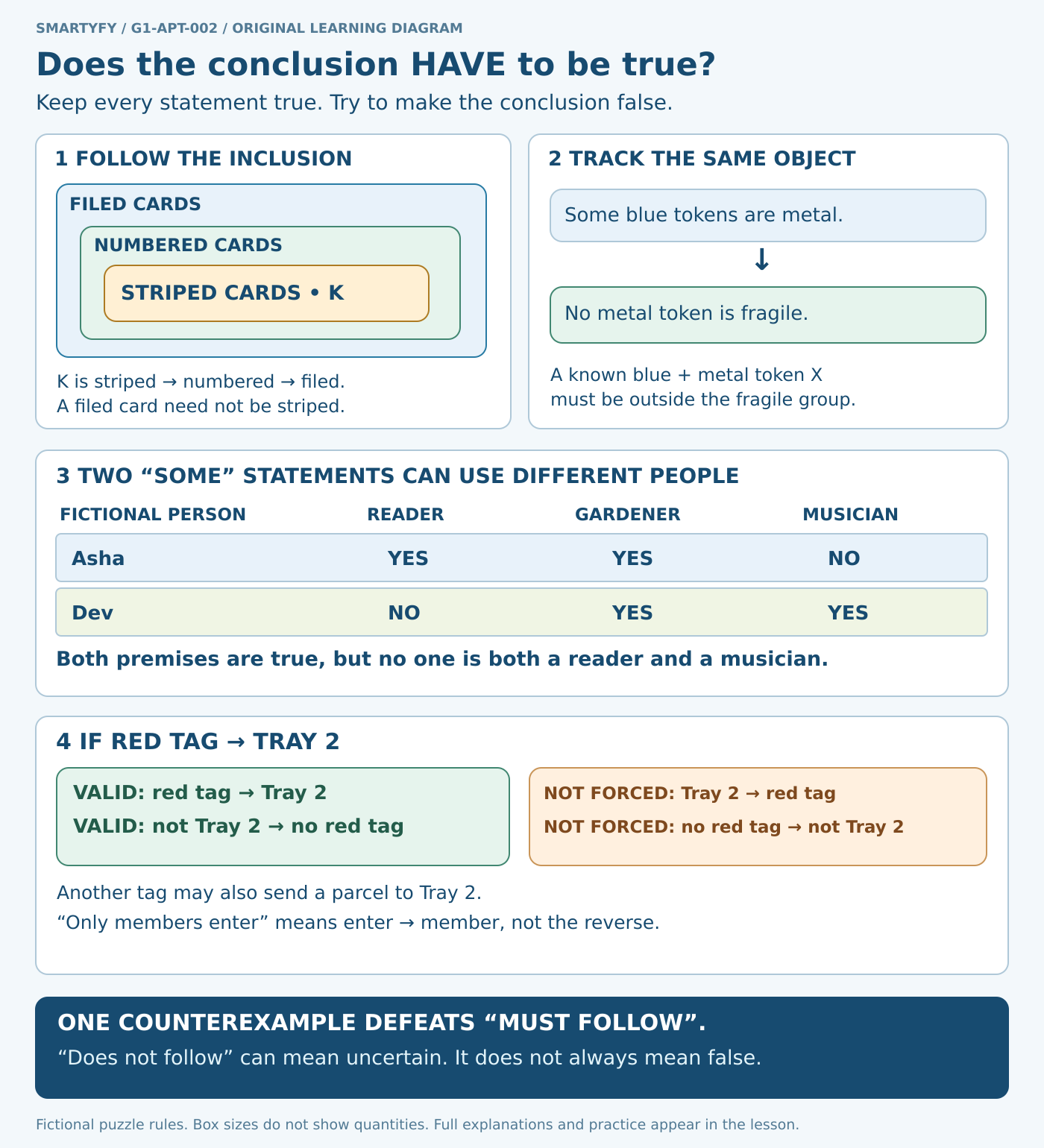
Scope: Deductive statement-and-conclusion problems, set relationships and conditional rules. This is a focused Screening aptitude lesson, not a descriptive Mains essay lesson. Allow 60–75 minutes including the ten original objective questions.
Syllabus mapping: Group I Screening Paper II-A, General Mental and Psychological Abilities, logical reasoning item 1, printed page 29 of Annexure II to APPSC Notification 07/2026, dated 6 October 2026, accessed through a labelled Edexlive-hosted PDF mirror. Direct official-host retrieval was unavailable. Check the APPSC portal for amendments.
1. Start with the exact job of a reasoning question
A premise is a statement supplied as a starting point. A conclusion is the claim we are asked to test. For a deductive examination exercise, accept its premises for the purpose of the question, even when the objects are imaginary. Do not add facts from daily life that the question has not supplied.
A deductive argument is valid when true premises cannot accompany a false conclusion. This evaluates the connection between statements; it is different from checking whether the premises describe the real world. A valid argument with true premises is called sound. These distinctions are explained in Stanford Encyclopedia of Philosophy, Classical Logic.
Here is our own small card puzzle. Every silver card is numbered. Card K is silver. Therefore K is numbered. The first rule covers every silver card, so it covers K. Now change the second statement: K is numbered. Can we conclude that K is silver? No. A numbered card could instead be green. The direction of the rule matters more than the familiar appearance of the words.
Three possible judgements: a conclusion must be true; it must be false; or the information leaves both possibilities open. “Does not follow” includes the last two situations. It does not automatically mean “the conclusion is false”.
2. Translate four common statement forms
Think of a set as a group of objects satisfying a condition. Use letters only after saying what they represent. For example, A = striped cards and B = numbered cards. The following table gives the working meanings used throughout this lesson.
| Statement | Meaning | What it does not say |
|---|---|---|
| All A are B | Every member of A belongs to B. | Not necessarily all B are A. |
| No A are B | A and B have no shared member. | It gives no size for either group. |
| Some A are B | At least one object belongs to both. | It does not mean “some but not all”. |
| Some A are not B | At least one A lies outside B. | It does not exclude other A from B. |
Existence convention: In modern set logic, “all A are B” by itself does not assert that A has a member. Some traditional syllogism exercises use an explicit non-empty-class convention. Read the examination’s directions. Our questions provide witnesses wherever existence is needed and do not depend on an unstated choice between these conventions.
For “some”, put a dot or cross inside the required region. That mark means at least one object exists there; it does not mean there is exactly one. For “no”, keep the two groups disjoint. For “all”, put A wholly inside B, allowing the possibility that their boundaries coincide. Do not assume B must contain extra objects just because your drawing leaves spare space.
3. Follow a chain without reversing it
Worked example 1: All striped cards are numbered. All numbered cards are filed. Card K is striped. Which memberships are guaranteed for K?
- Put striped inside numbered because of the first statement.
- Put numbered inside filed because of the second statement.
- Place K inside striped.
- K must therefore be inside numbered and inside filed.
All striped → numbered → filed. A filed card need not be striped.
To reject “all filed cards are striped”, add an unstriped filed card L. Nothing in the premises forbids L. The chain still holds, but the proposed reverse conclusion fails. This is stronger than saying “I do not think so”: you have supplied a specific arrangement showing why the conclusion is not forced.
4. Carry the same witness through a negative statement
Worked example 2: Some blue tokens are metal. No metal token is fragile. Therefore some blue tokens are not fragile.
Name one shared blue-and-metal token X. The second statement excludes every metal token from the fragile group, so it excludes X. X is still blue. We have now identified a blue token outside fragile, exactly what the conclusion requires.
Notice the word “same”. We did not take one object from the first statement and a different object from the second. We followed the known witness X. This habit prevents many mistakes with “some”. It also explains why we cannot strengthen the answer to “no blue token is fragile”: other blue tokens may be non-metal and fragile.
5. Two uses of “some” may describe different objects
Worked example 3: Some readers are gardeners. Some gardeners are musicians. Does it follow that some readers are musicians?
Build a tiny fictional club with two people. Asha is a reader and gardener but not a musician. Dev is a gardener and musician but not a reader. The first premise is satisfied by Asha, the second by Dev. Nobody in this club is both reader and musician. Therefore the proposed conclusion does not necessarily follow.
| Person | Reader? | Gardener? | Musician? |
|---|---|---|---|
| Asha | Yes | Yes | No |
| Dev | No | Yes | Yes |
Could a different club contain a person with all three interests? Certainly. That would make the conclusion possible, but a must-follow question demands more than possibility. This is why a single convenient Venn drawing can mislead: it may show one allowed arrangement rather than every allowed arrangement.
6. Read an “if” rule in the right direction
Write “if P, then Q” as P → Q. In the formal exercises here, it rules out P being true while Q is false. It does not by itself rule out other ways for Q to be true. Natural-language conditionals can involve additional context; our exercises deliberately use explicit, exception-free rules. For the distinction and standard inference forms, see Stanford Encyclopedia of Philosophy, Indicative Conditionals.
Fictional sorting rule: If a parcel has a red tag, it goes into Tray 2. This is a puzzle rule, not a statement about a real postal procedure.
| Additional fact | Proposed conclusion | Verdict |
|---|---|---|
| Parcel R has a red tag. | R goes into Tray 2. | Valid: apply the rule. |
| R does not go into Tray 2. | R has no red tag. | Valid: a red tag would contradict the given destination. |
| R goes into Tray 2. | R has a red tag. | Not guaranteed: other tags may also go there. |
| R has no red tag. | R does not go into Tray 2. | Not guaranteed: another rule may send it there. |
The first valid form is called modus ponens; the second, modus tollens. The two invalid forms are commonly called affirming the consequent and denying the antecedent. Learn the reason before the Latin labels. These basic patterns are also covered in OpenStax, Types of Inferences; all parcel examples and practice items here are original.
7. “Only” introduces a requirement
Worked example 4: Only registered members enter Room P. Mira enters Room P. Therefore Mira is a registered member. Translate the rule as enters → registered, not registered → enters.
Registration is necessary for entry under this rule: entry cannot happen without it. Registration has not been declared sufficient: it may not be enough on its own. A registered member might choose to stay outside or might lack another required condition. Necessary and sufficient conditions are discussed in OpenStax, Logical Statements.
Compare a different rule: “Every registered member enters Room P.” That runs registered → enters. If both rules are supplied, the two groups match. This is the force of “if and only if”: each condition implies the other. Do not silently turn an ordinary “if” into an “if and only if”.
8. A reliable solving method
- Fix the scope. Identify which objects, time and rule the statements concern.
- Underline quantity words. All, no, some, only and not carry the logic.
- Translate minimally. Use nested groups, a witness, or a one-way arrow.
- Try to defeat each conclusion. Keep every premise true while making that conclusion false.
- Choose the exact strength. Do not replace some with all, possible with certain, or a one-way rule with its reverse.
Mini-check: No glass token is wooden. Some round tokens are glass. We can conclude that some round tokens are not wooden, and that no wooden token is glass. We cannot conclude that all round tokens are glass. A wooden round token may exist alongside the known glass round token.
When a drawing is not enough: Label every dot and explain why it belongs where you put it. A visually attractive diagram is still wrong if it invents an overlap or omits a required member. For a negative answer, your counterexample must satisfy every premise, not just the easiest one.
9. Objective practice with explanations
All situations below are fictional. Accept the stated rules as true. Select the one best answer. “Some” means at least one; “must follow” means true in every arrangement satisfying the statements.
-
All striped cards are numbered. All numbered cards are filed. K is striped. Which must follow? A. K is filed. B. Every filed card is striped. C. No filed card is numbered. D. K is unnumbered.
Answer: A. Follow K through both inclusions. B reverses the chain. C contradicts K’s guaranteed numbered-and-filed membership. D contradicts the first rule applied to K.
-
Some blue tokens are metal. No metal token is fragile. Which must follow? A. All blue tokens are non-fragile. B. Some blue tokens are not fragile. C. Some fragile tokens are metal. D. No blue token is metal.
Answer: B. The blue-and-metal witness cannot be fragile. Other blue tokens are unrestricted, so A is too strong. C and D conflict with the premises.
-
Some readers are gardeners. Some gardeners are musicians. Which best evaluates “some readers are musicians”? A. It must be true. B. It must be false. C. It may be true or false. D. It is identical to the second premise.
Answer: C. Asha and Dev in the counterexample show it can be false; one person with all three interests shows it can be true. Neither possibility alone establishes necessity.
-
All red-tagged parcels go to Tray 2. R does not go to Tray 2. Which must follow? A. R has a red tag. B. R has no red tag. C. No parcel goes to Tray 2. D. Every untagged parcel goes to Tray 1.
Answer: B. A red tag would force R into Tray 2 and contradict the given fact. We know nothing about all other parcels or Tray 1.
-
All red-tagged parcels go to Tray 2. R goes to Tray 2. Is R necessarily red-tagged? A. Yes. B. No; the tag is not determined. C. No; R must have no tag. D. Yes, because destinations and tags are interchangeable.
Answer: B. R could be red-tagged, but a different tag could also lead to Tray 2. “Not determined” is different from “definitely absent”.
-
Only registered members enter Room P. Mira enters Room P. Which must follow? A. Every registered member enters. B. Mira is registered. C. Mira is the only member. D. Unregistered people also enter.
Answer: B. Entry requires registration. The rule does not require every member to enter or specify how many members there are. D conflicts with the restriction.
-
Some A are B. Which must follow? A. Some B are A. B. All A are B. C. Some A are not B. D. No B are A.
Answer: A. The same shared object is both A and B, whichever group you name first. B and C add information absent from the statement; D denies the required overlap.
-
No A are B. Some C are A. Which must follow? A. No C are B. B. Some C are not B. C. All B are C. D. Some A are B.
Answer: B. Follow the C-and-A witness outside B. Other C may belong to B, which defeats A as a necessary conclusion. C is unsupported; D contradicts the first statement.
-
All A are B. All C are B. A and C each contain at least one object. Must some A be C? A. Yes, because both are inside B. B. No, because A and C must be disjoint. C. It is not determined. D. Yes, unless B has no members.
Answer: C. Let B contain two cards, A only the first and C only the second: there is no overlap. Alternatively A and C can share a card. Both satisfy the premises. Common membership in a larger set does not settle the relationship between its subsets.
-
A puzzle machine prints a receipt if and only if its green lamp is on. It prints a receipt. Which must follow? A. The green lamp is on. B. The green lamp is off. C. Every machine prints receipts. D. The paper supply is unlimited.
Answer: A. “If and only if” supplies both directions, including receipt → lamp on. C and D concern facts outside the rule; B contradicts the required condition.
10. One-minute recall
- All A are B gives a one-way inclusion.
- Some means at least one, with no automatic “but not all”.
- Track the same witness when combining some with a universal rule.
- Two different “some” statements may use different witnesses.
- For P → Q, P gives Q; not Q gives not P.
- Q alone does not establish P; not P alone does not establish not Q.
- Only members enter means entry requires membership.
- One valid counterexample defeats a must-follow claim.
Final exercise: Explain question 9 aloud using only two cards. Then change your arrangement so A and C overlap. If you can do both without breaking either premise, you understand why the original conclusion is undetermined.
Source and authorship note: Definitions and standard logical forms were checked against the linked academic references. The card, token, club, room and sorting problems, explanations, tables and diagrams are original teaching material, not copied examination questions. Syllabus access and source-version limitations are stated above. Reviewed 12 October 2026.
Group 1 Lesson 0007 — Satavahanas: Rulers, Routes and Historical Evidence [G1-HIS-002]
GROUP 1 · HISTORY · G1-HIS-002
The Satavahanas: Rulers, Routes, Donations and Historical Evidence
Connect names to evidence instead of memorising an isolated list of kings.
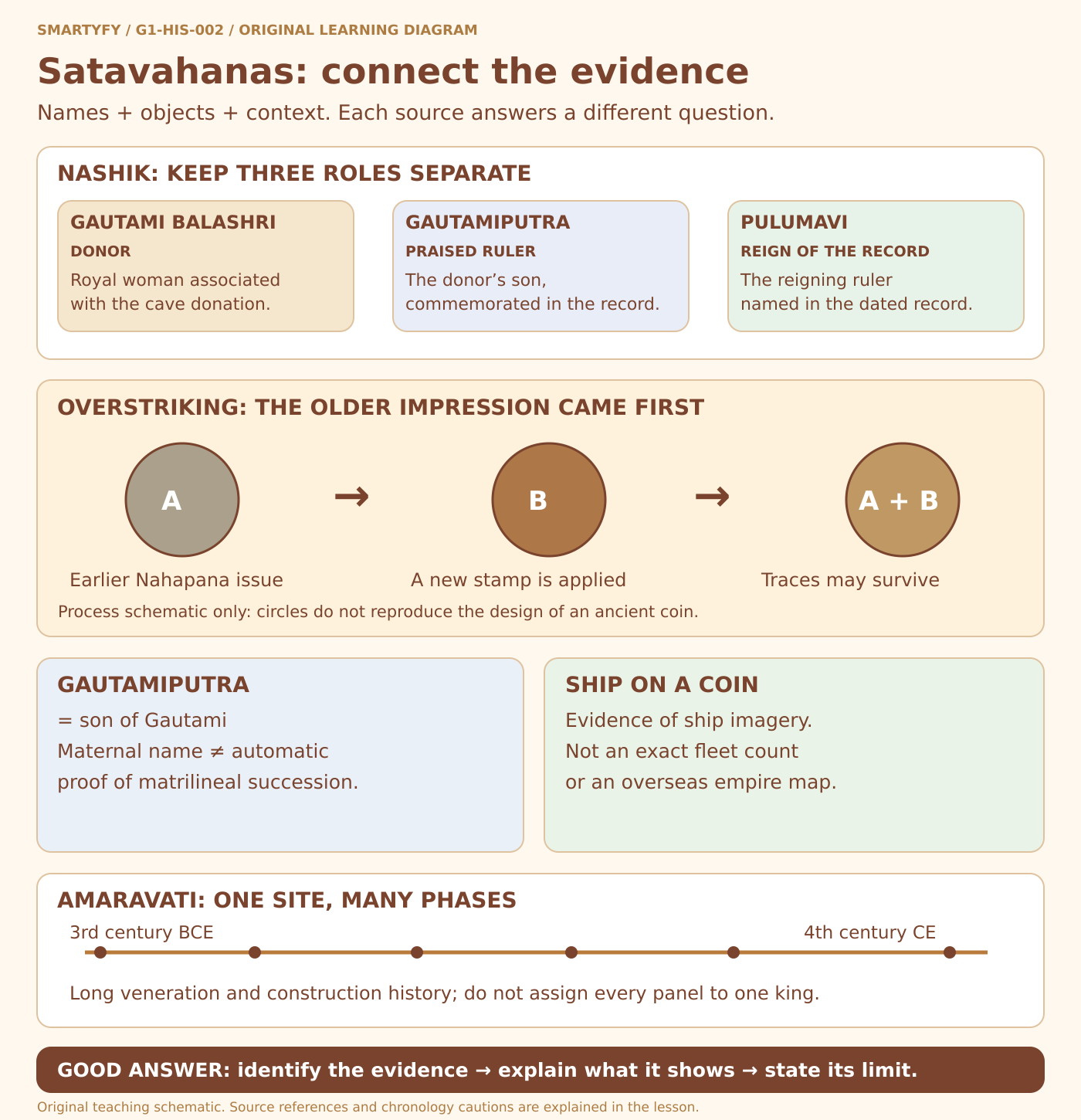
Scope: An introductory but substantive study of Satavahana political history, economic connections, religious patronage and source interpretation. This is not an exhaustive king-by-king chronology. Allow 65–80 minutes including objective practice and a short Mains answer.
Syllabus mapping: Group I Screening Paper I-A, history item 1; Mains Paper II-A, item 1, and Andhra history II-B, item 6. These entries occur on printed pages 27, 33 and 34 of Annexure II to APPSC Notification 07/2026, dated 6 October 2026, accessed through a labelled Edexlive-hosted PDF mirror. Direct official-host retrieval was unavailable. Check the APPSC portal for amendments.
1. Place the dynasty in the early historic Deccan
The Satavahanas ruled parts of the Deccan and western India during the centuries around the beginning of the Common Era. Their history links western-Deccan centres with the Andhra region. Their political reach changed across reigns; a single coloured map should not imply an unchanged boundary for the dynasty’s whole history. NCERT locates them in the early historic Deccan and discusses their inscriptions and family names. NCERT, Kinship, Caste and Class, pages 58–60.
Chronology caution: Early dates and some regnal sequences differ between reconstructions. The lesson therefore does not give a false exact foundation year. Use securely connected names, places and records first. When an examination asks a precise date, follow the notified reference framework and compare the relevant chronology rather than combining dates from incompatible lists.
| Place or area | Why it matters here |
|---|---|
| Pratishthana, identified with Paithan on the Godavari | An important Satavahana capital and commercial centre. |
| Naneghat, western Deccan | Royal inscriptions and the record associated with Naganika. |
| Nashik/Trirashmi caves | Inscriptions linking rulers, donors, monastic institutions and grants. |
| Amaravati, lower Krishna region | A major Buddhist monument with a long history of construction and sculpture. |
The historical Maharashtra Gazetteer identifies Pratishthana with Paithan and places it on routes linking other centres. Use its historical discussion separately from its old administrative boundaries and demographic descriptions. Maharashtra Gazetteer: ancient Pratishthana.
Why geography helps: A river valley can support settlement and movement; a pass can connect plateau and coast; a town can gather goods from producers and redistribute them. These are mechanisms to examine, not proof that every nearby settlement was ruled directly by the same king. Locate the sites first, then ask what the evidence says about political authority or exchange.
2. Learn rulers through an evidence chain
Simuka is conventionally identified as the founder in dynastic reconstructions, while the early chronology remains debated. Krishna, also called Kanha, belongs to the early sequence. Satakarni and his queen Naganika are associated with Naneghat. The surviving inscriptional record is more useful than a memorised sequence with unsupported exact dates. Maharashtra Gazetteer: early Satavahanas and chronological debate.
Satakarni and Naganika: The Naneghat record is important for royal family connections, sacrifices and gifts. Such ritual activity could publicly express status and sovereignty. It should not be read as a modern budget statement covering the whole kingdom. The Gazetteer discussion records Rajasuya and Ashvamedha among Satakarni’s sacrifices and describes Naganika’s inscription. Maharashtra Gazetteer: Naneghat evidence.
Gautamiputra Satakarni: Connect his name with conflict against Nahapana and with the reassertion of Satavahana power in the western Deccan. An unusually useful material clue is the restriking of Nahapana’s coins. A British Museum specimen preserves traces of the earlier design beneath the later one. This makes political change visible in a small object. British Museum collection description, silver coin 1907,0102.12, hosted on Google Arts & Culture. Its older proposed regnal dates are not adopted here.
Vasishthiputra Pulumavi: Connect this ruler with records at Nashik and Karle. A major Nashik inscription in his reign records the donation associated with Gautami Balashri and praises her son Gautamiputra. Keep the praised ruler, the donor and the reigning ruler distinct. They do not have to be the same person. Debala Mitra, Buddhist Monuments, Nashik discussion, page 171, archived by IGNCA.
Yajna Sri Satakarni: Connect the later Satavahana phase with coin evidence, including ship types. A ship image is a useful clue to maritime interests and imagery, but it is not a numerical record of a king’s navy or a map of conquered overseas territory. Scholarship discusses the variety and interpretation of these ship depictions. Mamta Dwivedi, early historic ports and ship imagery, 2023.
3. How an overstruck coin becomes evidence
Overstriking means stamping a new design onto an already existing coin. Sometimes parts of the older design remain visible. Numismatics is the study of coins and related monetary objects. A coin’s metal, weight, legend, symbols, production technique and find context can each answer a different question.
Secure relationship: the underlying impression came before the overstrike.
Further historical explanation: compare inscriptions, other coins and find context.
Work step by step. First, identify which impression lies beneath the other. Second, establish who issued each design using a reliable catalogue. Third, compare that relative order with the political evidence. Fourth, ask what the object does not reveal. A single coin cannot establish the population of an empire, the annual volume of trade or the exact circumstances in which every similar coin changed hands.
The Museum description cautiously suggests that the earlier coins may have been acquired after victory and reused. The word “may” matters: an interpretation should not be rewritten as an eyewitness account of the recovery of that particular specimen. Evidence can strongly support a historical reconstruction without answering every detail.
4. Names, mothers and succession are different kinds of evidence
Several Satavahana royal names include a mother’s name or lineage designation. Gautamiputra means son of Gautami; Prakrit forms such as Gotami-puta occur in inscriptions. Such a name is a metronymic. It shows the importance of the maternal connection in the name, but does not establish a matrilineal royal succession system. NCERT explicitly cautions that succession was generally patrilineal. NCERT, names and succession, pages 59–60.
Use a three-box check: name → relationship indicated → additional evidence needed. The first box might contain Gautamiputra. The second identifies the maternal reference. The third asks for actual succession records before deciding how the throne passed. Do not jump directly from “mother appears in the name” to “women ruled every institution”.
Gautami Balashri’s appearance as a donor and commemorator is historically important in its own right. It need not be exaggerated into a universal claim about all women’s circumstances. Equally, describing the dynasty’s generally patrilineal succession does not erase the public actions of individual royal women. Good historical answers preserve both points.
5. Production, routes and religious institutions
An economy needs more than a king’s victories. Farmers produce supplies; craft workers transform materials; traders move goods; settlements provide markets; institutions and donors mobilise resources. This is an analytical framework for reading the evidence. It is not a claim that we possess a complete Satavahana national-income account.
The archaeological description of Paithan records houses, streets, ceramics, beads and other objects. Different finds reveal different activities: buildings help reconstruct settlement; production remains and artefacts help examine crafts and consumption. A bead alone cannot establish the livelihood of every resident. National Monuments Authority, Paithan protected-area description.
Nashik records connect donations and land grants with Buddhist monastic institutions. A grant could help support a continuing institution rather than just one event. Mitra’s archaeological account describes fields and the later provision of a village in the relevant cave records. Mitra, Buddhist Monuments: Nashik inscriptions and Cave 3. Avoid turning this limited evidence into a claim that every village was donated or that every transaction used coins.
Worked reasoning exercise: Suppose an excavation report identifies a workshop and a separate inscription identifies a donation to a monastery. We can discuss production and patronage as two documented activities. We cannot identify the workshop owner as the donor unless a link is supplied. Historical reconstruction depends on connections that can be justified, not simply on placing two attractive facts next to each other.
For overseas exchange, combine ship imagery with port evidence, imported objects, inscriptions and written accounts where available. A trade network can cross political borders. Therefore “goods travelled between A and B” does not by itself prove “one ruler governed both A and B”. This distinction prevents a common error in sketch maps.
6. Amaravati: a monument with many phases
The ASI Amaravati Circle describes the Mahastupa as a monument venerated over a long span, from the third century BCE to the fourth century CE, with sculptured panels. That timespan is larger than a single reign. It is therefore misleading to attribute every surviving panel or building phase to one Satavahana ruler. ASI Amaravati Circle: regional archaeological heritage.
Learn to separate three questions: When did the site begin? When was a particular component made? Who supported that component? A site can remain important through several political periods. Stylistic dating, inscriptions and excavation context help assign a specific object or phase. The name of a famous dynasty alone does not do that work.
Religious patronage also needs careful language. Royal performance of Vedic sacrifices and support for Buddhist establishments can appear within the dynasty’s wider historical setting. “One community received a donation” is not equivalent to “all other traditions disappeared”. Explain the documented act and its context rather than imposing a single modern category on a diverse past.
7. Original objective practice
-
Pratishthana in this lesson is identified with:
A. Paithan B. Pataliputra C. Taxila D. KanchipuramAnswer: A. Paithan is the relevant Godavari reference point. The other cities belong to different historical-geographic contexts.
-
Naganika is particularly associated with which evidence?
A. A modern census B. Naneghat inscription C. Gupta copper coins only D. A Mughal farmanAnswer: B. Connect her with the Satakarni royal context and the Naneghat record, not a later dynasty or modern document.
-
Nahapana’s design is underneath a Gautamiputra overstrike. What follows directly?
A. The lower impression preceded the upper one B. Every coin was newly mined C. The empire had no trade D. The coin gives a complete battle narrativeAnswer: A. The physical sequence establishes relative order. A fuller historical explanation requires additional evidence.
-
A metronymic primarily provides information about:
A. The number of ports B. A maternal naming connection C. The total tax rate D. The size of the navyAnswer: B. A name derived through the mother is not, by itself, a complete account of succession or political power.
-
Which statement best fits the evidence discussed?
A. Maternal names automatically prove matrilineal succession B. Names and succession are unrelated questions that can never be studied together C. Maternal names are important but succession must be checked separately D. Royal women never appear in recordsAnswer: C. It recognises the naming evidence without overextending it. D conflicts with the donors discussed.
-
A royal praise inscription should be read:
A. As a complete household survey B. Without considering its author or purpose C. As useless because it praises someone D. As evidence whose claims should be compared with other sourcesAnswer: D. Purpose affects interpretation but does not remove evidential value. Neither unquestioning acceptance nor blanket dismissal is sound.
-
A ship on a coin alone proves:
A. An exact fleet size B. The issuer ruled every overseas destination C. Ship imagery was used on that coin D. Every household owned a shipAnswer: C. Trade or political interpretations need supporting evidence. The other claims exceed what the image establishes.
-
Why should Amaravati’s phases be distinguished?
A. Its history spans many generations B. Every sculpture has the same date C. Excavation context never matters D. A famous dynasty’s name dates every objectAnswer: A. A long-lived monument can contain components from different periods. B, C and D ignore that problem.
-
A record dated in Pulumavi’s reign praises Gautamiputra and names Gautami Balashri as donor. These roles are:
A. Necessarily the same person B. Reigning ruler, praised ruler and donor respectively C. Three names for one coin D. All modern historiansAnswer: B. Always separate a document’s date, subject and donor before interpreting it.
-
Goods moving across two regions establish political unity:
A. Always B. Whenever a coin is found C. Whenever a river connects them D. Not without additional evidenceAnswer: D. Exchange can cross borders. Trade geography and political geography are related but not identical.
8. Group I Mains writing practice
Original practice prompt: Explain how inscriptions and coins help reconstruct Satavahana history, and identify the limits of each. Write about 180–220 words. This is a teaching exercise, not an official previous question.
Plan: Open with the evidence problem. Use two named inscriptional examples, then the coin example. End by explaining why comparison is necessary. Do not turn a source question into a long unsupported king list.
Illustrative answer
Satavahana history is reconstructed by connecting different forms of evidence rather than relying only on dynastic lists. Inscriptions identify rulers, family relationships, donors and particular acts of patronage. The Naneghat record associated with Naganika illuminates the royal setting of ritual and gifts. Nashik records connect Gautamiputra, Pulumavi and Gautami Balashri with political commemoration and support for Buddhist institutions. The reigning ruler, praised ruler and donor must be distinguished when reading such records.
Coins supply another kind of evidence. Gautamiputra’s overstriking of Nahapana’s issues preserves a material sequence: the older impression preceded the newer one. Read alongside inscriptional evidence, such objects help examine political change. Coin legends and images can also contribute to the study of authority and exchange.
Both sources have limits. A praise inscription expresses the perspective and purpose of its commissioner; it is not a complete record of ordinary life. A coin find does not automatically establish the boundary of direct rule, and a ship image cannot give an exact fleet size. Nor does a maternal naming connection independently prove a matrilineal succession system.
Consequently, inscriptions and coins should be compared with archaeological context, monument phases and other records. This approach yields a better supported account of Satavahana political, economic and cultural history.
Self-check: Did you name evidence, explain its contribution, state a limit and avoid an unsupported exact date? A balanced answer should do all four.
9. Rapid revision
- Pratishthana → Paithan and the Godavari setting.
- Naganika and Satakarni → Naneghat, ritual and gifts.
- Gautamiputra → Nahapana conflict and overstruck coins.
- Gautami Balashri and Pulumavi → distinguish donor, praised ruler and reign.
- Metronymic → maternal name, not automatic proof of matriliny.
- Amaravati → a long-lived, multi-phase monument.
- Trade links, coin finds and political boundaries → do not treat them as identical.
Source note: Historical dates and interpretations can differ across older catalogues and gazetteers. This lesson identifies the relevant source and avoids adopting conflicting exact regnal dates. The diagrams, questions and model answer are original teaching material.
Group 1 Lesson 0004 — Indus Civilisation: Cities, Water, Crafts and Evidence [G1-HIS-001]
GROUP 1 · HISTORY · G1-HIS-001
The Indus Civilisation: How Archaeology Reveals an Urban World
Cities, water, crafts and trade, explained through evidence.
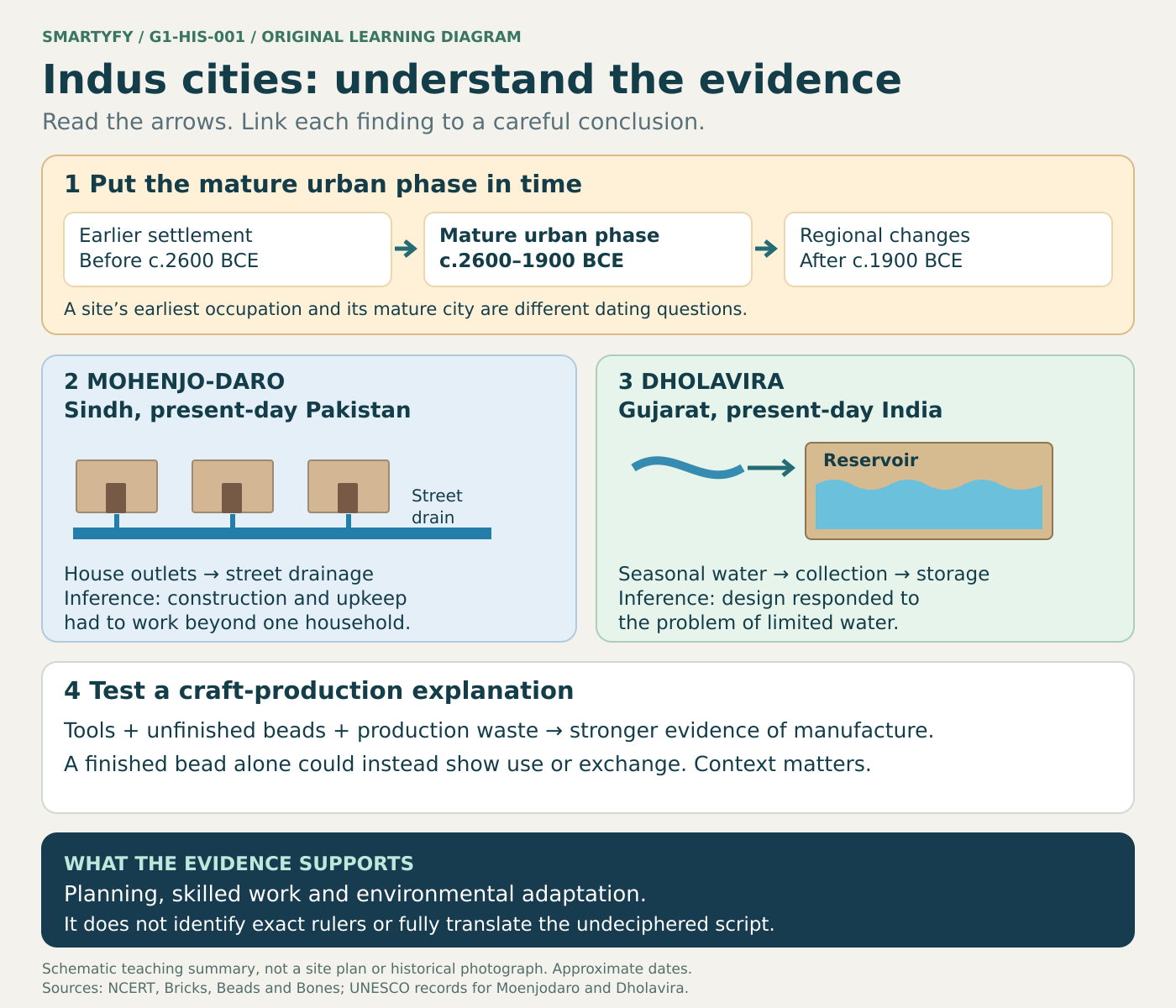
Academy lesson 0004, fully revised. This substantive history lesson replaces the earlier general chronology introduction while retaining the same Academy record. Allow 60–75 minutes with the practice test and writing exercise.
Syllabus scope: Group I Preliminary Paper I, History and Culture, Indus civilisation features, sites, society, art and religion. The mapping was checked against APPSC’s 2018 syllabus document, accessed through the clearly labelled archived document mirror, page 2. The official 2026 notification PDF was temporarily inaccessible during this check; no unverified 2026 syllabus revision is claimed. Confirm the applicable examination notification through the official APPSC syllabus portal. The descriptive practice below is an original Group I preparation exercise.
1. Start with the question: what kind of evidence survives?
The Harappan civilisation is also called the Indus civilisation. Its script remains undeciphered, so buildings, artefacts, plant remains, animal bones and their archaeological contexts carry much of the explanation. A seal can establish that particular signs or images were used; it cannot by itself provide a securely translated royal command. The mature urban phase is commonly placed around 2600–1900 BCE. Earlier settlement and later regional developments need their own context. NCERT, Bricks, Beads and Bones.
Regional farming, settlement and craft developments
↓
c.2600–1900 BCE: mature urban phase
Major cities, specialised production and wide exchange networks
↓
After c.1900 BCE
Urban contraction and changing regional settlement patterns
Why the date distinction matters: “People lived at a site before 2600 BCE” and “the mature city flourished from about 2600 BCE” can both be true. A settlement’s earliest occupation is not automatically the date of its best-known urban layout. In an objective question, look for words such as earliest, mature and late before selecting a date.
2. Build a mental map of sites
Indus civilisation sites extend beyond the immediate Indus River valley across parts of present-day Pakistan and northwestern and western India. Present-day state and country names help locate sites; they are not the political borders of the Bronze Age. NCERT site map, page 2.
| Site | Present-day location | Remember it through |
|---|---|---|
| Harappa | Punjab, Pakistan | The site that gives Harappan civilisation its name |
| Mohenjo-daro | Sindh, Pakistan | Urban layout, drains and the Great Bath |
| Dholavira | Khadir island, Gujarat, India | Reservoirs, stone architecture and adaptation to limited water |
| Kalibangan | Rajasthan, India | Evidence of an Early Harappan ploughed field |
| Lothal | Gujarat, India | Crafts and a large basin commonly interpreted as a dock |
Memory exercise: Cover the last two columns. Place Mohenjo-daro in Sindh, Dholavira in Gujarat and Kalibangan in Rajasthan, then give one evidence-based association for each. Avoid learning an unsupported “first”, “only” or “largest” claim from a short site list.
3. Mohenjo-daro: planning is a relationship between parts
Mohenjo-daro preserves a higher western sector and a larger lower settlement to the east. Streets and buildings show organised layouts, and drainage and water-related structures form an important part of the evidence. These surviving relationships are more informative than the statement “the city was advanced”: the answer should explain what was coordinated. UNESCO: Archaeological Ruins at Moenjodaro.
| Raised sector Major structures and platforms |
Lower settlement Residential blocks and streets |
| Connected systems: access routes · water · drainage · construction practices | |
Think through a drain connecting a house to a street channel. The house outlet must be positioned to join the channel; the gradient must allow flow; the channel must remain accessible enough for upkeep. The inference is that some decisions extended beyond a single household. However, a connected drain does not reveal the exact title of an official, the tax system or a written municipal law.
The Great Bath is a distinctive brick-built tank at Mohenjo-daro. Its special construction and setting have encouraged interpretations involving collective or ritual use. Use the words “interpreted as” when moving from the structure to a proposed social purpose. Identifying a surviving tank is a stronger statement than claiming to know the precise ceremony performed there.
4. Dholavira: adapt the city to its environment
Dholavira is located on Khadir island in Gujarat. UNESCO identifies its reservoirs, drainage, fortifications, extensive stone construction and planned urban divisions as distinctive features. Seasonal water availability made collection and storage central to the settlement’s design. It should not be reduced to “another city identical to Mohenjo-daro”. UNESCO: Dholavira.
The important chain of reasoning is environment → problem → design response. A limited or seasonal supply creates a storage problem. Reservoirs and channels are an infrastructure response. Their construction requires material, labour and maintenance. This explanation connects physical geography with social organisation rather than treating the reservoir as an isolated fact to memorise.
Andhra Pradesh connection: When discussing a modern AP town, you might also distinguish collecting water, storing it and maintaining the system. That is a comparative question, not proof that a present-day tank is directly descended from Dholavira or that ancient designs can simply be copied. Modern population, health standards, engineering and institutions differ.
5. Crafts and exchange: follow the production process
Dholavira has evidence of bead processing and work involving materials such as shell, copper and semi-precious stones. Its location also connected resources and exchange opportunities. Such finds allow questions about sourcing, skilled production and movement of goods. UNESCO: Dholavira craft evidence. For the wider civilisation, seals, weights and workshop remains are important archaeological clues, but their function must be assessed from context. J. M. Kenoyer: Trade and Technology of the Indus Valley.
Worked evidence problem: An excavation finds many unfinished beads, drilling debris and tools in one area. Finished jewellery alone could reflect consumption or exchange. A concentration of unfinished pieces and production waste strengthens the case for manufacture. The key is the combination of evidence, not a single attractive object.
Now suppose similar finished beads occur at a distant site. Several explanations are possible: movement of finished objects, movement of craftspeople, shared techniques or independent production. Establishing the strongest explanation requires material analysis and contextual comparison. Do not transform “similar object” automatically into “the same ruler controlled both places”.
6. Society, art and belief: use careful language
Differences in houses, access to goods and burial practices can inform discussion of social variation. Images, figurines and special structures can support interpretations of belief and symbolism. But an undeciphered script limits certainty about named deities, institutions and the people who held authority. A label such as “priest-king” should be treated as a conventional interpretation of an artefact, not a proven job title. NCERT: interpretation of material evidence.
| Evidence | Reasonable question or inference | Claim that needs more evidence |
|---|---|---|
| Coordinated construction | How was labour organised? | The exact constitution of the state |
| Reservoirs and channels | How was seasonal water managed? | Every resident had equal access at all times |
| Seals with signs and images | How were identity or transactions represented? | A complete translation of an undeciphered inscription |
| Different burial goods | Was there variation in status or practice? | The whole social hierarchy from one grave |
7. Urban change was a process, not a one-line ending
After the mature phase, large urban systems contracted and settlements and material practices changed across regions. Environmental change, river behaviour, economic networks and social responses have all been investigated. Treat a universal single-cause explanation with caution. “Urban decline” does not mean that every person disappeared or that every practice ended on one day. NCERT: end of the civilisation and changing interpretations.
Use a three-part explanation: identify the change, discuss possible mechanisms, and state the limits of evidence. For example, a shift in settlement location might reflect changing water availability, but chronology and local environmental evidence are needed before assigning that cause. This approach makes an answer analytical rather than a list of theories presented as established facts.
8. Original objective questions with explanations
-
The mature urban phase is commonly dated approximately to:
A. 2600–1900 BCE B. 600–300 BCE C. 1200–1500 CE D. 1757–1857 CEAnswer: A. The other ranges belong to much later periods. Earlier occupation at a site does not change what the phrase mature urban phase denotes.
-
Which site-location pair is correct?
A. Dholavira — Gujarat B. Mohenjo-daro — Tamil Nadu C. Kalibangan — Kerala D. Harappa — Andhra PradeshAnswer: A. Mohenjo-daro is in Sindh, Kalibangan in Rajasthan and Harappa in Punjab, Pakistan. These are present-day location labels.
-
Reservoirs at Dholavira most directly support a discussion of:
A. Railway administration B. Seasonal water management C. Medieval gunpowder D. Printed currencyAnswer: B. The physical structures relate to water collection and storage. The other options introduce technology or institutions unsupported by this evidence.
-
Many unfinished beads, tools and production waste in one area strengthen the inference of:
A. A manufacturing activity B. A fully translated constitution C. Universal literacy D. An identical religion at every siteAnswer: A. Multiple kinds of production evidence support manufacture. They do not establish the political, literacy or religious claims in B–D.
-
Which statement best respects the limits of evidence?
A. The Indus script supplies a complete translated list of kings B. Every citadel proves the presence of the same monarchy C. Drainage supports an inference of coordinated activity, but does not identify exact officials D. A seal proves the language spoken by everyoneAnswer: C. It separates an observation-based inference from claims that require independent evidence. A, B and D go beyond what the objects alone establish.
-
Why compare Mohenjo-daro with Dholavira?
A. To assume all cities were identical B. To show both shared urban concerns and local design differences C. To prove all settlement dates were the same D. To ignore water and material differencesAnswer: B. Comparison identifies similarities and variation. The other responses remove the very differences that make comparison useful.
-
Which statement about post-mature change is most careful?
A. Every settlement vanished on the same day B. All changes had one proven cause everywhere C. Urban contraction should be studied with regional chronology and evidence D. No later community retained any practiceAnswer: C. It permits investigation of different processes and continuities. The absolute claims in A, B and D are not established by the evidence presented.
-
A modern AP water-management example is best used as:
A. Proof that the Harappans built every modern tank B. A comparison of infrastructure problems, with historical differences acknowledged C. Evidence that engineering standards never change D. A replacement for archaeological evidenceAnswer: B. A comparison can clarify a concept while respecting different times and conditions. It cannot create a historical connection that has not been demonstrated.
9. Group I descriptive writing workshop
Original practice prompt: “Harappan urbanism reveals coordinated planning as well as adaptation to local environments.” Discuss in about 180–220 words. The word range is a practice target, not an asserted APPSC rule.
- Define urbanism through connected settlement functions.
- Use Mohenjo-daro for coordinated streets and drainage.
- Use Dholavira for environmental adaptation and storage.
- Connect craft evidence to specialised work and exchange.
- Conclude with the limits of political reconstruction.
Original model answer: Harappan urbanism involved the organisation of settlement space, infrastructure and economic activity. Archaeological evidence supports both shared practices and responses to different local settings. At Mohenjo-daro, the relationship between streets, residential areas and drainage indicates that construction decisions extended beyond individual households. Maintaining connected systems would also have required continuing coordination. This is stronger evidence of organisation than a general claim that the city was advanced.
Dholavira demonstrates how urban design responded to environmental constraints. Its reservoirs, channels and extensive use of stone reflect the importance of storing seasonal water and using available materials. Comparison with Mohenjo-daro therefore reveals variation within a wider urban tradition. Craft evidence adds an economic dimension: tools, unfinished objects and production waste can identify specialised work, while materials and artefact distributions help investigate exchange.
However, coordinated infrastructure does not reveal the precise form of government. The undeciphered script and incomplete archaeological record limit confident statements about named rulers or institutions. Harappan urbanism is consequently best explained through specific material relationships: planning connected buildings and services, adaptation addressed local conditions, and specialised production linked settlements. These conclusions are persuasive because they remain close to the evidence while acknowledging what is uncertain.
Self-review, 10-point practice rubric: relevant argument 2; accurate site examples 3; explained relationships 3; acknowledgement of limits 1; clear structure 1. This is a teaching rubric, not an official marking scheme.
Final retrieval challenge
Draw the timeline, place three sites correctly, explain one drainage inference, explain one craft-production inference and identify one claim that the undeciphered script prevents you from making confidently. Then write the answer without copying the model.
Telugu terms: సింధు నాగరికత — Indus civilisation; పురావస్తు ఆధారాలు — archaeological evidence; పట్టణ ప్రణాళిక — urban planning; జలాశయం — reservoir. Keep site names beside their English spellings for map recognition.
Editorial record: G1-HIS-001 / Academy lesson 0004, version 2.0, 12 October 2026. Original diagrams, worked reasoning, questions and model answer. Source notes distinguish the archived syllabus mapping from factual teaching references. This is one substantive history topic, not completion of ancient history.
Group 1 Lesson 0005 — Andhra Pradesh Physiography and Drainage [G1-GEO-001]
GROUP 1 · GEOGRAPHY · G1-GEO-001
Andhra Pradesh: Read the Land, Follow the Water
Coastal plains, Eastern Ghats, interior pediplains and river drainage explained together.
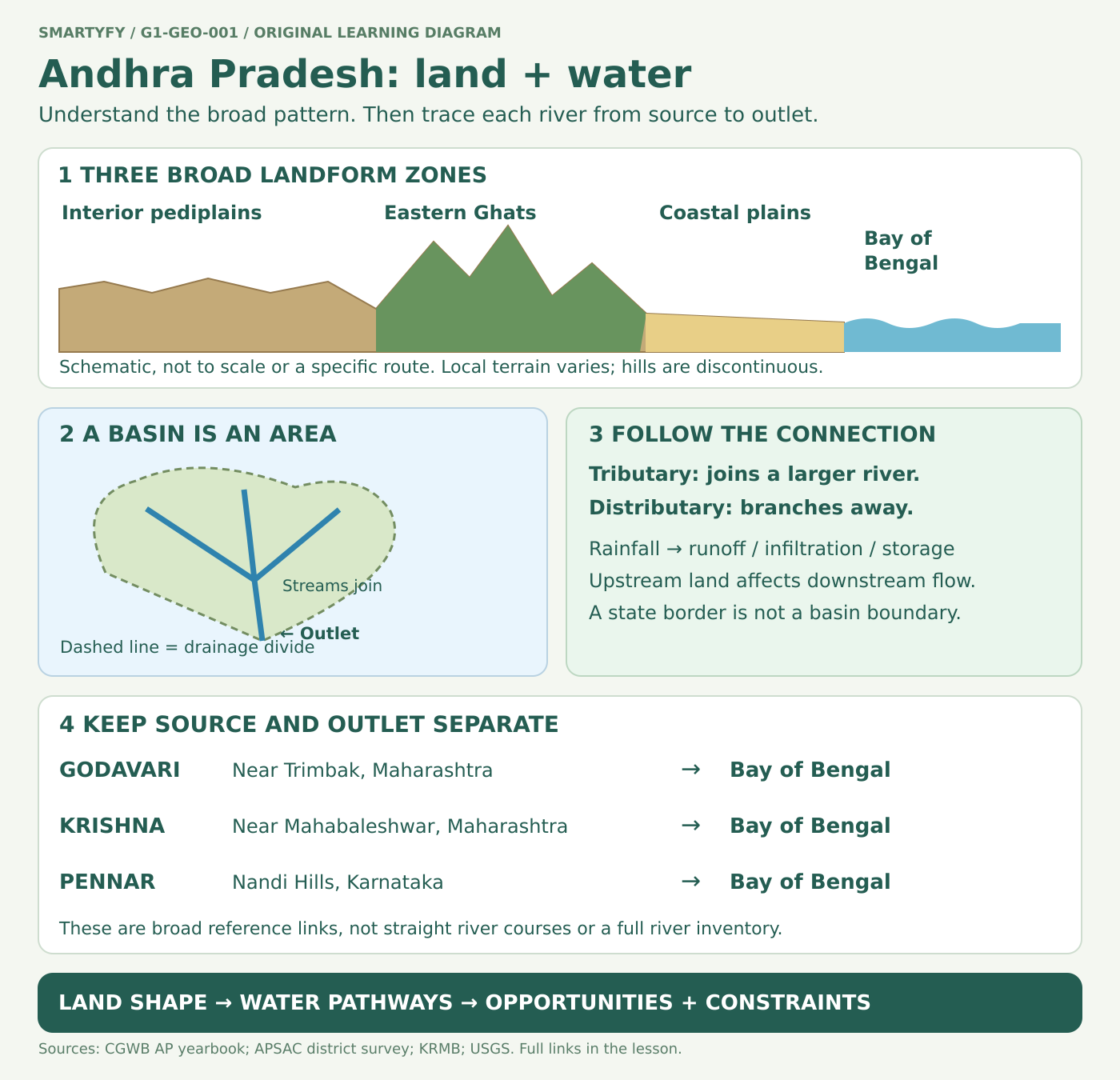
Academy lesson 0005, fully revised. This subject lesson replaces the general map-reading introduction while preserving its Academy record. Study time: about 60 minutes including practice and the descriptive exercise.
Syllabus scope: Screening Paper I-D, item 2 (physical divisions and drainage), pages 28–29; Mains Paper II-C, item 11 (landforms and rivers), page 35. Mapping checked in Annexure II of APPSC Notification 07/2026, dated 6 October 2026, via a labelled Edexlive-hosted PDF mirror. Direct official-host retrieval was unavailable; this is not a claim of independently verified official-host access. Check the APPSC portal for amendments. Stable physical-geography concepts are taught without relying on changing district counts.
1. Physical geography begins with shape
Relief means variation in the height and shape of the land. Physiography is the study or description of its physical features. Start with the Bay of Bengal to the east, then consider the coastal lowlands, hill belts and interior surfaces. A physical division is defined by landform characteristics; it is not the same thing as a district or revenue division.
The Central Ground Water Board describes three broad physiographic zones in Andhra Pradesh: coastal plains, Eastern Ghats and western pediplains. A pediplain is a broad, gently sloping erosional surface, often interrupted by residual hills. “Plain” here does not mean a completely smooth surface, and the interior is not uniform. CGWB Andhra Pradesh yearbook, chapter 2.
| Division | Landform idea | What to examine |
|---|---|---|
| Coastal plains | Lowland between the inland hills and the Bay of Bengal, with important deltaic stretches. | Deposited sediment, drainage, agriculture and coastal processes. |
| Eastern Ghats | Discontinuous hills and associated uplands rather than an unbroken wall. | Slopes, valleys, river crossings, forests and transport routes. |
| Western pediplains | Interior, gently rolling or undulating erosional terrain with local hills. | Rock and soil conditions, water storage, runoff and land use. |
The broad setting is consistent with the National Portal’s account of peninsular India: the plateau is flanked by the Ghats, with a coastal area between the Eastern Ghats and the Bay of Bengal. Do not turn this simplified arrangement into a claim that every east–west journey crosses identical landforms in exactly the same order.
2. Coastal plains and deltas: land made and remade by water
The coastal plain broadens around the Godavari–Krishna deltaic region. A delta is a depositional landform near a river’s outlet, built where the supply and accumulation of sediment interact with coastal processes. A river can divide into branches near its lower course, spreading water and sediment. The shape and development of a delta also depend on waves, tides and sediment supply; “every river makes an identical triangular delta” is too simple.
The learning chain is river transport → reduced capacity to carry some sediment → deposition → changing channels and landforms. A deposit is material laid down; erosion removes material. Both can occur within the same river system at different places and times.
AP application: Deltaic land can offer fertile soils and opportunities for irrigation, but low relief can also make drainage difficult. Therefore “fertile” does not mean “free from flooding”, and “near a river” does not guarantee water at the required time. An answer should discuss benefits and constraints together, rather than attach a single adjective to the whole coast.
3. Eastern Ghats and interior pediplains
The Eastern Ghats form a broken hill system. Rivers and valleys interrupt the hills, so the phrase “continuous mountain barrier” is misleading. Within Andhra Pradesh, the southern hill systems include ranges such as the Nallamala and Seshachalam. The CGWB account distinguishes these hill landscapes from the rolling western pediplains. CGWB, physiography section.
The Andhra Pradesh Space Applications Centre’s Sri Sathya Sai District Survey Report, 2023 provides a local example of pediplain and undulating terrain. A local example helps make the term concrete; it is not a reason to assume that every interior location has the same slope, soil or groundwater conditions.
Reason through a slope: On a hillside, gravity helps water move downslope. The actual amount and speed of runoff also depend on rainfall intensity, vegetation, soil and surface condition. A steep slope covered in vegetation and a sealed road surface need not respond in the same way. Landform is one part of the explanation, not the entire explanation.
4. A river is a line; a basin is an area
The river channel is the course in which water flows. The drainage basin or catchment is the land area draining towards a chosen outlet through a network of streams. A drainage divide separates neighbouring surface-drainage basins. The term watershed is often used for a basin in hydrology; some school usages use it for the dividing high ground. Read the definition used in the question and use “drainage divide” when you mean the boundary. USGS: Watersheds and Drainage Basins.
↓ some becomes runoff; some infiltrates, evaporates or is stored
Small streams join larger channels
↓
Water passes the selected outlet
A basin can extend across several states. Administrative borders and natural drainage boundaries answer different questions. The Krishna River Management Board describes the Krishna basin as extending across Maharashtra, Karnataka, Telangana and Andhra Pradesh. Thus, studying only the river’s final reach in AP cannot explain all the water arriving there. KRMB: About the Krishna basin.
5. Tributaries join; distributaries branch away
A tributary joins a larger river. A distributary branches away from a main channel, commonly in a delta. Learn the direction of the relationship rather than just the spelling of the terms.
| Tributary pattern Stream A + stream B → larger channel Joining |
Distributary pattern Main channel → branch A + branch B Splitting |
Worked identification: If a map shows a blue line meeting the Krishna, ask which way the flow arrows point. A joining channel is a tributary. If arrows show water leaving one channel along separate branches towards the coast, the relationship is distributary. Without flow direction or context, the shape of a junction alone can be ambiguous.
6. Three anchor rivers
| River | Source-region anchor | Outlet and study link |
|---|---|---|
| Godavari | Western Ghats near Trimbak in Maharashtra. | Bay of Bengal; important lower-course delta in AP. |
| Krishna | Western Ghats near Mahabaleshwar, Maharashtra. | Bay of Bengal; basin includes AP and upstream states. |
| Pennar / Penna | Nandi Hills, Karnataka. | Bay of Bengal; an important river system of southern AP. |
Sources: Nashik district authority: Trimbakeshwar; Krishna River Management Board; APSAC, Pennar drainage account; CGWB, AP drainage.
The source of a river need not lie in the state where it reaches the sea. Also, “east-flowing river” describes its broad journey towards an eastern outlet, not the direction of every bend. The Pennar, for example, includes northward reaches before its later journey towards the coast. Do not draw a straight arrow and mistake it for the complete channel.
The Krishna’s principal tributaries include the Bhima and Tungabhadra. Pennar tributaries include the Chitravathi and Papagni. The state also has other rivers, including Vamsadhara and Nagavali; the three anchors above are a starting framework, not an exhaustive river list.
7. Follow a rainstorm from hillside to coast
Original scenario: Imagine rain over a catchment containing hills, farms and a town. Some water enters the soil; some returns to the atmosphere; some is stored; some runs into channels. Downstream flow reflects these pathways and their timing. A statement that “all rain instantly reaches the river” ignores important processes.
Now imagine that part of the town’s vegetated ground is replaced by impermeable paving. Less water can enter the ground through that surface, and runoff may reach drains more rapidly. The final effect depends on the amount of paving, storm conditions, storage and the drainage system. This general mechanism is explained by the USGS runoff guide; the scenario is not a report about a particular AP town.
For an exam answer, connect cause and consequence: land-cover change → altered infiltration and runoff → possible changes in flow and sediment → implications downstream. Then state what additional information is needed. Do not infer a precise flood depth or date from a broad landform description.
8. Use the physical map without overclaiming
- Find orientation: locate the north arrow and Bay of Bengal.
- Read elevation: use the legend; colour does not have a universal meaning across every map.
- Trace drainage: follow source, tributaries, main river and outlet.
- Separate boundaries: river basins are not district outlines.
- State limits: a schematic shows relationships; a scale map supports distance and location measurement.
A useful hand-drawn answer diagram can label the interior surface, hill belt, coastal plain and sea. Mark it “schematic, not to scale”. If exact locations are required, use an appropriate official map instead of inventing coordinates or putting every hill range in one straight row.
9. Original objective questions with explanations
-
Which set best describes the broad AP physiographic divisions used by CGWB?
A. Coastal plains, Eastern Ghats, western pediplains
B. Himalayan glaciers, Thar dunes, coral atolls
C. Three revenue divisions only
D. Godavari, Krishna and Pennar, all of which are landform zonesAnswer: A. B lists unrelated settings, C confuses administration with landforms, and D names river systems rather than physiographic divisions.
-
A drainage basin is best understood as:
A. Only the narrow river channel
B. An area draining towards a selected outlet
C. Necessarily one district
D. Only the water currently stored behind a damAnswer: B. The catchment includes contributing land and its drainage network. A river channel or reservoir is only part of that broader system.
-
Which relationship is correctly stated?
A. A tributary always branches away towards the sea
B. A distributary necessarily flows uphill
C. A tributary joins a river; a distributary branches away
D. The terms mean the same thingAnswer: C. The distinction concerns network direction. Flow arrows and context help interpret a junction.
-
The Krishna’s source-region anchor is:
A. Nandi Hills, Karnataka
B. Near Mahabaleshwar in the Western Ghats
C. The Godavari delta
D. Pulicat LakeAnswer: B. Nandi Hills is the Pennar source anchor in this lesson. A river’s source and lower-course outlet must not be exchanged.
-
Why is “all rainfall immediately becomes river flow” incorrect?
A. Rain cannot fall in a basin
B. Water can infiltrate, evaporate or be stored as well as run off
C. Tributaries never carry water
D. Basin boundaries are always political bordersAnswer: B. Multiple water pathways and their timing affect streamflow. A catchment is not a perfectly sealed funnel.
-
Which statement about deltas is most balanced?
A. They are all identical triangles
B. Their development involves sediment supply, deposition and coastal processes
C. Fertile deltaic land cannot flood
D. Every river must have a large deltaAnswer: B. A, C and D turn broad tendencies into universal claims. Productive lowlands can still face drainage and flood challenges.
-
A major river basin crosses state boundaries. What follows?
A. Its upstream catchment is irrelevant downstream
B. Its river must stop at each border
C. Natural drainage and administrative boundaries describe different systems
D. Every state has the same rainfall and land coverAnswer: C. Upstream conditions can matter downstream. A border does not itself interrupt water movement.
-
Which statement is appropriate for a conceptual cross-section?
A. It proves exact heights without a scale
B. It can explain relationships when labelled schematic and not to scale
C. It replaces all official maps
D. Every AP location has the exact same profileAnswer: B. A schematic is a teaching tool. It must not be used to claim measurements or precise local terrain that it does not contain.
10. Group I descriptive practice
Original question: Explain how relief and drainage together shape opportunities and constraints in Andhra Pradesh. Practise in 180–220 words; this is a teaching range, not an official APPSC rule.
Illustrative model answer
Andhra Pradesh’s physical geography includes coastal plains, the discontinuous Eastern Ghats and western pediplains. These divisions differ in slope, elevation and surface conditions, so their relationship with water must be examined rather than assumed to be uniform.
The Godavari and Krishna lower courses are associated with important deltaic plains. Deposited sediment and irrigation opportunities support agriculture, while low relief also makes effective drainage important. Fertility therefore coexists with constraints such as inundation risk and the need to maintain water-management systems.
In hill and interior landscapes, slope, rock, soil and vegetation influence runoff and storage. Rivers link these areas with downstream settlements. The Krishna basin extends beyond Andhra Pradesh, showing why a state boundary cannot be treated as a natural catchment boundary. Rainfall and land-use changes upstream may affect downstream flow and sediment.
Relief alone does not determine every outcome. Rainfall intensity, infiltration, infrastructure and human management also matter. A useful analysis therefore connects landform, water pathways and land use, while distinguishing broad geographical tendencies from local measurements.
Planning should work with this physical diversity. Basin-scale understanding and location-specific evidence offer a stronger basis for decisions than treating the entire coast or interior as identical.
Self-check, 10 points: 2 for the three divisions; 2 for river-basin understanding; 2 for a clear opportunity; 2 for a constraint and qualification; 2 for a connected conclusion. This is an instructional rubric.
11. One-minute recap
- Landform divisions and administrative divisions are different.
- AP’s broad zones include coastal plains, Eastern Ghats and western pediplains.
- A basin is an area; a channel is a course; a divide is a boundary.
- Tributaries join and distributaries branch away.
- Godavari, Krishna and Pennar reach the Bay of Bengal, but their sources lie outside AP.
- Follow the chain: relief → water movement → opportunities and constraints.
Group 1 Lesson 0006 — National Income, Real Growth and Wellbeing [G1-ECO-001]
GROUP 1 · ECONOMY · G1-ECO-001
National Income, Real Growth and Wellbeing: Read What the Number Measures
GDP, GVA, prices, population and human development through simple worked examples.

Academy lesson 0006, fully revised. This detailed subject lesson replaces the brief scarcity introduction while preserving the Academy record. Allow 60–75 minutes with the numerical practice and descriptive answer.
Syllabus scope: Screening Paper I-C, items 1–2 (development and national income), page 28; supports Mains Paper IV growth and inclusion, page 37. Mapping checked in Annexure II of APPSC Notification 07/2026, dated 6 October 2026, via a labelled Edexlive-hosted PDF mirror. Direct official-host retrieval was unavailable; this is not a claim of independently verified official-host access. Check the APPSC portal for amendments. MoSPI’s statistical update is checked separately. All numerical examples are invented, not actual GDP figures.
1. Start with production, not the headline
Gross Domestic Product (GDP) measures the value of final production within an economy over a period. “Domestic” points to the economic territory; “product” points to production; “gross” means that consumption of fixed capital has not yet been deducted. GDP is a flow over time, unlike a stock such as the number of machines available on a particular date. IMF: GDP basics.
A headline saying “the economy is worth more” leaves several questions unanswered. Are goods and services more expensive? Was more produced? Did the population change? Is the figure measured in current prices or constant prices? Learning to ask these questions is more useful than treating every larger rupee total as an equal improvement in living standards.
2. Value added: count each contribution once
Gross Value Added (GVA) subtracts intermediate inputs used in production from the value of output. To connect aggregate GVA at basic prices to GDP at market prices, add taxes on products and subtract subsidies on products. These are the relevant product-tax adjustments, not every tax in the government’s accounts. MoSPI, Understanding the New Series of GDP, question 1.
Worked example: a fictional production chain
For simplicity, suppose a farmer produces grain worth ₹100 with no purchased intermediate inputs in this toy example. A mill buys the grain and sells flour for ₹160. A baker buys the flour and sells bread to final consumers for ₹250. Ignore taxes, subsidies, imports and inventories here.
| Producer | Output value | Intermediate inputs | Value added |
|---|---|---|---|
| Farmer | ₹100 | ₹0 | ₹100 |
| Mill | ₹160 | ₹100 | ₹60 |
| Baker | ₹250 | ₹160 | ₹90 |
| Total | ₹510 in sales | ₹260 | ₹250 |
Adding every sale gives ₹510, but that includes the grain again inside the flour and again inside the bread. Adding value added gives ₹100 + ₹60 + ₹90 = ₹250, the final bread value under these assumptions. The example explains the logic; real farmers and firms have additional inputs and much more complex accounts.
Final value = ₹250; adding ₹100 + ₹160 + ₹250 would count some production repeatedly.
3. Domestic and national answer different questions
GDP concerns production within the economy. Gross National Income (GNI) adjusts GDP for net primary income from the rest of the world. Primary income includes relevant labour and property income. Residency in national accounts is an economic concept; it is not simply the citizenship printed on a passport. OECD: GNI definition.
Original calculation: GDP is 1,000 units; residents receive 70 units of primary income from abroad; non-residents receive 90 units from the economy. Net primary income from abroad = 70 − 90 = −20. GNI = 1,000 − 20 = 980 units.
A factory’s foreign ownership does not remove its domestic production from GDP. Cross-border income associated with that production is considered when moving to a national-income measure. Likewise, not every international money transfer is primary income: a transfer and income earned from labour or property are different accounting concepts.
4. Gross and net: allow for capital being used up
Machines, buildings and other fixed assets provide services over time. Consumption of fixed capital measures the relevant loss in their value through use, ageing and normal obsolescence. Subtract it from a gross measure to obtain its net counterpart. Thus, net national income equals GNI minus consumption of fixed capital. OECD: NNI.
If the fictional GNI above is 980 and consumption of fixed capital is 80, NNI is 900. Keep the two adjustments separate: domestic → national adjusts cross-border primary income; gross → net deducts fixed-capital consumption. One does not replace the other.
GNI 980 − consumption of fixed capital 80 = NNI 900
5. Nominal and real: separate prices from quantities
Nominal output is valued at current prices. A real measure removes price effects so that changes in production can be compared more meaningfully. In a simple fixed-base exercise, apply the same base-year prices to quantities in both years. Actual national accounts use detailed methods; a one-product example is only a learning model.
| Measure | Base year | Later year |
|---|---|---|
| Quantity | 10 units | 12 units |
| Price per unit | ₹20 | ₹25 |
| Current-price value | ₹200 | ₹300 |
| Value at the base-year price | ₹200 | ₹240 |
Step 1: Nominal growth = (300 − 200) ÷ 200 × 100 = 50%.
Step 2: Later output at the old price = 12 × ₹20 = ₹240. Real growth = (240 − 200) ÷ 200 × 100 = 20%.
Step 3: Explain the difference. More units were produced, but the selling price also rose. The 50% increase in current-price value cannot all be described as an increase in physical output.
The simple GDP deflator index for the later year is nominal GDP ÷ real GDP × 100 = 300 ÷ 240 × 100 = 125, with the base year at 100. Do not call this a measured Consumer Price Index: the GDP deflator and CPI concern different coverage and methods.
6. Per capita: divide by people, then ask about distribution
Per capita means per person. Real GDP per capita = real GDP ÷ population. It can help compare average production across differently sized populations, but an average is not a statement that everyone receives the same amount.
Worked example: output and population both grow
Suppose real output rises from 1,000 to 1,200 units while population rises from 100 to 110. Initially, output per person is 1,000 ÷ 100 = 10. Later, it is 1,200 ÷ 110 ≈ 10.909. Per-capita growth is about 9.09%, less than the 20% growth in total output.
An equivalent calculation is 1.20 ÷ 1.10 − 1 ≈ 0.0909. Simply subtracting population growth from output growth gives an approximation, not the exact percentage here. Keep the ratio of the growth factors when an exact calculation is required.
Worked example: one average, two distributions
Five fictional incomes are 20, 20, 20, 20 and 20 units. Their mean is 20. A second set is 5, 5, 5, 5 and 80; its mean is also 20. The same total and mean hide very different distributions. In the second set, the median, or middle observation after ordering, is only 5.
This arithmetic explains why a rise in average income alone does not establish that every household is better off. A fuller assessment needs evidence on distribution and the experiences of different groups. These examples describe invented numbers, not any real community.
7. Growth and human development
Economic growth concerns increasing output. Human development asks wider questions about people’s capabilities and opportunities. More resources can support health, education and infrastructure, but their conversion into better lives depends on access, public policy and how gains are distributed.
The Human Development Index (HDI) combines health, education and income dimensions. UNDP uses life expectancy at birth; mean years of schooling for adults aged 25 and above and expected years for children entering school; and GNI per capita for living standards. Normalised dimension indices are combined using a geometric mean, with a logarithmic treatment of income. Do not simply average raw years and rupees. UNDP: HDI methodology.
| Health Length of life |
Education Schooling achievements and expectations |
Living standards GNI per person |
| Normalise the indicators → construct dimension indices → combine using the defined methodology | ||
HDI is also a summary, not a complete measure of inequality, security or environmental sustainability. It should be read alongside other indicators. A current rank must always be labelled with the report edition and data year; no unverified current India rank is inserted into this lesson.
8. An AP-style policy question
Fictional scenario: A district’s measured output increases after a new processing facility opens. Before concluding that development has improved equally for everyone, ask: Did employment and earnings improve? Which households benefited? Are essential services more accessible? What happened to pollution and resource use? What time period and price basis does the output figure use?
The point is not that GDP is useless. It is useful for its purpose, while other questions require other evidence. Environmental damage, distribution and unpaid household services are not fully captured by the headline output total. IMF: GDP and wellbeing limitations. A balanced answer states both the usefulness of the measure and its limits.
9. Original objective practice
-
Why subtract intermediate inputs when measuring value added?
A. To remove all wages
B. To avoid counting earlier production repeatedly
C. To exclude all services
D. To turn every gross measure into a net measureAnswer: B. Inputs purchased from other producers already embody production. Fixed-capital consumption is a different adjustment, so D is incorrect.
-
Aggregate GVA at basic prices is 800, taxes on products 100 and subsidies on products 20. GDP at market prices is:
A. 680 B. 880 C. 920 D. 800Answer: B. 800 + 100 − 20 = 880. Use product taxes and subsidies in this bridge.
-
GDP is 1,200; primary income received from abroad is 40 and paid abroad is 70. GNI is:
A. 1,230 B. 1,310 C. 1,170 D. 1,200Answer: C. Net primary income = 40 − 70 = −30; GNI = 1,170. Add the net amount, not both flows as positives.
-
GNI is 1,170 and consumption of fixed capital is 90. NNI is:
A. 1,260 B. 1,080 C. 90 D. 1,170Answer: B. Net national income deducts fixed-capital consumption from GNI: 1,170 − 90 = 1,080.
-
A one-product economy’s quantity rises from 20 to 22 while price is unchanged. Real growth is:
A. 2% B. 10% C. 20% D. 110%Answer: B. The increase of 2 on the original 20 is 10%. D describes the new level relative to the old, not growth alone.
-
Real output and population both increase by 10%. Real output per person:
A. Rises 20% B. Rises 10% C. Is unchanged D. Falls 10%Answer: C. The ratio of growth factors is 1.10 ÷ 1.10 = 1. Total and per-capita growth are not the same measure.
-
Which HDI statement is accurate?
A. It simply averages raw GDP, years and percentages.
B. It includes health, education and GNI-per-capita dimensions using defined index methods.
C. It directly measures every environmental impact.
D. It is a measure of income inequality alone.Answer: B. The dimensions require normalisation and aggregation. C and D claim coverage the headline HDI does not provide.
-
Two populations have identical mean incomes. What necessarily follows?
A. Their income distributions are identical.
B. Their medians are identical.
C. Their averages are equal, but distribution may differ.
D. Every person receives the mean.Answer: C. The two five-person examples demonstrate why an average does not determine distribution.
-
A nominal output total rises. Which question is essential before interpreting this as real growth?
A. Whether prices also changed
B. Whether the number is printed in bold
C. Whether every firm has the same owner
D. Whether the period can be ignoredAnswer: A. Current-price values combine quantity and price effects; also check the time period and comparable methodology.
-
A new statistical base year is introduced. The best comparison is to:
A. Join any two convenient numbers from unlike series.
B. Ignore source notes.
C. Use comparable estimates and inspect the series and methodology.
D. Treat every revision as a change in actual production on the release day.Answer: C. A measurement revision and an economic event are different. Consistent series help avoid false growth calculations.
10. Group I descriptive practice
Original question: Why should GDP growth be considered alongside measures of human development? Write 180–220 words for this exercise; this is not an official APPSC word-limit claim.
Illustrative model answer
GDP is a useful measure of production within an economy. Real GDP growth helps distinguish increased output from an increase caused only by prices. Expanding production can create resources for employment, infrastructure and public services, so growth remains important.
However, aggregate output does not reveal every aspect of people’s lives. Population growth can reduce the increase in output per person, and an average can conceal unequal distribution. Two populations may have the same mean income but very different opportunities. Environmental damage and unpaid household services also require evidence beyond the headline GDP figure.
Human-development measures broaden the assessment. UNDP’s HDI combines health, education and income dimensions through a defined methodology. It encourages attention to whether economic resources are associated with longer lives, learning and improved living standards. Yet HDI itself remains a summary and does not capture every inequality or environmental constraint.
A balanced evaluation should therefore combine real and per-capita output measures with distributional, health, education and sustainability indicators. For a new industry, for example, increased production should be examined alongside employment quality, access to services and environmental effects.
The aim is to use each measure for the question it can answer, rather than either equating growth with complete development or dismissing GDP altogether.
Self-check, 10 points: 2 for GDP’s usefulness; 2 for price/population distinctions; 2 for distribution or environmental limits; 2 for accurate HDI explanation; 2 for a balanced conclusion. This is a teaching rubric.
11. One-minute recap
- Value added avoids repeatedly counting intermediate production.
- Domestic → national: adjust net primary income from abroad.
- Gross → net: deduct consumption of fixed capital.
- Nominal → real: separate price effects from output change.
- Per capita: divide by population, then investigate distribution.
- Development: connect output with health, education, opportunity and sustainability.
Group 1 Lesson 0002 — Preamble, Rights and Directive Principles [G1-POL-001]
GROUP 1 · POLITY · G1-POL-001
The Preamble, Rights and Directive Principles: One Constitution, Different Jobs
Understand the purpose, identify the protection, and explain how government should act.
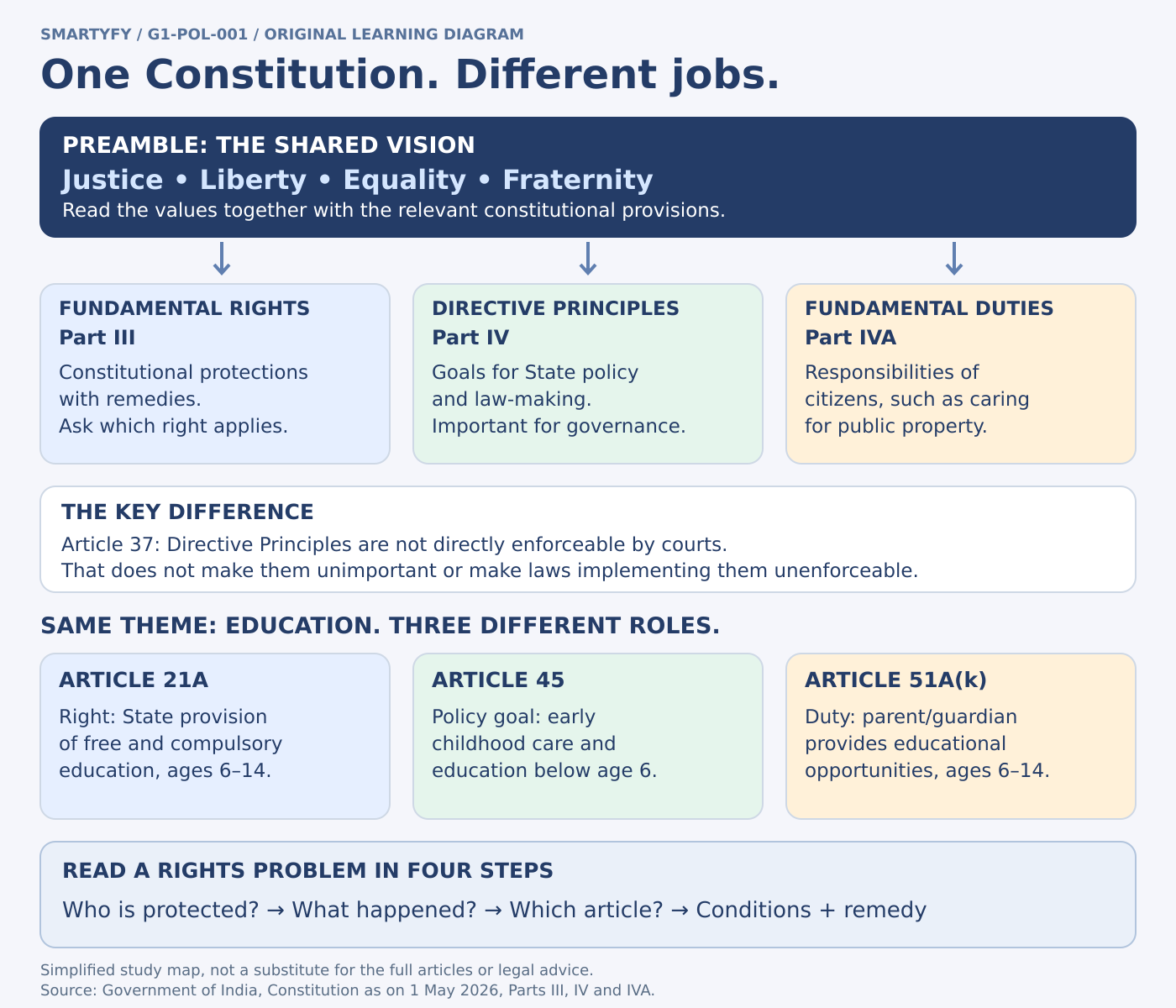
Academy lesson 0002, fully revised. This subject lesson replaces the earlier general syllabus-planning introduction while preserving the Academy record. Study time: about 60–75 minutes including questions and writing.
Source and syllabus version: The constitutional provisions below were checked in the Government of India’s Constitution, as on 1 May 2026. The Group I Preliminary Paper I-B mapping to the Preamble, Fundamental Rights and Directive Principles was checked in the archived APPSC 2018 syllabus document, page 3, hosted by a mirror. The applicable 2026 APPSC annexure remains unverified because the official PDF was inaccessible during checking. A current constitutional source does not by itself verify a current examination scheme. Check the official APPSC syllabus portal for the applicable notification. The writing task is original Group I practice, not an official past question.
1. A simple starting picture
Imagine a public library being planned in an Andhra Pradesh town. Three questions arise. What kind of society should the library serve? What protections must officials respect while running it? What public goals should guide its development? These are different questions, although the same decision may involve all three.
The Preamble expresses the Constitution’s overall vision. Fundamental Rights provide constitutional protections. Directive Principles guide the State towards social and economic goals. Fundamental Duties describe responsibilities of citizens. They belong to one constitutional framework, but they are not interchangeable labels. The Supreme Court’s constitutional overview explains that the Constitution binds the organs of government and enables judicial review of unconstitutional action.
PREAMBLE: What values should guide the whole system?
↓ Read the relevant operative provisions ↓
PART III: Fundamental Rights → protections and constitutional remedies
PART IV: Directive Principles → goals for State policy and law-making
PART IVA: Fundamental Duties → responsibilities of citizens
2. Read the Preamble as a connected idea
The opening locates the Constitution’s authority in the people. The description of India then states the nature of the republic, while justice, liberty, equality and fraternity express its aspirations. Do not memorise the words as an unrelated string. Ask what problem each idea addresses.
| Term | Core meaning | Misreading to avoid |
|---|---|---|
| Sovereign | India has independent constitutional authority in its internal and external affairs. | It does not mean every public official has unlimited power. |
| Socialist | A commitment to social and economic justice and reducing deprivation. | The word alone does not supply every detail of an economic policy. |
| Secular | Freedom of conscience and religion operates within a constitutional order of equal citizenship. | It does not mean that people are prohibited from having religious beliefs. |
| Democratic | Public power is grounded in the people and exercised through constitutional democratic institutions. | An electoral majority is not permission to ignore constitutional limits. |
| Republic | The head of the State does not hold office by hereditary entitlement. | It does not mean that every office is filled by direct popular election. |
The Preamble records adoption on 26 November 1949. The Constitution generally came into force on 26 January 1950, although certain provisions commenced earlier. The 42nd Amendment Act, 1976 altered the Preamble by adding the terms socialist and secular and introducing integrity into its reference to the nation. The amendment’s year and its commencement date are different details: the Preamble footnotes give 3 January 1977 for these changes. Official text: Preamble and Article 394.
Justice, liberty, equality and fraternity work together
Justice asks whether social, economic and political arrangements are fair. Liberty protects space for thought, expression and belief. Equality concerns status and opportunity. Fraternity connects mutual respect with individual dignity and national unity. These are organising ideas, not four separate departments.
Return to the imaginary library. Publishing a clear membership rule can improve fair access. Allowing different viewpoints supports learning and expression. Treating readers with dignity helps people use the space without humiliation. A good answer explains these relationships; it does not simply attach four values to any example.
3. Fundamental Rights: ask four questions
A right is a protected claim or freedom. A Fundamental Right has constitutional status in Part III. To analyse one, ask: who is protected, against what action, under which provision, and with what limits or remedy? Different rights answer these questions differently.
| Article | Starting point | Exam distinction |
|---|---|---|
| 14 | Equality before law and equal protection of laws for persons within India. | Its wording is not limited to citizens. |
| 19 | Specified freedoms, including expression, peaceful unarmed assembly and occupation, for citizens. | Read the restriction clause for the particular freedom. |
| 21 | Protection of life and personal liberty for persons, subject to the constitutional requirement concerning legal procedure. | It is not restricted to citizens, and legality cannot be reduced to an official’s personal preference. |
| 21A | State provision of free and compulsory education for children aged six to fourteen, in the manner determined by law. | Do not confuse this age range with Article 45. |
Read the full wording and qualifications in Part III. This table is a starting map, not a complete account of all rights or case law.
Worked example: a rule and its reason
Suppose an imaginary public library requires identity details for borrowing expensive reference books. A learner should not instantly write either “all rules violate liberty” or “any rule made by an official is valid”. First identify what the rule does and whom it affects. Then ask whether the distinction has a relevant purpose, whether the applicable law permits it, and whether it operates consistently with constitutional protections. The information given may be insufficient for a final legal conclusion.
The skill being tested is disciplined analysis. Compare two fictional explanations: “We apply a published borrowing rule because books need to be returned” and “We reject an otherwise eligible reader because an official dislikes that person’s views.” They raise different issues. A reason must be examined, rather than accepted merely because somebody calls it administrative convenience.
4. Freedom is protected; restrictions need justification
Article 19 does not give a single unrestricted freedom to do anything. Its clauses protect specified activities and permit restrictions under specified conditions. For expression, Article 19(2) identifies grounds including public order, defamation and incitement to an offence, among others. The law and the reasonableness of the restriction matter. Grounds appearing in one clause should not automatically be copied into every other clause.
Mini-case: In a fictional town, a peaceful, unarmed public meeting is proposed. The starting freedom is Article 19(1)(b), not a supposed right to assemble with weapons. Article 19(3) is the relevant restriction clause. A good answer identifies both the protected freedom and the conditions governing restriction. The label “public order” alone does not settle whether a particular restriction is valid.
5. Rights need remedies
Justiciable means capable of being dealt with or enforced through a court. Article 32 guarantees the right to approach the Supreme Court through appropriate proceedings to enforce Part III rights. Article 226 empowers High Courts to issue directions, orders and writs for Fundamental Rights and other purposes within its jurisdictional framework. Thus, Article 226 is not confined to Fundamental Rights in the way Article 32 is.
A writ is a type of judicial order. Both provisions mention writs such as habeas corpus and mandamus, but knowing their names does not establish entitlement to a particular order in every dispute. Procedure, jurisdiction, facts and the nature of the claim matter. For this introductory lesson, retain the distinction between protection and a mechanism for enforcement. Official text: Articles 32 and 226.
6. Directive Principles: public goals with a different legal form
Part IV contains the Directive Principles of State Policy, often shortened to DPSPs. Article 37 makes two points that must be learned together: courts do not directly enforce these provisions, and they remain fundamental to governance, with the State responsible for applying them in law-making. Calling them “non-justiciable” does not mean calling them useless.
For example, Article 47 concerns nutrition, living standards and public health. An imaginary AP municipality deciding how to improve sanitation can use such a goal to organise policy priorities. But citing Article 47 does not automatically establish that any chosen policy is lawful, well designed or adequately funded. The policy still needs evidence, legal authority, implementation and review.
Distinguish the principle from a law implementing it. A statute may create enforceable entitlements or duties even when the underlying Directive Principle is not directly enforceable by itself. Therefore, “DPSPs are non-justiciable” does not imply “every welfare law is unenforceable”.
7. One theme, three constitutional locations
| Fundamental Right | Directive Principle | Fundamental Duty |
|---|---|---|
| Article 21A State provision of free and compulsory education Ages 6–14 |
Article 45 State endeavour towards early childhood care and education Below age 6 |
Article 51A(k) Citizen parent or guardian’s duty to provide educational opportunities Ages 6–14 |
Part IVA’s duties belong to citizens. Other examples include developing a scientific temper and safeguarding public property. A useful connection is responsibility alongside protection, not an unsupported claim that officials may cancel a person’s rights whenever they allege poor citizenship. Official text: Articles 45 and 51A.
8. Can the Constitution be amended without limit?
No. In Kesavananda Bharati, the Supreme Court recognised limits on Parliament’s amending power through the basic-structure doctrine. The Court’s dedicated judgment resource explains the majority conclusion. The learning point is the difference between a power to amend and a power to destroy the Constitution’s basic structure. Avoid claiming that every word is unchangeable or that any amendment is valid simply because a majority supports it.
9. Original objective practice, with explanations
-
Which pairing is correct?
A. Fundamental Rights — Part IV
B. Directive Principles — Part III
C. Fundamental Duties — Part IVA
D. Preamble — Article 51A onlyAnswer: C. Rights are in Part III and Directive Principles in Part IV. Article 51A contains duties; it is not the Preamble.
-
Consider: (1) Article 14 uses the category of persons. (2) Article 19 protects its listed freedoms for citizens. Which is correct?
A. 1 only B. 2 only C. Both D. NeitherAnswer: C. The different words are intentional. It is inaccurate to say that every Fundamental Right has exactly the same beneficiaries.
-
What follows most accurately from Article 37?
A. Directive Principles have no constitutional significance.
B. They are directly enforceable through every Article 32 petition.
C. They guide governance and law-making although courts do not directly enforce them.
D. No law implementing a Directive Principle can be enforced.Answer: C. A discards their importance, B confuses their legal form with Part III, and D confuses a principle with a statute implementing it.
-
A question concerns peaceful, unarmed assembly. Which pair should be read first?
A. Articles 19(1)(b) and 19(3)
B. Articles 21A and 45
C. Articles 47 and 51A(k)
D. Articles 32 and 394 onlyAnswer: A. It links the specific freedom with its restriction clause. B and C address different subjects; remedies or commencement do not replace identification of the freedom.
-
Which statement about remedies is accurate?
A. Article 226 is limited only to Part III rights.
B. Article 32 concerns enforcement of Part III rights.
C. Article 32 makes every policy preference a Fundamental Right.
D. A writ must automatically be issued whenever requested.Answer: B. Article 226 extends to other purposes as well. The nature of the claim and legal conditions still matter, so C and D are unsupported.
-
Which education-related match is incorrect?
A. Article 21A — ages 6–14
B. Article 45 — early childhood below six
C. Article 51A(k) — parent or guardian’s educational duty
D. Article 45 — identical legal form to Article 21AAnswer: D. They share an educational theme, but Article 45 is a Directive Principle and Article 21A a Fundamental Right.
-
Which statement about constitutional dates is correct?
A. An Act’s year does not by itself establish every provision’s commencement date.
B. The Constitution was adopted by the 42nd Amendment.
C. The Preamble was first adopted in 1976.
D. Every provision of a 1976 Act necessarily took effect during 1976Answer: A. Do not confuse these dates. An Act’s year does not by itself tell you when each of its provisions commenced. The Preamble amendments took effect on 3 January 1977.
-
The best meaning of the basic-structure limitation is:
A. No constitutional provision can ever change.
B. Parliament can amend but cannot destroy the Constitution’s basic structure.
C. Any amendment is valid if described as a policy measure.
D. The doctrine removes all power to legislate.Answer: B. It identifies a limit on amendment without denying the power itself. A, C and D take the proposition beyond its meaning.
-
A public-health law pursues a Directive Principle. Which conclusion is safest?
A. It cannot create enforceable duties.
B. It is automatically valid regardless of its contents.
C. Its legal provisions and constitutional compatibility still require examination.
D. Its purpose converts every clause into a Fundamental Right.Answer: C. A policy goal does not settle the validity or enforceability of every measure used to pursue it.
-
Which answer best explains fraternity?
A. Identical opinions on every public issue
B. Mutual respect connected to dignity and national unity
C. Hereditary entitlement to public office
D. The removal of all constitutional remediesAnswer: B. Fraternity concerns a sense of common membership with dignity. It does not require uniformity of opinion.
10. Group I descriptive practice
Original question: “Fundamental Rights and Directive Principles have different legal forms but contribute to a common constitutional purpose.” Explain with an example. Practise in 180–220 words. This word range is for this exercise, not a claim about an official examination rule.
Plan before writing: State the distinction → explain the connection → give one precise example → add a qualification → conclude.
Illustrative model answer
The Constitution combines protections for individuals with goals for social transformation. Fundamental Rights in Part III are supported by constitutional remedies. Directive Principles in Part IV guide State policy and law-making. Article 37 makes the latter non-enforceable by courts while recognising their fundamental importance to governance.
Their different legal forms do not make them unrelated. A public institution must respect rights while pursuing wider welfare goals. For example, an education policy can expand learning opportunities, but its administration must also observe applicable constitutional protections. The education provisions illustrate the importance of precision: Article 21A concerns free and compulsory education for children aged six to fourteen, whereas Article 45 addresses early childhood care and education below six.
Policy objectives alone do not establish that every chosen measure is valid or effective. Legal authority, fairness, resources and implementation must also be assessed. Equally, the non-justiciability of a Directive Principle does not make a statute implementing it unenforceable.
Thus, rights and policy principles should be understood together: constitutional government must protect people while improving the social conditions in which they live. A balanced answer recognises both their common purpose and their distinct legal operation.
Self-check, 10 points: 2 for the Part III/IV distinction; 2 for accurate Article 37 explanation; 2 for a precise example; 2 for a balanced qualification; 2 for a clear, connected conclusion. This is a teaching rubric, not an APPSC marking scheme.
11. One-minute recap
- Preamble: purpose and values.
- Rights: identify the beneficiary, protection, conditions and remedy.
- DPSPs: non-justiciable principles that matter for governance.
- Duties: citizens’ responsibilities under Part IVA.
- Education: 21A, 45 and 51A(k) have related themes and different roles.
- Amendment: a constitutional power with basic-structure limits.
Teach it back: Without looking, explain why “DPSPs are non-justiciable” does not mean “welfare laws cannot be enforced”. Then distinguish the scope of Articles 32 and 226 in two sentences.
Group 1 Lesson 0003 — Biodiversity, Habitats and Conservation [G1-ENV-001]
GROUP 1 · ENVIRONMENT · G1-ENV-001
Biodiversity and Conservation: Protect the Variety, the Habitat and the Connections
Genes, species, ecosystems and practical conservation reasoning, with an Andhra Pradesh example.

Academy lesson 0003, fully revised. This detailed environment lesson replaces the earlier general source-checking introduction while retaining the Academy record. Allow about 60–75 minutes including the practice test and writing task.
Syllabus scope: Screening Paper II-B(i), item 22 (biodiversity), page 30; supports Mains Paper V environmental conservation, page 39. Mapping checked in Annexure II of APPSC Notification 07/2026, dated 6 October 2026, via a labelled Edexlive-hosted PDF mirror. Direct official-host retrieval was unavailable; this is not a claim of independently verified official-host access. Check the APPSC portal for amendments. All organism counts and management scenarios are invented for teaching.
1. Biodiversity is more than a list of animals
Biodiversity means the variety of life at several levels: differences within species, between species and among ecosystems. Plants, fungi and microorganisms matter alongside familiar animals. An ecosystem includes living communities interacting with their non-living surroundings. These distinctions follow the Convention on Biological Diversity, Article 2.
| Level | What varies? | A simple teaching example |
|---|---|---|
| Genetic diversity | Inherited variation within a species and its populations. | Different inherited traits among varieties of the same crop. |
| Species diversity | The variety of species and their relative representation. | Several plant, insect, bird and fungal species in a habitat. |
| Ecosystem diversity | Different kinds of interacting communities and physical environments. | A landscape containing forest, freshwater wetland and coastal mangrove systems. |
The three levels are connected but not interchangeable. Planting many individuals of one identical crop variety does not necessarily increase genetic diversity. Counting more individual birds does not necessarily mean more bird species. Protecting a species in a collection does not automatically preserve the habitat interactions on which wild populations depend.
Between species → different kinds of organisms
Among ecosystems → different living–physical systems
2. Richness, abundance and evenness
Species richness is the number of species in a defined sample or area. Abundance concerns the number of individuals. Evenness describes how balanced the relative abundances are. Always state the area, sampling effort and group of organisms being compared.
Worked example: the same count can hide a different pattern
| Species | Sample A | Sample B |
|---|---|---|
| P | 10 | 46 |
| Q | 10 | 1 |
| R | 10 | 1 |
| S | 10 | 1 |
| T | 10 | 1 |
| Total individuals | 50 | 50 |
Both samples contain five species and 50 individuals. Their richness and total abundance match. Sample A is more even; Sample B is dominated by P. Therefore “both have five species” is true but incomplete. This is a counting demonstration, not a calculation of a named diversity index.
Now imagine visiting A for five minutes and B for five hours. A difference in observed species could partly reflect different effort. Before claiming an ecological change, ask whether the place, season, method and effort are comparable. A survey finding and an explanation of its cause are different steps.
3. Why variation and relationships matter
Different organisms contribute to functions such as pollination, nutrient cycling, decomposition and food-web interactions. Genetic variation can provide material for populations to respond to changing conditions. But avoid the absolute claim that every more-diverse system will outperform every less-diverse system under every disturbance. The kind of diversity, the function and the disturbance matter.
Think of a fictional orchard with flowering plants, pollinating insects, soil organisms and insect-eating birds. Counting only fruit trees misses relationships supporting the system. If flowering resources outside the crop’s flowering period disappear, some pollinators may lose part of their food supply. The chain of explanation is a changed resource → an effect on organisms → a possible effect on an ecological function.
The CBD’s biodiversity and sustainable-development account connects biodiversity with food systems, ecosystems and genetic resources. An exam answer should explain a mechanism rather than simply assert that “nature is useful”.
4. Habitat loss and fragmentation are related but distinct
A habitat is the place or type of environment where an organism occurs. Habitat loss removes suitable habitat. Fragmentation breaks or separates its spatial arrangement into patches. A project can cause both. IPBES: drivers of biodiversity and ecosystem change.
↓ a barrier or unsuitable land separates patches
After: less connectivity, more edges, potentially harder movement
↓Possible effects: altered access to food, mates or seasonal habitat
Worked scenario: A fictional animal uses one patch for feeding and another for shelter. If the route between them becomes impassable, retaining both patches may still be insufficient. The problem is not only the number of hectares left; it is whether the habitat remains usable as a connected system.
Conversely, a narrow corridor drawn on a map is not automatically effective. Its vegetation, disturbance, width and suitability for the target organisms need evidence. “Connect patches” is a starting conservation idea, not a complete engineering or ecological design.
5. Several pressures can act together
IPBES identifies land- and sea-use change, direct exploitation, climate change, pollution and invasive alien species as major direct pressures on biodiversity. They can interact. For instance, habitat degradation and pollution may affect the same wetland. A single-cause explanation may miss the combined problem. IPBES drivers framework.
In a fictional freshwater pond, nutrient inputs could change water conditions while shoreline clearance removes shelter. Investigating only the visible clearing may overlook water quality; investigating only water quality may overlook habitat structure. A strong answer identifies the pressure, the pathway and the evidence needed to evaluate it.
6. Four words that should not be mixed up
| Term | Question it answers | Caution |
|---|---|---|
| Endemic | Is the organism naturally restricted to a specified region? | State the region; endemic does not automatically mean threatened. |
| Alien / introduced | Has it been introduced outside its natural range through human activity? | Not every introduced species becomes invasive. |
| Invasive alien | Does an introduced species establish and spread with harmful impacts? | Origin alone is not proof of harmful invasion. |
| Threatened | What is the assessed risk of extinction? | This is an assessment category, not a synonym for unfamiliar or locally uncommon. |
The IPBES invasive-alien-species learning resource distinguishes stages such as introduction, establishment and spread. The IUCN guidance on Red List use groups Vulnerable, Endangered and Critically Endangered as threatened categories. Data Deficient does not establish that a species is safe; it signals insufficient information for an assessment. Always record the assessment scope and date before quoting a particular species’ status.
7. Conservation in place and outside the habitat
In-situ conservation protects organisms and viable populations in their natural surroundings and conserves their ecosystems. Ex-situ conservation maintains components of biodiversity outside their natural habitats. The approaches can complement each other. CBD definitions.
| Approach | Example | What it cannot guarantee by itself |
|---|---|---|
| In situ | Managing a habitat so wild populations and their interactions can persist. | A legal boundary alone does not ensure habitat quality or effective management. |
| Ex situ | A suitable seed collection, botanical collection or conservation-breeding programme. | Keeping specimens does not automatically restore a functioning wild habitat. |
For a fictional rare plant, a suitable seed collection could provide a safeguard while its habitat is restored. However, storage methods must suit the species, genetic representation matters, and return to the wild requires suitable conditions. Do not assume that every seed can be stored indefinitely or that releasing organisms is always appropriate.
Conservation sequence: identify what needs protection → establish the pressure → choose a fitting intervention → involve relevant local knowledge and institutions → monitor outcomes. Counting activities, such as the number of saplings planted, is not the same as demonstrating survival, habitat recovery or improved biodiversity.
8. Andhra Pradesh connection: Coringa mangroves
The Andhra Pradesh Forest Department identifies Coringa Wildlife Sanctuary near Kakinada as a mangrove ecosystem supporting varied plants and animals. Mangroves provide a useful example of a coastal living system shaped by water, sediment and salinity. AP Forest Department: Coringa. The district government’s Coringa account describes habitat, sediment-stabilisation and coastal roles.
Use the example carefully. Protecting a mangrove system involves more than increasing a tree count. Suitable tidal water movement, substrate conditions, native vegetation and associated organisms matter. Planting unsuitable species in an unsuitable place does not automatically recreate a mangrove ecosystem.
Original management exercise: Imagine a restoration proposal that reports only “10,000 seedlings planted”. Ask what species were used, whether the site suits them, how survival will be measured, whether water movement remains appropriate, and what happens to the wider habitat. The number is fictional. The point is to distinguish an activity from a conservation outcome.
9. Original objective questions
-
Which example primarily concerns genetic diversity?
A. Inherited variation among varieties of the same crop
B. A list of unrelated bird species
C. A comparison of mangrove and grassland ecosystems
D. The number of rocks in a plotAnswer: A. B concerns species, C ecosystem types and D non-living material. Genetic diversity is variation within a species and its populations.
-
Samples A and B each contain five species and fifty individuals, but one is dominated by a single species. What can differ?
A. Only their total individual count
B. Their evenness
C. Necessarily their richness
D. Their number of identified species must be unknownAnswer: B. Richness and total abundance are specified as equal. The distribution across species can still differ.
-
A larger number of individuals of one species necessarily proves:
A. Higher species richness
B. Greater ecosystem diversity
C. Only a higher count of that species in the stated observation
D. That all threats have endedAnswer: C. An abundance increase is not automatically an increase in richness or ecosystem diversity.
-
Why can fragmentation matter even if two habitat patches remain?
A. Every organism can cross every barrier
B. Movement between resources may become difficult
C. Habitat quality can never change
D. All species respond identicallyAnswer: B. Connectivity can affect access to food, mates or seasonal habitat. The magnitude of the effect requires species-specific evidence.
-
Which statement about introduced species is accurate?
A. All introduced species are automatically invasive.
B. None can cause harm.
C. Introduction, establishment, spread and harmful impact are distinct considerations.
D. Their origin alone proves extinction risk.Answer: C. The biological invasion process requires more precise analysis than treating every non-native organism as identical.
-
Which set comprises IUCN threatened categories?
A. Vulnerable, Endangered, Critically Endangered
B. Least Concern, Data Deficient, Not Evaluated
C. Endemic, Native, Alien
D. Mangrove, Wetland, ForestAnswer: A. B contains other assessment categories; C concerns range or origin; D names ecosystem types.
-
Ex-situ conservation means conservation:
A. Only in undisturbed wild habitat
B. Outside natural habitats
C. Without any scientific management
D. That automatically replaces all in-situ workAnswer: B. It can support conservation but does not itself recreate all wild ecological relationships.
-
Which is the strongest way to evaluate a planting programme?
A. Count seedlings once and stop.
B. Assume any tree species is suitable everywhere.
C. Examine species suitability, survival, habitat conditions and ecological outcomes.
D. Treat planting effort and restored biodiversity as identical.Answer: C. An activity count is only an input or output indicator; conservation success needs evidence about outcomes.
-
Two biodiversity surveys use very different sampling times and effort. Before inferring change, one should:
A. Ignore methods.
B. Check comparability and possible observation bias.
C. Select whichever total is larger.
D. Assume season cannot affect observations.Answer: B. Method and effort can influence what is observed, so raw counts alone may be misleading.
-
Coringa is useful in this lesson as an AP example of:
A. A mangrove ecosystem
B. An alpine glacier
C. A desert dune field
D. An ex-situ seed freezerAnswer: A. Its coastal habitat illustrates why water conditions, vegetation and ecological relationships must be considered together.
10. Group I descriptive practice
Original question: Explain why biodiversity conservation should protect habitats and ecological relationships, not merely increase the number of visible organisms. Use an AP example. Practise in 180–220 words; this range is instructional.
Illustrative model answer
Biodiversity includes variation within species, among species and among ecosystems. It cannot therefore be measured adequately by counting only visible animals or planted trees. Even equal species counts may conceal different relative abundances, while genetic variation and ecological interactions may remain unexamined.
Habitats provide the physical and biological conditions needed by populations. Their loss removes suitable space; fragmentation can reduce connections between feeding, breeding or seasonal areas. Retaining isolated patches may be insufficient when organisms cannot move between necessary resources. The effects nevertheless depend on the species and the nature of the barrier.
Coringa’s mangroves provide an Andhra Pradesh example. Effective conservation requires attention to suitable water movement, sediment, native vegetation and associated organisms. A planting programme should therefore be evaluated through survival and habitat outcomes, not only the number of seedlings placed.
In-situ conservation protects organisms in their natural surroundings. Ex-situ measures, such as suitable collections or conservation breeding, can provide complementary safeguards but cannot automatically replace functioning wild ecosystems.
A sound strategy identifies pressures, selects interventions suited to the habitat, includes relevant local knowledge and monitors ecological outcomes. Conservation is thus the maintenance of viable living systems and their diversity, rather than a race to produce the largest activity count.
Self-check, 10 points: 2 for biodiversity levels; 2 for a mechanism such as fragmentation; 2 for an accurate AP example; 2 for conservation-method distinctions; 2 for monitoring and a connected conclusion. This is a teaching rubric.
11. One-minute recap
- Biodiversity includes genes, species and ecosystems.
- Richness counts species; abundance counts individuals; evenness concerns their balance.
- Habitat loss and fragmentation can operate together but are different ideas.
- Endemic, alien, invasive and threatened answer different questions.
- In-situ and ex-situ methods can complement each other.
- Measure conservation outcomes, not only activities.
Group 1 Lesson 0001 — Ratios, Percentages and Weighted Averages [G1-APT-001]
GROUP 1 · GENERAL APTITUDE · G1-APT-001
Ratios, Percentages and Weighted Averages: Always Find the Base
A step-by-step lesson with visual methods, worked examples and explained practice.
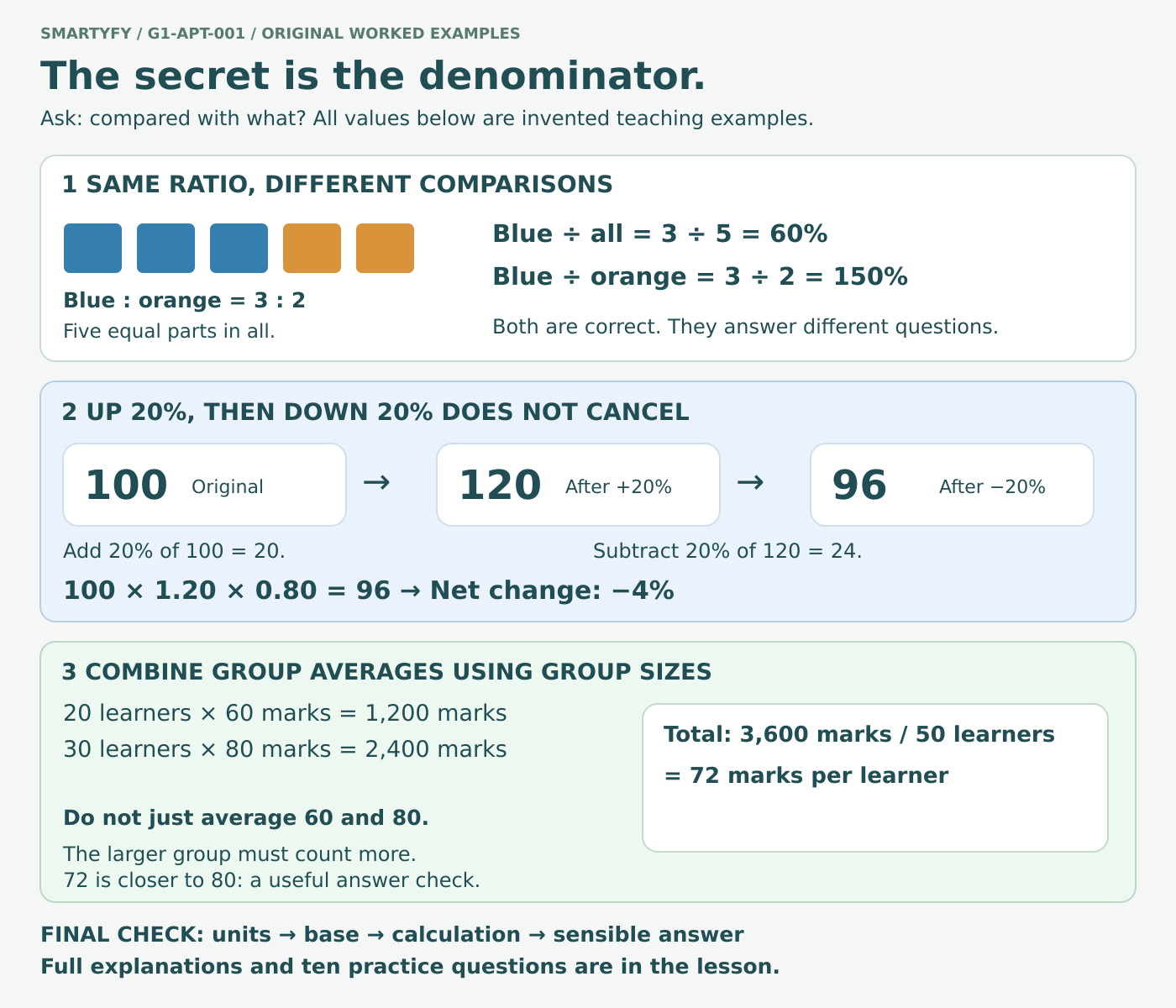
Academy lesson 0001, fully revised. This substantive aptitude lesson replaces the earlier study-system introduction while retaining the Academy record. Allow 50–65 minutes, including solving the questions before reading the answers.
Syllabus scope: Group I Preliminary Paper II-A, ratio and proportion, weighted mean, percentage and data interpretation: items 7, 8, 10 and 15 in the APPSC 2018 syllabus document, page 5, accessed through a labelled archive mirror. The official 2026 APPSC annexure was inaccessible during checking, so the current examination scheme is not claimed as verified. Consult the official syllabus portal. All numerical cases below are invented teaching examples, not actual AP statistics or examination results.
1. The question hidden inside every percentage
A percentage expresses a quantity relative to a base of 100. The most important question is “Percentage of what?” A ratio compares quantities, but its denominator may be another part rather than the whole. These ideas are introduced in NCERT’s Comparing Quantities, reproduced on IIT Kanpur’s SATHEE. The examples and methods below are original.
Imagine a study room with 18 blue folders and 12 orange folders. Blue to orange is 18:12, or 3:2. But the blue share of all folders is 18 out of 30, or 60%. The ratio 3:2 does not mean blue folders are 150% of the total. They are 150% of the orange folders, which is a different base.
BLUE : ORANGE = 3 : 2
■ ■ ■ ■ ■ Five equal parts in the whole
Blue share = 3 ÷ (3 + 2) × 100 = 60%
Blue relative to orange = 3 ÷ 2 × 100 = 150%
Worked example 1: split a total using a ratio
A fictional reading programme divides 420 practice sheets between two groups in the ratio 4:3. There are 4 + 3 = 7 equal parts. One part is 420 ÷ 7 = 60 sheets. The shares are 4 × 60 = 240 and 3 × 60 = 180 sheets. Check: 240 + 180 = 420 and 240:180 simplifies to 4:3.
Why it works: A ratio provides relative sizes, not the actual total. Dividing by the sum of its parts gives the size of one part. This method also makes it clear why splitting 420 by 4 and by 3 separately would be wrong.
2. Units must agree before comparison
Suppose one route is 750 metres and another is 3 kilometres. Comparing 750:3 directly mixes units. Convert 3 kilometres to 3,000 metres. The ratio becomes 750:3,000 = 1:4. The shorter route is 25% of the longer route.
Write the unit next to the number until the conversion is finished. This small habit prevents large errors. It also helps with time: 30 minutes compared with two hours is 30:120 = 1:4, not 30:2.
3. Change is measured against the starting value
For a positive starting value, percentage change = (new value − original value) ÷ original value × 100. A negative result represents a decrease. If the original value is zero, this usual formula cannot produce a finite percentage change because division by zero is undefined.
Worked example 2: 240 becomes 300
- Find the change: 300 − 240 = 60.
- Identify the original base: 240.
- Calculate: 60 ÷ 240 × 100 = 25% increase.
Now reverse the journey: 300 becomes 240. The loss is still 60, but the original base is now 300. The decrease is 60 ÷ 300 × 100 = 20%. The same absolute difference produces different percentage changes because the starting points differ.
4. Percentage points are different from percentage change
A fictional test centre’s pass rate changes from 60% to 75%. Subtraction gives an increase of 15 percentage points. The relative percentage increase in the rate is (75 − 60) ÷ 60 × 100 = 25%. Both statements are correct when clearly labelled.
But neither statement tells us the increase in the number of successful candidates without knowing the numbers who took the test. If the first test had 100 candidates and the second had 80, the successful count is 60 in both. The pass rate rose while the count stayed the same. This is why a rate and a count must not be treated as interchangeable.
| Test | Candidates | Successful | Pass rate |
|---|---|---|---|
| First | 100 | 60 | 60% |
| Second | 80 | 60 | 75% |
5. Successive percentages use a changing base
Increasing a number by 20% means keeping its original 100% and adding 20%, so multiply by 1.20. Decreasing a number by 20% means keeping 80%, so multiply by 0.80. These factors make a two-stage calculation easy to see.
Worked example 3: up 20%, then down 20%
Start with 100 units. After the increase: 100 × 1.20 = 120. After the decrease: 120 × 0.80 = 96. The result is 4 units below the original 100, a net decrease of 4%.
This is not a special property of the starting number 100. With 500 units, the path is 500 → 600 → 480, again a 4% decrease. Choosing 100 is often a convenient way to understand a percentage problem; it is not a claim that the actual starting quantity must be 100.
Another example: A 10% rise followed by a 20% rise multiplies the original by 1.10 × 1.20 = 1.32. The combined rise is 32%, not 30%. The extra two percentage points arise because the second increase also applies to the first increase.
6. Reverse percentages: work backwards using division
A fictional workbook pack costs ₹720 after a 10% discount. The final amount is 90% of its original price. Therefore original price = 720 ÷ 0.90 = ₹800. Check forward: 10% of ₹800 is ₹80; subtracting ₹80 leaves ₹720.
Adding 10% of ₹720 would give ₹792, which is wrong because the original discount was calculated on the original price, not the final price. Write an equation when unsure: original × 0.90 = final. Then undo the multiplication by dividing.
Similarly, a quantity of 575 after a 15% increase began at 575 ÷ 1.15 = 500. Check: 15% of 500 is 75. These are arithmetic teaching cases, not current prices or purchasing advice.
7. Weighted means: larger groups must count more
A simple mean is the total of the values divided by their number. A weighted mean gives each value the importance represented by its weight. When combining group averages, the group sizes are the weights because every individual should count once.
Worked example 4: combine two practice-test groups
Group A has 20 learners with an average of 60 marks. Group B has 30 learners with an average of 80 marks, on the same scale. Group A’s total is 20 × 60 = 1,200. Group B’s total is 30 × 80 = 2,400. Together, there are 3,600 marks across 50 learners. Combined mean = 3,600 ÷ 50 = 72 marks.
The unweighted mean of the two averages, (60 + 80) ÷ 2 = 70, gives each group equal importance despite their different sizes. That method would be appropriate here only if the group sizes were equal. Since the larger group has the higher average, the combined result should be closer to 80 than to 60. The answer 72 passes that check.
(20 × 60 + 30 × 80) ÷ (20 + 30)
= (1,200 + 2,400) ÷ 50
= 72 marks
8. Combine rates using the underlying counts
Suppose Centre A has 100 candidates and a 60% pass rate; Centre B has 300 candidates and an 80% pass rate. The successful counts are 60 and 240. The combined rate is (60 + 240) ÷ (100 + 300) × 100 = 75%. It is not the simple average of 60% and 80%, which is 70%.
If only the two rates are supplied and the candidate counts are unknown, the exact combined rate cannot be determined. For positive group sizes it must lie between the two rates, but many values are possible. “Insufficient data” can therefore be the mathematically correct answer, not a failure to calculate.
9. Original practice questions
Try each question first. Then compare both your answer and your choice of denominator with the explanation.
-
Two quantities are in the ratio 5:3. What percentage of their total is the first quantity?
A. 62.5% B. 60% C. 166.67% D. 37.5%Answer: A. The total contains 8 ratio-parts, so the first share is 5 ÷ 8 × 100 = 62.5%. Option C compares the first quantity with the second, not with the total.
-
Divide 540 sheets in the ratio 4:5. What is the smaller share?
A. 240 B. 300 C. 135 D. 108Answer: A. One part is 540 ÷ 9 = 60; the smaller share is 4 × 60 = 240. The other share is 300, and the two sum to 540.
-
A quantity rises from 80 to 100. Its percentage increase is:
A. 20% B. 25% C. 80% D. 125%Answer: B. The increase is 20 on a base of 80: 20 ÷ 80 × 100 = 25%. A uses the new value as the denominator; D describes the new value as a percentage of the original, not the increase alone.
-
A rate falls from 40% to 30%. Which description is correct?
A. A fall of 10 percentage points and 25% relative to the original rate
B. A fall of 10% and 25 percentage points
C. A fall of 30 percentage points
D. The underlying count must fall by exactly 10Answer: A. The difference is 10 percentage points; 10 ÷ 40 × 100 = 25%. Counts require denominators, so D does not follow.
-
A number increases by 10% and then decreases by 10%. The final number is:
A. 100% of the original B. 99% of the original C. 90% of the original D. 101% of the originalAnswer: B. Multiply 1.10 × 0.90 = 0.99. For a starting 100, the stages are 100 → 110 → 99.
-
A fictional pack costs ₹680 after a 15% discount. Its original price was:
A. ₹782 B. ₹800 C. ₹578 D. ₹695Answer: B. The final price is 85% of the original, so 680 ÷ 0.85 = 800. Adding 15% of 680 uses the wrong base.
-
Ten learners average 50 marks and thirty learners average 70 marks. What is the combined mean?
A. 60 B. 65 C. 67.5 D. 120Answer: B. Total marks = 10 × 50 + 30 × 70 = 2,600. Divide by 40 learners to get 65. The larger group correctly receives more weight.
-
Two centres report pass rates of 50% and 80%, but no candidate counts. The exact combined rate is:
A. Necessarily 65% B. Necessarily 80% C. Not determined by the information D. Necessarily 130%Answer: C. Equal candidate counts would give 65%, but unequal counts give other weighted results. The counts are needed.
-
The ratio of 600 metres to 2.4 kilometres is:
A. 250:1 B. 1:4 C. 4:1 D. 1:400Answer: B. Convert 2.4 kilometres to 2,400 metres, then simplify 600:2,400. A mixes numerical values expressed in different units.
-
A quantity rises from zero to 50. Under the usual percentage-change formula, the increase is:
A. 50% B. 100% C. 5,000% D. Undefined because the original denominator is zeroAnswer: D. The absolute increase is 50, but the usual relative-change formula divides by the original value. Do not assign a finite percentage by guessing.
10. A complete data-interpretation drill
| Centre | Candidates | Successful |
|---|---|---|
| A | 120 | 72 |
| B | 180 | 135 |
| C | 100 | 65 |
Questions: Which centre has the highest success rate? What is the combined rate? What percentage of all successful candidates came from B?
Explained solution: The rates are A: 72 ÷ 120 = 60%; B: 135 ÷ 180 = 75%; C: 65 ÷ 100 = 65%. B has the highest rate. Total successful = 72 + 135 + 65 = 272; total candidates = 400; combined rate = 272 ÷ 400 × 100 = 68%. B’s share of successful candidates uses 272 as its denominator: 135 ÷ 272 × 100 ≈ 49.63%. Notice how the denominator changes with the question.
11. One-minute recap
- Part-to-part ratio and part-to-whole share answer different questions.
- Convert units before comparing quantities.
- Percentage change uses the original value as the base.
- A change between rates can be expressed in percentage points or relative percent.
- Successive changes multiply factors; they do not simply cancel or add.
- Reverse a percentage by dividing by the appropriate factor.
- Combine group means and rates using totals or correct weights.
Teach it back: Explain why “up 20%, then down 20%” leaves a 4% decrease, using numbers rather than a memorised formula. Then create your own pair of unequal groups and verify the weighted mean by reconstructing their totals.
Build your preparation routine
Start with a simple plan you can follow consistently.
- Review the current official syllabus. Note the topics for your selected APPSC group.
- Set a realistic weekly schedule. Reserve time for study, revision, and practice.
- Keep a topic tracker. Record what you finish and what needs another review.
- Return for new lessons. Published material will appear in your chosen track.