Quantum Computing Master Course — 032. Product States
Lesson 032: Product States
Smartyfy Quantum Computing Master Course
Starting point and objectives
A product state describes a joint pure state that can be built from one state vector for each subsystem. You will expand such states, factor suitable four-entry vectors, and calculate independent local measurement probabilities. You will also learn two limits: independent outcomes in one basis do not prove a product state, and the pure-state factorization test must not be mistaken for the general mixed-state definition of entanglement.
Our tensor order remains |q₁q₀⟩, with vector entries corresponding to 00, 01, 10, and 11. In this lesson, any unqualified four-entry state vector represents a normalized pure state. Random mixtures of preparations will be discussed separately and explicitly.
Expand the tensor product
Let q₁ have |u⟩ = α|0⟩+β|1⟩ and q₀ have |v⟩ = γ|0⟩+δ|1⟩. Their product is |u⟩⊗|v⟩ = αγ|00⟩ + αδ|01⟩ + βγ|10⟩ + βδ|11⟩. Its vector is [αγ,αδ,βγ,βδ]. Ordinary distribution expands the two factors while preserving their order.
If each factor is normalized, the squared norm of the product is (|α|²+|β|²)(|γ|²+|δ|²)=1. This is a useful shortcut, but writing all four entries remains valuable when checking basis order. Concatenating the two vectors as [α,β,γ,δ] would not perform a tensor product.
For Z measurements, p(q₁=a,q₀=b) equals p(q₁=a)p(q₀=b). For example, |αγ|² = |α|²|γ|². The same independence holds for any pair of fixed local measurement bases, because a joint overlap factors into the product of two local overlaps. This claim concerns separate local measurements; a joint entangled measurement asks a different question.
Worked example with nontrivial probabilities and phase
Prepare q₁ in [sqrt(3)/2,1/2] and q₀ in [1,i]/sqrt(2). Their product is [sqrt(3),i sqrt(3),1,i]/(2sqrt(2)). The Z probabilities are (3/8,3/8,1/8,1/8). Summing rows gives q₁ probabilities (3/4,1/4); summing columns gives q₀ probabilities (1/2,1/2).
Condition on q₀ = 1. The surviving q₁ amplitudes are i sqrt(3)/(2sqrt(2)) and i/(2sqrt(2)). The branch probability is 1/2, so renormalization gives i[sqrt(3)/2,1/2]. After discarding global phase i, q₁ has the same state as before. A local measurement outcome on one factor does not change the other factor's state in a product preparation.
The phase i does matter for measurements on q₀ itself. Its state is |y+⟩, so a Y measurement returns + with certainty. Consequently, a Z measurement on q₁ together with a Y measurement on q₀ has only two nonzero joint probabilities: (0,+) occurs with probability 3/4 and (1,+) with probability 1/4. Independence is compatible with deterministic behavior on one side.
A compact factorization test for pure two-qubit states
Arrange [a,b,c,d] into the coefficient matrix M = [[a,b],[c,d]], using q₁ as the row and q₀ as the column. A product vector gives M = [[α],[β]] [γ,δ]. There is no complex conjugation in this outer product: we are arranging tensor coefficients, not forming a density matrix.
Every such matrix has determinant ad−bc = 0. Conversely, a nonzero two-by-two coefficient matrix with zero determinant has rank one, so it can be written as a column times a row. Normalizing those factors yields a product-state representation, with any remaining unit-magnitude factor absorbed as a phase. Thus a normalized pure two-qubit vector is a product state exactly when ad = bc.
When a convenient entry vanishes, do not divide by it. Use a different nonzero row or column. For instance, [0,0,γ,δ] factors as |1⟩⊗[γ,δ]. The determinant criterion handles this case without a division-by-zero exception. The zero matrix also has zero determinant, but it is excluded because a state vector must be normalized.
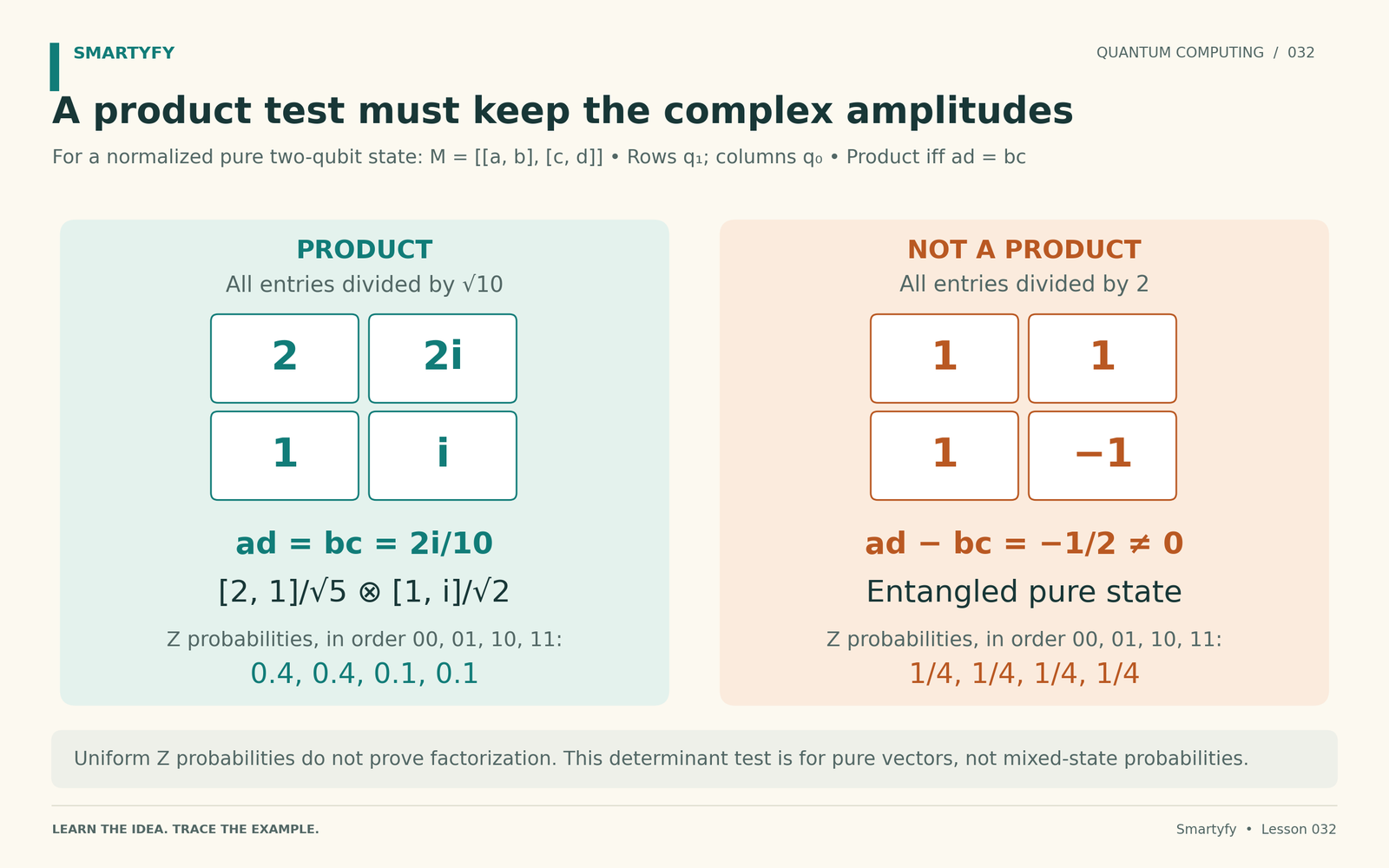
As a worked factorization, [2,2i,1,i]/sqrt(10) has ad = 2i/10 and bc = 2i/10. Its second row is half its first, and the within-row ratio is i. Therefore it factors as [2,1]/sqrt(5) ⊗ [1,i]/sqrt(2). Multiplication recovers all four original amplitudes.
What the test cannot tell you from probabilities alone
Consider [1,1,1,−1]/2. Every Z outcome has probability 1/4, so the two Z outcomes are statistically independent. Yet ad−bc = −1/4−1/4 = −1/2, which is nonzero. The pure state is not a product and is therefore entangled. Relative phases can hide entanglement from a single measurement setting.
For pure bipartite states, being entangled means not being expressible as a product vector. For mixed states, the definition is different: a state is separable if it is a probabilistic mixture of product states, and entangled if no such mixture represents it. A nonproduct mixed state can therefore be separable.
A mixed state describes a statistical mixture of preparations rather than one state vector. A density matrix records such a mixture as ρ = Σ_j p_j |ψ_j⟩⟨ψ_j|, where p_j are nonnegative preparation probabilities summing to one. The outer product |ψ_j⟩⟨ψ_j| multiplies a column vector by its conjugate-transpose row; it is a matrix, not the tensor product used to combine qubits. A single pure preparation has ρ = |ψ⟩⟨ψ|. For a mixture of computational basis states, the diagonal entries are their preparation probabilities. We use this limited preview here; Lessons 092–094 develop density matrices and reduced states systematically.
For example, choose |00⟩ or |11⟩ with equal classical probability. This preparation gives perfectly correlated Z outcomes but is a separable mixture of two product states. Its density matrix is diag(1/2,0,0,1/2). It is not the coherent vector (|00⟩+|11⟩)/sqrt(2), even though those preparations share one Z histogram. The vector determinant test applies to the coherent pure state, not to a list of mixture probabilities.
Local gates preserve product structure
Applying U to q₁ and V to q₀ maps |u⟩⊗|v⟩ to (U|u⟩)⊗(V|v⟩). The output is still a product. Local unitary gates alone cannot create entanglement from a product input. A gate capable of entangling the subsystems must involve a joint interaction, and even such a gate may leave some particular product inputs unentangled.
Practice exercises with worked solutions
-
Exercise 1. Expand |−⟩⊗|y+⟩ in our ordered basis.
Solution. Multiply [1,−1]/sqrt(2) by [1,i]/sqrt(2) as a tensor product. The vector is [1,i,−1,−i]/2. Its four Z probabilities are all 1/4, and ad = −i/4 equals bc = −i/4, confirming product structure.
-
Exercise 2. Factor [0,3,0,4]/5.
Solution. Only the q₀=1 column is nonzero. Therefore the vector is ([3,4]/5)⊗|1⟩. The first factor is normalized because 9/25+16/25=1. Multiplication gives zero, 3/5, zero, and 4/5 in the required order.
-
Exercise 3. Is (sqrt(3)|00⟩+|11⟩)/2 a product?
Solution. Its coefficients are a=sqrt(3)/2, b=0, c=0, d=1/2. Thus ad−bc=sqrt(3)/4, which is nonzero. The vector is normalized and pure, so it is entangled. Its unequal weights do not prevent entanglement.
-
Exercise 4. For the worked product preparation, find p(q₁=1 given q₀=0).
Solution. The joint probability p(1,0)=1/8 and the conditioning probability p(q₀=0)=1/2. Their ratio is 1/4. It matches q₁’s original one probability, as independence requires. This conditional probability is defined because the conditioning event has nonzero probability.
Knowledge check
-
1. The product-vector entries are:
- A. [|α|²,|β|²]
- B. [α,β,γ,δ]
- C. [αγ,αδ,βγ,βδ]
- D. [α+γ,β+δ]
Answer: C. Distributing the tensor factors gives one amplitude for each ordered pair of basis labels.
-
2. For a normalized pure two-qubit vector, product structure is equivalent to:
- A. a+b+c+d=0
- B. All probabilities equal
- C. Every entry real
- D. ad−bc=0
Answer: D. Zero determinant means the coefficient matrix has rank one and factors into two vectors.
-
3. Independent Z outcomes prove:
- A. A unique pure state
- B. Independence in that setting
- C. A zero relative phase
- D. No entanglement in every case
Answer: B. A phase-entangled pure state can have a uniform, independent Z distribution.
-
4. A separable mixed state is:
- A. A mixture of product states
- B. Always diagonal
- C. Always one product vector
- D. Always entangled
Answer: A. Its definition permits classical correlations among different product preparations.
-
5. Local unitary gates acting on a product input can:
- A. Keep it a product
- B. Always entangle it
- C. Make local measurement outcomes statistically dependent
- D. Convert it into a correlated mixture
Answer: A. The tensor-product action transforms each factor separately and preserves factorization.
Pitfalls and summary
Expand amplitudes in the declared tensor order, then derive probabilities. The coefficient-matrix determinant is a complete product test for normalized pure two-qubit vectors. It is not a test on probability arrays or a general mixed-state entanglement criterion. Product states yield independent local statistics, but independence in just one setting and classical correlation in just one setting are both insufficient diagnoses of entanglement.
Primary sources and further study
The sources below verify conventions and definitions. The derivations, worked examples, practice questions, and explanations in this lesson are original course material.