Quantum Computing Master Course — 036. Testing Separability
Lesson 036: Testing Separability
Smartyfy Quantum Computing Master Course
Prerequisites and objectives
Lesson 032 introduced the product-state determinant test. Here we turn it into a careful diagnostic method, including factor construction, zero entries, basis changes, and numerical uncertainty. You will decide whether a specified pure two-qubit vector factors, verify its factors, and explain why the same method does not classify an arbitrary mixed preparation.
We retain |q₁q₀⟩ order, with coordinates [a, b, c, d] corresponding to 00, 01, 10, 11. Unless explicitly stated otherwise, the input is a normalized pure-state vector. This assumption is part of the test, not a conclusion obtained from a histogram.
What separability means in this setting
A pure two-qubit state is a product if it equals u ⊗ v for normalized single-qubit vectors u and v. It is entangled if no such factorization exists. The term separable agrees with product for pure bipartite states, but a mixed separable state can be a probability-weighted mixture of several different product states.
This distinction matters when interpreting experimental data. An array of four probabilities is not a pure-state vector, and a collection of randomly selected preparations is not their coherent amplitude sum. The reduced-state framework supplies the more general language; today we use the pure-vector criterion only where its assumptions hold.
The coefficient matrix test
Arrange the amplitudes into M = [[a, b], [c, d]]. If u = [α, β] and v = [γ, δ], then M = [[αγ, αδ], [βγ, βδ]]. Its determinant is ad − bc = αβγδ − αβδγ = 0.
Conversely, a nonzero two-by-two matrix with determinant zero has rank one. Its rows are proportional, or one row vanishes. It can be written as a column times a row, yielding a tensor-product factorization. After normalizing the factors and absorbing any common phase, the original normalized vector is recovered.
The coefficient row uses no conjugation: M = u v^T, not u v†. We are organizing tensor amplitudes rather than building a density matrix. The bra notation used in an outer-product projector has a different purpose and does include conjugation.
Worked example constructing factors
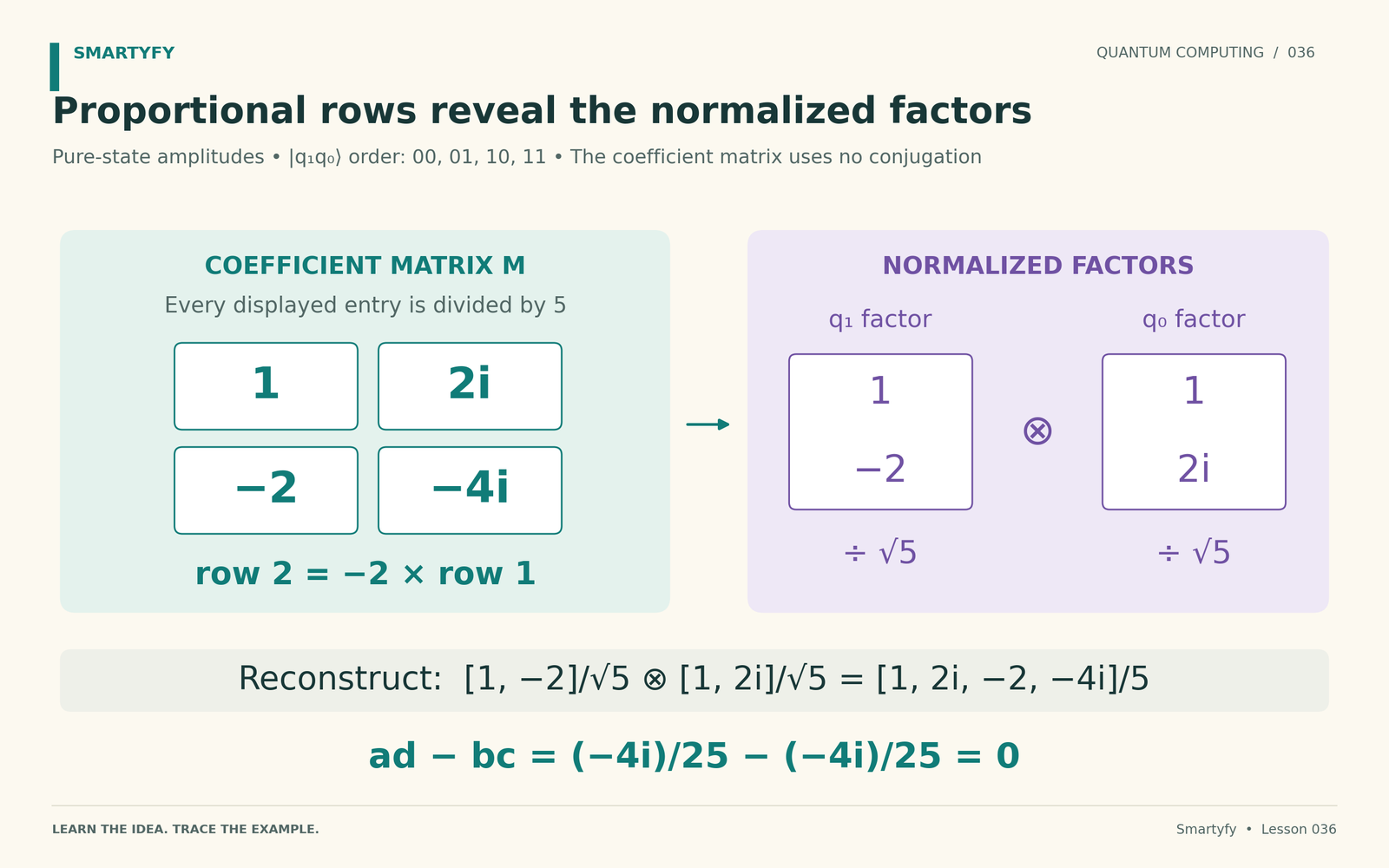
Consider ψ = [1, 2i, −2, −4i]/5. Its squared norm is (1 + 4 + 4 + 16)/25 = 1. The determinant is (−4i)/25 − (−4i)/25 = 0. The second coefficient row is negative twice the first, suggesting first-factor direction [1, −2].
Within the first row, the relative amplitudes are [1, 2i], suggesting the second factor. Both directions have norm √5. Thus ψ = [1, −2]/√5 ⊗ [1, 2i]/√5. Multiplying the normalized factors gives exactly the original four amplitudes.
Verification should include reconstruction, not only a determinant near zero. A factorization with the order reversed would yield [1, −2, 2i, −4i]/5, which is different under fixed subsystem labels. Both expressions are normalized product states, so normalization alone would not catch the ordering error.
Handle zero entries without dividing by them
The state [0, 0, 3, 4i]/5 has a zero first row. It factors immediately as |1⟩ ⊗ [3, 4i]/5. Trying to compute c/a or b/a would divide by zero unnecessarily. Choose a nonzero row or column before forming ratios.
By contrast, [0, 1, 1, 0]/√2 has determinant −1/2. It is not a product. The absence of some amplitudes does not imply separability; their pattern and relationships matter. The all-zero vector also has determinant zero but is excluded because it cannot represent a normalized state.
Local basis changes preserve the answer
Suppose local unitaries U and V transform the two subsystems. The new coefficient matrix is M′ = U M V^T. To check the transpose, the output coefficient at labels r,s is the sum of U_ri M_ij V_sj over i,j. This is exactly the stated matrix product.
Its determinant is det(U)det(M)det(V). Unitary determinants have unit magnitude and are nonzero, so a zero determinant remains zero and a nonzero determinant remains nonzero. Pure-state entanglement cannot be created or removed by local unitary changes of basis.
This also explains why a single probability setting is insufficient. The entangled pure state [1, 1, 1, −1]/2 has uniform computational-basis probabilities. The sign makes its determinant −1/2, even though that one histogram looks independent. Discarding phases before the test would replace the actual state with another model.
Exact mathematics and finite precision
Take ψε = √(1 − ε²)|00⟩ + ε|11⟩ for real ε between zero and one. Its determinant is ε√(1 − ε²), which is nonzero for every strictly interior ε. The state is therefore entangled even when ε is very small. At either endpoint it becomes a product basis state.
A computer represents numbers with finite precision, and an experiment estimates a state with uncertainty. Testing whether a calculated determinant is smaller than a tolerance is a numerical decision rule, not a proof of exact separability. Report the residual and assumptions rather than declaring every tiny nonzero value a physical discovery.
Similarly, a reconstructed density matrix might be mixed because of noise or uncertainty. Applying the pure-vector determinant rule to a selected eigenvector would not classify the full state. A valid conclusion must match the object that was actually supplied or estimated.
Four exercises with worked solutions
-
Factor [2, −2i, 1, −i]/√10.
Solution. The second row is half the first, and each row has internal ratio −i. The factors [2, 1]/√5 and [1, −i]/√2 reproduce all four entries. Their individual norms are one, and the combined denominator is √10.
-
Test [1, 0, 0, 2]/√5 for product structure.
Solution. The determinant is (1/√5)(2/√5) − 0 = 2/5. Since the vector is normalized and pure, the nonzero determinant proves entanglement. Unequal weights do not change that conclusion.
-
Factor [0, 1, 0, i]/√2 without dividing by its first entry.
Solution. Only the q₀ = 1 column is nonzero. Thus the state is [1, i]/√2 ⊗ |1⟩. The factors recover coordinates zero, 1/√2, zero, and i/√2 in order.
-
An experiment randomly prepares 00 or 11 with equal probability. Can its four outcome probabilities be passed into the pure-state determinant test?
Solution. No. This is a mixture of two product preparations and is separable by construction. Treating square roots of its probabilities as coherent amplitudes would invent phase coherence and yield a different, entangled Bell state.
Five explained multiple-choice questions
-
The test ad − bc = 0 is complete here for: A. Every mixed state. B. Arbitrary probability lists. C. Every multipartite system. D. Normalized pure two-qubit vectors.
Answer: D. The specified pure two-qubit coefficient matrix is the object whose rank determines factorization.
-
A zero first amplitude means: A. Choose another nonzero row or column when factoring. B. Always product. C. The state is invalid. D. Always entangled.
Answer: A. Zero entries need careful algebra, not automatic classification.
-
After local unitaries, a product pure state: A. Loses normalization. B. Remains product. C. Must become entangled. D. Becomes zero.
Answer: B. Each factor transforms independently and remains normalized.
-
Uniform computational probabilities establish separability: A. Always. B. Only for complex vectors. C. No. D. Only for four outcomes.
Answer: C. Relative phase can make a uniform-probability pure state entangled.
-
A tiny computed determinant should be interpreted with: A. Numerical and state-estimation uncertainty. B. A claim of exact zero automatically. C. The amplitude magnitudes alone. D. No tolerance discussion.
Answer: A. Finite precision and experimental uncertainty limit exact classification claims.
Pitfalls and summary
State the purity assumption, preserve amplitude phases and subsystem order, and reconstruct any proposed factors. Use the determinant as an exact mathematical criterion for the specified vector, while keeping numerical tolerances and mixed-state questions separate.
Primary sources and further study
These sources support the definitions and context. The numerical examples, exercises, and explanations here were prepared for this lesson. Research papers are optional advanced reading.