AAO Lesson 007: Separate cash movement from period profit
Study baseline: AAO LDCE 2024 notification dated 19 September 2024 and its corrigenda, including 6 November 2024. That examination was scheduled for 8–11 January 2025. The target examination year has not been specified. Check the official notification and amendments for your examination sitting; this is not a claim that the 2024 notice is the current syllabus for a later examination.
AAO · Lesson 007 · English
Separate cash movement from period profit
Study time: about 90 minutes including practice. Prerequisites: AAO-002, AAO-003, AAO-006.
Learning outcomes
- Prepare cash and accrual views from the same evidence without treating financing as income.
- Record receivable, advance, accrued-expense and prepaid-expense adjustments with both account effects.
- Reconcile two consecutive periods and correct double recognition.
1. Two questions can produce two correct numbers
“How much did the bank balance increase?” asks about cash movement. “How much profit did the business earn this month?” asks about the month's income and expenses. A customer can pay after work is completed; an organisation can pay rent before using the premises; an owner can introduce money without earning revenue. A correct answer begins by identifying which question is being asked.
Under the accrual assumptions used in this lesson, income and expense belong to the period in which they arise, rather than automatically to the date cash is received or paid. NCERT explains the revenue-recognition and matching concepts in sections 2.2.7–2.2.8 and discusses cash and accrual bases in section 2.4. Our examples are original simplified service-business cases. Government Accounting Rules 1990, Rule 21, prescribes actual cash receipts and disbursements rather than amounts merely due, while preserving specifically authorised book adjustments. These commercial accrual examples do not replace that government rule. Lesson 009 develops the distinction.
Also distinguish a cash summary from a complete profit statement prepared on any accounting basis. A summary listing every bank receipt and payment includes capital introduced, loans and asset purchases. Its net movement cannot be labelled profit merely by adding the words “cash basis”.
2. Four timing differences, with their other side
| Situation at period end | Period effect | Other account effect | Why |
|---|---|---|---|
| Service earned but not collected | Recognise earned revenue. | A receivable remains. | The right to the stated amount exists although cash will arrive later. |
| Cash received for service not yet performed | Exclude it from earned revenue for this period. | A customer advance liability remains. | The cash has arrived, but the stated service obligation has not been fulfilled. |
| Expense incurred but not paid | Include the expense. | An outstanding-expense liability remains. | Delaying settlement has not removed this period's cost. |
| Payment covering a future period | Charge only the portion used this period. | The unused portion is prepaid expense. | Part of the payment relates to a future benefit. |
These are not instructions to add every possible adjustment to every question. First ask whether the initial records already contain it. If a trial balance already includes an outstanding-expense liability and the correct expense, adding it again duplicates the charge. State the starting point: raw cash records, unadjusted accounts or already adjusted accounts.
3. Worked April case: prepare both views
Original fictional file. Oak Learning Services begins April 2024 with Bank ₹20,000 and proprietor's capital ₹20,000, with no other balances. The following are its only April events. There are no taxes, drawings, bad debts or other costs. Equipment is acquired on the last day; for this short timing exercise, assume no April depreciation or impairment. That simplification is not a general rule that equipment has no depreciation.
| Event | Amount and timing fact |
|---|---|
| Completed and billed services | ₹18,000 earned in April. Customers pay ₹13,000 in April; ₹5,000 remains due. |
| Advance from another customer | ₹6,000 received for work to be performed in May. None is performed in April. |
| Premises rent | ₹9,000 paid on 1 April for April, May and June equally. |
| Staff wages | ₹5,000 paid for April work; a further ₹1,000 for April remains unpaid. |
| Materials | ₹2,400 paid and completely used in April. |
| Equipment | ₹12,000 paid on 30 April; retained as an asset under the stated assumptions. |
| Additional proprietor's capital | ₹10,000 deposited in the business bank account. |
| Loan received | ₹5,000 received from a lender; no April interest is due under the stated exercise terms. |
Step 1: reconstruct cash without deciding profit yet
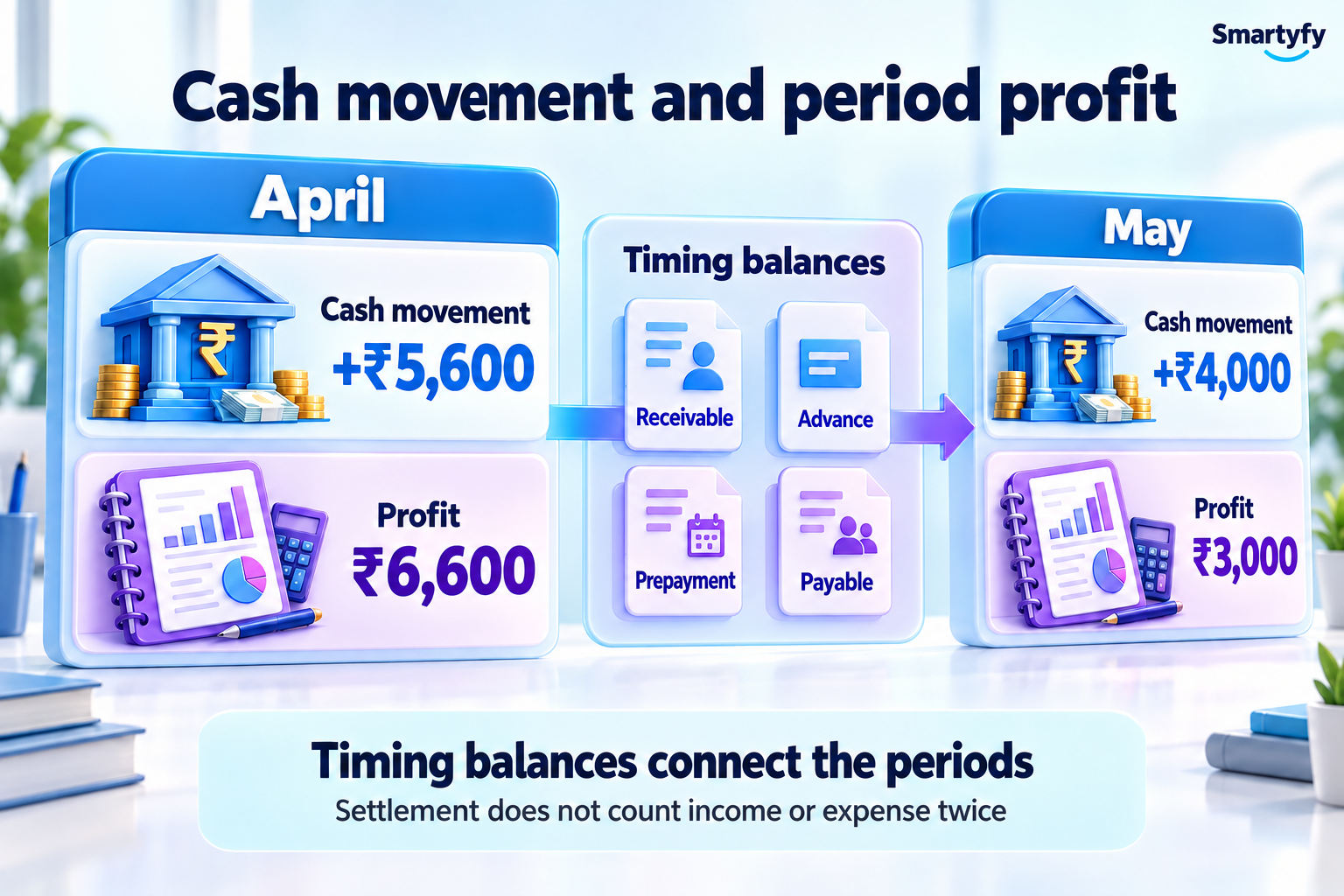
Receipts = 13,000 + 6,000 + 10,000 + 5,000 = ₹34,000. Payments = 9,000 + 5,000 + 2,400 + 12,000 = ₹28,400. Net bank increase = ₹5,600. Closing Bank = 20,000 + 5,600 = ₹25,600.
The capital and loan receipts increase bank funds but are not service revenue. Equipment reduces bank funds but is retained as an asset in this case. Rent payment includes two future months. These facts explain why ₹5,600 is not automatically April profit.
Step 2: identify April income and expense
April revenue is ₹18,000, including the ₹5,000 still receivable. The ₹6,000 May advance is excluded from April revenue. Rent expense is 9,000 ÷ 3 = ₹3,000. Wage expense is 5,000 + 1,000 = ₹6,000. Materials expense is ₹2,400.
| Item | Amount |
|---|---|
| Revenue earned | ₹18,000 |
| Less rent expense | ₹3,000 |
| Less wages expense | ₹6,000 |
| Less materials expense | ₹2,400 |
| Total expense | ₹11,400 |
| April profit | ₹6,600 |
Step 3: show the adjustment entries, not just the final answer
For clarity, initially record the ₹9,000 rent payment as Prepaid rent debit, Bank credit. At April end, debit Rent expense ₹3,000 and credit Prepaid rent ₹3,000. The remaining prepaid asset is ₹6,000.
The completed service is recorded as Receivables debit ₹18,000, Service revenue credit ₹18,000. Its collection is Bank debit ₹13,000, Receivables credit ₹13,000. The separate advance is Bank debit ₹6,000, Customer advances credit ₹6,000. Receiving that advance is not the same event as earning it.
Record paid wages as Wages expense debit ₹5,000, Bank credit ₹5,000. Then record the unpaid April portion as Wages expense debit ₹1,000, Wages payable credit ₹1,000. The payable is the other side of recognising a cost before paying it.
If the full ₹9,000 rent had instead already been charged to Rent expense, the correcting adjustment would be Prepaid rent debit ₹6,000, Rent expense credit ₹6,000. Both starting methods produce the same final expense ₹3,000 and asset ₹6,000. Do not use both adjustments on the same starting records.
Step 4: close the accounting equation
| Assets | Amount | Liabilities and equity | Amount |
|---|---|---|---|
| Bank | ₹25,600 | Loan | ₹5,000 |
| Receivables | ₹5,000 | Wages payable | ₹1,000 |
| Prepaid rent | ₹6,000 | Customer advance | ₹6,000 |
| Equipment | ₹12,000 | Capital introduced: 20,000 + 10,000 | ₹30,000 |
| April profit | ₹6,600 | ||
| Total | ₹48,600 | Total | ₹48,600 |
An omitted adjustment usually affects two places. Forgetting the wages accrual overstates profit by ₹1,000 and understates liabilities by ₹1,000. Charging all rent understates profit and prepaid assets by ₹6,000. An equation that balances does not prove that each period's result is right: a consistently wrong entry can affect both sides.
4. Build a bridge from bank movement to profit
Start with the ₹5,600 bank increase. Remove the ₹10,000 owner's capital and ₹5,000 loan because they are financing receipts. Add back the ₹12,000 equipment payment because it is not an expense under the stated assumptions. This leaves ₹2,600: receipts from customers ₹19,000 less payments for rent, wages and materials ₹16,400.
Now apply the timing differences: add the ₹5,000 earned but uncollected; subtract the ₹6,000 received but unearned; add the ₹6,000 rent paid for future months; subtract the ₹1,000 incurred but unpaid wages. Thus:
5,600 − 10,000 − 5,000 + 12,000 + 5,000 − 6,000 + 6,000 − 1,000 = ₹6,600 profit.
Each sign answers a question. Is something included in cash but excluded from this period's income or expense? Or is something absent from cash but required in this period's result? Do not memorise a list of signs without knowing the starting measure.
5. Follow the same items into May
Assume these are the only May events: collect the outstanding ₹5,000; pay the outstanding April wages ₹1,000; perform all the work covered by the ₹6,000 customer advance; and use May's one-month rent. Continue the exercise's no-depreciation simplification.
| Event | Entry | May profit effect |
|---|---|---|
| Collect April debtor | Bank Dr ₹5,000; Receivables Cr ₹5,000. | None: income was earned in April. |
| Pay April wage liability | Wages payable Dr ₹1,000; Bank Cr ₹1,000. | None: expense was incurred in April. |
| Perform prepaid customer work | Customer advances Dr ₹6,000; Service revenue Cr ₹6,000. | Revenue ₹6,000, with no new cash receipt. |
| Use May rent | Rent expense Dr ₹3,000; Prepaid rent Cr ₹3,000. | Expense ₹3,000, with no new cash payment. |
May bank increase is 5,000 − 1,000 = ₹4,000; May profit is 6,000 − 3,000 = ₹3,000. Closing Bank is ₹29,600. Remaining assets are Bank ₹29,600, Prepaid rent ₹3,000 and Equipment ₹12,000: total ₹44,600. Loan ₹5,000 plus accumulated equity ₹39,600 also totals ₹44,600. Receivables, wages payable and the customer advance are now zero. Recording their settlement as fresh May income or expense would count the same economic item twice.
6. Independent practice and complete solutions
Practice A: reconstruct revenue
Cash collected from service customers is ₹11,000. Opening receivables are ₹2,500 and closing receivables ₹3,500. Opening customer advances are ₹600 and closing advances ₹900. Assume there are no write-offs, refunds or non-service receipts. Find the period's revenue.
Solution. Use changes between opening and closing balances. The receivable increase of ₹1,000 means earned revenue exceeds the related collections by ₹1,000. The advance increase of ₹300 means receipts exceed the related earned revenue by ₹300. Revenue = 11,000 + (3,500 − 2,500) − (900 − 600) = ₹11,700. This does not assume that every opening receivable was collected or every opening advance was earned. Any unchanged amount carried forward is present in both balances and cancels.
Practice B: reconstruct expense
Payments for support services total ₹7,800. Opening expense payable is ₹900 and closing payable ₹1,500. Opening prepayment is ₹1,200 and closing prepayment ₹1,500. No other adjustment applies. Calculate expense and then combine it with Practice A.
Solution. The payable increase of ₹600 adds to the expense represented by cash payments; the prepayment increase of ₹300 removes a net future benefit. Expense = 7,800 + (1,500 − 900) − (1,500 − 1,200) = ₹8,100. Opening balances need not all be settled or used: any balance carried unchanged into closing balances cancels in these differences. Profit = 11,700 − 8,100 = ₹3,600. Cash surplus from the two stated streams is 11,000 − 7,800 = ₹3,200; the net timing adjustment increases the result by ₹400.
Practice C: repair double recognition
A learner correctly recorded Oak's ₹18,000 April revenue and ₹6,000 April wages expense. In May they credit Service revenue for the ₹5,000 debtor collection and debit Wages expense for the ₹1,000 settlement. What is wrong, and how would you correct those two May misclassifications without changing Bank again?
Solution. May revenue is overstated by ₹5,000 and May wages expense by ₹1,000, overstating May profit by ₹4,000. Debit Service revenue ₹5,000 and credit Receivables ₹5,000 to reclassify the wrongly credited collection. Debit Wages payable ₹1,000 and credit Wages expense ₹1,000 to reclassify the wrongly debited settlement. These corrections leave the already recorded Bank entries unchanged and clear the actual outstanding balances.
7. Summary and exam-answer structure
For a numerical answer, show: the period and starting records; a cash summary if required; a schedule of earned income and incurred expense; each adjustment's second account effect; and an independent reconciliation. Capital, borrowing, asset purchase and timing differences should not disappear into an unexplained balancing figure.
Before finishing, ask: have I recognised an item twice across periods? Have I used the right opening and closing balances? Have I confused settlement with earning or consumption? Have I stated any simplification, such as the depreciation assumption? A reasoned answer explains both the amount and why it belongs to that period.