AAO Lesson 018: Route transactions through subsidiary books and post once
AAO · Lesson 018 · English
Route transactions through subsidiary books and post once
Study time: about 100 minutes including practice. Prerequisites: AAO-013, AAO-014, AAO-016.
Learning outcomes
- Route credit goods, immediate-money and own-use-asset transactions correctly.
- Post individual party accounts and periodic book totals once.
- Reconcile control totals and repair duplicate or wrongly routed entries.
1. Choose the book before posting the account
A transaction needs one route into the books and one complete double entry. Using subsidiary books divides repetitive work into useful streams; it does not create extra transactions. This lesson follows lessons 013, 014 and 016. You will classify an invoice, enter its net amount, post individual parties and aggregate accounts, and prove that nothing has been posted twice.
Willow Audio Retail is an original fictional retailer. “Goods” below means merchandise acquired for resale. A computer used by Willow’s own staff is an asset purchase, even though a computer could be merchandise in another business. Read purpose and settlement terms before choosing a book.
Scope. This is commercial book-keeping. There is no VAT or other tax, cash discount, inventory valuation, cost-of-sales calculation or government transaction authority. All returns are accepted and relate to the identified credit goods transactions. October rent is for the completed current month. Opening Bank is ₹25,000, Mira’s receivable ₹4,000 debit, and Atlas’s payable ₹3,000 credit. Other relevant party balances are nil. These are selected balances, not a complete opening trial balance.
The conceptual support is NCERT Financial Accounting I, chapter 4: purchases, section 4.2, printed pages 125–127/PDF 27–29; purchase returns, 4.3, printed 127–129/PDF 29–31; sales, 4.4, printed 129–131/PDF 31–33; sales returns, 4.5, printed 131–132/PDF 33–34; and journal proper, 4.6, printed 139–140/PDF 41–42.
2. Read the complete October transaction set
Use the following 17 events as the source register. Reference numbers other than A101 and S41 are fictional tracking labels supplied for this exercise. Bank settlement means an immediate money movement. A later payment of an invoice settles a liability already recorded; it is not another purchase.
| Date | Event and calculation | Amount | Book of original entry |
|---|---|---|---|
| 2 October | Atlas credit goods A101: 20 × ₹600 less 10% | ₹10,800 | Purchases book |
| 3 October | Goods for resale paid immediately through Bank | ₹2,400 | Cash book, bank payment |
| 4 October | Mira credit sale S41: 12 × ₹1,000 less 5% | ₹11,400 | Sales book |
| 5 October | Computer for Willow’s own use bought on credit from Delta, D05 | ₹9,000 | Journal proper |
| 7 October | Accepted return to Atlas: 2 × ₹540, debit note DN01 | ₹1,080 | Purchase returns book |
| 8 October | Accepted return from Mira: 2 × ₹950, credit note CN01 | ₹1,900 | Sales returns book |
| 10 October | Bank receipt from Mira against her debt | ₹8,000 | Cash book, bank receipt |
| 12 October | Bank payment to Atlas against its payable | ₹7,000 | Cash book, bank payment |
| 14 October | Immediate merchandise sale settled through Bank | ₹3,600 | Cash book, bank receipt |
| 16 October | Beryl credit goods B16: 6 × ₹500 | ₹3,000 | Purchases book |
| 18 October | Nila credit sale S42: 4 × ₹800 | ₹3,200 | Sales book |
| 20 October | Furniture for Willow’s own use paid through Bank | ₹4,500 | Cash book, bank payment |
| 22 October | Accepted Beryl return: 1 × ₹500, DN02 | ₹500 | Purchase returns book |
| 24 October | Accepted Nila return: 1 × ₹800, CN02 | ₹800 | Sales returns book |
| 27 October | Bank payment to Delta against computer payable | ₹4,000 | Cash book, bank payment |
| 28 October | Bank receipt from Nila against her debt | ₹1,000 | Cash book, bank receipt |
| 30 October | Pay completed October rent through Bank | ₹1,200 | Cash book, bank payment |
Atlas’s list amount is ₹12,000; the ₹1,200 trade reduction leaves ₹10,800. Mira’s list amount is ₹12,000; the ₹600 reduction leaves ₹11,400. The credit books record these net invoice amounts. The reductions are not separate cash-discount entries. Returns reverse the original net unit price: ₹540 for Atlas and ₹950 for Mira, rather than their list prices.
3. Prepare four distinct credit registers
The rows below are the actual subsidiary-book entries. The wider source register above is a teaching aid and is not an additional posting book. Retain each invoice or return reference so the individual party posting can be checked against the later total.
| Date | Invoice | Supplier to credit | Net amount |
|---|---|---|---|
| 2 October | A101 | Atlas | ₹10,800 |
| 16 October | B16 | Beryl | ₹3,000 |
| 31 October total | Debit Purchases once | ₹13,800 |
| Date | Invoice | Customer to debit | Net amount |
|---|---|---|---|
| 4 October | S41 | Mira | ₹11,400 |
| 18 October | S42 | Nila | ₹3,200 |
| 31 October total | Credit Sales once | ₹14,600 |
| Date | Debit note | Supplier to debit | Amount |
|---|---|---|---|
| 7 October | DN01 | Atlas | ₹1,080 |
| 22 October | DN02 | Beryl | ₹500 |
| 31 October total | Credit Purchase Returns once | ₹1,580 |
| Date | Credit note | Customer to credit | Amount |
|---|---|---|---|
| 8 October | CN01 | Mira | ₹1,900 |
| 24 October | CN02 | Nila | ₹800 |
| 31 October total | Debit Sales Returns once | ₹2,700 |
A return note supports an adjustment to the debt. It does not show a cash refund in this case. Each accepted supplier return reduces what Willow owes, so debit the supplier. Each accepted customer return reduces what the customer owes, so credit the customer.
4. Understand why the individual and total postings differ
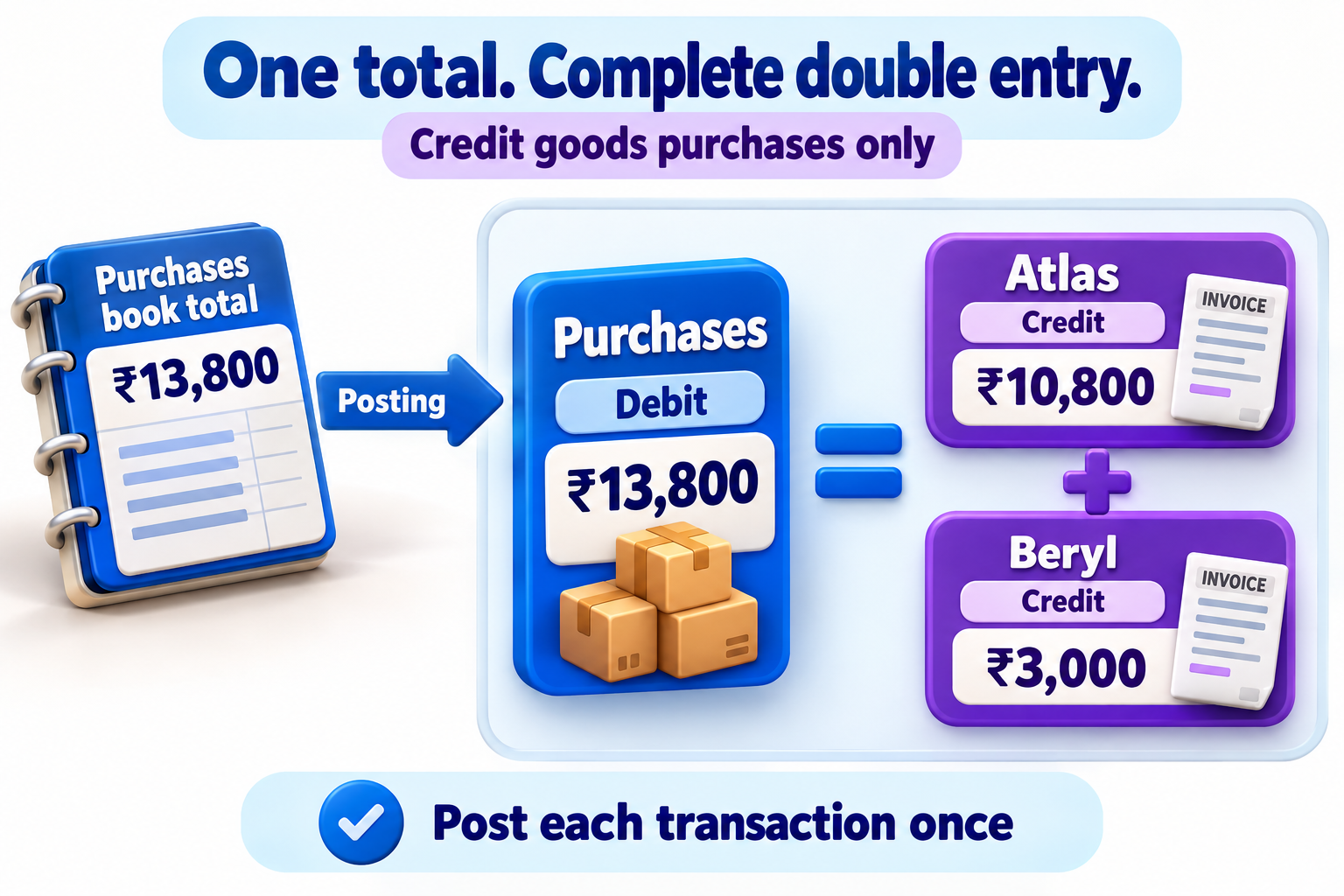
For A101, Atlas needs a ₹10,800 credit to increase its liability. Beryl needs a ₹3,000 credit for its invoice. Together these are the credit side of ₹13,800 of merchandise purchases. The matching debit is the purchases-book total posted once to Purchases. Do not additionally debit Purchases for each invoice after posting that total.
The illustration therefore links Purchases debit ₹13,800 with Atlas credit ₹10,800 plus Beryl credit ₹3,000. It deliberately excludes the ₹2,400 immediate Bank purchase, which takes the cash-book route. “Post once” means complete both aspects once, not omit one side of double entry.
| Book | Individual party entries | Single aggregate counterpart |
|---|---|---|
| Purchases | Atlas credit ₹10,800; Beryl credit ₹3,000 | Purchases debit ₹13,800 |
| Sales | Mira debit ₹11,400; Nila debit ₹3,200 | Sales credit ₹14,600 |
| Purchase returns | Atlas debit ₹1,080; Beryl debit ₹500 | Purchase Returns credit ₹1,580 |
| Sales returns | Mira credit ₹1,900; Nila credit ₹800 | Sales Returns debit ₹2,700 |
Customer debits record new receivables from credit sales. Sales is credited for the combined revenue. Purchase Returns is credited because the returns reduce the purchase measure; Sales Returns is debited because customer returns reduce the sales measure. Separate return accounts preserve the gross transaction and return trail.
In the journal proper on 5 October, debit Computer ₹9,000 and credit Delta ₹9,000. Computer records the own-use asset; Delta records the unpaid amount. Neither Purchases nor Bank belongs in that entry. When Delta later receives ₹4,000, debit Delta and credit Bank. Do not acquire the same computer a second time.
5. Complete the dated bank route
The cash book’s bank column already records the Bank side. Post each outside counterpart shown below once. The running balance provides an independent arithmetic check; it is not another ledger to post on top of the cash book.
| Date | Counterpart and its posting | Bank debit receipt | Bank credit payment | Bank balance debit |
|---|---|---|---|---|
| 1 October | Opening balance | 25,000 opening | — | 25,000 |
| 3 October | Purchases debit | — | 2,400 | 22,600 |
| 10 October | Mira credit | 8,000 | — | 30,600 |
| 12 October | Atlas debit | — | 7,000 | 23,600 |
| 14 October | Sales credit | 3,600 | — | 27,200 |
| 20 October | Furniture debit | — | 4,500 | 22,700 |
| 27 October | Delta debit | — | 4,000 | 18,700 |
| 28 October | Nila credit | 1,000 | — | 19,700 |
| 30 October | Rent expense debit | — | 1,200 | 18,500 |
| October movements | Opening excluded | 12,600 | 19,100 | 18,500 closing |
Check ₹25,000 + ₹12,600 − ₹19,100 = ₹18,500. For a two-sided cash-book balance, receipts including opening total ₹37,600. Payments ₹19,100 plus balance c/d ₹18,500 also total ₹37,600. The c/d figure is retained Bank money, not an expense or an additional payment to a supplier.
6. Read each party account chronologically
A balance column labelled Dr or Cr makes the direction explicit. Supplier payments and purchase returns are debits because they reduce liabilities. Customer receipts and sales returns are credits because they reduce receivables. Do not confuse the business’s ledger with an account statement written from the other party’s viewpoint.
| Party | Date and entry | Debit | Credit | Running balance |
|---|---|---|---|---|
| Atlas | 1 October opening | — | 3,000 | 3,000 Cr |
| Atlas | 2 October Purchases A101 | — | 10,800 | 13,800 Cr |
| Atlas | 7 October Purchase Returns DN01 | 1,080 | — | 12,720 Cr |
| Atlas | 12 October Bank | 7,000 | — | 5,720 Cr |
| Beryl | 16 October Purchases B16 | — | 3,000 | 3,000 Cr |
| Beryl | 22 October Purchase Returns DN02 | 500 | — | 2,500 Cr |
| Delta | 5 October Computer D05 | — | 9,000 | 9,000 Cr |
| Delta | 27 October Bank | 4,000 | — | 5,000 Cr |
| Party | Date and entry | Debit | Credit | Running balance |
|---|---|---|---|---|
| Mira | 1 October opening | 4,000 | — | 4,000 Dr |
| Mira | 4 October Sales S41 | 11,400 | — | 15,400 Dr |
| Mira | 8 October Sales Returns CN01 | — | 1,900 | 13,500 Dr |
| Mira | 10 October Bank | — | 8,000 | 5,500 Dr |
| Nila | 18 October Sales S42 | 3,200 | — | 3,200 Dr |
| Nila | 24 October Sales Returns CN02 | — | 800 | 2,400 Dr |
| Nila | 28 October Bank | — | 1,000 | 1,400 Dr |
Combined listed payables are ₹5,720 + ₹2,500 + ₹5,000 = ₹13,220. Independently, opening ₹3,000 + credit merchandise ₹13,800 + credit computer ₹9,000 − purchase returns ₹1,580 − supplier payments ₹11,000 = ₹13,220. Including Delta here is correct even though its computer invoice does not belong in the purchases book.
Receivables are ₹5,500 + ₹1,400 = ₹6,900. The separate proof is opening ₹4,000 + credit sales ₹14,600 − sales returns ₹2,700 − debt collections ₹9,000 = ₹6,900. The immediate ₹3,600 sale does not create a continuing customer receivable.
7. Distinguish book totals from ledger totals
The Purchases ledger receives ₹13,800 from the purchases book and ₹2,400 from the cash book, giving ₹16,200 debit. Net purchases after ₹1,580 returns are ₹14,620. The Sales ledger receives ₹14,600 from the sales book and ₹3,600 from the cash book, giving ₹18,200 credit. Net sales after ₹2,700 returns are ₹15,500.
These measures answer different questions. “Credit purchases-book total” means ₹13,800; “total merchandise purchases recorded” means ₹16,200. Neither includes the computer or furniture. Bank payments to Atlas and Delta settle liabilities and cannot be added again to either purchase measure.
Do not report ₹15,500 − ₹14,620 as gross profit. Net purchases do not establish the cost of goods sold without the required inventory and other cost information. The selected balances also do not establish a complete trial balance or overall profit.
8. Correct only the effect proved wrong
Computer misclassified. Suppose the ₹9,000 computer was wrongly debited to Purchases, while Delta was credited correctly. Debit Computer ₹9,000 and credit Purchases ₹9,000. Delta is already right, and no Bank movement occurred on acquisition. A second credit to Delta would double the liability.
Duplicate invoice. Suppose A101 was recorded and posted twice. Purchases becomes wrongly ₹27,000 instead of ₹16,200, and Atlas’s closing credit becomes ₹16,520 instead of ₹5,720. Debit Atlas ₹10,800 and credit Purchases ₹10,800. Reference the duplicated invoice; do not reverse the genuine original as well.
Settlement treated as purchase. Suppose the ₹7,000 payment to Atlas correctly credited Bank but wrongly debited Purchases. Debit Atlas ₹7,000 and credit Purchases ₹7,000. Bank needs no further entry because the real payment is already recorded. Each correction compares the actual wrong effect with the required effect, rather than replaying the whole transaction.
9. Five graded exercises with full solutions
Exercise A Net invoice and return 4 marks
Credit goods comprise 15 units at ₹800 less 20% trade discount. Three units are accepted back at the same net price. Find the invoice, return and remaining invoice liability before payment.
Answer: net unit price ₹800 × 80% = ₹640 (1 mark). Invoice ₹640 × 15 = ₹9,600 (1); return ₹640 × 3 = ₹1,920 (1); remaining ₹7,680 (1). Credit the supplier for the invoice and debit it for the return. The trade reduction is already built into both amounts.
Exercise B Combine two routes 3 marks
Credit sales are ₹24,600, immediate cash sales ₹5,400 and total accepted sales returns ₹1,200. Find total Sales credits and net sales.
Answer: total Sales credits are ₹24,600 + ₹5,400 = ₹30,000 (1 mark); net sales are ₹30,000 − ₹1,200 = ₹28,800 (1). The cash sales arrive through the cash book, so they are excluded from the credit sales book but included in the Sales ledger (1). No profit figure follows.
Exercise C Find a missing aggregate effect 5 marks
Verified credit-sales invoices and correctly posted customer debits total ₹9,000. Sales was credited only ₹8,000. Identify the missing effect and explain what must not be invented.
Answer: Sales lacks a ₹1,000 credit (1 mark). The customers already carry their complete ₹9,000 debits (1), so do not debit them another ₹1,000 (1). Correct the omitted or short aggregate Sales posting with its original-book reference (1). No Suspense balance or other counterpart is given; do not invent a new two-sided journal involving an arbitrary account (1). If a real system has already used Suspense, its established records must be inspected before prescribing that system’s rectification entry.
Exercise D Separate collection from revenue 4 marks
A ₹900 Bank receipt from Mira was correctly debited to Bank but wrongly credited to Sales. It was settlement of an existing debt. Give the correction and reason.
Answer: debit Sales ₹900 and credit Mira ₹900 (2 marks). The debit removes revenue that this collection did not earn, and the credit reduces the existing receivable (1). Bank is already correct and remains untouched (1). Crediting Sales again would increase the original error.
Exercise E Classify before calculating 4 marks
A retailer buys an own-use office asset for ₹6,000 on credit. A clerk proposes entering it in the purchases book because the invoice says “purchase.” Choose the correct route and entry.
Answer: use journal proper because this is an own-use asset bought on credit (1 mark). Debit the appropriate asset ₹6,000 and credit its supplier ₹6,000 (2). The purchases book is for credit merchandise under this lesson’s convention; the invoice’s everyday wording does not decide account classification (1).
10. Two multiple-choice checks
MCQ 1. Which amount is Willow’s purchases-book total? A. ₹13,800. B. ₹16,200. C. ₹22,800. D. ₹14,620.
Answer: A. B includes the immediate Bank purchase, C adds the own-use computer to credit merchandise, and D is net purchases after combining routes and deducting returns. Each distractor answers a different question or misclassifies an asset.
MCQ 2. How is the ₹2,700 sales-returns total posted? A. Credit Sales Returns and debit customers. B. Debit Sales Returns and credit the individual customers. C. Debit Bank and credit Sales. D. Debit customers and credit Sales again.
Answer: B. Customer credits reduce receivables; the aggregate debit records the return measure. A reverses the required direction. C invents a Bank receipt. D repeats the sale rather than recording its accepted return.
11. A structured model answer
Question, 10 marks: “Explain Willow’s subsidiary-book postings and reconcile selected closing balances.”
- Classification, 2 marks: restrict the four credit books to the relevant merchandise invoices and accepted returns; send immediate Bank events to the cash book and the credit computer to journal proper.
- Totals and directions, 3 marks: Purchases debit ₹13,800 against supplier credits; Sales credit ₹14,600 against customer debits; Purchase Returns credit ₹1,580 against supplier debits; Sales Returns debit ₹2,700 against customer credits. Post each aspect once.
- Selected balances, 3 marks: Bank ₹18,500 debit; Atlas ₹5,720, Beryl ₹2,500 and Delta ₹5,000 credit; Mira ₹5,500 and Nila ₹1,400 debit. Show the dated entries supporting them.
- Proof and limit, 2 marks: reconcile payables ₹13,220 and receivables ₹6,900 independently. Distinguish Purchases ledger ₹16,200 and Sales ledger ₹18,200 from credit-book totals. Do not claim gross profit or a complete trial balance.
Final self-check: every invoice has one route, every party posting has evidence, every total has the correct side, and every settlement changes an existing balance. Those checks catch errors that equal debit and credit totals alone may miss.