AAO Lesson 028: Record asset disposal and reconcile the retained asset register
AAO · Lesson 028 · English
Record asset disposal and reconcile the retained asset register
Study time: about 110 minutes including practice. Prerequisites: AAO-026, AAO-012, AAO-020.
Learning outcomes
- Calculate depreciation to the relevant cessation date from stated availability and disposal facts.
- Remove original cost and accumulated depreciation, then compare net proceeds with carrying amount.
- Reconcile disposed and retained assets without recording proceeds as ordinary sales revenue.
1. Disposal is a sequence, not a subtraction from cost
An equipment sale has at least three distinct numbers: original cost, carrying amount at the relevant date and net disposal proceeds. A sound answer first brings depreciation up to the appropriate cessation date, then removes the sold item’s cost and its accumulated depreciation, then measures the gain or loss. The cash receipt alone does not identify profit.
Scope. These original fictional cases use commercial accrual accounts and administrative equipment under the cost model. Straight-line calculations use equal-month apportionment. There are no changes in estimates, impairment, revaluation, taxes, replacement components, financing elements or unreported sale costs unless expressly stated. These are ordinary disposals of owned equipment, not sale-and-leaseback or the routine sale of assets previously rented to customers. Selected AS 10 treatment is stipulated as bookkeeping instruction under the dated AAO-2024 baseline, not as a rule for government cash accounts.
The central discipline is asset identity. Removing the correct amount from the total control account is impossible unless the register identifies which item’s cost and accumulated depreciation belong to the sale. The other equipment must remain in the books.
2. Read the dated asset register
Brookfield Office Support has two administrative units on 1 April 2023. Their prior depreciation is correct and fully posted. Unit A remains in active use until its completed disposal at the close of 30 September 2023. There is no earlier retirement-and-held-for-disposal date. Delivery and acceptance are completed that day; the case stipulates that disposal recognition conditions are met then.
The buyer pays ₹48,000 into Bank on 30 September. Brookfield separately pays ₹2,250 directly attributable selling costs that day. On 1 October 2023, it purchases Unit C for ₹48,000 cash; C is immediately available for use. Unit B continues throughout the year. The financial year ends 31 March 2024.
| Unit | Available from | Cost | Residual | Life | Annual charge | Accumulated depreciation at 1 April 2023 |
|---|---|---|---|---|---|---|
| A, later sold | 1 April 2020 | ₹90,000 | ₹9,000 | 6 years | ₹13,500 | ₹40,500: three full years |
| B, retained | 1 April 2022 | ₹60,000 | ₹6,000 | 6 years | ₹9,000 | ₹9,000: one full year |
| C, new this year | 1 October 2023 | ₹48,000 | ₹0 | 4 years | ₹12,000 | Not present at opening |
At opening, cost is ₹1,50,000 and accumulated depreciation ₹49,500, giving carrying amount ₹1,00,500. A contributes ₹49,500 carrying amount; B contributes ₹51,000. Notice that A’s carrying amount happens to equal the combined accumulated-depreciation balance. Equal numbers can refer to different things, so label each one instead of relying on recognition.
3. Charge the correct periods before removing anything
Unit A’s current-year charge is ₹13,500 × 6/12 = ₹6,750 for April–September. Its accumulated depreciation at disposal is ₹40,500 + ₹6,750 = ₹47,250. Its carrying amount is therefore ₹90,000 − ₹47,250 = ₹42,750. The old ₹9,000 residual was an estimate at the originally expected end of useful life; it is not substituted for carrying amount when the asset is sold earlier.
| Unit | 2023–24 period | Charge | Accumulated amount after charge | Destination |
|---|---|---|---|---|
| A | 6 months to 30 September | ₹6,750 | ₹47,250 | Entire cost and accumulated amount removed on disposal |
| B | 12 months | ₹9,000 | ₹18,000 | Retained; carrying amount ₹42,000 |
| C | 6 months from 1 October | ₹6,000 | ₹6,000 | Retained; carrying amount ₹42,000 |
| Total current expense | Three different time windows | ₹21,750 | Do not retain A’s amount | Closing retained carrying amount ₹84,000 |
The sale does not remove A’s ₹6,750 current expense from profit and loss. That expense records its service before disposal. Removing accumulated depreciation from the balance sheet is a separate step that clears the sold asset’s associated credit balance.
4. Compare net proceeds with updated carrying amount
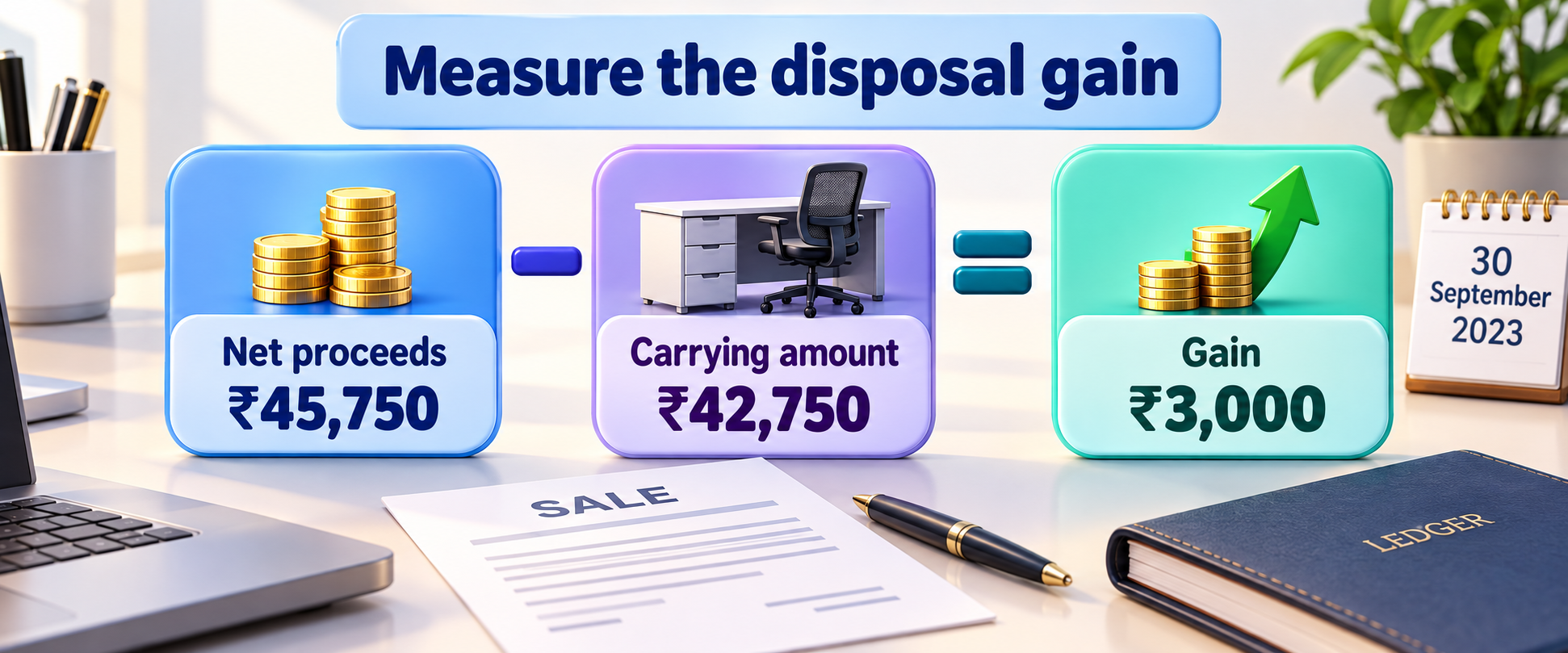
Net disposal proceeds are ₹48,000 − ₹2,250 = ₹45,750. Compare that with carrying amount ₹42,750: gain ₹3,000. Brookfield receives ₹48,000 cash from the buyer, but only ₹3,000 is the gain after the selling cost and removal of the remaining asset value.
| Step | Amount |
|---|---|
| Original cost | ₹90,000 |
| Less accumulated depreciation through cessation | ₹47,250 |
| Carrying amount removed | ₹42,750 |
| Gross proceeds less selling costs | ₹48,000 − ₹2,250 = ₹45,750 |
| Net proceeds less carrying amount | ₹45,750 − ₹42,750 = ₹3,000 gain |
Subtracting net proceeds from original cost would suggest a ₹44,250 loss. It would count ₹47,250 already allocated as depreciation as though that amount remained unrecognised. Comparing proceeds with the stale 1 April carrying amount would instead report a ₹3,750 loss and conceal the missing final depreciation.
The ₹3,000 gain belongs in profit and loss as a disposal result in this stipulated ordinary equipment case, not as ₹48,000 ordinary sales revenue. The distinction matters for both gross-profit analysis and the audit trail.
5. Chronological journals through an asset-disposal account
The disposal account is a temporary clearing account that gathers the sold item’s amounts. It must close to zero. We record the actual gross receipt and separate selling-cost payment because that is how Bank moved; do not replace them with a fictitious single bank transaction.
| Date/ref | Debit | Credit | Purpose |
|---|---|---|---|
| 30 September J1 | Depreciation expense ₹6,750 | Accumulated depreciation ₹6,750 | Bring A’s depreciation to its cessation date |
| 30 September J2 | Asset disposal ₹90,000 | Equipment cost ₹90,000 | Remove A’s original cost, not its net value |
| 30 September J3 | Accumulated depreciation ₹47,250 | Asset disposal ₹47,250 | Clear only A’s associated accumulated amount |
| 30 September J4 | Bank ₹48,000 | Asset disposal ₹48,000 | Record buyer’s payment |
| 30 September J5 | Asset disposal ₹2,250 | Bank ₹2,250 | Record directly attributable selling cost once |
| 30 September J6 | Asset disposal ₹3,000 | Profit and loss: disposal gain ₹3,000 | Close the gain, leaving disposal account nil |
| 1 October J7 | Equipment cost ₹48,000 | Bank ₹48,000 | Recognise new C separately from selling A |
| 31 March J8 | Depreciation expense ₹9,000 | Accumulated depreciation ₹9,000 | B’s full year |
| 31 March J9 | Depreciation expense ₹6,000 | Accumulated depreciation ₹6,000 | C’s six months |
| 31 March J10 | Profit and loss ₹21,750 | Depreciation expense ₹21,750 | Close all three expense segments once |
Buying C does not reduce the gain on A. An old asset’s disposal and a new asset’s acquisition are different transactions even when their gross cash amounts happen to match. Likewise, J5 already includes the ₹2,250 selling cost in the gain calculation; charging it again as another P&L expense would understate profit.
6. Actual ledger proof: leave only the retained assets
| Debit side | Amount | Credit side | Amount |
|---|---|---|---|
| 1 April Balance b/d | ₹1,50,000 | 30 September Asset disposal: A | ₹90,000 |
| 1 October Bank: C | ₹48,000 | 31 March Balance c/d: B + C | ₹1,08,000 |
| Total | ₹1,98,000 | Total | ₹1,98,000 |
| Debit side | Amount | Credit side | Amount |
|---|---|---|---|
| 30 September Asset disposal: A | ₹47,250 | 1 April Balance b/d | ₹49,500 |
| 31 March Balance c/d: B + C | ₹24,000 | 30 September Depreciation: A | ₹6,750 |
| — | — | 31 March Depreciation: B and C | ₹15,000 |
| Total | ₹71,250 | Total | ₹71,250 |
| Debit side | Amount | Credit side | Amount |
|---|---|---|---|
| Equipment cost | ₹90,000 | Accumulated depreciation | ₹47,250 |
| Bank: selling cost | ₹2,250 | Bank: gross receipt | ₹48,000 |
| Profit and loss: gain | ₹3,000 | — | — |
| Total | ₹95,250 | Total | ₹95,250 |
Depreciation expense has debits ₹6,750, ₹9,000 and ₹6,000 against a closing credit to P&L of ₹21,750: both sides total ₹21,750 and the account closes. On 1 April 2024, Equipment cost is brought down debit ₹1,08,000 and Accumulated depreciation credit ₹24,000. Disposal and Depreciation expense are both zero.
Independently reconcile net carrying amount: opening ₹1,00,500 + additions ₹48,000 − current depreciation ₹21,750 − carrying amount disposed ₹42,750 = closing ₹84,000. Then check the remaining register: B ₹60,000 − ₹18,000 = ₹42,000; C ₹48,000 − ₹6,000 = ₹42,000. These two independent paths agree.
Do not put proceeds ₹45,750 into the asset roll-forward in place of carrying amount disposed ₹42,750. Proceeds explain the bank movement and gain. The roll-forward explains what left the equipment balance.
7. A closed miniature set of accounts
To test every counterpart, isolate the asset transactions above. Assume opening Bank ₹50,000 and no other assets, liabilities or transactions in this miniature check. Opening capital is therefore ₹50,000 + ₹1,00,500 = ₹1,50,500. This is a checking case, not a claim that a real service business has no revenue or other expenses.
| Debit side | Amount | Credit side | Amount |
|---|---|---|---|
| 1 April Balance b/d | ₹50,000 | 30 September Disposal selling cost | ₹2,250 |
| 30 September Disposal receipt | ₹48,000 | 1 October Equipment C | ₹48,000 |
| — | — | 31 March Balance c/d | ₹47,750 |
| Total | ₹98,000 | Total | ₹98,000 |
P&L has depreciation debit ₹21,750 and disposal gain credit ₹3,000, leaving loss ₹18,750. Transfer it by debit Capital and credit Profit and loss ₹18,750. P&L then totals ₹21,750 on each side. Closing capital is ₹1,31,750, exactly closing Bank ₹47,750 + retained equipment ₹84,000. The cash reduction is only ₹2,250; the accounting loss is ₹18,750. Their difference is explained by the asset movements, not by an omitted bank entry.
8. Cessation can precede sale
Separate case: Lark Services has equipment costing ₹50,000 with accumulated depreciation ₹20,000 on 1 April 2023. Its valid unchanged time-based schedule charges ₹10,000 per year. At the close of 30 June it is retired from active use and held for disposal. It is sold on 30 September. There is no earlier relevant cessation date.
Depreciation is three months, ₹2,500, giving accumulated depreciation ₹22,500 and carrying amount ₹27,500 at retirement. The net realisable value at 30 June is stipulated as ₹30,000, so the retirement measurement does not require a write-down. Gross proceeds on 30 September are ₹32,000 and selling costs ₹1,000: net ₹31,000. The disposal gain is ₹31,000 − ₹27,500 = ₹3,500.
Charging until September would wrongly add a further ₹2,500 depreciation and then report a ₹6,000 gain. The combined full-period net effect would coincidentally remain ₹1,000 income, but both depreciation and disposal gain would be misstated. An overall profit tie-out cannot replace the dated cessation test.
Temporary idleness is different. If Lark merely paused work in June while keeping the asset available and did not retire it and hold it for disposal, the stated time-based schedule would not stop merely because output paused. Document both the asset’s status and the relevant dates. Retirement-and-held-for-disposal also requires a separate lower-carrying-amount/net-realisable-value check; stopping depreciation does not guarantee the former carrying amount is recoverable.
Boundary worth retaining. The ordinary-disposal presentation used above is not universal. AS 10 paragraph 76 addresses an enterprise that routinely sells assets previously held for rental in its ordinary activities; those circumstances have a different inventory/revenue treatment. Sale-and-leaseback also needs its relevant rules. Neither exception is present in Brookfield or Lark.
9. Graded practice and complete solutions
- Loss variant. Keep Brookfield’s A dates and selling costs, but change gross sale proceeds to ₹43,000. Find net proceeds, gain or loss and the closing disposal transfer.
- Missing final depreciation. A clerk omits A’s ₹6,750 final charge, removes only ₹40,500 accumulated depreciation and reports a ₹3,750 disposal loss. Diagnose both errors. Would the combined P&L effect of A alone necessarily reveal them?
- Wrong asset identity. After all current depreciation is posted correctly, the clerk clears ₹49,500 accumulated depreciation on selling A instead of ₹47,250. Find the wrong closing accumulated depreciation, carrying amount and disposal gain.
- Retirement measurement. In a separate Lark variant, net realisable value at 30 June is ₹25,000 rather than ₹30,000. Find the retirement write-down and the amount retained for disposal immediately afterwards.
- Next-year retained register. Assume B and C remain available throughout 2024–25 with unchanged estimates and no other movements. Find each charge, combined depreciation and carrying amounts at 31 March 2025.
- No proceeds. An unrelated administrative asset has cost ₹40,000 and accumulated depreciation ₹28,000, already updated to the proper cessation date. It is abandoned and no future benefits are expected from use or disposal. There are no proceeds or costs. Give the carrying amount removed and a balanced direct derecognition entry.
Answers
1. Net proceeds ₹43,000 − ₹2,250 = ₹40,750. Carrying amount remains ₹42,750, so loss is ₹2,000. After the cost, accumulated depreciation, receipt and costs have been transferred, close by debit Profit and loss ₹2,000 and credit Asset disposal ₹2,000. A loss needs a credit to clear the disposal account’s remaining debit balance.
2. Required accumulated depreciation was ₹47,250 and required gain ₹3,000. The clerk understates expense by ₹6,750 and understates the disposal result by ₹6,750, changing a ₹3,000 gain into a ₹3,750 loss. Correct A-only effect is expense ₹6,750 less gain ₹3,000 = ₹3,750 net expense; the wrong loss alone is also ₹3,750. Total profit can coincide despite wrong period expense, gain classification and asset history.
3. Correct pre-removal accumulated depreciation is ₹49,500 + ₹21,750 = ₹71,250. Removing ₹49,500 leaves ₹21,750 instead of ₹24,000. Cost remains ₹1,08,000, so wrong carrying amount is ₹86,250 instead of ₹84,000. Excess disposal credit ₹2,250 inflates the gain to ₹5,250. Repair by debit the disposal gain/P&L and credit Accumulated depreciation ₹2,250, preserving the appropriate account-closing state.
4. The correctly updated carrying amount is ₹27,500. The lower stipulated net realisable value is ₹25,000, requiring a ₹2,500 write-down recognised in P&L and a retained disposal amount of ₹25,000. This is separate from the ₹2,500 depreciation to June. Do not keep charging monthly depreciation as a substitute for the retirement measurement.
5. B charges ₹9,000, leaving ₹42,000 − ₹9,000 = ₹33,000. C charges ₹12,000 for its first full reporting year, leaving ₹42,000 − ₹12,000 = ₹30,000. Combined depreciation is ₹21,000 and carrying amount ₹63,000. A contributes nothing: its cost and accumulated depreciation were removed in September 2023.
6. Carrying amount is ₹12,000. Debit Accumulated depreciation ₹28,000; debit Loss on derecognition ₹12,000; credit Equipment cost ₹40,000. Debits equal credits and both asset-related balances are cleared. No Bank entry is invented. The loss account is then closed to P&L in the chosen bookkeeping system.
10. Objective checks, model answer and final controls
A. Brookfield’s main-case gain is: (a) ₹48,000; (b) ₹5,250; (c) ₹3,000; (d) a ₹3,750 loss.
Answer: (c). Net proceeds ₹45,750 less updated carrying amount ₹42,750 gives ₹3,000. (a) calls the gross receipt profit; (b) omits selling costs; (d) omits final depreciation before calculating the result.
B. In Lark’s main case, time-based depreciation stops at: (a) the first day with no output, whatever the reason; (b) 30 September because cash arrives then; (c) 31 March because accounts close then; (d) 30 June, when it is retired from active use and held for disposal.
Answer: (d). Both status conditions are expressly met in June, before derecognition on sale. (a) confuses idleness with cessation; (b) automatically equates the bank date with the depreciation endpoint; (c) ignores the asset’s dated status.
Written prompt. Explain Brookfield’s disposal and demonstrate that the retained equipment is correct.
Model answer. A’s six-month charge is ₹6,750, bringing its accumulated depreciation to ₹47,250 and carrying amount to ₹42,750. Net proceeds are ₹48,000 less ₹2,250 selling costs, or ₹45,750, so the disposal gain is ₹3,000. Remove cost ₹90,000 and accumulated depreciation ₹47,250, record the actual receipt and cost payment, and close the disposal account to P&L. The remaining cost control is ₹1,50,000 + ₹48,000 − ₹90,000 = ₹1,08,000. Accumulated depreciation is ₹49,500 + ₹21,750 − ₹47,250 = ₹24,000. Net equipment ₹84,000 agrees with retained B ₹42,000 and C ₹42,000. The disposal result and new acquisition are recorded separately.
- Verify identity, status, cessation and disposal dates.
- Update depreciation before measuring carrying amount.
- Use net proceeds and count selling costs once.
- Remove the sold item’s cost and accumulated depreciation, not the whole control account.
- Close the disposal account and reconcile the retained register independently.
Source checks. Original cases and journals use the asset-disposal-account foundation in NCERT Chapter 7, section 7.9.1, printed pages 251–252 / PDF pages 26–27. The dated cessation, retirement measurement and ordinary disposal boundaries are checked against ICAI AS 10, paragraphs 57, 73–77 and 79–81. The retained rental-asset and sale-and-leaseback exceptions prevent treating the main-case presentation as a universal revenue rule.