AAO Lesson 003: Build journal entries, ledger balances and a first trial balance
Study baseline: AAO LDCE 2024 notification dated 19 September 2024 and its corrigenda, including 6 November 2024. That examination was scheduled for 8–11 January 2025. The target examination year has not been specified. Check the official notification and amendments for your examination sitting; this is not a claim that the 2024 notice is the current syllabus for a later examination.
AAO • Lesson 003 • English
Build journal entries, ledger balances and a first trial balance
Study time: about 85 minutes, including practice. Prerequisites: AAO-002.
Learning outcomes:
- Use debit and credit according to account type and direction of change.
- Journalise the eight transactions from Lesson 002 and derive closing balances.
- Prepare a balanced trial balance and identify an error it cannot reveal.
1. Debit and credit are positions, not judgements
A debit is an entry on the left side of an account; a credit is an entry on the right. Neither word inherently means good, bad, money received or money paid. Whether an increase is a debit or a credit depends on the type of account. This lesson uses the asset–liability–equity approach rather than switching between different mnemonic systems.
| Account type | Increase | Decrease | Usual balance |
|---|---|---|---|
| Assets | Debit | Credit | Debit |
| Liabilities | Credit | Debit | Credit |
| Capital / equity | Credit | Debit | Credit |
| Revenue | Credit | Debit | Credit |
| Expenses | Debit | Credit | Debit |
| Drawings | Debit | Credit | Debit |
Revenue ultimately increases equity, so its increase is recorded on the credit side. Expenses and drawings reduce the owner’s equity; their increases are held in debit-balance accounts until the appropriate closing process. Drawings still do not become an expense merely because both normally carry debit balances.
“Usual” is not “universal.” Contra accounts, adjustments, overpayments and overdrafts require later treatment. For now, work within the explicit facts. Do not force an unfamiliar balance into the wrong category just to satisfy a mnemonic.
2. Use the four-question entry method
- Which entity’s books are being prepared?
- Which accounts change, and what type is each account?
- Does each account increase or decrease?
- Which account is debited, which is credited, and do the totals agree?
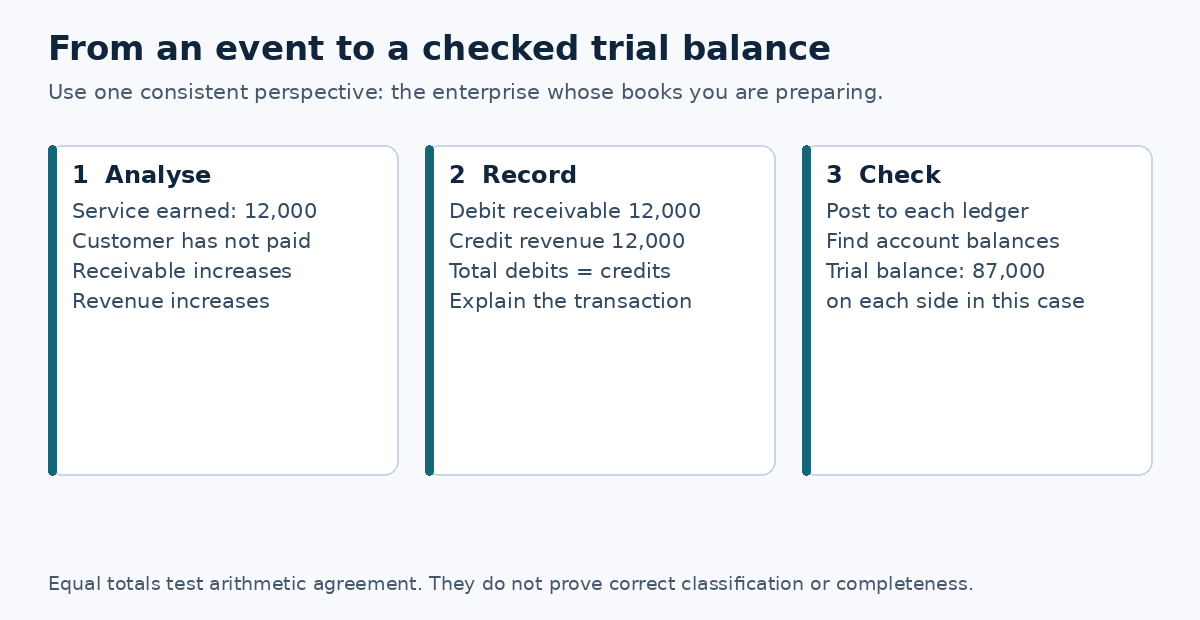
A journal puts transactions in date order. A ledger groups entries by account. A trial balance gathers the resulting debit and credit balances at one date. These are three stages of organising the same evidence, not three separate transactions.
3. Worked journal: Cedar Documentation
Use the eight events and assumptions in Lesson 002. Amounts are rupees; ignore taxes, interest and depreciation in this introductory case. “Dr” and “Cr” below explicitly identify the sides. For this worked case, events J1–J8 occur on 1–8 April 2024 respectively. J1 means the first journal reference, not a government form number. Use these fictional ledger folios: Bank L01, Loan L02, Equipment L03, Receivables L04, Capital L05, Service revenue L06, Rent expense L07 and Drawings L08. The folios connect the journal to the account where it is posted.
| Event | Debit | Credit | Reason |
|---|---|---|---|
| J1 1 April 2024 |
Bank 60,000 | Capital 60,000 | Bank asset and owner’s contribution increase. |
| J2 2 April 2024 |
Bank 20,000 | Loan 20,000 | Bank and outside obligation increase. |
| J3 3 April 2024 |
Equipment 15,000 | Bank 15,000 | One asset replaces another. |
| J4 4 April 2024 |
Receivables 12,000 | Service revenue 12,000 | Earned fee creates a customer claim. |
| J5 5 April 2024 |
Rent expense 4,000 | Bank 4,000 | Current rent is consumed and paid. |
| J6 6 April 2024 |
Bank 7,000 | Receivables 7,000 | Collection settles part of the claim. |
| J7 7 April 2024 |
Loan 5,000 | Bank 5,000 | Principal obligation and bank fall. |
| J8 8 April 2024 |
Drawings 3,000 | Bank 3,000 | Personal withdrawal reduces the owner’s interest. |
| Journal totals | 126,000 | 126,000 | Each transaction has equal debits and credits. |
A useful narration for event 6 is “Being part collection of the previously recorded service receivable.” That short sentence makes it harder to mistake the receipt for a second earning of revenue.
4. Post and balance the bank account
Collect every journal line naming Bank. Its debits are 60,000, 20,000 and 7,000, totalling 87,000. Its credits are 15,000, 4,000, 5,000 and 3,000, totalling 27,000. Therefore the remaining bank asset is a debit balance of 60,000.
Do not confuse movement with balance. The journal includes 126,000 on each side across all transactions. The bank’s debit movements total 87,000. Its final balance is 60,000. Each number answers a different question.
A. Follow J6 all the way through the records
On 6 April, the customer pays ₹7,000 against the fee earned on 4 April. Journal reference J6 contains a Bank debit and a Receivables credit. Post the Bank debit to L01 with the opposing account name “Receivables”; post the Receivables credit to L04 with the opposing name “Bank.” Mark both postings with J6. This creates a two-way trail: journal to ledger and ledger back to journal. Never post the whole transaction twice merely because it appears in two ledgers.
B. Bank ledger L01: a debit-balance account
| Debit date | Particulars / reference | Amount | Credit date | Particulars / reference | Amount |
|---|---|---|---|---|---|
| 1 Apr | Capital / J1 | 60,000 | 3 Apr | Equipment / J3 | 15,000 |
| 2 Apr | Loan / J2 | 20,000 | 5 Apr | Rent expense / J5 | 4,000 |
| 6 Apr | Receivables / J6 | 7,000 | 7 Apr | Loan / J7 | 5,000 |
| — | — | — | 8 Apr | Drawings / J8 | 3,000 |
| — | — | — | 30 Apr | Balance c/d | 60,000 |
| 30 Apr | Total | 87,000 | 30 Apr | Total | 87,000 |
| 1 May | Balance b/d | 60,000 | — | — | — |
Why is balance c/d on the credit side if Bank has a debit balance? Actual debit entries total ₹87,000 and actual credit entries total ₹27,000. The excess debit of ₹60,000 is placed on the smaller, credit side only to close the displayed April totals equally. “c/d” means carried down. On the next line for 1 May, the same ₹60,000 returns to its natural debit side as balance b/d, brought down. The balancing line is not a payment, expense or new journal transaction. Do not include it as another credit movement when calculating the real bank balance.
C. Receivables ledger L04: trace an unsettled claim
| Debit date | Particulars / reference | Amount | Credit date | Particulars / reference | Amount |
|---|---|---|---|---|---|
| 4 Apr | Service revenue / J4 | 12,000 | 6 Apr | Bank / J6 | 7,000 |
| — | — | — | 30 Apr | Balance c/d | 5,000 |
| 30 Apr | Total | 12,000 | 30 Apr | Total | 12,000 |
| 1 May | Balance b/d | 5,000 | — | — | — |
The customer originally owed ₹12,000 and has paid ₹7,000, leaving a ₹5,000 claim. The ledger expresses the same economic story as Lesson 002. The balance belongs on the debit side of the trial balance even though its c/d closing line appears on the ledger’s credit side.
D. Loan ledger L02: a credit-balance account
| Debit date | Particulars / reference | Amount | Credit date | Particulars / reference | Amount |
|---|---|---|---|---|---|
| 7 Apr | Bank / J7 | 5,000 | 2 Apr | Bank / J2 | 20,000 |
| 30 Apr | Balance c/d | 15,000 | — | — | — |
| 30 Apr | Total | 20,000 | 30 Apr | Total | 20,000 |
| — | — | — | 1 May | Balance b/d | 15,000 |
Here the larger actual movement is on the credit side: ₹20,000 borrowed against ₹5,000 principal repaid. The balance c/d is therefore ₹15,000 on the debit side, then b/d appears on the credit side. The trial balance uses that credit nature. Do not add the ₹15,000 balancing line to the ₹5,000 repayment and conclude that the loan has been extinguished.
E. What to carry forward, and what to close
The three ledgers above are continuing asset or liability accounts at an interim date. At a year-end closing stage, revenue and expense accounts are transferred to the appropriate final accounts; drawings are transferred to capital. That closing process is different from simply carrying an asset or liability balance forward. This lesson's trial balance is deliberately unadjusted and pre-closing, so retain revenue, expense and drawings as separate balances.
| Account | Debit movements | Credit movements | Closing balance |
|---|---|---|---|
| Equipment | 15,000 | 0 | 15,000 Dr |
| Receivables | 12,000 | 7,000 | 5,000 Dr |
| Loan | 5,000 | 20,000 | 15,000 Cr |
| Capital | 0 | 60,000 | 60,000 Cr |
| Service revenue | 0 | 12,000 | 12,000 Cr |
| Rent expense | 4,000 | 0 | 4,000 Dr |
| Drawings | 3,000 | 0 | 3,000 Dr |
5. Assemble the trial balance
| Account | Debit | Credit |
|---|---|---|
| Bank | 60,000 | — |
| Equipment | 15,000 | — |
| Receivables | 5,000 | — |
| Rent expense | 4,000 | — |
| Drawings | 3,000 | — |
| Loan | — | 15,000 |
| Capital | — | 60,000 |
| Service revenue | — | 12,000 |
| Total | 87,000 | 87,000 |
This is before closing revenue, expense and drawings accounts into capital. Consequently, capital here is 60,000, while the net equity calculated in Lesson 002 is 65,000. There is no contradiction: 60,000 + 12,000 − 4,000 − 3,000 = 65,000. Replacing capital by 65,000 while leaving revenue, expense and drawings in the trial balance would count their effects twice.
6. Why agreement is necessary but insufficient
Suppose equipment costing 15,000 is wrongly debited to Rent expense while Bank is correctly credited. The entry still has equal amounts on both sides. The trial balance can agree, yet equipment is understated and expenses are overstated by 15,000, so profit is understated by 15,000 under this exercise’s assumptions.
Model subjective answer: A trial balance tests the arithmetical agreement of ledger balances. It may reveal unequal posting or total errors, but agreement does not establish that all transactions were recorded or that accounts were classified correctly. A complete omission leaves both sides unchanged; an equal debit to the wrong account can also preserve agreement. Voucher review and classification checks are therefore still needed.
7. Practice with complete solutions
- Journalise a bank payment of 2,400 to a supplier who was already owed that amount. Does it create a new expense?
- A customer pays 3,500 against an existing receivable of 5,000. Give the entry and remaining receivable.
- A bank ledger has debit movements of 18,400 and credit movements of 7,650, with no opening balance. Find its balance.
- A trial balance has debit total 52,700 and credit total 51,200. A credit sale of 1,500 was posted only to the customer’s debit. Identify the omitted posting and show its correction. Do not post the debit twice.
Solutions
- Debit Supplier payable 2,400; credit Bank 2,400. Both the obligation and bank asset decrease. The settlement itself is not a new expense; the original underlying purchase or expense requires its own prior accounting.
- Debit Bank 3,500; credit Receivables 3,500. Remaining receivable = 5,000 − 3,500 = 1,500 Dr.
- 18,400 − 7,650 = 10,750 Dr. Debits exceed credits.
- The omitted posting is a credit of 1,500 to Sales revenue. After posting it, credit total = 51,200 + 1,500 = 52,700, matching debit total. This is a posting-error repair in the stated pre-finalisation situation, not a second full sale journal. If a suspense account had already been used, the correction would require that additional context.
8. Posting challenge: extend the ledgers yourself
Return to the original eight transactions, before drawing the 30 April balancing lines. Add J9 on 9 April: collect a further ₹2,000 from the same customer. Add J10 on 10 April: repay another ₹1,000 of loan principal by bank. No new income, expense or interest arises. Prepare the two entries, amend Bank, Receivables and Loan, and produce the revised trial balance totals.
Complete solution and error diagnosis
J9: debit Bank ₹2,000; credit Receivables ₹2,000. J10: debit Loan ₹1,000; credit Bank ₹1,000. Bank debit movements now total ₹89,000 and credit movements ₹28,000, giving ₹61,000 Dr. Receivables are ₹12,000 − ₹7,000 − ₹2,000 = ₹3,000 Dr. Loan is ₹20,000 − ₹5,000 − ₹1,000 = ₹14,000 Cr. Replace, rather than add to, the earlier balance c/d figures when redrawing the April ledgers.
Revised trial-balance debits = 61,000 Bank + 15,000 Equipment + 3,000 Receivables + 4,000 Rent + 3,000 Drawings = ₹86,000. Credits = 14,000 Loan + 60,000 Capital + 12,000 Revenue = ₹86,000. Net equity remains ₹65,000. Assets are now ₹79,000 and liabilities ₹14,000, so the equation also agrees: 79,000 = 14,000 + 65,000.
If you credited J9 to new revenue instead of Receivables, both sides would still agree at ₹88,000, but revenue and receivables would each be overstated by ₹2,000. If it disagrees by ₹1,000, check whether J10 was posted to both Bank and Loan. If the loan appears to be zero, check whether you treated the balance c/d as an actual repayment. These different mistakes require different corrections.
Common mistakes and summary
- Calling every debit an expense or every credit income.
- Recording a debt collection as fresh revenue.
- Using movements instead of closing balances in a trial balance.
- Mixing pre-closing accounts with already-adjusted capital.
- Assuming matching totals prove the books are correct.
Analyse the event, choose the sides, post once and balance each account. Then test the trial balance and review the substance of the entries separately.