AAO Lesson 004: Use percentages, ratios and weighted averages without denominator errors
Study baseline: AAO LDCE 2024 notification dated 19 September 2024 and its corrigenda, including 6 November 2024. That examination was scheduled for 8–11 January 2025. The target examination year has not been specified. Check the official notification and amendments for your examination sitting; this is not a claim that the 2024 notice is the current syllabus for a later examination.
AAO • Lesson 004 • English
Use percentages, ratios and weighted averages without denominator errors
Study time: about 50 minutes, including practice. Prerequisites: AAO-001.
Learning outcomes:
- Calculate achievement, shortfall and relative change using the correct base.
- Distinguish percentage-point differences from percentage changes.
- Compute weighted averages and verify multi-step calculations.
1. A percentage needs a base
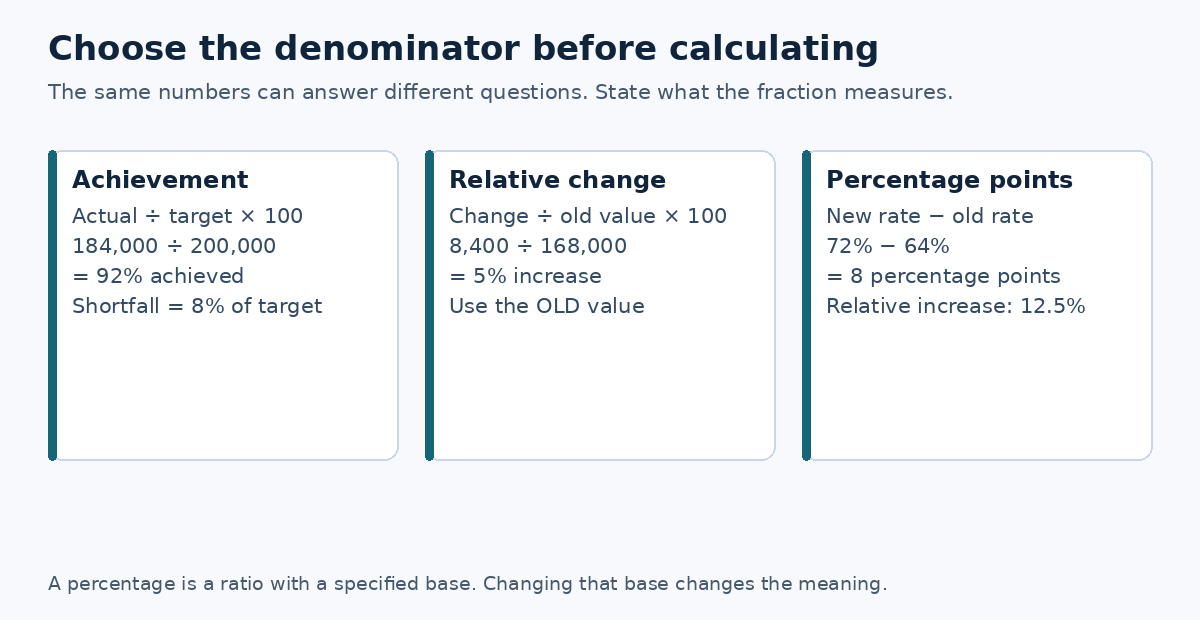
“Ten per cent” is incomplete until you know ten per cent of what. In exam cases, the most common error is often the denominator, not multiplication. Translate the wording into a fraction before using a shortcut. Percentage = relevant part ÷ specified whole × 100. Use consistent units in numerator and denominator: rupees with rupees, cases with cases, or hours with hours.
The datasets in this lesson are fictional and are not official performance statistics. Calculations are mathematical practice, not tax, interest-rate or departmental entitlement rules.
2. Achievement and shortfall
Worked case: A unit has a collection target of ₹2,00,000 and collects ₹1,84,000. Achievement = 1,84,000 ÷ 2,00,000 × 100 = 92%. Shortfall = 2,00,000 − 1,84,000 = ₹16,000. Shortfall as a percentage of target = 16,000 ÷ 2,00,000 × 100 = 8%.
Check: achievement and shortfall use the same target as denominator, so 92% + 8% = 100%. If someone divides 16,000 by actual collection, they obtain about 8.70%. That is the extra amount needed expressed as a percentage of the actual, which is a different question. Both fractions can be computed; only one answers “shortfall as a percentage of target.”
Reverse percentage: If actual collection ₹1,84,000 is 92% of target, target = 1,84,000 ÷ 0.92 = ₹2,00,000. Do not add 8% of actual to recover the target: the original 8% was measured against target.
3. Increase, decrease and percentage points
For a relative change, use the old value: (new − old) ÷ old × 100. If expenditure changes from ₹1,68,000 to ₹1,76,400, the difference is ₹8,400 and the relative increase is 8,400 ÷ 1,68,000 × 100 = 5%. Check by multiplication: 1,68,000 × 1.05 = 1,76,400.
If the direction is reversed, the decrease from ₹1,76,400 to ₹1,68,000 is 8,400 ÷ 1,76,400 × 100 ≈ 4.76%, not 5%, because the starting base has changed.
Now compare rates. A completion rate rises from 64% to 72%. The difference is 8 percentage points. Relative to the old rate, the increase is 8 ÷ 64 × 100 = 12.5%. Write the unit explicitly so that your answer does not confuse these two descriptions.
4. Successive changes multiply
A value of ₹10,000 rises by 20% and then falls by 20%. After the increase it is 10,000 × 1.20 = ₹12,000. After the decrease it is 12,000 × 0.80 = ₹9,600. The final value is 96% of the original, so the net change is a 4% decrease.
The changes do not cancel because the second 20% applies to a larger base. The general calculation is original × first multiplier × second multiplier. For an increase of p%, the multiplier is 1 + p/100; for a decrease, it is 1 − p/100. Do not add successive rates unless the problem explicitly gives both changes on the same original base.
5. Weighted average: combine counts before rates
Two fictional units report completion of cases:
| Unit | Cases received | Completion rate | Cases completed |
|---|---|---|---|
| A | 250 | 84% | 250 × 0.84 = 210 |
| B | 750 | 92% | 750 × 0.92 = 690 |
| Total | 1,000 | Calculated below | 900 |
The combined rate is 900 ÷ 1,000 × 100 = 90%. The simple mean of the two rates is (84 + 92) ÷ 2 = 88%, which wrongly gives equal weight to unequal workloads. Unit B has three times as many cases, so its rate must carry three times the weight.
Equivalent check: (250 × 84 + 750 × 92) ÷ 1,000 = 90. The weights are case counts. If the question concerned average expenditure per employee, the weights would be employee counts, not the number of offices. Identify what each average is “per.”
6. Ratios and units
A training budget of ₹84,000 is divided between two activities in the ratio 3:4. There are 3 + 4 = 7 equal parts. One part is 84,000 ÷ 7 = ₹12,000. The allocations are 3 × 12,000 = ₹36,000 and 4 × 12,000 = ₹48,000. Check that the amounts sum to ₹84,000 and simplify back to 3:4.
A ratio is not automatically a percentage share. In a 3:4 split, the first activity receives 3/7 of the total, about 42.86%, not 3/4 = 75%. The latter compares the first allocation with the second rather than with the whole.
7. Exam-style practice
- A target is ₹2,40,000 and actual is ₹2,22,000. Find achievement and shortfall percentages of target.
- A bill decreases from ₹8,000 to ₹6,800. Find the percentage decrease. By what percentage must ₹6,800 increase to return to ₹8,000?
- A rate changes from 75% to 81%. State the percentage-point change and relative percentage increase.
- Forty learners average 70 marks and sixty average 80. Find the combined average.
- Split ₹96,000 in the ratio 5:3. Give both shares.
- A value is discounted by 10% and then by 5%. Is the total discount 15%? Calculate on an original ₹2,000.
Complete solutions
- Achievement = 2,22,000 ÷ 2,40,000 × 100 = 92.5%. Shortfall = ₹18,000, so 18,000 ÷ 2,40,000 × 100 = 7.5%. Check: 100%.
- Decrease = 1,200 ÷ 8,000 × 100 = 15%. Required increase = 1,200 ÷ 6,800 × 100 ≈ 17.65%. Different starting values explain the difference.
- 81 − 75 = 6 percentage points. Relative increase = 6 ÷ 75 × 100 = 8%.
- Total marks = 40 × 70 + 60 × 80 = 2,800 + 4,800 = 7,600. Total learners = 100. Combined average = 76, not 75.
- Eight parts; each is 96,000 ÷ 8 = 12,000. Shares are ₹60,000 and ₹36,000.
- Final value = 2,000 × 0.90 × 0.95 = ₹1,710. Discount = ₹290, or 290 ÷ 2,000 × 100 = 14.5%. The second discount applies after the first.
8. Explain an objective answer, not just its letter
MCQ: Two equal-sized groups have average scores 60 and 80. Their combined average is: A 65; B 70; C 75; D cannot be calculated.
Answer: B, 70. Equal group sizes give equal weights, so (60 + 80) ÷ 2 = 70. A and C would imply unequal weights; D is incorrect because the relative weights are already known to be equal. Notice the condition that makes a simple average valid.
Common mistakes and summary
- Using the new value in the denominator of an increase measured from the old.
- Calling an 8-point rate change an 8% relative increase without calculation.
- Averaging unequal groups without weights.
- Adding successive discounts instead of multiplying the remaining proportions.
- Rounding intermediate results before the final step.
Write the quantity, unit and denominator first. Estimate the direction and size, calculate, and then reverse-check the answer against the original data.