AAO Lesson 005: Write a reasoned accounting answer: a bank reconciliation case
Study baseline: AAO LDCE 2024 notification dated 19 September 2024 and its corrigenda, including 6 November 2024. That examination was scheduled for 8–11 January 2025. The target examination year has not been specified. Check the official notification and amendments for your examination sitting; this is not a claim that the 2024 notice is the current syllabus for a later examination.
AAO • Lesson 005 • English
Write a reasoned accounting answer: a bank reconciliation case
Study time: about 95 minutes, including practice. Prerequisites: AAO-002, AAO-003.
Learning outcomes:
- Separate own-book omissions from timing differences in a bank reconciliation.
- Compute adjusted bank and statement balances with explicit signs.
- Write a structured answer with facts, treatment, working, checks and a conclusion.
1. The purpose of a reconciliation
A reconciliation explains why two records of the same relationship differ at a stated date. Here, the enterprise maintains a bank column in its own cash book, while the bank issues a statement. Transactions can appear in those records on different dates. One record may also contain a charge, interest entry or error that the other has not yet recorded.
This introductory case starts with a favourable bank balance in the enterprise’s books. We express the bank statement as money available to the enterprise, rather than relying on the bank’s debit/credit terminology. After the basic case, a signed-balance extension introduces an overdraft without changing the underlying reasoning. All amounts are fictional; no bank fees or rates in this lesson are prescribed government rates.
A reconciliation is not an instruction to invent an adjustment until totals match. Every difference needs a reason, evidence and the appropriate treatment. A matching unexplained total is weaker than a transparent working that identifies an unresolved item.
2. Separate two kinds of difference
| Difference | Meaning in this case | Treatment |
|---|---|---|
| Bank fee not recorded in the cash book | The bank has reduced available money; the enterprise omitted the known charge. | Update the enterprise’s books: debit bank-fee expense, credit Bank. |
| Interest credited by bank but omitted by enterprise | The bank has increased available money; the enterprise omitted the known income. | Update the enterprise’s books: debit Bank, credit interest income. |
| Cheque issued but not presented | The enterprise recorded payment; the bank has not yet processed it. | Explain as a timing difference; do not pay or record the expense twice. |
| Deposit recorded but not yet credited by bank | The enterprise recorded a deposit; the bank has not yet included it. | Explain as a timing difference; do not remove a valid deposit from the books solely because clearance is pending. |
These treatments assume the underlying entries and documents are valid and the timing facts are confirmed. A stale instrument, disputed charge, duplicate entry or bank error needs separate investigation rather than automatic treatment as an ordinary timing item.
3. Worked case and complete solution
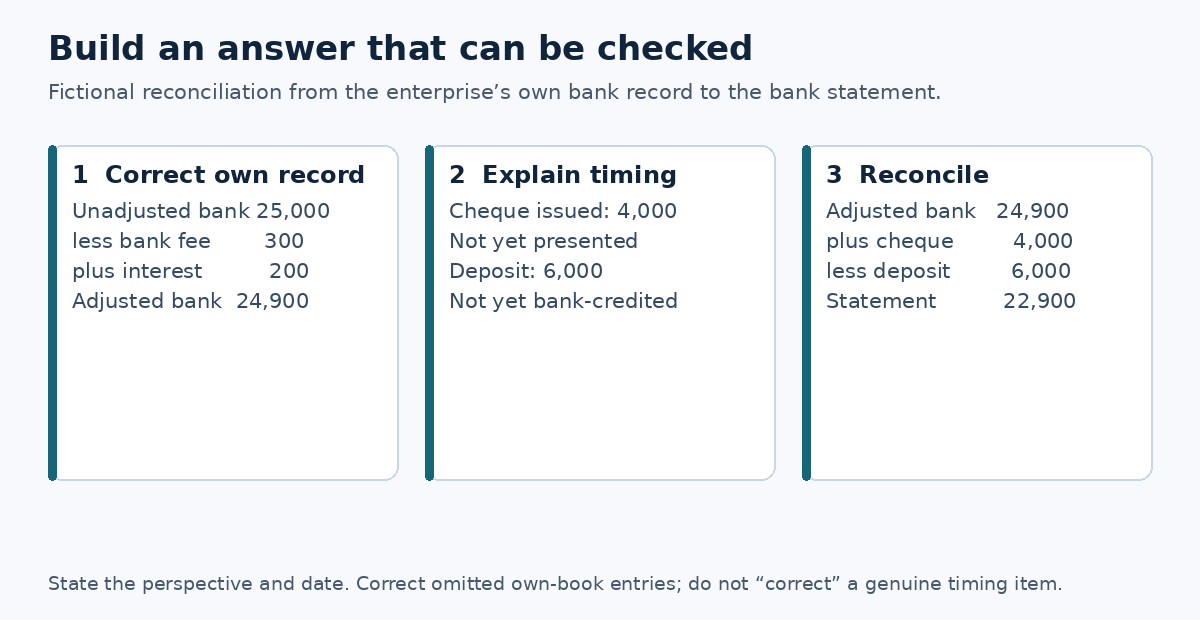
At 31 March, a fictional enterprise’s unadjusted cash-book bank balance is ₹25,000. A statement review identifies a ₹300 bank fee and ₹200 interest credit that are absent from the cash book. A cheque issued and recorded for ₹4,000 has not been presented. A deposit of ₹6,000 recorded in the cash book has not yet been credited by the bank. There are no other differences. Calculate the adjusted cash-book balance and the corresponding bank-statement balance.
Read the underlying records before using a formula
The following original records generate the amounts in the question. They are simplified bank-column extracts, not official departmental forms. A receipt in the bank column is a debit to the enterprise’s Bank account; a payment is a credit. The statement columns instead use the everyday labels “money in” and “money out.” Both show the balance available to the enterprise.
| Date | Reference / description | Receipt | Payment | Balance |
|---|---|---|---|---|
| 1 Mar | Opening balance | — | — | 20,000 |
| 7 Mar | R012: customer transfer | 12,000 | — | 32,000 |
| 12 Mar | P031: operating payment | — | 9,000 | 23,000 |
| 28 Mar | CH104: cheque issued | — | 4,000 | 19,000 |
| 30 Mar | DP02: cash deposit | 6,000 | — | 25,000 |
| Date | Reference / description | Money in | Money out | Available balance |
|---|---|---|---|---|
| 1 Mar | Opening balance | — | — | 20,000 |
| 7 Mar | R012: customer transfer | 12,000 | — | 32,000 |
| 12 Mar | P031: operating payment | — | 9,000 | 23,000 |
| 29 Mar | BF03: bank fee | — | 300 | 22,700 |
| 31 Mar | IN03: interest credit | 200 | — | 22,900 |
Matching pass 1: Confirm the same account, currency, opening balance and closing date. The common ₹20,000 opening balance is the starting control; it is not another March receipt.
Matching pass 2: Match R012 for ₹12,000 and P031 for ₹9,000 by reference, amount and direction. Mark each row once in each record. Matching by amount alone can confuse two separate equal-value payments.
Matching pass 3: List every unmatched row. CH104 and DP02 appear only in the cash book; BF03 and IN03 appear only in the statement. Use the stated clearance evidence to classify CH104 and DP02 as timing items. Use the statement and the stated validity of the fee/interest to support the missing own-book entries.
| Reference | Only in | Verified reason in this exercise | Action |
|---|---|---|---|
| CH104 / 4,000 | Cash book | Issued but not presented | Keep in timing schedule; check later clearance. |
| DP02 / 6,000 | Cash book | Valid deposit awaiting bank credit | Keep in timing schedule; check deposit evidence and later credit. |
| BF03 / 300 | Statement | Valid fee omitted from own books | Record expense and reduce Bank once. |
| IN03 / 200 | Statement | Valid interest omitted from own books | Record income and increase Bank once. |
This schedule is the bridge between evidence and arithmetic. It also prevents double correction: BF03 and IN03 must not be included again after you start the reconciliation from an already adjusted cash-book balance.
Step A: Correct the omitted own-book items
Debit Bank-fee expense ₹300 and credit Bank ₹300. Debit Bank ₹200 and credit Interest income ₹200. Adjusted cash-book bank balance = 25,000 − 300 + 200 = ₹24,900.
| Entry | Increase | Decrease | Balance |
|---|---|---|---|
| Unadjusted closing balance | — | — | 25,000 |
| BF03: bank fee recorded | — | 300 | 24,700 |
| IN03: interest recorded | 200 | — | 24,900 |
The updated cash book now includes all valid bank-originated items identified in this exercise. CH104 and DP02 remain recorded at their original amounts and are not entered again.
Step B: Move from adjusted cash book to statement
| Item | Effect | Running amount |
|---|---|---|
| Adjusted cash-book bank balance | Start | 24,900 |
| Add cheque issued but not presented | +4,000 | 28,900 |
| Subtract deposit not yet credited | −6,000 | 22,900 |
| Bank-statement balance | Favourable | 22,900 |
Why add the cheque? The enterprise already reduced its bank record by ₹4,000. The bank has not yet made that reduction, so its reported available balance is ₹4,000 higher for this item. Why subtract the deposit? The enterprise already increased its bank record by ₹6,000, but the bank has not; the statement is ₹6,000 lower for this item.
Step C: Reverse-check
Starting from the statement: 22,900 − 4,000 + 6,000 = 24,900, the adjusted cash-book figure. Starting from the unadjusted cash book: 25,000 − 300 + 200 + 4,000 − 6,000 = 22,900. Both routes agree. The signs reverse when you reverse the direction; memorising a sign without the starting point is unsafe.
4. Turn working into a subjective answer
Use five elements: scope, principle, application, numerical working and conclusion. This is a teaching structure, not an official mandatory answer format.
Model answer: At 31 March, the two records differ because some bank-originated items are missing from the enterprise’s books and two instruments are at different stages of clearance. The ₹300 fee reduces the cash-book bank balance and the ₹200 interest credit increases it, producing an adjusted balance of ₹24,900. The unpresented ₹4,000 cheque is added when moving to the statement because only the enterprise has recorded its payment. The ₹6,000 deposit awaiting credit is subtracted because only the enterprise has recorded the receipt. The resulting bank-statement balance is ₹22,900. The reverse calculation gives ₹24,900, confirming the reconciliation under the stated assumption that there are no other differences.
A complete numerical answer should also show the reconciliation table. A conclusion alone does not expose the reasoning or allow a marker to see which step caused an error. If a question instead asks for relevant departmental rules, add the verified provision and its conditions; the present generic accounting example does not justify inventing a government rule number.
5. Diagnose a weak answer
Weak answer: “Cash book 25,000 plus 4,000 minus 6,000 equals 23,000. Thus the bank is correct.”
There are two problems. First, the answer ignores the bank fee and interest and therefore uses an unadjusted starting balance. Second, “the bank is correct” is not established merely by performing the arithmetic. The stated evidence supports the listed differences; it does not support a general claim that the bank never makes mistakes.
Repair: Adjust the own-book omissions first, state the movement from adjusted cash book to statement, and give the qualified conclusion supported by the facts. A reasoned answer is precise about what has been checked.
6. Practice with complete solutions
Case A: Unadjusted cash-book bank balance ₹18,500; unrecorded bank fee ₹250; customer transfer directly credited by bank but not yet recorded by the enterprise ₹1,750; issued cheque not presented ₹3,200; recorded deposit awaiting bank credit ₹4,600. The customer transfer settles an existing receivable. There are no other differences.
- Give the two entries needed to adjust the enterprise’s books.
- Calculate adjusted cash book and corresponding statement balance.
- Explain why the direct customer transfer is not fresh revenue.
Case A solution
- Debit Bank-fee expense 250, credit Bank 250. Debit Bank 1,750, credit Receivables 1,750. Both entries are balanced.
- Adjusted cash book = 18,500 − 250 + 1,750 = 20,000. Statement = 20,000 + 3,200 − 4,600 = 18,600. Reverse check: 18,600 − 3,200 + 4,600 = 20,000.
- The receivable arose when revenue was already earned and recognised. The transfer changes one asset into another, bank for receivable, rather than earning the same income again.
Case B: A favourable statement balance is ₹31,800. Cheques issued but unpresented total ₹5,500, and valid recorded deposits awaiting bank credit total ₹7,200. The cash book has already been adjusted for every own-book omission. Find that adjusted cash-book balance.
Case B solution: Starting from statement, subtract the unpresented payments and add the uncleared deposits: 31,800 − 5,500 + 7,200 = ₹33,500. Check forward: 33,500 + 5,500 − 7,200 = ₹31,800.
Short-answer practice: Why should genuine timing differences normally not be posted a second time in the enterprise’s books?
Model answer: The enterprise has already recorded the underlying receipt or payment. The difference arises because the bank has not yet recorded the matching movement. Posting the item again would duplicate the entry rather than explain the timing difference. The item should remain identifiable for subsequent clearance checks.
7. Graded extensions: change the facts, keep the logic
Extension 1: prove that timing items clear
Suppose the next statement shows CH104 paid on 2 April and DP02 credited on 3 April, with no other movements. Starting from the March statement balance of ₹22,900, the bank now subtracts ₹4,000 and adds ₹6,000: 22,900 − 4,000 + 6,000 = ₹24,900. That matches the adjusted March cash-book balance. The enterprise does not record those two transactions again, because its books already contain them. Retain the later statement references as clearance evidence.
Extension 2: use signed amounts for an overdraft
New fictional case: The unadjusted cash book shows an overdraft of ₹8,000. A valid ₹200 bank fee is omitted. A cheque for ₹1,500 is issued but not presented, and a valid recorded deposit of ₹2,700 awaits bank credit. Find the statement balance.
Represent the overdraft as −8,000. The omitted fee reduces the position further: −8,000 − 200 = −8,200. The unpresented cheque means the statement has not yet recorded a payment that the cash book has, so add 1,500. The uncleared deposit has not reached the statement, so subtract 2,700. Statement = −8,200 + 1,500 − 2,700 = −9,400, an overdraft of ₹9,400. Reverse check: −9,400 − 1,500 + 2,700 = −8,200. The logic is unchanged; the starting amount is now negative.
Extension 3: identify whose error it is
Own-book error: A valid cheque for ₹1,200 was entered as a ₹2,100 payment in the cash book. The books reduced Bank by ₹900 too much. Correct Bank upward by ₹900 and correct the corresponding account according to the original entry. Do not label the ₹900 as new income merely because Bank must be debited.
Bank error: The correctly adjusted cash book is ₹12,500. A statement shows ₹12,900 solely because the bank wrongly credited ₹400 belonging to another account; the mistake is confirmed in the exercise facts. Explain the ₹400 difference and seek correction in the bank record. Do not enter the unrelated money as the enterprise’s income. The correctly adjusted statement would be 12,900 − 400 = ₹12,500.
Extension 4: find the double adjustment
A learner starts from the already adjusted ₹24,900 but again subtracts the ₹300 fee, adds ₹200 interest, adds the ₹4,000 cheque and subtracts the ₹6,000 deposit. Their result is ₹22,800. Explain the error.
Solution: The fee and interest are already included in ₹24,900. Applying them again reduces the result by their net effect of ₹100. Only timing adjustments remain: 24,900 + 4,000 − 6,000 = ₹22,900. Choose either an unadjusted start with all relevant corrections, or an adjusted start with only the remaining differences; never combine both routes.
Common mistakes and summary
- Using the unadjusted cash-book balance after identifying omitted charges or credits.
- Applying memorised plus/minus signs without stating the starting record.
- Recording a genuine timing item twice.
- Assuming every unexplained difference is a timing difference.
- Giving a final figure without a date, perspective, working or check.
Separate corrections from timing, show the direction of reconciliation and reverse-check the result. The same discipline supports later service-rule and audit answers: identify the issue, use supported facts, apply the appropriate principle and conclude only as far as the evidence allows.